Key Takeaways
- 304 stainless steel kids bottles usually need 3,000-5,000 pcs MOQ for custom color and logo
- Tritan is lighter and lower cost, but stainless steel handles dents and school use better
- Ask for LFGB, FDA, REACH, and lead/cadmium coating tests before shipment
- A 350-500 ml capacity fits most school, camp, and promotional kids programs
Buying a bulk kids bottle looks simple until one PO has a school district logo, parent complaints, import paperwork, and child safety standards sitting on the same line. One cute bottle that leaks after a 1.2 m drop test or shows coating rub-off under 3M tape becomes your problem. Not the factory’s. We’ve seen this go sideways over a 0.3 mm lid gasket.
As a children water bottle manufacturer in Zhejiang, China, we see buyers spend 6 emails on Pantone color and only 1 line on lid durability, drop resistance, straw parts, and carton packing. This is the wrong question to ask if the bottle is for 6-year-olds throwing bags onto concrete. For school district buyers and kids-product importers, the right custom kids water bottle needs safe materials, a lid the line can assemble consistently, decoration that passes QC, and a lead time we can actually ship—30 days is different from 45 days when the buyer flagged the artwork only after pre-production sample approval.
The real head-to-head spec table
For a bulk kids bottle program, check the working spec before the artwork. We see 6-8 quote sheets a month that say “kids bottle” with no material grade, lid drawing, wall thickness, or test standard, then the buyer asks why two prices are 40% apart. This is the wrong question to ask. A custom school water bottle used every day in a classroom is not the same build as a low-cost children water bottle made for a one-week promotional giveaway. QC pulled one sample last March with a 0.32 mm body wall when the PO typo said 0.23 mm, and that one digit changed the whole cost sheet.
| Spec | 304 stainless steel | Tritan plastic | PP sports bottle |
|---|---|---|---|
| Typical capacity | 350 ml, 450 ml, 500 ml | 400 ml, 500 ml, 600 ml | 450 ml, 500 ml |
| Unit FOB China range | USD 3.20-6.80 | USD 1.80-3.60 | USD 0.90-1.80 |
| MOQ for custom color | 3,000-5,000 pcs | 3,000 pcs | 5,000-10,000 pcs |
| Best fit | School retail, licensed character orders, importers selling above the entry price point | Back-to-school kits, camp packs, mid-price wholesale where buyers want to see the water level | Promotions, 3-day events, budget tenders where landed cost matters more than shelf feel |
| Main risk | Paint chipping if the powder coating cure time is cut or the adhesion test fails | Scratch marks and odor claims if cheap resin is mixed in | Lower perceived value and a service life closer to one term than one school year |
For children water bottle wholesale orders shipped to Europe or North America, we usually quote stainless steel when the bottle has to survive a full school year. The math is cleaner. Tritan makes sense when the buyer wants a visible water level and a lighter carton, for example 9.5 kg instead of about 13 kg on a 48 pcs master carton. PP is fine for low-price distribution, but do not sell it to the end customer as a premium custom made kids bottle. We have seen this go sideways when a tender sample looked acceptable, then the buyer flagged scuffed caps after the first classroom trial.
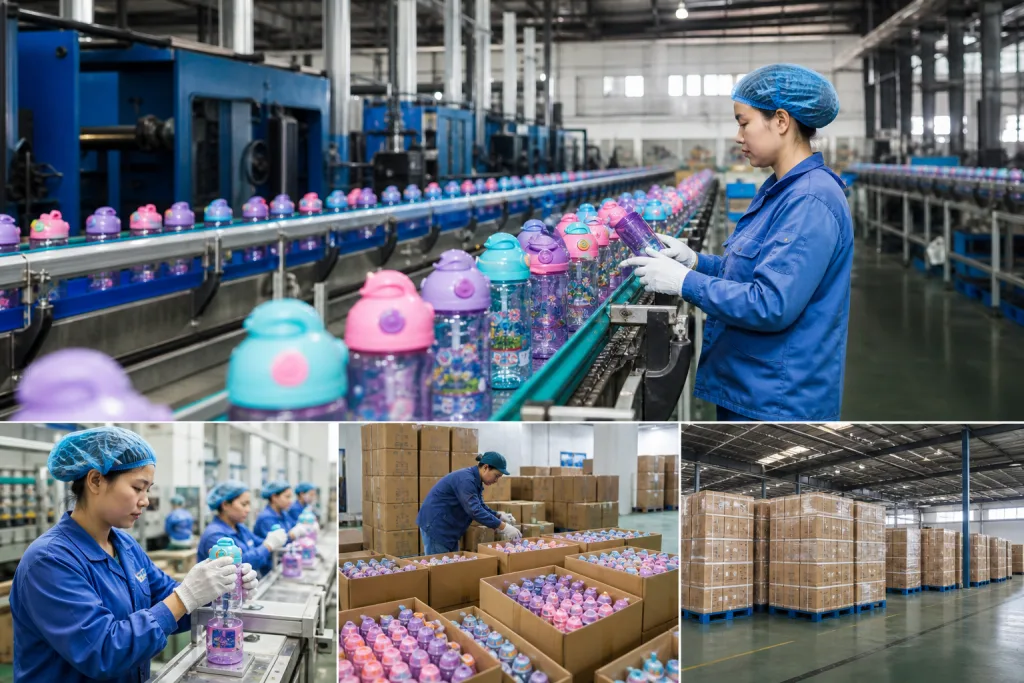
Our Hangzhou line in Zhejiang can run about 420,000 stainless drinkware units per month across kids, sports, and travel categories. For a children water bottle custom order, normal production lead time is 30-40 days after sample approval, plus 7-10 days for pre-production sampling and artwork confirmation. We run the color match on a Pantone light box, then check the first 30 pcs off the line before mass packing starts.
Material choice changes your complaint rate
School buyers look at safety first. Importers look at safety and returns. Distributors look at both, plus margin. The material call sets the complaint rate. For a bulk children water bottle order, 304 stainless steel is the safest default when you need durability, taste neutrality, and a stronger retail or tender position. On our line, we check double-wall samples with a thickness gauge in 0.01 mm steps; a typical build uses 0.4-0.5 mm inner wall and 0.5 mm outer wall stainless steel. Go thinner and the bottle dents in transit. Go thicker and your freight bill and unit cost climb fast. This is not the place to chase a 2 cent saving.
Tritan is a solid pick for a bulk school water bottle when children need to see the liquid level. It is BPA-free, clear, and lighter than stainless steel. The weak spots are scratch marks, logo wear, and buyer confusion with cheap PC-style plastic. QC pulled a sample after a 48-hour rub test and the print held, but the buyer still flagged the finish because the gloss looked close to PC. If you choose Tritan, put the grade on the purchase order and require a food-contact test from a recognized lab.
PP is not a bad material. It works for a children water bottle promotional campaign where price beats long-term use. We have run PP lids at a 3,000 pcs MOQ for event jobs and moved fast. If you are a children water bottle distributor selling into retail chains, PP can look too cheap unless the mold lines, cap fit, and color match are clean. We've seen this go sideways when the buyer asked for a school listing and the sample looked like a giveaway cup. For most import programs, PP should be treated as an event bottle, not a full-year school bottle.
Do not accept “food grade” as a complete material specification. Write 304 stainless steel, Tritan, PP, silicone, and test requirements directly into the proforma invoice.
For China exports, we usually prepare to FDA food-contact requirements for the U.S. and LFGB or EU food-contact rules for Europe. Our QC desk keeps the REACH checklist next to the incoming-material rack, because coatings, decals, silicone straws, and plastic lids may also need screening for phthalates, PAHs, lead, cadmium, and heavy metals. One typo on a PO, such as a missing test item or the wrong lid code, can hold the order before packing.
Lids decide whether backpacks stay dry
Children do not baby bottles. They drop them on classroom tile, jam them into sports bags, chew the spout, and leave the lid half-locked after lunch. On the line, QC pulled 12 samples from a 3,000 pcs pilot run last September, and 2 leaked at the button hinge after the shake test. That is why the lid system matters as much as the bottle body. A good-looking custom logo kids bottle with a weak lid turns into warranty emails within two weeks of school use.
For a custom kids bottle, we usually compare four lid styles: screw cap, flip straw lid, push-button lid, and handled spout lid. Screw caps cost less and have fewer parts, but we have seen Grade 1 kids lose them before the second week of term. Flip straw lids fit ages 4-10 because drinking is easy and the motion feels familiar. Push-button lids look better on a shelf, but the spring needs cycle testing and the button area needs extra carton protection; one US buyer flagged cracked buttons after a 14 kg master carton was dropped at the corner. Handled spout lids work well for school kits because children can carry them without grabbing the bottle body.
Ask your children water bottle supplier for three tests before approving mass production. First, run a leak test with the bottle filled, closed, inverted, and shaken for at least 30 seconds. Second, run a drop test from 1.0 meter onto a hard surface, usually on the base, side, and lid corner. Third, run a lid cycle test. For better programs, we test flip mechanisms for 3,000 open-close cycles on a small pneumatic jig. For lower-cost projects, 1,000 cycles is a realistic minimum. Skipping this is the wrong question to ask when the target user is a 6-year-old with a full backpack.
Silicone parts should come out for cleaning, but they cannot be so loose that children pull them out every day. We check the plug fit with a simple pull gauge and reject parts that slide out before the agreed force. Straw diameter also matters. A 6-7 mm internal straw is easier to drink from than a narrow straw, but it still has to fit the lid seal without pinching. If your order is for kindergarten or elementary school use, avoid hidden gaskets and tiny lock pieces. Teachers and parents do not want a lid that needs five minutes of cleaning every night.
Decoration is not just a logo
A children water bottle customized for schools or kids-product importers usually carries more than one mark: mascot artwork, grade colors, sponsor logo, student name, or retail box copy. Decoration affects MOQ, lead time, scratch resistance, and landed cost. Match the process to how the bottle will be used, not only to the AI or PDF artwork file. We see this go sideways when a buyer approves a full-wrap cartoon on Monday, then asks for dishwasher resistance after QC pulled the first 20 pcs from the line.
Silk screen printing works for simple one- to three-color logos. It is a common choice for a custom logo kids bottle, especially on stainless steel powder coating or plastic bodies. Setup cost is usually USD 30-80 per color, depending on print size and factory process. Heat transfer printing is better for colorful cartoon-style graphics, but it adds cost and needs adhesion testing with 3M tape and 500 g rubbing pressure. Laser engraving lasts well on stainless steel, but the color is fixed by the metal surface and can look too serious for children under 8 years old.
Powder coating is the standard finish for bulk kids water bottle programs because it improves grip and gives the bottle a shelf-ready look. For school tenders, we usually push matte coating instead of glossy coating because fingerprints and desk scratches show less. Pantone color matching is possible, but expect normal tolerance. A factory can get close to Pantone 2925C, but stainless steel curvature, 60-80 μm coating thickness, and baking temperature around 180°C can shift the shade a little under a D65 light box.
For children water bottle customizable projects with multiple school names, variable data is possible, but it changes the production flow. If you need 50 schools with 300 pcs each, this is the wrong question to ask: it is not one clean 15,000 pcs order. Each design needs artwork confirmation, line clearance, and carton separation. The line must stop, clean the screen or jig, and restart with the next school name. We normally suggest adding 5-7 extra working days for multi-design school district orders, and we ask the buyer to lock the school list before mass printing.
Private label packaging can be a brown box, color box, belly band, hang tag, or retail-ready display carton. For Amazon-style importers, we can apply FNSKU labels and carton marks, but send the routing guide before packing starts, not after 312 cartons are taped. One buyer once changed the ship-from code after final inspection, and the math did not work: relabeling added 2 days and extra carton handling cost.
Use-case fit for school buyers
A school district buyer is solving a different problem from a retail importer. The job is fewer parent complaints, fewer wet backpacks, and fewer bid disputes after delivery. For a bulk school water bottle, we normally spec a 400-500 ml stainless steel bottle with a flip straw or handled spout lid, powder-coated body, and one-color school logo. On our line, QC checks the straw hinge with a 90-degree open-close pull before packing, because that small part is where school orders come back to bite.
For preschool and lower elementary, 350-400 ml is enough. Bigger bottles look nice on a quote sheet. Full, they get heavy. A 500 ml bottle filled with water weighs roughly 0.65-0.75 kg depending on material and lid, and we have had buyers flag this after testing samples with 4-year-olds. That weight works for older children, but the math doesn't work for some kindergarten programs. For middle school, 500-600 ml makes more sense, especially for sports days or outdoor programs.
If sponsors fund the order, decoration needs control. Too many logos make the bottle look like a trade show giveaway. One school mark plus one sponsor mark is cleaner, and our pad-printing jig holds that layout better than three small sponsor marks wrapped around a curved body. For children water bottle promotional use, cost can come down with a PP bottle or single-wall stainless bottle, but food-contact testing still belongs in the spec. Promotional does not mean disposable from a compliance standpoint.
For school districts in North America, ask the children water bottle vendor for carton-level labeling by school, grade, or delivery site. Sorting at the children water bottle factory in China costs less than paying domestic warehouse labor after arrival; we have seen a USD 0.08 carton label prevent hours of rework at the buyer's warehouse. A typical master carton for kids bottles holds 24 or 36 pcs, depending on bottle size and packaging. If you need classroom packs of 25 pcs, say it before carton design is locked, because changing the inner box after the die-line is approved slows the order.
For Europe, check multilingual warning text, recycling marks, packaging waste rules, and REACH declarations early. We run label artwork through a pre-production file check, and one common finding is English-only warning copy on bottles shipping to 3 or 4 EU markets. If you are a children water bottle distributor selling across several EU countries, one label layout becomes a problem when it skips local language requirements. We've seen this go sideways after mass packing, and repacking 36 pcs cartons is nobody's favorite job.
Pricing, MOQ, and inspection reality
Price confusion usually starts with one loose phrase: bulk kids bottle. Specs decide the quote. A 450 ml double-wall 304 stainless bottle with powder coating, flip straw lid, two-color print, and color box may be FOB Ningbo USD 4.20-5.80 at 5,000 pcs. A 500 ml Tritan bottle with one-color print and OPP bag may be USD 2.10-3.20. A PP promotional bottle may land below USD 1.50, but it sits in a different shelf position. Last month QC pulled two samples from the line: the stainless bottle weighed 238 g, the PP bottle was 61 g. Buyers feel that difference right away.
MOQ follows the customized part, not the buyer’s target price. Logo printing can start at 1,000 pcs for some stock colors. Custom powder coating usually starts at 3,000 pcs per color, because the coating line loses time during color change and oven cleaning. Custom molded lid parts can require 10,000-30,000 pcs, plus tooling from USD 1,500 to USD 8,000 depending on complexity. If a children water bottle supplier promises 500 pcs, custom mold, custom color, full testing, and the lowest price, the math doesn't work. We’ve seen this go sideways when the PO said “Pantone lid” but the buyer expected a new mold.
Inspection belongs in the order, not in a late email after packing. For bulk kids bottle shipments, we suggest AQL Level II with critical defects at 0, major defects at 2.5, and minor defects at 4.0. Critical defects include sharp edges, foreign material inside the bottle, unsafe small parts, severe leakage, or failed food-contact documentation. Major defects include poor logo placement, lid malfunction, obvious dents, and coating peeling. Minor defects include small cosmetic marks within agreed limits. On kids bottles, we run a simple leak test with warm water and a 30-second upside-down hold before the inspector opens the cartons.
Pre-shipment inspection should happen when 100% of goods are produced and at least 80% packed. Too early is a trap. You are only checking the cleanest part of the run, usually the cartons nearest the packing table. Inspect after the container is loaded, and you are arguing with a locked door and a truck waiting outside the gate. Zhejiang and broader China supply chains move fast, but the standard needs to be fixed before production starts, down to print tolerance in mm and acceptable scratch length on the coating.
Payment terms for new buyers are usually 30% deposit and 70% before shipment. Larger repeat children water bottle distributors may negotiate better terms after stable order history, but factories rarely extend credit on a first custom children water bottle order. We ship after balance is cleared, because resin, cartons, lids, and labor are already paid by then; one delayed 70% balance can block a 40HQ container for 3 days at Ningbo.
Documents you should request early
Do not wait until the vessel is booked to ask for compliance files. Ask before we cut the PP straw or spray the first color panel. A responsible children water bottle manufacturer should tell you which documents are from stock and which tests must be renewed for your material, Pantone color, and decoration method. A black powder coating test does not cover a neon pink coating. A lid test does not cover a different silicone straw with a 6.5 mm bite valve.
For a children water bottle bulk order, request the bill of materials, food-contact test reports, coating heavy metal test, silicone or plastic component reports, factory audit documents if needed, and product photos matching your approved sample. We usually match those photos to 6 angles from the golden sample: front, back, lid open, lid closed, bottom mark, and inner straw assembly. For school and kids-product importers, BSCI, ISO 9001, or similar factory management documents are nice to have, but they do not replace product-level testing. The buyer flagged this once on a 3,000 pcs order; the audit passed, but the straw report was for the wrong resin grade.
U.S. buyers should check whether the product falls under children’s product rules based on age grading, labeling, and intended use. If the bottle is marketed to children under 12, CPSIA-related requirements may apply, including lead content and tracking label expectations. For some programs, ASTM-related mechanical safety review is also requested by the buyer or retailer. European buyers should pay close attention to EU food-contact compliance, REACH, and packaging directives. This is the wrong question to ask: “Do you have a certificate?” Ask whether the report matches your exact SKU, including 304 stainless body, silicone straw, printed logo, and the 1-color gift box your PO lists.
The best time to confirm documents is before deposit. The second-best time is before sample approval. The worst time is when the goods are finished and your forwarder asks for paperwork. We have seen this go sideways at carton sealing, with 86 cartons already on pallets and QC pulling the sample because the tracking label missed the production date. A children water bottle vendors list may look similar on price, but the difference shows up when you ask for test traceability, batch control, and a clear corrective action plan for failed inspection points.
If you want a stable custom children water bottle program for several school years, build a controlled spec sheet now: capacity in ml, material grade, lid drawing with straw diameter, coating code, logo method with artwork size in mm, packing style, test standard, AQL, carton mark, spare parts ratio, and approved sample photos. Simple file. Big value. That document protects both you and the factory, especially when a reorder comes 8 months later and the new PO has a small typo in the lid color code.
Send your school bottle spec for a factory quote
Share capacity, material, logo, quantity, market, and delivery date. We will return a practical MOQ, FOB price, and testing plan.
Frequently asked questions
What is a realistic MOQ for a bulk kids bottle order?
For stock bottle colors with a one-color logo, 1,000 pcs may be possible. For a true custom kids water bottle with Pantone powder coating, custom logo, and retail packaging, expect 3,000-5,000 pcs per color. Custom lid colors often need 5,000 pcs or more because plastic injection setup and color change waste are higher. A new lid mold can require 10,000-30,000 pcs to make tooling worthwhile. If you are a school district buying for several schools, combine volume but keep cartons separated by school name or delivery site.
Which material is safest for children water bottle wholesale programs?
304 stainless steel is usually the safest commercial choice for durability, taste neutrality, and parent confidence. Tritan is also widely used for a bulk children water bottle when buyers want a transparent body and lighter weight. PP is acceptable for budget promotional use, but it has a shorter perceived life. Safety depends on the full bill of materials, not just the body: lid plastic, silicone straw, coating, ink, and packaging must also be checked. For Europe, request LFGB or EU food-contact and REACH-related reports. For the U.S., request FDA food-contact support and lead/cadmium checks.
How long does production take for children water bottle custom orders?
A normal children water bottle custom order takes about 30-40 days after sample approval for standard stainless or Tritan models. Pre-production samples usually add 7-10 days after artwork and color confirmation. If you need multiple school logos, variable names, custom packaging, or a new lid color, add another 5-15 working days. Ocean freight to North America or Europe can add 25-45 days depending on port and season. For back-to-school delivery, you should start sourcing at least 90-120 days before the required warehouse date.
Can we order a children water bottle customized for each school?
Yes, but treat each school design as a separate production control item. If you order 20,000 pcs across 40 schools, the factory must manage 40 artwork approvals, printing screens or digital files, carton marks, and packing lists. The unit price may be slightly higher than one shared design because line changeover and QC time increase. We suggest setting a minimum of 300-500 pcs per school design where possible. For very small school quantities, use a common bottle color and one standardized logo position to keep cost and mistakes under control.
What inspection standard should we use for a custom school water bottle?
Use AQL Level II as a practical default. Set critical defects at 0, major defects at 2.5, and minor defects at 4.0. Critical issues include leaking, sharp edges, unsafe small parts, contamination, or missing compliance documentation. Major issues include broken lids, badly misprinted logos, dents, coating peeling, or incorrect colors outside agreed tolerance. Also add function tests: 30-second inverted leak test, 1.0 meter drop test, lid open-close cycle check, and random capacity measurement. Inspection should happen after 100% production and at least 80% packing, before final payment and shipment release.