Key Takeaways
- Typical MOQ is 1,000 pieces per SKU for custom color and 3,000 pieces for new mold-related changes
- 304 stainless steel with 0.4-0.5 mm inner wall is the normal baseline for retail insulated bottles
- Powder coating usually adds USD 0.25-0.60 per piece versus basic spray paint depending on finish
- AQL 2.5/4.0 inspection is practical for bulk insulated water bottle orders above 2,000 pieces
A bulk insulated water bottle looks simple until you put 5,000 pieces into a retail launch or promo program. Then the questions start costing money: straight wall or tapered body, powder coat or spray paint, copper lining or standard vacuum, leakproof lid or drinking spout, carton packing or gift box. A 3% defect rate on 30 approval samples looks small. On a 5,000-piece order, that is 150 bottles for rework, credit notes, or replacement cartons. Last month QC pulled 80 pcs from the line after a lid torque check showed weak sealing at 0.6 N·m. Small miss. Big headache.
We manufacture stainless thermos programs in Zhejiang, China for outdoor retailers, promotional brands, and distributors. “Best bottle” is the wrong question to ask. The right bottle matches your sales channel, target FOB, logo method, and inspection standard. We run different routes for supermarket shelf packs, Amazon gift boxes, and distributor bulk cartons, because the math changes fast: a 0.35 USD lid upgrade sounds cheap until it hits 12,000 pcs. Below is a head-to-head way to compare bulk thermos options before you send an RFQ.
The real product choices
Most buyers ask for a bulk insulated water bottle, then send five reference photos that are not the same item. We see this every week. A sports bottle, coffee tumbler, narrow-mouth thermos, and food flask can all use double-wall vacuum insulation, but the tooling, lid set, carton size, and retail positioning are different. Last month QC pulled a 750 ml sample from the line because the buyer’s photo showed a carry handle, while the PO text said “standard screw cap.” That 1-line mismatch changes the lid cost and leak test.
For outdoor retail, we usually start with a 500 ml, 750 ml, or 1,000 ml stainless bottle with 304 inner steel, 201 or 304 outer steel, a screw lid, and powder coating. For promotional thermos programs, 500 ml and 600 ml sizes sell faster because freight, carton weight, and event handling matter more than maximum capacity. A 600 ml bottle packed 24 pcs/carton can stay under 15 kg, which makes warehouse teams happier than a heavy 1,000 ml case. For a distributor thermos catalog, we run two lines: one lower-cost style for campaign volume, and one premium customized thermos for margin. Mixing both into one “universal” bottle is the wrong question to ask.
Here is the practical head-to-head from our quoting desk and sample room:
| Type | Best use | Typical MOQ | Risk point |
|---|---|---|---|
| Stainless water bottle | Outdoor retail, clubs, corporate gifts with logo print or laser engraving | 1,000 pcs/color | Lid leakage and coating scratches, especially after a 60 cm carton drop test |
| Travel thermos | Commuter coffee and staff gifts where one-hand drinking matters | 1,000 pcs/color | Drinking lid complexity, silicone ring fit, and push-button return |
| Large outdoor flask | Camping, hiking, and field work orders that need higher capacity | 800-1,000 pcs/color | Vacuum failure after impact; we check this with a temperature retention test after sampling |
| Low-cost promo bottle | Events, giveaways, and mailers with tight landed-cost targets | 2,000 pcs/color | Thin steel and weak paint; the buyer usually flags scratches on dark colors first |
A good thermos supplier should push you to define the sales channel first. If a thermos vendor quotes only from a photo, with no questions about capacity tolerance, coating, carton drop test, or compliance market, you are not getting engineering support. You are getting a number that can move later. We have seen this go sideways: the first quote says 18 days, then the real sample with the correct lid takes 12 more days because the mold room had to adjust the thread by 0.3 mm.
Steel grade and vacuum performance
The material conversation gets oversimplified. “304 stainless” helps, but it is not a full spec. For a manufacturer thermos specification, split the inner wall, outer wall, lid contact parts, gasket, and coating, then write each material on the PO. The liquid-contact inner wall should normally be SUS304 for Europe and North America. We still see buyers send a PO with only “SS bottle” typed in the material column; QC cannot inspect that properly. Some price-sensitive thermos promotional projects use 201 stainless on the outer shell, which is acceptable if the coating is stable and the buyer understands the shelf position.
Wall thickness decides dent resistance, weight, and how the bottle feels when a customer picks it up. A common retail bottle uses 0.4-0.5 mm inner wall and 0.5 mm outer wall before forming. Cheap bottles may drop below 0.35 mm. Bad saving. You save cents, not dollars, and the bottle starts to feel soft in the hand after the hydraulic forming line and polishing take their bite. For outdoor retailers, the math does not work; the buyer flagged this on a 750 ml sample last year because the shoulder dented during a 1.2 m drop check.
Vacuum performance should be written as a test, not a slogan printed on a carton. For a 500 ml bottle, a realistic factory thermos benchmark is hot water at 95°C, tested after 6 hours at room temperature. Depending on cap design and body shape, we run 60-72°C after 6 hours. Bigger bottles often hold temperature better because the volume-to-surface ratio improves. Copper plating inside the vacuum layer can add performance, but it also adds cost, usually USD 0.15-0.35 per piece. On the line, the vacuum furnace record and the infrared thermometer reading matter more than a pretty “keeps hot 12 hours” claim.
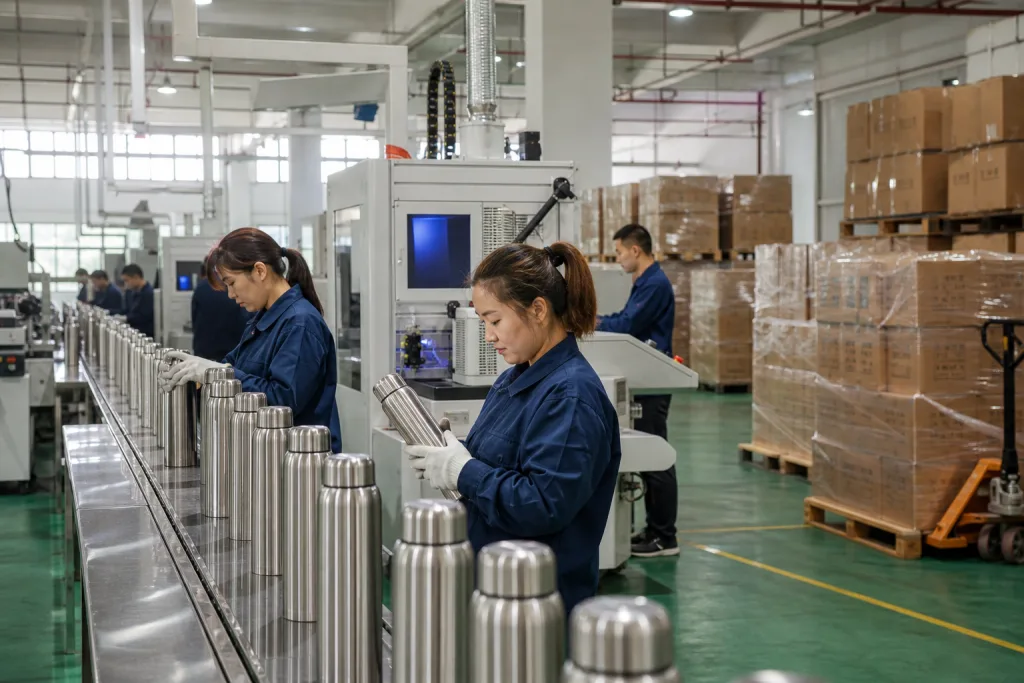
Ask your thermos manufacturer for three numbers with the sample report: initial test temperature, ambient room temperature, and final temperature after a fixed time. Without those, “keeps hot 12 hours” is marketing copy. Zhejiang factories serving export buyers usually run vacuum testing inline and again by random sampling, often with a hot-water tank, timer, and digital probe logged by batch number. At BottleForge Industrial in China, our standard line capacity is about 450,000 stainless drinkware units per month, with vacuum leakage checks built into production rather than left only for final inspection.
Lid designs compared honestly
The lid is where 7 out of 10 bulk insulated water bottle problems start. Buyers spend two weeks approving bottle color and logo placement, then pick a lid from a 3D rendering because it looks clean. Bad shortcut. For thermos bulk orders, lid design changes tooling cost, line speed, leak rate, cleaning complaints, and carton volume; QC pulled one 1,000 ml sample last month with a 0.4 mm gasket gap, and the whole pilot run had to stop.
A simple screw cap is still the safest option. Fewer parts. Lower leakage risk. It works well for hiking bottles and retail shelves. Add a carry handle, and it becomes easier to sell for outdoor use without adding much assembly trouble. A flip straw lid sells in sports channels, but it brings more failure points: straw length, hinge pin, silicone valve, vent hole, lock fit, and dust-cover tension all need checking on the line. Push-button coffee lids feel premium, but the math does not work if the buyer wants low price, bag-leakproof performance, and soft-touch parts in the same lid; we run tighter torque checks and usually spec better gasket material for this style.
| Lid type | Best fit | Cost impact | Buyer warning |
|---|---|---|---|
| Screw cap | Outdoor, retail, corporate gift | Base cost | Check gasket compression |
| Flip straw | Sports and school use | +USD 0.30-0.80 | More parts, more QC |
| Coffee sip lid | Commuter thermos custom programs | +USD 0.25-0.70 | Not always bag-leakproof |
| Dual lid set | Premium retail bundle | +USD 0.80-1.50 | Higher packing volume |
For promotional brands, I usually recommend a screw cap or one tested drinking lid, not three new ideas from the catalog. We have seen this go sideways when a PO says “black lid” but the artwork file shows a grey PP flip top, and nobody catches it until the pre-production sample. For outdoor retail, lid compatibility across 500 ml, 750 ml, and 1,000 ml bottles helps distributors thermos programs avoid spare-part confusion. If you plan repeat orders, ask whether the gasket, straw, and lid are standard components. A customized thermos with a good-looking private lid creates trouble if replacement parts require 10,000 pieces and 45 days.
Branding methods by order type
Custom thermos decoration is not only a logo choice. It changes unit cost, MOQ, lead time, compliance risk, and how the bottle looks after 30 days in use. A customizable thermos for a staff gift has different decoration logic from a retail bottle that gets rubbed on shelf trays, knocked in dish racks, and carried outdoors. We see this on the line: a 0.3 mm logo stroke that looks sharp in PDF can fill in after coating and print, then QC pulls the sample.
Laser engraving is clean and durable on powder-coated bottles because it burns through the coating and shows the stainless steel below. We run it often for outdoor retailers and premium corporate programs, especially from 500 to 5,000 pieces. The trade-off is color. You get stainless contrast, not a full-color logo. Silk screen printing costs less for one- or two-color artwork and works well on smooth cylindrical bodies, but ink adhesion must be checked with a 3M tape test, especially on textured powder coating. Heat transfer and water transfer handle complex artwork, but they add process control work and slow the line; we have seen full-wrap decals shift 1.5 mm at the seam when the operator rushes drying time.
For a thermos promotional campaign, the lowest-risk route is usually one-position silk screen or laser engraving, packed in a white box or kraft box. Simple wins here. For a retail custom thermos, powder coating plus laser logo plus color sleeve often looks more premium than forcing complicated printing onto the bottle body. The buyer sometimes asks for “full color on the bottle, same price,” and this is the wrong question to ask if the order is 1,000 pieces and the launch date is 18 days away.
Approximate decoration adders from China production are direct: laser logo USD 0.08-0.20 per piece, one-color silk screen USD 0.06-0.15, multi-color print USD 0.15-0.45, and full wrap transfer often USD 0.50 or more depending on coverage. These are not fixed prices, but they help check whether a thermos suppliers quote is realistic. If a supplier thermos quote includes full-color wrap, gift box, spare lid, and premium coating at the same price as a plain bottle, the math doesn't work. We once saw a PO say “laser full-color logo”; that typo alone cost two days of artwork confirmation before mass production could start.
Spec table for sourcing decisions
We tell buyers to send an RFQ with hard numbers, not a mood board. On our line, QC checks wall thickness with a micrometer at 0.01 mm, and that is how we sort a promo cup from a retail thermos before we quote. Use the table below for the three buckets we ship most: promo volume, outdoor retail, and distributor assortment planning.
| Specification | Promo bottle | Outdoor retail bottle | Premium thermos |
|---|---|---|---|
| Capacity | 500-600 ml | 750-1,000 ml | 500-750 ml |
| Inner steel | 304, 0.35-0.4 mm | 304, 0.4-0.5 mm | 304, 0.5 mm |
| Outer steel | 201 or 304 | 304 preferred | 304 preferred |
| Coating | Spray paint or basic powder | Matte powder coat | Textured powder or metallic |
| Logo | Silk screen | Laser or screen | Laser, debossed sleeve, gift set |
| FOB range | USD 3.20-5.20 | USD 5.00-8.50 | USD 7.50-12.00 |
| Lead time | 25-35 days | 30-45 days | 40-55 days |
The price bands here assume existing tooling and normal export cartons from Zhejiang, China. New mold work can add USD 1,500-8,000 depending on body, lid, and plastic parts. A few days ago the buyer flagged a PO with a lid color typo, and that would have sent the sample to the wrong bin. After artwork approval, we usually need 7-10 days for pre-production samples, then mass production starts after sign-off.
Keep the same spec table on every quote. I have seen buyers compare a promo bottle with 201 outer steel, thin wall, and polybag to another quote with 304 outer steel, gift box, and AQL inspection; that is not a fair comparison, and the math does not work. If one supplier leaves out the carton drop test, call it out before you ask for best price.
Compliance, packing, and inspection
For Europe and North America, plan compliance before the purchase order, not after the line has packed 48 cartons. Stainless bottles for food contact may need LFGB, FDA, REACH-related declarations, and sometimes California Proposition 65 statements depending on your market and retail customer. For kids or school channels, buyers may ask for CPSIA or ASTM-related checks on coatings and accessible parts; last year one school buyer flagged a 0.6 mm paint edge near the handle pin during sample review. Your thermos supplier should state which tests exist for the current model and which items need retesting after color, coating, silicone, straw, or 304 stainless material changes.
Factory audits matter too. BSCI, Sedex, ISO 9001, or customer-specific audits do not guarantee a clean shipment, but they cut basic supply chain risk. For a distributor thermos program that repeats every season, confirm audit validity and production ownership before paying the deposit. We have seen this go sideways. Some thermos vendors are trading companies using three different factories, and the buyer only finds out when the carton mark style changes between two POs. That can work, but you should know who controls the vacuum testing machine, powder coating booth, logo jig, and final packing tables.
Packing is not a small detail. A plain white box is low-cost and fast to run. A color gift box improves retail display, but it adds printing setup, increases carton CBM, and raises damage risk if the board is only 250 gsm instead of 350 gsm. For e-commerce or FBA-style shipments, you may need barcode labels, FNSKU labels, carton drop testing, and tighter master carton weight control; one Amazon buyer pushed back because the FNSKU was 3 mm too close to the box seam. Keep export cartons under about 15 kg when possible. Warehouse teams handle them better, and damage claims drop.
Use AQL inspection for thermos customized orders above 2,000 pieces. A common setting is critical 0, major 2.5, minor 4.0. Major defects include leakage, poor vacuum, sharp edges, wrong logo, serious coating chips, and lid malfunction. Minor defects include small dust points or slight color variation within the approved range. Agree on defect definitions before production; this is the wrong question to ask at final inspection when QC pulled the sample and the vessel is already booked. Arguing about them at final inspection can burn 2 days vs 0.5 day for a signed defect board at pre-production.
How to choose your partner
A good thermos manufacturer does not just say yes. They push back when the target price, decoration, and compliance plan do not line up. If you want a 750 ml powder-coated bottle, retail gift box, laser logo, spare lid, and 35-day delivery at USD 3.50 FOB, an experienced thermos team should flag the gap on the first call. On the coating line, we run a cross-hatch tape test before bulk approval. Silence is not service. It is delayed disappointment.
For outdoor retailers, I would put engineering stability first: proven molds, coating adhesion that survives a 48-hour salt spray check, reliable vacuum test data, and spare parts on hand. For promotional brands, speed and artwork control matter more: clear dielines, sample sign-off in 3 to 5 days, predictable MOQ, and packing that matches the PO. For thermos distributors building a catalog, repeatability wins. You need the same black, white, navy, and stainless finishes six months later, not a one-off batch that the buyer cannot match. QC pulled the sample after a 500-cycle lid test, and that is the kind of detail that saves a program.
Ask direct questions before you select a thermos factory: What is the MOQ per color? Which parts are 304 stainless? What is the wall thickness before forming? What temperature test do you use? Can you provide REACH or LFGB reports for this model? How many units per month can the line produce? What is the normal lead time after deposit and artwork approval? Can you pack by inner carton, barcode, or mixed SKU carton? We check wall thickness with a micrometer at three points, because the brochure never tells the full story. If a supplier dodges these questions, the buyer will be chasing answers after the deposit clears.
For many programs, the right answer is not the cheapest manufacturer thermos quote. The wrong question is, "Who is cheapest?" The better question is which quote has fewer unknowns. A slightly higher FOB price can be cheaper after you count late shipment, failed inspection, repacking, customer returns, and emergency air freight. We have seen a USD 0.12 gap disappear fast when one carton spec was wrong by 2 mm and the warehouse had to rework the whole lot. That is the math.
Send your thermos spec and target FOB price
We will check mold fit, MOQ, decoration method, packing, compliance needs, and realistic lead time before you commit to production.
Frequently asked questions
What MOQ should I expect for a custom stainless thermos order?
For an existing mold, the practical MOQ is usually 1,000 pieces per color for powder coating or spray painting. If you use stock colors and a simple laser logo, some factories can support 500 pieces, but the FOB price will be higher. For new body tooling, new lid tooling, or a fully customized thermos shape, expect 3,000-5,000 pieces per SKU and tooling charges from about USD 1,500 to USD 8,000. Promotional thermos orders with tight deadlines should stay with existing molds.
How long does production take after sample approval?
For a normal bulk insulated water bottle order from China, plan 30-45 days after deposit, artwork confirmation, and pre-production sample approval. A simple laser logo on stock bottles can be faster, often 20-30 days. Custom powder color, gift box printing, transfer artwork, or dual-lid packing can push lead time to 45-55 days. Add 7-10 days for sample making before mass production. If your retail launch date is fixed, build in at least one extra week for inspection and booking changes.
Which logo method is best for outdoor retail bottles?
For outdoor retail, laser engraving on powder coating is usually the safest choice. It resists abrasion better than many printed logos and gives a clean premium look. One-color silk screen can also work, especially on smooth coating, but you should request an adhesion test such as 3M tape testing before approval. For full-color artwork, heat transfer is possible, but it adds cost and process risk. On a 2,000-piece custom thermos order, logo method can change the total cost by USD 200 to over USD 1,000.
Can I mix colors or sizes in one bulk thermos order?
Yes, but the MOQ is usually calculated by color and sometimes by size. For example, a factory may accept 3,000 pieces total if each color reaches 1,000 pieces. Mixing 300 black, 300 white, and 400 green sounds simple, but coating setup and QC become inefficient. Size mixing is easier when the bottle uses the same lid and carton structure. For distributor thermos programs, we recommend limiting the first order to 2-4 colors and expanding after sell-through data is clear.
What inspection standard should I use for thermos bulk shipments?
Use AQL inspection with clear defect definitions. A common export setting is critical 0, major 2.5, minor 4.0. Critical defects include unsafe sharp edges or contamination. Major defects include leakage, vacuum failure, wrong logo size, serious coating damage, missing parts, and non-functioning lids. Minor defects include small dust points, light carton marks, or slight color variation within the approved sample range. For orders above 2,000 pieces, final random inspection is worth the cost, usually a few hundred dollars compared with thousands in possible claims.