Key Takeaways
- A standard plastic bulk infuser bottle usually starts from 3,000 pcs, while stainless or glass versions often need 1,000-2,000 pcs per color
- Typical FOB China pricing ranges from USD 1.20-2.80 for plastic, USD 2.60-5.50 for glass, and USD 4.20-8.50 for stainless designs
- New custom logo infuser bottle production normally takes 30-45 days after deposit and approved pre-production sample
- Logo setup, color matching, custom molds, gift boxes, and third-party testing can add USD 150-3,500 before mass production
A bulk infuser bottle looks simple until we quote it on a real cost sheet. Bottle body material, infuser basket mesh size, lid gasket spec, carton packing, logo process, and FDA or LFGB testing can each change the unit price by USD 0.08 to USD 0.45. Small changes add up fast. For a wellness brand or hydration startup, a 3,000-piece order is either a clean first run or inventory that sits in the warehouse for 9 months because the buyer picked the wrong lid structure.
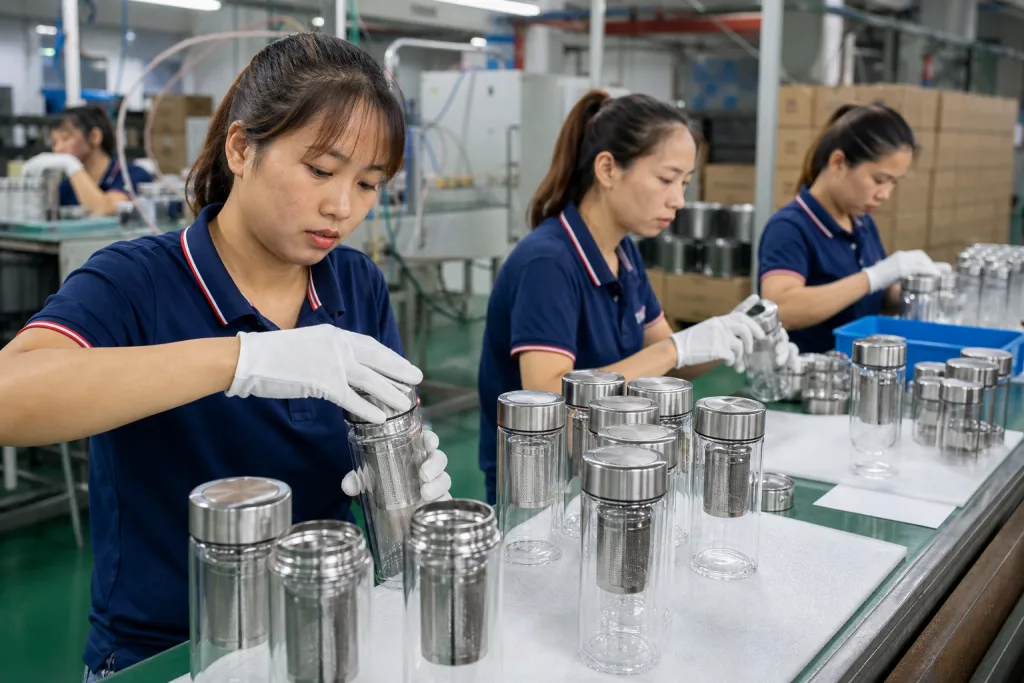
At our Hangzhou, Zhejiang factory, buyers usually ask the same questions: unit cost, workable MOQ, and ship date out of China. The honest answer depends on material choice, artwork readiness, and how much custom packaging you need. We run 304 stainless infuser baskets through a 0.5 mm burr check before assembly, and QC pulled one sample last month because the silicone seal had a 1 mm flash line. That kind of detail affects timing. If your logo file is clean AI format and the color box dieline is approved on day 1, a standard bulk infuser bottle project moves faster than a PO where the barcode is missing or “matte black” is typed as “mate black.”
Start with the landed cost
Most new buyers ask for the cheapest factory infuser bottle price first. Fair question. It is also the wrong question to ask at the start of a bulk infuser bottle program. The unit price on a quotation is one line in landed cost, not the full bill. We run the costing sheet with inland trucking in China, export cartons, logo setup, packaging print, inspection, freight, duty, and warehouse handling. Last month a buyer flagged a USD 0.06 gap between two quotes, then missed the USD 0.22 per unit difference caused by a 5-layer carton upgrade and Amazon FBA relabeling.
For a typical 24 oz to 32 oz plastic bulk fruit infuser bottle, FOB Ningbo or Shanghai can sit around USD 1.20-2.80 per unit depending on Tritan, PP, or AS material. A glass custom tea infuser bottle with sleeve and stainless strainer often lands at USD 2.60-5.50 FOB. A stainless steel customized infuser bottle with double-wall vacuum insulation may be USD 4.20-8.50 FOB, and sometimes higher if you need powder coating, laser logo, and retail packaging. On the line, the difference is not abstract: Tritan parts need cleaner injection, glass sleeves need a separate sleeve-fit check, and vacuum bottles go through a 24-hour heat retention test before packing.
Freight can change the picture fast. A 40HQ container may hold about 18,000-30,000 plastic infuser bottles, depending on carton size. If you ship only 1,000 pieces by air to meet a launch date, the freight cost can exceed the bottle cost. We usually price sea freight and express sample freight early for startups, because a product that looks profitable at FOB can fail once DHL bills by volumetric weight. We saw this go sideways on a 32 oz bottle packed in a tall gift box: the carton measured 58 cm x 42 cm x 52 cm, and the air rate killed the margin.
The safest comparison is landed cost per sellable unit. If one quote is USD 0.18 cheaper but uses thin cartons, weak lid threading, or no AQL inspection, the cheaper supplier may cost more after returns. QC pulled the sample on one low-price lid last year because the thread skipped after 6 open-close cycles. The math does not work when 3% of cartons arrive crushed and your warehouse charges to rework them.
Material choice drives the base price
The main body material usually sets the floor price for a custom infuser bottle. Plastic works for gym bottles and daily hydration promos because it is light; on a 10,000 pcs order, the carton CBM often decides whether the buyer argues about USD 0.06 or accepts the quote. Tritan is the premium plastic we run most often because it has clearer gloss and better drop performance than cheaper AS. For North American and European orders, buyers usually ask for BPA-free material, FDA food-contact support, LFGB or EU 10/2011 documentation, plus REACH control on coatings and silicone parts. QC checks the resin lot sheet before the line starts.
Glass changes the positioning. A bulk tea infuser bottle made from borosilicate glass feels cleaner and more giftable, but the math changes fast: breakage allowance, thicker cartons, and freight all move the landed cost. We see wellness brands choose glass for office desks and home use, not running belts or bikes. If you want a custom fruit infuser bottle for retail shelves, glass can look sharp, but it needs a sleeve or molded pulp tray; last season a buyer flagged 7 cracked pcs in a 500 pcs trial carton because the foam insert was cut 3 mm too short.
Stainless steel costs the most, but it gives the strongest shelf value. For a factory tea infuser bottle with vacuum insulation, common stainless grades are 304 for the inner wall and 201 or 304 for the outer wall. Wall thickness is often 0.4-0.5 mm for commercial tumblers, with heavier gauges on premium models. The infuser basket can be 304 stainless mesh or perforated sheet; mesh suits fine tea, while larger holes work better for fruit. We check the mesh seam with calipers because a rough 0.2 mm burr is enough for a buyer to reject the pre-shipment sample.
A customizable tea infuser bottle also needs a cleaning check. This is the wrong question to ask: “Does it look premium?” Ask whether a user can rinse the basket and lid in 20 seconds. If the basket is too narrow or the lid has hidden grooves, complaints come in after launch even when the first impression is strong. QC pulled one sample where tea leaves stayed trapped under the silicone ring after three rinse cycles.
MOQ tiers you can actually plan around
MOQ is not a factory trick. It comes from resin or steel purchasing, Pantone color batching, logo fixture setup, line changeover, and printed packaging. At BottleForge Industrial in Zhejiang, China, our monthly drinkware capacity is about 450,000 units across stainless, plastic, glass, and specialty bottles. Still, a 600 pcs customized infuser bottle order can block a coating booth for half a shift, so the line needs a production plan that matches the actual work.
For a stock-shape factory direct infuser bottle with a one-color logo, a practical MOQ is often 1,000-3,000 pcs. Plastic fruit infuser bottle bulk orders commonly start at 3,000 pcs per model, especially with a custom body color, because the injection team needs one clean color batch instead of purging the barrel twice. Glass models can sometimes start at 1,000-2,000 pcs if the glass body and lid are standard. Stainless vacuum designs usually make sense from 1,000 pcs per color, but 2,000-3,000 pcs gives better pricing because coating, laser engraving, and assembly waste drop once we run a full rack.
Packaging has its own MOQ. A custom printed color box may require 1,000-3,000 pcs, while molded pulp inserts or special paper tubes can need 3,000-5,000 pcs. We have seen this go sideways when the buyer approves 2,000 bottles but asks for 800 printed boxes in four languages; the math does not work at the box supplier. If you are testing a wellness subscription box or influencer launch, use a neutral kraft box with a sticker first, then move to full retail packaging after the second PO.
For distributor infuser bottle programs, mixed colors are possible, but six colors at 500 pcs each will not price like one color at 3,000 pcs. Each color adds handling, QC separation, carton marking, and inventory risk; QC pulled samples last month because two blue shades were only 0.5 tone apart under the light box, and the buyer flagged it. If your launch budget is tight, start with two strong colors and one logo method.
Customization costs beyond the logo
A custom logo infuser bottle can stay cheap, or it can start eating margin fast. For most startup orders, we run silk screen printing, pad printing, laser engraving, heat transfer, or UV printing; for a 500-3,000 pcs trial order, these cover most buyer briefs. A one-position, one-color logo often has a setup cost around USD 50-120 and a running cost of USD 0.03-0.15 per unit. Laser engraving on stainless may cost USD 0.08-0.25 per unit depending on logo size and position. QC pulled one sample last month where the logo sat 3 mm too close to the lid thread. Small miss. Big complaint.
Color matching is another cost, and buyers often underbudget it. If you need a Pantone-matched lid, silicone strap, sleeve, or bottle body, the factory may charge USD 80-200 for color sampling, and MOQ can rise because resin, coating powder, or silicone must be mixed in batches. For a customizable fruit infuser bottle, the fruit basket color is easy to forget, but it shows through the clear body. A mismatched basket can make the product feel cheap. We have seen this go sideways when the PO says “mint green” but the artwork file says Pantone 324C.
A custom made infuser bottle with a new lid shape, proprietary basket, grip texture, or unique bottle silhouette moves into tooling. This is where the math changes. Simple plastic lid tooling may cost USD 1,500-4,000. A full bottle mold can be USD 6,000-18,000 depending on cavities and finish. Stainless steel tooling varies widely; a new lid and infuser assembly may be USD 2,000-8,000, while a new body form can be higher. Tooling lead time is usually 20-35 days before you even start formal production samples. On the line, we check the first T1 parts with a digital caliper, and a 0.4 mm sealing gap is enough to fail the leak test.
Retail details also add cost: barcode labels, FNSKU stickers, hang tags, instruction leaflets, QR inserts, shrink wrap, and Amazon carton requirements. None of these are hard, but they must be listed before the final quote. A distributor fruit infuser bottle order with three markets may need three label versions, and that slows packing from about 900 pcs/hour to 600 pcs/hour when workers must switch sticker rolls. The wrong question is “can you add it later?” The right question is whether the packing BOM is locked before we print cartons.
Lead time from inquiry to shipment
A realistic timeline protects your launch. For a standard customized tea infuser bottle using an existing mold, sample preparation runs 5-10 days after artwork confirmation. On our line, the clock starts after the AI logo file, Pantone code, and print position in mm are confirmed, not after the first email inquiry. If the logo method is simple, approve clear production photos first, then request one physical sample by express. DHL, FedEx, or UPS sample transit from China to the US or Europe often takes 3-6 working days.
After sample approval and deposit, mass production normally takes 25-40 days for plastic or glass orders and 35-50 days for stainless insulated orders. Peak season matters. From August to November, factories in Zhejiang and other China production areas handle 40-60 holiday and Q1 retail programs at the same time, so lead time can stretch by 7-15 days. We have seen this go sideways when a buyer changes the sleeve artwork after the deposit; the line waits, and the planned 32 days becomes 41 days. Chinese New Year is the other major risk; production planning should start at least 90 days before the holiday if you need goods shipped before the shutdown.
Inspection and shipping add more time. A final random inspection using AQL 2.5 for major defects and 4.0 for minor defects takes 1 day on site in most cases, plus booking time. QC pulled the sample carton last month and found a 2 mm logo shift against the approved sample, so we held packing until the pad-printing plate was adjusted. Sea freight to the US West Coast may be 18-28 days port-to-port, while Europe is often 30-40 days. Rail to Europe works for some shipments, but bottle cartons are bulky; a 40HQ fills by volume before it reaches weight limit, so the math must be checked.
If you need a factory fruit infuser bottle for a trade show in six weeks, avoid new molds, custom packaging, and special colors. Pick an existing color. Use a stock carton. This is the wrong time to chase a gift-box upgrade with a new barcode sticker and a typo on the PO. Fast projects work when you remove decisions, not when everyone rushes every decision badly.
Quality checks that prevent returns
Infuser bottles fail in predictable ways: leaking lids, loose baskets, cracked plastic, rough stainless edges, weak logo adhesion, silicone odor, and crushed retail boxes. We catch these before the goods leave China, not after your warehouse team opens 80 cartons with wet inserts. For a bulk tea infuser bottle, QC checks basket fit with a go/no-go feel, lid torque with a torque meter, seal compression at the silicone ring, and whether CTC tea or rooibos dust escapes through the mesh or punched holes. For a fruit infuser bottle custom order, we run a basket lock pull test because lemon cubes and frozen berries add pressure when the buyer shakes the bottle. Small part, big return risk.
Common tests include leak testing, drop testing, dishwasher simulation where applicable, coating adhesion cross-hatch test, logo rub test, odor check, and carton drop test. On the line, QC pulled the sample after 24 hours because one flip lid passed upside-down leak testing but failed after a side drop from 1.2 m. Stainless insulated bottles should get vacuum performance checks, usually hot water temperature retention over 6-12 hours with a probe thermometer and logged room temperature. Glass bottles need thermal shock and packaging drop checks, especially for e-commerce channels where one bottle may pass through 6 handling points before delivery.
Documentation depends on your market. For Europe, ask early about LFGB, EU food-contact declarations, REACH, and packaging waste requirements; do not leave this until the PO is approved, because lab slots can add 7-10 days. For the US, FDA food-contact compliance and California Prop 65 screening may be relevant. If the bottle is for children, the bar is higher, and you may need ASTM or CPSIA-related testing depending on design and claims. We have seen this go sideways when the artwork says “kids bottle” but the buyer only budgeted for adult drinkware testing.
We recommend a pre-production sample, in-line inspection for first-time factory direct infuser bottle orders, and final random inspection before balance payment. The math is simple. It costs less to reject 200 lids during assembly, while the lid gasket jig is still on the workbench, than to receive 2,000 customer complaints after launch. For new molds or a new logo process, we also run a small pilot lot before mass packing so the buyer can flag color, barcode, and retail box copy issues before 5,000 units are sealed.
How to brief the factory
A clean brief gets you an accurate quote in 24-48 hours. A loose brief gets you a cheap number that moves after sampling. For a distributor tea infuser bottle or wellness startup launch, send the target capacity in ml, preferred material such as 304 stainless or Tritan, lid type with a photo or drawing, infuser use case, logo file in AI or PDF, packaging style, destination port, required certifications, and expected order quantity. We run quotes from a costing sheet, not guesswork; one missing lid gasket size can change the price by USD 0.08.
Be honest about your sales channel. A customized fruit infuser bottle for spa retail has different packaging needs than a customizable infuser bottle for Amazon FBA. Amazon orders need FNSKU labels, carton weight kept under the buyer’s warehouse limit, polybag suffocation warnings if used, and cartons that survive a 60 cm drop test. Boutique retail cares more about color box finish and shelf presence, so the buyer may flag a dull matte box even when the bottle passes AQL 2.5. We have seen this go sideways.
Define your acceptable trade-offs early. If your target FOB price is USD 2.00, say so. The factory can suggest a standard mold, a simpler lid, one-color print, or a neutral box with a printed barcode sticker. If your brand position requires a premium custom tea infuser bottle, protect the parts users touch every day: lid thread fit, silicone seal compression, basket edge smoothness, coating feel, and cleaning access. QC pulled one sample last month because the laser logo looked fine, but the infuser rim had a 0.3 mm burr.
Good sourcing is not asking ten factories for numbers. Wrong question. Build one specification that three serious suppliers can quote against, then compare the real gaps: material grade with test report, MOQ logic by color, tooling ownership terms, QC process at AQL 2.5, and whether the line can hit your launch date. We ship based on production slots; a PO typo like “mat black” instead of “matte black” can cost 12 days vs 18 days once artwork approval resets.
Get a factory quote with real MOQ numbers
Send your target price, quantity, artwork, and market. We will return practical options with cost, lead time, and packaging assumptions.
Frequently asked questions
What is the normal MOQ for a bulk infuser bottle order?
For an existing mold with a simple logo, the normal MOQ is 1,000-3,000 pcs. Plastic bulk fruit infuser bottle orders often start at 3,000 pcs per color because resin color and assembly setup need volume. Glass can sometimes start at 1,000-2,000 pcs, while stainless insulated models usually make better cost sense from 1,000 pcs and improve at 3,000 pcs. Custom printed boxes may have a separate MOQ, often 1,000-3,000 pcs. If you need six colors, confirm whether the MOQ is per model or per color before approving the quotation.
How much does a custom infuser bottle cost from China?
A standard plastic custom infuser bottle is often USD 1.20-2.80 FOB China, depending on capacity, material, lid design, and logo. A glass tea or fruit infuser version usually ranges from USD 2.60-5.50 FOB, especially if it includes a sleeve and stainless basket. Stainless vacuum insulated versions commonly run USD 4.20-8.50 FOB. These ranges do not include ocean freight, duty, inspection, or domestic delivery. Logo, packaging, barcode labels, and testing can add USD 0.05-0.80 per unit depending on your requirements.
Can I order a custom made infuser bottle with my own mold?
Yes, but it is only worth doing if you expect repeat volume. A new plastic lid mold may cost USD 1,500-4,000, while a full bottle body mold can be USD 6,000-18,000. Tooling usually takes 20-35 days, then you still need samples, testing, and mass production. For a first wellness brand launch, we often suggest using an existing factory infuser bottle mold with custom color, logo, and packaging. After you prove sales at 5,000-10,000 pcs, proprietary tooling becomes easier to justify.
What certifications should I ask for when sourcing infuser bottles?
For Europe, ask about LFGB, EU 10/2011 for plastic food-contact materials, REACH, and relevant packaging declarations. For the United States, FDA food-contact support is common, and Prop 65 review may be needed depending on materials and coatings. If the bottle is marketed to children, discuss CPSIA or ASTM-related requirements before sampling. Factory audits such as BSCI or ISO 9001 can also matter for larger retailers. Do not wait until production is finished to ask for reports; testing can take 5-10 working days or longer.
How long does production take after I approve the sample?
For an existing mold customized infuser bottle, mass production usually takes 25-40 days for plastic or glass and 35-50 days for stainless insulated designs. Add 5-10 days for logo samples and 3-6 working days for international sample courier delivery. Final inspection, export booking, and loading may add another 3-7 days. Ocean freight then takes about 18-28 days to the US West Coast and 30-40 days to many European ports. New tooling can add 20-35 days before production sampling even starts.