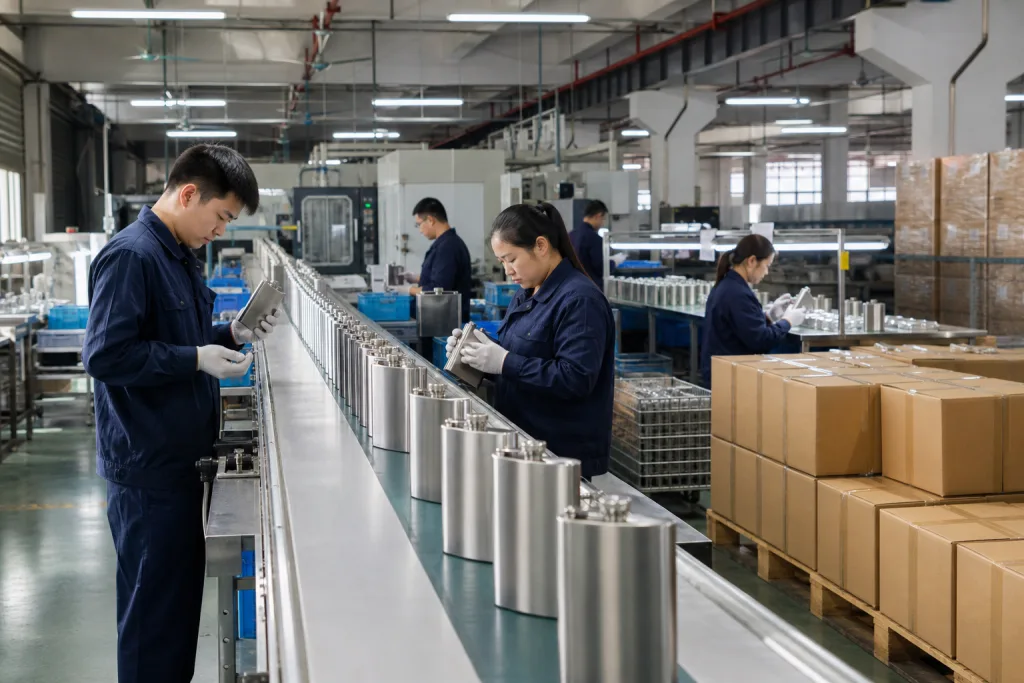
Key Takeaways
- A standard bulk hip flask MOQ usually starts at 1,000–3,000 pcs per size and finish
- 304 stainless steel at 0.4–0.6 mm wall thickness is the normal export baseline
- Laser engraving is cleaner for premium alcohol flask wholesale bulk programs than large-area printing
- Growlers, canteens, and tumblers need different leak tests, coatings, cartons, and compliance files
A bulk hip flask looks simple until your logo, carton drop test, compliance file, and delivery date hit the same PO. Specs get people in trouble. “Stainless steel flask, 6 oz, matte black” is not enough for a China factory to quote cleanly or hold quality across 5,000 pcs; we still need wall thickness in mm, cap type, finish standard, packing method, and whether QC should test for coating rub with 3M tape.
If you buy bulk drinkware for retail, corporate gifting, spirits promotion, outdoor kits, or hospitality, compare hip flasks with nearby items like bulk canteen, beer growler bulk, and beer tumbler bulk. The wrong question is “which one looks better in the catalog?” The buyer should ask who will use it, what margin it needs to carry, and where it can fail. Our Zhejiang production partners run 180,000–240,000 drinkware units/month, and we’ve seen this go sideways when a buyer approved a glossy sample, then flagged fingerprints on the matte bulk shipment after QC pulled the sample from line carton No. 7.
Hip flask versus nearby drinkware
Procurement teams put hip flasks, canteens, growlers, and beer tumblers into one drinkware bulk basket because all of them are metal. On the line, they are different jobs. A 0.8 mm shell, a TIG weld, a cap torque check, a polish step, and carton packing all change by product. QC pulled the sample for a thread gauge test, and that is where the split shows up.
A bulk hip flask is usually a compact 3 oz to 8 oz piece for spirits, gifting, tourism retail, wedding favors, or promo kits. It needs a clean brushed finish, tight cap threads, safe welds, and a logo in the right spot. A bulk canteen is larger, usually 500 ml to 1,000 ml, and sits in outdoor or military-style programs. That job may need a shoulder strap, pouch, cup, or powder coat. A bulk growler or wholesale growler is usually 32 oz or 64 oz for craft beer, taproom merchandise, and refill runs. A beer tumbler in bulk is closer to insulated drinkware, with a lid, vacuum wall, and heavier master carton. We run different packing lines for those four.
Here is the comparison buyers should use before they ask for FOB China pricing:
| Product | Common capacity | Best fit | Main risk | Typical MOQ |
|---|---|---|---|---|
| Bulk hip flask | 3–8 oz | Spirits promo, gifts, retail sets | Cap leakage, scratches, logo defects | 1,000–3,000 pcs |
| Wholesale canteen | 500–1,000 ml | Outdoor, camping, heritage brands | Coating chip, accessory mismatch | 1,000–2,000 pcs |
| Beer growler wholesale | 32–64 oz | Breweries, taprooms, events | Thread seal, denting, freight cost | 500–1,500 pcs |
| Beer tumbler wholesale | 12–20 oz | Retail drinkware, bar programs | Vacuum failure, lid fit | 1,000–3,000 pcs |
If your buyer brief says “best wholesale drink bottle” but the user is putting spirits in a jacket pocket, the hip flask wins. If the user is refilling beer, the growler wins. This is the wrong question to ask at the sample stage. We have seen that mix turn into dead stock, and the math does not work. One PO typo on the carton mark is enough to slow a shipment by 2 weeks.
Core specifications that affect price
For a bulk hip flask, the quote usually moves on five items: material grade, wall thickness, surface finish, cap construction, and packaging spec. Cheap quotes hide details. We see this often when a PO says “stainless steel” but the sample tag on our PMI gun reads 201, not 304 stainless. A proper export-grade stainless steel flask uses 304 stainless steel for the body, while 201 stainless sometimes appears on low-cost local-market styles. For Europe and North America, we recommend 304 unless your testing plan already confirms the lower-grade material will pass FDA, LFGB, or your buyer’s own lab check.
Wall thickness is commonly 0.4 mm, 0.5 mm, or 0.6 mm. A 0.4 mm flask works for a 10,000 pcs giveaway, but it dents faster when cartons get squeezed in a mixed container. QC pulled one 6 oz sample last month with a side dent after a 76 cm drop test. Not good. A 0.6 mm flask feels stronger in hand and fits alcohol flask wholesale programs where the item sits in retail packaging instead of being handed out loose at an event. For a 6 oz flask, the FOB China price gap between light promotional grade and a better retail grade may be USD 0.25–0.55 per piece before packaging upgrades.
Cap design gets less attention than it deserves. A hinged captive cap is common because users do not lose it, but the hinge has to sit straight, the rivet cannot wobble, and the gasket must stay seated after tightening. On the line, we run the thread by hand first, then check it again during AQL inspection. The buyer flagged it once because 14 pcs in a 500 pcs pilot run had caps that felt gritty after polishing dust stayed in the thread. If you are buying alcohol flask in bulk for an airline, hotel, spirits brand, or event agency, request a 100% water leak test at factory level, not only random inspection.
For canteen wholesale or growler bulk orders, the cost drivers change. A wholesale canteen may need a canvas pouch with 600D fabric, an aluminum cup, or a PP cap with a specific strap length. A beer growler in bulk may need thicker stainless, a swing lid, or a pressure-capable screw lid. A beer tumbler wholesale bulk order adds vacuum insulation, lid tooling, and sometimes powder coating, with curing temperature checked on the oven panel. Benchmarking all of these against a hip flask unit price is the wrong question to ask; the math does not work because the production steps are not the same.
Branding methods compared honestly
Brand owners usually ask about the logo first. Factories ask whether that logo will pass bending, packing rub, sea freight, and customer handling. On a curved hip flask, decoration is not just appearance. It affects rejects, lead time, and shelf value. Last month QC pulled 32 pcs from a 1,200 pcs lot because the logo sat 2 mm off-center after the body fixture was changed.
Laser engraving is the safest premium choice for brushed stainless, matte coating, and dark powder finishes. It will not peel, and it holds 6 pt small text better than screen printing. For bulk hip flask orders above 1,000 pcs, laser setup is usually USD 30–80 per design, with a per-piece cost around USD 0.08–0.25 depending on size and speed. We run fiber laser on a curved jig, and the operator checks the first 10 pcs with a steel ruler before the line continues. It is a strong fit for alcohol flask wholesale bulk, wedding retail sets, and corporate gift programs.
Silkscreen printing is cheaper for single-color logos on smooth surfaces, but it can scratch if the ink system is weak or the surface is not cleaned before printing. It works for promotional alcohol flask bulk orders where budget matters more than lifetime durability. For multi-color logos, expect higher setup cost, tighter registration control, and more QC time. The buyer often says “just print it cheaper,” but if the logo crosses the flask curve by 45 mm, the math doesn't work. We have seen this go sideways during tape test after drying.
UV printing gives more color, but it is less forgiving on curved bodies. It can be done, but confirm artwork size and test adhesion before bulk production. For canteen bulk or beer tumbler in bulk with powder coating, we prefer laser engraving or tested pad printing unless the order volume pays for proper sampling. Our usual sample check is 3 pcs, 24-hour adhesion rest, then a 3M tape pull and thumb rub test. Small detail. Big difference.
Packaging is branding too. A white box is cheap, usually USD 0.08–0.18. A color gift box may add USD 0.20–0.60. A set box with funnel, cups, foam insert, and printed sleeve can add more than the flask itself. That is normal for retail alcohol flask wholesale, but it needs to be fixed before the quotation is locked. We once had a PO typo showing “black foam” while the approved sample used white EVA, and the buyer flagged it during pre-shipment inspection.
Use-case fit by sales channel
The right SKU depends on the sales channel. An online retail buyer worries about carton crush, barcode scans, and return photos; a distributor selling to breweries or outdoor shops asks whether the item fits their shelf story. A hip flask is compact, low freight per unit, and easy to bundle. We ship 6 oz flasks at roughly 120 pcs per master carton when the box style is simple, so they work well for gift sets, spirits merchandising, souvenir shops, and Q4 promotions.
For e-commerce, a 6 oz or 8 oz bulk hip flask with laser logo, individual box, and polybag protection is usually the cleanest setup. If the product goes into Amazon FBA, you will need FNSKU labeling, carton weight control, drop-test packaging, and barcode accuracy. Keep master cartons under 15 kg where possible to reduce handling damage and warehouse complaints. QC pulled one sample last month where the FNSKU was 2 mm too close to the box edge; the scanner still read it in our office, but the buyer flagged it before inbound booking.
For breweries and taprooms, beer growler wholesale often makes more sense than pushing a flask into the wrong channel. A 64 oz stainless growler has higher perceived value and supports refill behavior. Freight bites harder. A 64 oz growler carton consumes far more CBM than hip flasks, so FOB price alone can mislead you. Beer growler wholesale bulk buyers should compare landed cost per sellable unit, not factory price per unit; we have seen a USD 0.40 cheaper growler lose money after the forwarder quoted 18 cartons per CBM instead of the 42 cartons the buyer assumed.
For outdoor retail, a bulk canteen or wholesale canteen can fit better than a flask because the use case is water, hiking, camping, or field kits. Buyers sometimes search canteen bulk when they actually want a military-style bottle with a cup and cover. That is a different Bill of Materials. If you need a rugged look, specify coating thickness, strap material, buckle type, and accessory packing at RFQ stage. The line needs those details early; changing from a 20 mm nylon strap to a cotton canvas strap after PP sample approval can add 7 days and mess up the packing tray size.
For bars, festivals, and beverage distributors, beer tumbler bulk or beer tumbler wholesale may be the better move. Tumblers are used openly and repeatedly, while flasks are more occasion-based. If your sales channel depends on visible brand exposure, a tumbler can outperform a flask despite the higher unit cost. This is the wrong question to ask if the buyer only compares unit price; at a festival booth, a 500 ml tumbler with a 45 mm front logo gets seen 20 times, while a flask often stays in a pocket.
Compliance and inspection checkpoints
For Europe and North America, documents are not optional. A bulk hip flask that touches alcohol should be treated as a food-contact product. Ask for the material declaration, food-contact test reports where they apply, and coating safety data if the flask has paint or powder coat. On our line, QC keeps an XRF printout for each lot, and we have stopped a batch before packing when a buyer flagged missing pigment data on a matte finish. For EU buyers, REACH and food-contact migration testing come into play depending on the material and finish. For the US, FDA food-contact expectations and California Proposition 65 risk review can apply, especially for coated or decorated items.
Inspection has to be written into the purchase order. The math does not work if the PO is vague. A normal AQL plan might use AQL 2.5 for major defects and AQL 4.0 for minor defects, and we tighten it for retail programs. Major defects include leakage, sharp edges, wrong material, broken hinge, unreadable barcode, wrong logo, and serious dents. Minor defects include light polishing marks, small color variation, and slight box scuffs within an agreed limit. We once saw a PO type “303 stainless” instead of 304 stainless, and the buyer caught it before the cartons were printed.
Factory checks should cover capacity verification, cap torque feel, thread alignment, 100% or batch leak testing, surface inspection under consistent lighting, and carton drop testing. We run a torque meter at 0.8-1.2 N·m on the cap, and a 500 ml graduated cylinder for fill checks is on the table every morning. For drinkware wholesale shipments from Zhejiang, we use a pre-production sample, a top-of-production sample after the first 50–100 pcs, and final random inspection when at least 80% is packed. QC pulled the sample from cavity 2 at 09:20 once, and that caught a miscut thread before the line ran the full order.
For growler wholesale and beer tumbler wholesale bulk, add vacuum testing if insulated, lid fit testing, coating adhesion cross-hatch testing, and odor checks for silicone or plastic parts. For canteen wholesale, inspect accessories carefully. We saw a pouch zipper sit 3 mm off center on one shipment, and the buyer rejected the whole set even though the bottle body passed. A good bottle with a poor pouch still becomes a complaint. China can ship consistent drinkware, but only when the quality standard is written down before production starts.
MOQ, lead time, and landed cost
Most China factories can fire back a bulk hip flask quote the same day, but a fast quote is not the same as a line-ready order. On our floor, QC pulled the sample, checked the cap torque, and a 0.2 mm seam gap was enough to stop the job. For an existing mold with a simple logo, 1,000 pcs is a normal MOQ. If you want custom finish or retail packaging, 3,000 pcs is the more realistic number. A new body shape, special cap, or full gift set usually starts at 5,000–10,000 pcs. Sampling takes 7–12 days for laser logo or screen print, then 15–25 days for custom color coating or packaging that needs insert cards, trays, or window boxes.
Approved sample to mass production is usually 25–35 days for standard alcohol flask wholesale orders. In Q3 gifting season, we plan 40–50 days because the polishing line, packing table, and carton area all back up at once. Ocean freight to North America or Europe can add 25–45 days, depending on port, route, customs, and consolidation. If your launch date is fixed, count backward from delivery, not from the PO date. A buyer once flagged a ship-to typo on the purchase order and lost four days before booking was even issued.
FOB Ningbo or Shanghai is the usual term for Zhejiang drinkware factories. A simple 6 oz stainless flask may sit around USD 0.90–1.80 FOB, and the gap comes from thickness, finish, and logo method. We check wall thickness with a micrometer, and a 0.6 mm spec will price differently from a heavier body. A retail gift set can land at USD 2.20–5.50. A wholesale canteen often runs USD 2.50–7.00 once you add accessories, while a bulk growler can go much higher because the carton is larger and the stainless weight jumps. A cheap-looking quote can be the wrong question to ask.
Do not skip defect allowance or spare parts. If the design allows it, ask for 1%–2% extra caps or gaskets, and lock replacement terms before the boxes leave the warehouse. QC pulled 20 pcs under AQL 2.5 on one recent run and found two loose gaskets, which is why we push buyers to write this into the order. A 2% defect rate on a low-price item can still wipe out margin once service calls, returns, and reshipping hit the books. This is where cheap programs go sideways.
RFQ details that prevent rework
A clean RFQ cuts back-and-forth faster than hard negotiation. For bulk hip flask pricing, send capacity, material grade, wall thickness, finish, logo method, logo size, packaging, compliance market, inspection standard, target order quantity, and delivery term. On the line, QC pulls the sample with a wall-thickness gauge and checks the drawing against it. If you only send a photo, we have to guess the blanks, and that guess is where rework starts.
Use plain factory language: “6 oz 304 stainless steel hip flask, 0.5 mm body, brushed finish, laser logo 45 x 30 mm, hinged screw cap, individual white box, master carton under 15 kg, AQL 2.5/4.0, FOB Ningbo, 3,000 pcs.” That is enough for a serious factory in Zhejiang to quote cleanly. The buyer flagged a PO once because “white box” became “whitel box” in the email chain, and that typo still cost a day.
If you are comparing alcohol flask wholesale bulk with beer growler wholesale bulk or beer tumbler in bulk, ask for separate landed-cost models. Different carton CBM, test list, and return risk. The lowest unit price across unrelated products is the wrong question to ask. We have seen that go sideways when one channel needs retail packs and another ships loose. A CBM sheet on the packing table settles the argument fast.
At BottleForge Industrial in Hangzhou, China, we push unclear specs back early. Two extra days on drawings, samples, and packaging confirmation cost less than fighting about scratches, leakage, or carton damage after 60 cartons land at your warehouse. We run a 1.2 m drop test on the master carton before shipment. A reliable bulk drinkware order is built before the deposit is paid.
Send your flask RFQ for factory review
Share capacity, finish, logo, packaging, quantity, and destination. We will check the spec and quote realistic FOB China options.
Frequently asked questions
What is the normal MOQ for a bulk hip flask order?
For an existing 6 oz or 8 oz stainless steel model, the practical MOQ is usually 1,000 pcs with laser engraving or one-color printing. If you need custom powder coating, color gift box, or a set with funnel and cups, expect 3,000 pcs. A new body shape or cap design can push MOQ to 5,000–10,000 pcs because tooling, fixtures, and material purchasing must be justified. For trial orders, some factories in China may accept 500 pcs, but unit price and decoration cost will be higher.
Is 304 stainless steel necessary for alcohol flask bulk orders?
For Europe and North America, 304 stainless steel is the safer default for alcohol flask bulk programs. It has better corrosion resistance than lower-cost alternatives and is easier to support with food-contact documentation. Some very low-cost flasks use 201 stainless steel, but we do not recommend it for serious drinkware wholesale unless testing and buyer approval are clear. For a retail-grade flask, specify 304 stainless steel, 0.5–0.6 mm wall thickness, smooth inner welds, and no oily smell after cleaning.
How should I choose between hip flask, canteen, growler, and tumbler?
Start with the user behavior. Choose a bulk hip flask for spirits gifts, souvenir retail, wedding sets, or compact promotional kits. Choose canteen wholesale for outdoor, camping, or heritage-style water use. Choose beer growler wholesale for breweries, taprooms, and refill merchandise, usually in 32 oz or 64 oz sizes. Choose beer tumbler wholesale for bars, events, and repeat daily use. If brand visibility matters every day, tumblers may work better. If low freight and gift packaging matter, hip flasks are usually more efficient.
What quality tests should be required before shipment?
At minimum, require leak testing, cap thread inspection, logo position check, surface defect grading, capacity check, barcode verification, and carton drop testing. For final inspection, AQL 2.5 for major defects and AQL 4.0 for minor defects is a common starting point. For beer tumbler bulk, add vacuum insulation testing and lid fit checks. For growler bulk, check cap seal and dent resistance. For coated canteen bulk, add adhesion testing and color comparison against the approved sample.
How long does production and shipping usually take from China?
Sampling normally takes 7–12 days for a standard bulk hip flask with laser engraving, or 15–25 days if coating and custom packaging are involved. Mass production is usually 25–35 days after sample approval, but peak season can reach 40–50 days. Ocean freight from China to Europe or North America often adds 25–45 days, plus customs and inland delivery. For holiday gift programs, you should start the RFQ at least 90–120 days before the required warehouse date.