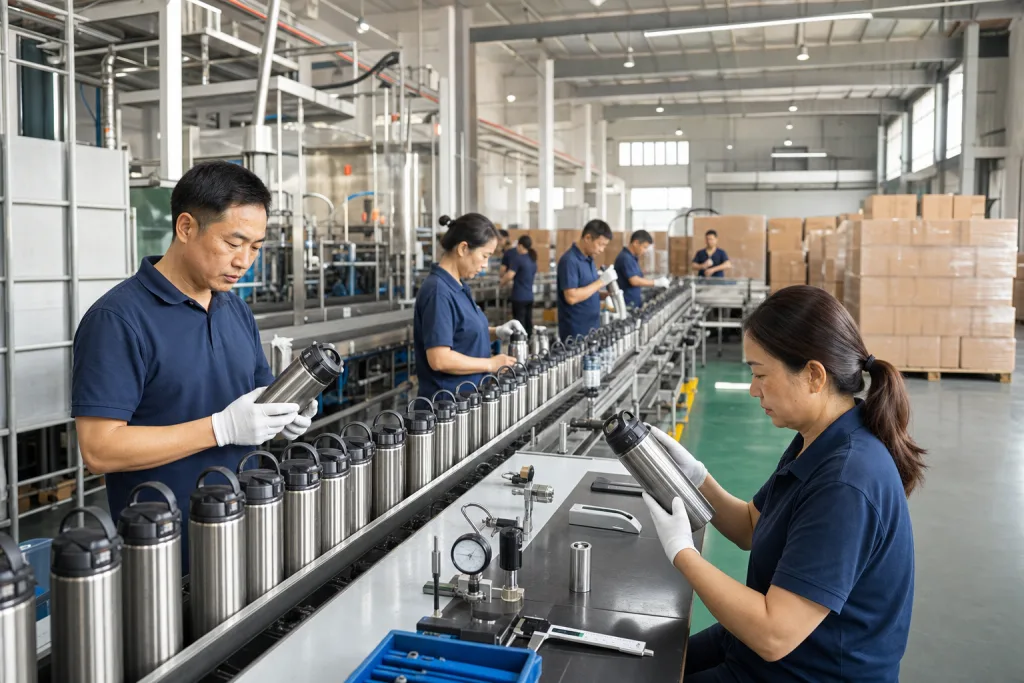
Key Takeaways
- Set bottle leak testing at 100% for sports caps and 2.5% AQL for visual defects
- A practical MOQ for custom logo shaker bottle orders starts around 1,000-3,000 pcs per color
- Logo durability should be checked with 3M tape, 50 rub cycles, and dishwasher risk notes
- Allow 25-35 days production after artwork approval for normal China bulk sports water bottle orders
A bulk gym water bottle looks easy until 3,000 pieces land with caps that squeak, logos that rub off, or cartons crushed on a pallet before a chain rollout. We saw that last month: QC pulled the sample at 2000 ml fill testing, and the lid still wept after three shakes. The issue was not a bottle cost of USD 0.18 more. The math does not work that way. You lose on a delayed launch, member complaints, or a distributor stuck rework-sorting stock in a warehouse.
From our factory network in Zhejiang, the orders that ship cleanest are not the flashy ones. They are the ones with hard pass or fail points: leak rate, odor, logo adhesion, carton strength, and replacement terms. If you are buying a custom sports water bottle, custom gym water bottle, or custom shaker bottle for retail, membership gifts, or franchise distribution, lock those weak points before the line starts. The buyer flagged a typo on the PO once, and it almost sent 5,000 lids to the wrong packing spec. That is the wrong question to ask: how cheap can it be. Ask where it breaks first.
The cap fails before the bottle
Most complaints on a bulk gym water bottle start at the cap, not the body. We see it on the return photos: wet backpack, stained towel, angry gym member. A plain screw cap has fewer chances to fail; flip lids, straw lids, push buttons, and shaker spouts bring hinges, springs, pins, plugs, and gaskets into the line. On one 8,000 pcs gym promo order last year, QC pulled 23 leaking samples from the first packed cartons, all from the cap seal. If you are sourcing a bulk fitness water bottle for a membership campaign, cap design matters more than a 20 ml capacity difference.
For PP or Tritan sports bottles, ask for the cap assembly drawing and gasket material before you approve the sample. A silicone gasket is normal, but the supplier should state thickness and Shore hardness on the spec sheet. For 600-1000 ml bottles, we usually run a 1.5-2.0 mm gasket; thin soft rings deform after 300-500 open-close cycles and the buyer flags leakage at the thread. Check the caliper reading. If the lid has a straw, confirm whether the straw is food-grade PE, PP, or silicone, and ask if replacement straws can ship in the same master carton.
For shaker products, the mixing ball or grid adds another failure point. A custom made shaker bottle with a loose grid can rattle during transport, pop out during washing, or trap protein powder in the corners. We have seen this go sideways on supplement bundles. If you want a custom logo shaker bottle, request a pre-production sample filled with 500 ml water, shaken for 30 seconds, inverted for 10 minutes, and dropped from 80 cm on the base and side. Simple test. It catches weak lids before 5,000 pcs are printed.
Our practical rule in Zhejiang is blunt: every sports cap order should get 100% leak testing before packing. Visual appearance can follow AQL, but leakage should not. On the line, we run inverted leak checks with water, then QC marks failed caps with a red sticker before rework. A distributor gym water bottle program may accept tiny molding flow marks; it cannot accept wet cartons, because the math does not work once freight, replacement stock, and gym member complaints start stacking up.
Plastic smell kills repeat orders
Odor is hard to photograph and easy to argue over. It still kills bulk gym water bottle reorders. A member cracks the cap, catches plastic smell or a hint of lubricant, and the bottle drops from daily-use gear to a cheap giveaway. We see it most often on LDPE squeeze bottles below USD 0.45, PP caps made from mixed-grade resin, and silicone valves stored in open PE bags beside the injection line.
For fitness brands in Europe and North America, material compliance belongs on the purchase order, not buried in a WeChat message or a loose email thread. For plastic sports bottles, write food-contact test reports into the PO against LFGB, EU 10/2011, or FDA requirements based on the selling market. If your gym chain also sells through retail, REACH and CA Prop 65 screening may be needed. A customizable fitness water bottle is not compliant just because it looks like the 2023 order; we had one buyer flag a cap resin change after QC pulled the sample and the supplier’s report showed the wrong PP grade.
Odor control starts with resin and keeps going through storage. Virgin Tritan, PP, and HDPE usually bring fewer smell complaints than recycled or mixed-grade inputs, but good resin can still pick up odor if caps sit 2 meters from machine oil or next to freshly printed cartons. Ask the supplier to air out components for at least 24 hours after molding and before final packing when the order uses enclosed plastic bags. Simple step. It works.
For a customized gym water bottle order, put odor into the QC checklist: open 20 random bottles per inspection lot, smell them immediately, then fill 5 samples with 60°C water for 30 minutes and smell again. This is not a laboratory test. It catches bad line decisions before they become 1-star reviews, especially when AQL 2.5 inspection only checks appearance, print position in mm, and carton drop marks.
Logo methods are not equal
A bottle can pass the leak tester and still make your brand look cheap. We see this on custom sports water bottle and custom fitness water bottle orders when the logo lifts after a fingernail scratch, the Pantone is half a shade off, or the print sits 3 mm low against the mold parting line. The factory usually can print. The wrong question is “which logo method is cheapest?” The better question is which method matches the bottle material, surface curve, coating, and how the buyer’s customer will abuse it.
Silkscreen printing works well on straight-wall PP, Tritan, stainless steel, and aluminum bottles; we run it for 1-3 color logos when the artwork has clean edges and no heavy gradients. It struggles on deep curves, textured grip zones, and large wraparound art because the screen frame and jig cannot keep pressure even across the body. Heat transfer gives more print area and better gradient color, but the heat press needs tight temperature control; last month QC pulled the sample after the film edge lifted 1.2 mm on a powder-coated bottle. Laser engraving lasts on stainless steel and powder coating, but clear plastic bodies are the wrong target for it.
For a customized shaker bottle, think about oily hands, protein powder residue, and dishwashers. Users ignore “hand-wash only.” We’ve seen this go sideways on gym promo orders where the logo looked perfect at packing, then the buyer flagged peeling after staff washed samples in a 60°C office dishwasher. We normally advise a 3M tape pull test, 50 dry rub cycles, and 20 wet rub cycles on pre-production samples. If dishwasher safety is part of your sales claim, test at least 5 cycles at 55-65°C before mass production.
Artwork files should show the Pantone code, print size in mm, position from base or centerline, and acceptable tolerance. Do not leave “logo centered” on the PO; one buyer sent that wording on 8,000 pcs, then rejected samples because the mark was centered by bottle height, not by the flat print panel. For most distributor sports water bottle jobs, ±1.5 mm logo position tolerance is realistic. For premium retail, tighten it to ±1.0 mm, but expect slower jig setup and more rejects on the line.
Capacity claims create chargebacks
A “750 ml” bottle is not always a 750 ml usable bottle. We see three quoting habits on the line: brimful measured to the lip, safe fill measured below the thread, and old mold capacity copied from a 2019 spec sheet without a water test. Small? No. If your carton, website, and barcode label say 750 ml but QC pulls 715 ml usable with a graduated cylinder, the buyer flags it before the pallet leaves Hangzhou. For a distributor fitness water bottle or distributor shaker bottle program, that mistake turns into relabeling cost, carton rework, and retailer pushback.
Define the capacity method on the PO: brimful to the rim, rated capacity at the printed mark, or recommended fill with mixing headspace. For shaker cups, the scale should leave room for powder and shaking. A 700 ml custom shaker bottle often feels right at 600 ml once the spring ball and protein powder go in. For squeeze bottles used in HIIT studios or cycling classes, fast flow and one-hand use matter more than chasing the biggest printed number. We had one buyer ask for “800 ml minimum” on a bike bottle, then reject the sample because the cage fit was wrong. The math doesn’t work.
Wall thickness is the quiet spec that causes trouble. A cheap bulk sports water bottle can pass sample review, then feel soft in hand after mass production because the factory cut resin weight by 8 g per piece. For PP shaker cups, 1.2-1.6 mm body wall is common depending on size and mold structure. For Tritan sports bottles, stable designs often sit around 1.5-2.2 mm. Ask for target product weight in grams and write the tolerance, such as ±3%, on the order sheet. We run random weight checks with a 0.1 g digital scale during packing; it catches silent cost cutting faster than a photo report.
If the bottle includes measurement marks, request a water-fill check on 10 production samples. QC should fill to each printed line with a measuring cylinder, not just eyeball it under the lamp. Scale markings need readable ink, straight alignment, and a practical tolerance agreed before mass production. For gym chains selling nutrition products, inaccurate shaker markings become a trust issue, not just a technical defect. We’ve seen this go sideways over a 50 ml mismatch.
Cartons break after inspection passes
About 7 out of 10 buyers check the bottle and barely look at the export carton. Wrong move. A bulk gym water bottle order can pass final inspection in China and still land in North America with oval bodies, scuffed lids, or crushed retail boxes. We have seen cartons look fine at AQL 2.5, then fail after 18 days on the water plus 4 warehouse touches. The line did its job; the box did not.
For sea freight from Ningbo or Shanghai, we normally spec 5-ply export cartons for heavy stainless steel bottles and strong 3-ply or 5-ply cartons for plastic sports bottles, based on bottle size and packing count. For a 750ml stainless bottle packed 24 pcs per carton, the carton can hit 16-17 kg fast. Carton burst strength or edge crush test data is worth asking for on rollouts above 3,000 pcs. If you ship to Amazon FBA or a 3PL, keep carton weight below 15-18 kg. The math does not work when a cheap carton saves USD 0.12 and creates 60 warehouse damage claims.
Inner packing should follow the finish. Clear Tritan bottles can use polybags or tissue separation. Powder-coated stainless bottles need more protection, usually individual bags plus dividers or white boxes. A customizable sports water bottle with a glossy logo will scuff if bottles rub during vibration, especially on dark colors like black or navy. Ask for a 1-hour carton vibration check, or at minimum have QC pull the packed carton, seal it with 48mm tape, and run a hard shake test before approval.
Labeling is packaging quality too. Distributor gym water bottle and distributors sports water bottle shipments often need SKU labels, carton marks, country of origin, and FNSKU labels. If the order has 4 colors, do not allow mixed cartons unless your warehouse asked for that setup in writing. We once had a PO with “blue lid” typed as “blue lead,” and the buyer flagged it only after cartons were printed. A clean carton plan prevents picking errors after delivery.
MOQ decisions shape your risk
MOQ is not just a factory rule. It sets how much cash sits on the table before you know if the bottle sells. For custom gym water bottle and customizable gym water bottle orders in China, we usually quote 1,000-3,000 pcs per color for existing molds with one-color printing. If the buyer asks for new color resin, private mold changes, or full wrap decoration, MOQ often moves to 5,000 pcs or more because the line has to run a full color batch and wash the injection barrel afterward. Small runs sound safe. The math often does not work.
At BottleForge Industrial in Hangzhou, Zhejiang, typical sports bottle capacity is about 300,000 units per month across standard plastic, stainless, and shaker lines. Normal lead time is 25-35 days after deposit and artwork approval, with another 3-7 days for inspection, booking, and local trucking. Air samples usually take 7-10 days if the mold exists. We had one PO last April with the Pantone code typed as 186C on page one and 185C on page three; QC pulled the sample before mass production, or that gym opening order would have shipped in two reds.
If you are new to the category, do not start with six colors and three lid styles. Start with one or two colors, one cap system, and a decoration method that has already passed testing on the same body size. A bulk fitness water bottle for staff onboarding can stay simple: logo print, standard cap, no silicone sleeve. A custom made shaker bottle for supplement sales needs tighter odor, leakage, and measurement checks, because buyers will shake protein powder in it on day one and blame the bottle if the lid weeps 2 mm at the seal.
Distributors fitness water bottle and distributors shaker bottle buyers should check reorder stability before chasing the lowest MOQ. Ask whether the mold is factory-owned, shared, or privately controlled. Ask how long the color masterbatch record is kept and whether the factory keeps a signed golden sample in the QC room. We ship repeat orders where the second batch must sit next to the first batch on a retail shelf; a reorder six months later should not look like a cousin of the first shipment.
Inspection must target real failures
A generic final inspection report is not enough for a customized sports water bottle order. Build the checklist around the failures buyers actually complain about after delivery. For most orders, we run AQL 2.5 for major defects and AQL 4.0 for minor visual defects, but leakage, wrong logo, wrong color, and unsafe contamination go into the critical bucket. No debate there. Last month QC pulled 125 pcs from finished cartons and found 4 lids with silicone rings seated 1.5 mm off groove; that kind of issue will not show up on a pretty “overall workmanship” line.
Your QC checklist should cover cap torque or closure feel, leak test, logo position with a ruler check in mm, print adhesion by 3M tape test, capacity check, odor check, barcode scan if applicable, carton drop condition, and random assembly fit. For a customizable shaker bottle, add mixing grid fit, measurement scale accuracy, and powder trap areas under the grid. For a customized fitness water bottle with a straw lid, add straw length, suction performance, and lid vent function. We have seen this go sideways when the bottle passed leak testing upright, then failed in a gym bag because the vent plug was too soft.
Do the inspection after at least 80% of goods are packed, not when loose bottles are still moving through the workshop. Pull samples from finished cartons, not from a table prepared by the production team. That table is the wrong place to inspect. If the supplier is in Zhejiang or another China manufacturing cluster, a third-party inspection is usually easy to book within 48-72 hours, but the checklist must be agreed before production. We ask buyers to freeze the inspection points with the PO because one typo, such as “matte black” written as “met black,” can cost 12 days of rework instead of a 2-hour pre-production correction.
The best suppliers will not be offended by a tough checklist. It protects both sides. You get fewer claims. The factory gets fewer vague complaints. When a distributor sports water bottle program grows from 3,000 pcs to 30,000 pcs, everyone already knows which defects matter. The math does not work if the line ships 60 cartons per pallet and the buyer flags leaking caps only after the container reaches Hamburg.
Send your bottle brief before choosing a mold
Share capacity, material, logo, market, and launch date. We will flag weak specs before you commit to bulk production.
Frequently asked questions
What is a realistic MOQ for a bulk gym water bottle order?
For existing molds, most China factories can start around 1,000-3,000 pcs per color with a one-color logo. If you need a custom resin color, full wrap print, special lid color, or private packaging, expect 3,000-5,000 pcs. For a new private mold, the investment is usually much higher and the project should be planned around 10,000 pcs or more. If you are testing a gym chain rollout, use an existing mold first and spend money on better logo testing, carton strength, and inspection instead of opening a mold too early.
Which material is best for a custom sports water bottle?
It depends on use. PP is cost-effective for shaker cups and squeeze bottles, often suitable for promotional gym programs. Tritan gives better clarity and a more premium feel for a custom sports water bottle, but costs more. Stainless steel is better for insulation and retail positioning, especially 18/8 stainless with a 0.4-0.5 mm inner wall on many vacuum bottles. For fitness brands, material choice should match claims: BPA-free, food-contact compliant, odor controlled, and tested to the market standard you sell into, such as LFGB, EU 10/2011, FDA, or REACH screening.
How long does production take for custom gym water bottle orders?
For an existing bottle mold with standard logo decoration, plan 25-35 days after deposit, artwork approval, and sample confirmation. Add 7-10 days for sampling if you need a physical pre-production sample. More complex decoration, custom packaging, or peak-season factory loading can add 5-15 days. Sea freight to Europe or North America can take another 25-45 days depending on port and service. If you have a fixed gym opening or campaign launch, count backward and leave at least 10 days for final inspection, booking, and possible rework.
Can I order a custom logo shaker bottle that is dishwasher safe?
Sometimes, but do not assume it. The bottle material, logo method, ink system, and lid structure all affect dishwasher performance. PP shaker cups may handle warm washing, but printed logos can fade or peel if the ink is not specified for it. If dishwasher safety is a sales claim, test production-level samples for at least 5 cycles at 55-65°C, then check leakage, warping, odor, and print adhesion. Many brands choose to label shaker bottles as hand-wash recommended because it reduces warranty arguments and protects logo appearance.
What defects should I reject in a bulk sports water bottle inspection?
Reject critical defects such as leakage, wrong material, wrong logo, contamination, sharp edges, broken caps, incorrect barcode, and missing country-of-origin labels. Major defects usually include obvious scratches, poor lid fit, severe color mismatch, unreadable measurement marks, or logo position outside tolerance. Minor defects can include small flow marks or tiny scuffs if they do not affect appearance badly. A practical inspection plan uses AQL 2.5 for major defects and AQL 4.0 for minor defects, while testing leakage at 100% during factory packing for sports caps and shaker lids.