Key Takeaways
- A practical bulk growler bottle MOQ starts at 1,000 pcs for stock shapes and 3,000-5,000 pcs for custom tooling
- FOB China pricing for stainless 64 oz growlers commonly ranges from USD 4.80-9.50 depending on steel gauge, lid, coating, and packaging
- Normal lead time is 35-55 days after deposit and artwork approval; custom molds add 20-35 days
- AQL 2.5/4.0 inspection, REACH/LFGB testing, and carton drop tests should be budgeted before PO release
A bulk growler bottle order looks simple until the quote sheet hits your inbox. One supplier prices a 64 oz stainless growler at USD 5.20 FOB, another says USD 8.40, and both claim “same quality.” They are usually quoting different wall thickness, lid structure, carton spec, finish, inspection level, or delivery window. We measure body thickness with a digital caliper on the line; 0.45 mm and 0.60 mm do not belong in the same price comparison.
If you buy bulk drinkware for a retail brand, brewery program, outdoor distributor, or corporate channel, chasing the cheapest wholesale growler is the wrong question to ask. Lock a sellable spec. Protect the ship date. Keep defect risk below 2.5% AQL. From Zhejiang, China, we see most costing mistakes happen before the first sample is approved: a buyer approves matte black, the PO says powder coating, and QC pulled the sample later with a logo adhesion issue after the tape test.
What actually changes the quote
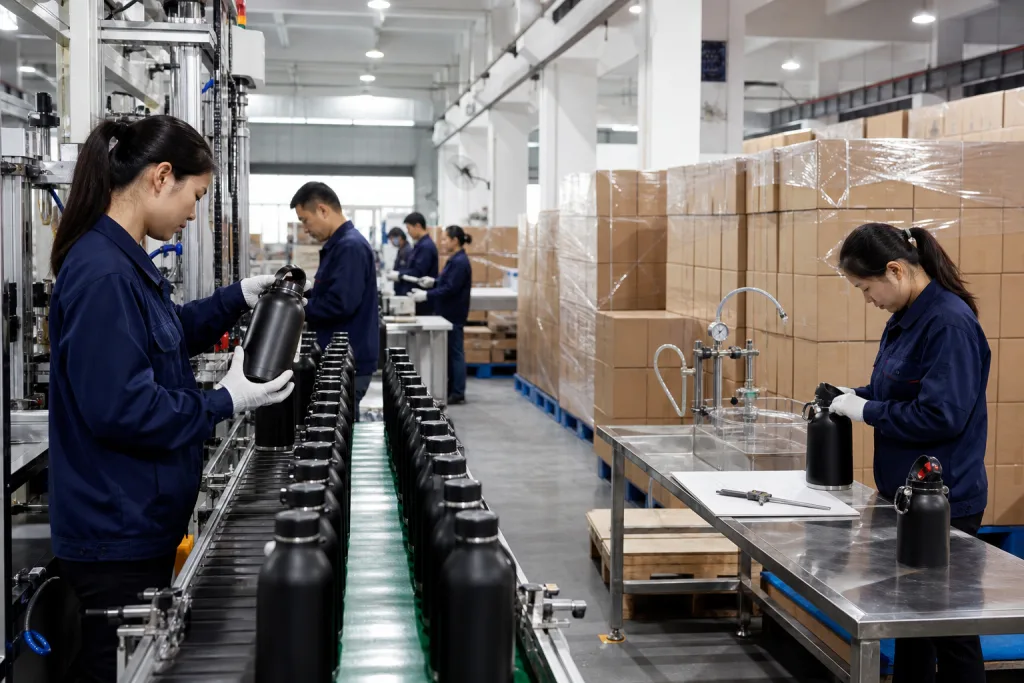
For a bulk growler bottle, the biggest cost driver is not the logo. It is the body construction. A single-wall stainless growler for cold fill stays cheap, but export buyers often spec double-wall vacuum insulation, 18/8 stainless steel, powder coating, and a leak-resistant cap. That changes material weight, TIG welding time, vacuum oven yield, and rework risk. We run this on the line every month, and QC usually sees the first trouble at the mouth weld, not at the printed logo.
A typical 64 oz double-wall growler uses 0.4-0.5 mm inner wall stainless and 0.5-0.6 mm outer wall stainless. If you push the wall thickness down to save USD 0.20, the bottle can dent in transit or feel cheap in the hand. Bad trade. For retail shelves or beer growler wholesale channels, the buyer will pick up the sample, tap the shoulder, and flag it before they even read the spec sheet.
The lid also matters. A simple screw cap may add USD 0.35-0.60. A handle lid with silicone sealing ring can add USD 0.70-1.20. Swing-top or pressure-style lids cost more and need tighter leak testing; our QC team usually runs inverted leak checks for 30 minutes before carton packing. For beer growler in bulk programs, buyers sometimes ask for carbonation tolerance. Be careful here: most standard vacuum growlers are not pressure vessels unless designed and tested for that use. We have seen this go sideways when a PO says “beer growler” but the approved sample is only for cold water.
Surface finish is the next driver. Brushed steel is usually the lowest cost. Powder coating adds USD 0.40-0.90 depending on color, coating thickness, and scratch testing. Full-color transfer, gradient spray, or retail gift box packaging can move a quote more than the bottle itself; one buyer once saved USD 0.18 on the body, then added USD 0.52 with a 4-color box and foam insert. When comparing drinkware wholesale quotes from China, ask every supplier to break out bottle, lid, logo, inner packing, master carton, and test cost separately.
MOQ tiers that make sense
MOQ is where 7 out of 10 new buyers lose a week. Ask for 300 pcs with a matched Pantone powder coat, private lid, printed inner carton, and logos on both sides, and most Zhejiang factories will either pass or quote a unit price nobody can sell. The line has a changeover cost, the spray booth needs enough kg of powder to run clean, and the printing jig still has to be made even if QC only pulls 32 pcs for inspection.
For our Hangzhou-area supply chain, a workable MOQ for stock stainless growler bulk orders is 1,000 pcs per model, with 500 pcs per color if that color is already on the coating schedule. Tight, but possible. For custom powder coating, 1,000 pcs per color is the safer number because the booth cleaning and color-loss allowance start to make sense. For a new lid mold, shaped body, or special capacity, expect 3,000-5,000 pcs minimum and tooling fees from USD 800-3,500 depending on complexity; the buyer flagged a 2 mm lid mismatch on one trial mold last season, and fixing that was not free.
Here is how we usually see the numbers work after the PO, artwork, and carton marks stop changing:
- 500-999 pcs: sample order or distributor test run; higher unit cost, stock colors only, and the line will not wait 2 hours for a custom spray setup.
- 1,000-2,999 pcs: normal wholesale growler order with acceptable FOB pricing; one or two logo methods are fine if the artwork file is clean and the laser jig is approved.
- 3,000-9,999 pcs: better steel purchasing and stronger carton pricing; this range works for beer growler wholesale bulk programs where we can book 304 stainless coil and cartons in one batch.
- 10,000 pcs and above: dedicated production plan and cleaner freight planning; useful for national retail or drinkware bulk campaigns, especially when we can load full pallets instead of mixed loose cartons.
If you also source bulk canteen, wholesale canteen, or canteen wholesale items, combine forecasts before the first quote. We cannot always merge stainless growlers and canteen bulk models on the same line because neck diameter and welding fixtures differ, but shared coating colors or the same 5-layer export carton can cut setup waste. Do not ask for the lowest MOQ first. The better question is where the math starts to work.
FOB cost ranges by specification
FOB changes every week with 304 stainless coil, USD/RMB, and carton paper, so we quote a range, not a fantasy number. For a standard 64 oz stainless bulk growler bottle from China, a working FOB range is USD 4.80-6.20 for single-wall or basic double-wall construction, USD 6.20-8.20 for retail-grade double-wall vacuum with powder coating, and USD 8.20-9.50+ for a heavier body, premium lid, gift box, and multi-position branding. Last month QC pulled the sample after the lid torque test hit 1.8 N·m and the buyer still pushed for a lower target. The math did not work.
Smaller 32 oz units can drop by USD 0.80-1.50, but this is not a clean rule. The lid, coating setup, print plate, and carton stay on the line. On a 128 oz bottle, the cost can jump fast because the forming yield drops and the shipper box gets bigger by 20-30 mm in every direction. If you compare bulk drinkware only by liter size, you miss the real cost driver.
Logo method is where a lot of buyers save or waste money. One-color silkscreen usually lands at USD 0.08-0.18 per position. Laser engraving is often USD 0.15-0.35, depending on logo size and curved surface area. Heat transfer or full-wrap artwork can run USD 0.50-1.20 and needs abrasion checks before we release mass production. We usually tell buyers to pick the durable mark first, then decide whether the decoration is worth the extra setup. We ship enough rework orders to know this goes sideways fast.
Packaging can eat margin without warning. A plain white box may add USD 0.18-0.35. A color retail box can add USD 0.45-0.90. Molded pulp insert, barcode label, warning insert, FNSKU, and master carton upgrades add more. For e-commerce, the cheapest carton is the wrong choice. We saw a 5-layer box fail the 1.2 m drop test on a 12-bottle master carton, and the buyer flagged it after the first launch. One cracked neck costs more than the box upgrade.
Lead time from sample to vessel
A clean bulk growler bottle timeline has four stages: sample, artwork approval, mass production, and shipment. For standard materials, pre-production samples usually take 7-12 days after the logo file is confirmed, assuming the AI or PDF artwork is clean and the laser position is marked in mm. If you need a custom powder color, add 5-8 days for color plaque approval. If you need new tooling, add 20-35 days before the first usable sample; last season QC pulled one first-shot sample because the lid thread was 0.4 mm tight.
Mass production normally takes 35-55 days after deposit, final artwork, and sample sign-off. During peak export months before summer and Q4 retail, the same order may need 60 days. Zhejiang and other China drinkware factories can run large volume, but coating, vacuum testing, and packaging still take line time. No shortcut there. Our partner lines can handle about 450,000 stainless drinkware units per month across tumblers, bottles, and growlers, but capacity only helps buyers who release POs early; we once lost 6 days because the PO listed matte black while the approved sample card said PMS 426C powder coat.
A typical schedule looks like this:
- Day 1-3: confirm spec sheet, quote, PI, payment terms; check capacity, carton size, and whether the buyer needs 304 stainless called out on the PI.
- Day 4-15: sample production and courier transit; we run logo placement with a fixture, then pack the sample with a leak test note.
- Day 16-20: buyer testing, artwork correction, approval; this is where buyers often flag logo size or handle clearance.
- Day 21-65: material prep, forming, welding, vacuum, coating, logo, packing; vacuum failure, coating dust, and carton drop-test issues all get caught here.
- Day 66-70: final inspection and shipment booking; AQL 2.5 checks usually focus on leakage, dents, coating scratches, and barcode scans.
Sea freight to Europe or North America can add 25-45 days port to port. If your launch date is fixed, approving samples on the day production must start is the wrong question to ask; the math does not work. We ship smoother when the buyer leaves at least 12 days between sample approval and the factory’s material lock date, especially if the forwarder still needs the booking form, HS code check, and pallet plan.
Quality checks worth paying for
Quality control for wholesale drinkware is not a beauty check. For growlers, write the test points into the PO before we run the line: 100% leak test by inversion for 3 minutes, vacuum retention at 95°C with readings at 6 and 12 hours, coating adhesion by cross-hatch tape test, odor check after hot-water rinse, lid fit with a torque gauge, carton drop on 1 corner and 3 edges, plus barcode scan on the printed retail box. If those items are missing from the PO, the math doesn't work when 600 pcs arrive with slow lid seepage and the supplier says “within normal range.”
For stainless food-contact products, common documents include LFGB for Germany/EU food contact, REACH for restricted substances, FDA food-contact reference for the US market, and sometimes California Proposition 65 screening depending on your sales channel. If the product is sold as a beer growler bulk item, match the marketing copy to the tested use shown on the report. Do not print pressure-related claims unless the lid and body are built for pressure; we have seen buyers flag “keeps beer carbonated” on artwork when the sample was only tested as a normal 304 stainless vacuum bottle.
Final inspection is usually based on ANSI/ASQ Z1.4 sampling with AQL 2.5 for major defects and 4.0 for minor defects. For higher-risk retail orders, some buyers use AQL 1.5 major. Inspection cost in China is often USD 180-350 per man-day, depending on location and agency. Cheap insurance. One scratched powder-coated container can burn through that cost in the first 20 cartons, especially when QC pulled the sample under 800 lux light and found coating chips around the bottom weld line.
Ask for functional test photos, not only beauty shots. You want the boring evidence: water leak inversion on the bench, vacuum temperature retention sheet with start and end readings, coating cross-hatch result after 3M tape pull, lid torque check in N·m, master carton dimensions in cm, gross weight in kg, and pallet loading photos if the order ships by container. If you are buying beer tumbler wholesale bulk or alcohol flask wholesale bulk items in the same PO, inspect them as separate lines. Different products fail differently, and mixing the defect count is the wrong question to ask.
How to brief the factory
A tight sourcing brief saves about three email rounds, sometimes 2 working days in peak season. Start with capacity in ml or oz, body type, stainless grade, wall thickness target in mm, lid style, finish, logo method, packing, certification market, order quantity, and required delivery date. If you only write “quote wholesale growler” or “send price for drinkware wholesale,” the factory will guess, and the quote sheet will come back full of assumptions. We see it every week. Last month QC pulled a 64 oz sample where the PO said matte black, but the buyer’s reference photo was powder-coated dark grey.
Tell the supplier your sales channel. A brewery promotion order needs fast logo approval and carton marks for event distribution; an outdoor retail bottle needs better abrasion resistance on the coating; an Amazon FBA item needs FNSKU labeling, 80 cm drop-tested packaging, polybag warning language, and tighter cosmetic control; a corporate gift often needs cleaner lid packaging and gift-box corners that do not crush in transit. For distributor stock, master carton strength and mixed color packing may matter more. For alcohol flask bulk or alcohol flask in bulk programs, capacity marking and local alcohol-related rules may also apply. The buyer flagged this once: “1.9 L” was acceptable in their market, but “64 oz beer growler” on the retail box was not.
Use a simple RFQ table. One row for the base bulk growler bottle, one for optional premium lid, one for retail box, one for laser logo, one for silkscreen logo, and one for testing. Ask for FOB Ningbo or FOB Shanghai, not a vague delivered price. We are in Zhejiang, so FOB Ningbo is usually cleaner for stainless drinkware exports; some consolidated wholesale drinkware shipments still move better through Shanghai when the forwarder is combining 6 or 8 suppliers. On our side, the costing clerk checks carton CBM, gross weight, and pallet plan before the line gives a firm ship date.
Share your target price, but do not make the factory bury the real cost. If your target is USD 5.50 and the safe spec is USD 6.40, change the product; do not squeeze the weld quality. The math doesn't work. We can reduce the lid cost, simplify the coating, change from retail box to white box, or adjust MOQ from 1,000 pcs to 3,000 pcs, but a thin weld on a growler will come back as leakage complaints after filling. That applies to bulk canteen, beer tumbler bulk, wholesale canteen, and growler wholesale orders alike.
Where buyers usually lose money
The first leak is over-customization at low volume. A 1,000 pc order with custom body, custom lid, custom coating, custom box, and five-color artwork almost never hits a clean cost target. The math doesn't work. We run this on the line often: one buyer asked for a new shoulder shape, matte powder coating, and a kraft gift box, then pushed back when the mold fee and setup loss added about 18 days to the schedule. Start with a proven mold, then change the finish and logo. Move to a private mold after reorder data proves demand.
The second leak is ignoring freight cube. Growlers are bulky. A 64 oz unit in retail box may pack 12 pcs per master carton, with a carton size around 52 x 39 x 32 cm depending on the bottle. The unit FOB may look good, then ocean freight and warehouse handling eat the landed cost. Ask for carton dimensions before you approve the quote. We usually check this with a tape measure at packing table, because a 10 mm taller insert can change the master carton and cut pallet efficiency fast.
The third leak is late compliance. Testing after mass production can trap inventory if something fails. For EU and North American buyers, confirm food-contact material, coating, printing ink, and silicone ring compliance before deposit. BSCI or social audit status may also matter if you sell to large retailers. QC pulled a sample last season where the silicone ring passed the fit check, but the ink supplier document named the wrong coating code on the report. That one typo on the PO held shipment for 6 days.
The fourth leak is treating every related item as the same product. Beer tumbler in bulk, beer tumbler wholesale, alcohol flask wholesale, beer growler wholesale, and growler bulk orders use different tooling, sealing, and testing logic. Cost them separately. You can put them into one sourcing program, but a flask cap thread and a growler swing lid do not fail in the same way under pressure testing. We've seen this go sideways when a buyer used one target price sheet for 5 SKUs and only found the margin gap after AQL 2.5 inspection.
Send your growler spec for a real factory quote
Share capacity, quantity, finish, logo, market, and target date. We will return a practical FOB China quote with MOQ and timeline.
Frequently asked questions
What is the real MOQ for a custom bulk growler bottle?
For an existing mold, the practical MOQ is usually 1,000 pcs per model. If you want a custom powder color, plan for 1,000 pcs per color because coating lines need setup time and paint loss allowance. For private mold body shapes or new lid tooling, 3,000-5,000 pcs is more realistic, with tooling fees around USD 800-3,500. Small 300-500 pc runs can work for sampling or local event tests, but the FOB price may be 15-35% higher and color options will be limited. If you need both bulk growler and bulk canteen items, share color standards and artwork files to reduce setup friction.
How much should I budget for a 64 oz stainless growler wholesale order?
A sensible FOB China budget for a 64 oz stainless double-wall growler is USD 6.20-8.20 with powder coating and one logo. A basic single-wall or lighter construction may be USD 4.80-6.20, while a heavier retail-grade version with premium handle lid, color box, and multi-position logo can reach USD 8.20-9.50 or more. Add testing, inspection, inland trucking, ocean freight, duty, and warehouse handling to calculate landed cost. Do not compare quotes unless lid type, steel thickness, carton, logo method, and certification requirements are identical.
Can growlers be used for carbonated beer?
Some buyers assume every beer growler in bulk can hold carbonated beer under pressure. That is risky. Many stainless vacuum growlers are designed for temperature retention and leak resistance, not pressure storage. If you need beer growler wholesale products for filled beer, tell the factory the pressure requirement, filling method, cap type, and local compliance rules before sampling. The lid, thread, gasket, and body design may need specific testing. If the factory cannot provide pressure test data, avoid pressure-related claims on packaging. For brewery merchandise where customers fill and consume quickly, a standard leak-tested growler may be enough, but the use case must be clear.
What certifications should I request for Europe and North America?
For Europe, ask for LFGB food-contact testing and REACH screening for coatings, inks, plastic parts, and silicone rings. For North America, FDA food-contact material references are common, and California Proposition 65 screening may be needed depending on your channel. If you sell to large retailers, BSCI or similar social audit status may be requested. For children’s versions, requirements become stricter and may involve ASTM or CPSIA-related checks. For normal adult bulk drinkware, budget USD 300-900 per test set depending on materials and lab scope. Confirm the test plan before mass production, not after goods are packed.
How long before launch should I place the PO?
For stock mold growlers with normal logo and packaging, place the PO at least 90-110 days before your required warehouse date. That allows 7-12 days for sample, 35-55 days for production, 5 days for inspection and shipment booking, and 25-45 days for ocean freight to Europe or North America. If you need custom tooling, add 20-35 days. If your launch is tied to summer, Oktoberfest, or Q4 gifting, add another 10-15 days buffer because coating and packing capacity gets tight. Air freight can rescue samples, but it is usually too expensive for growler bulk shipments.