Key Takeaways
- For a 500 ml bulk glass water bottle, ask for 2.0-2.5 mm borosilicate wall thickness, not just “thick glass.”
- A silicone sleeve can add USD 0.35-0.80 per unit depending on height, Pantone color, and cutout design.
- Leak testing should cover 100% of assembled bottles, while final inspection can use AQL 2.5/4.0.
- For customized glass water bottle retail programs, packaging specs often affect damage rate more than the bottle itself.
A bulk glass water bottle looks simple on a shelf: clear body, clean cap, maybe a silicone sleeve and your logo. The risk starts after it leaves the shelf. We have seen a 500 ml bottle pass a quick visual check, then fail after one dishwasher cycle, leak inside a 3-layer e-commerce carton, or arrive with a sleeve color 2 Pantone shades off so the retail set looks cheap.
For wellness brands and sustainable retailers, the spec sheet protects the margin. If you source from China, especially through a borosilicate glass bottle factory in Zhejiang, define glass composition, wall thickness in mm, cap structure, decoration, packaging, and test standards before we make the first sample. Our Hangzhou team in Zhejiang typically handles MOQs from 1,000 units per SKU and production lead times of 25-35 days after artwork approval; QC pulled one sample last month because the PO said matte black lid, but the approved artwork file showed gloss black. Small typo. Big delay.
Start with glass material
The first line on your spec sheet should not read “glass bottle.” Write the glass type. For wellness retail, we usually quote borosilicate because it handles temperature change better than soda-lime glass. If you are buying a borosilicate glass bottle bulk order, ask the supplier to confirm high borosilicate glass with typical thermal shock resistance around 120°C. Ask for it in writing on the PI, not only in a WeChat message. That does not make the bottle unbreakable. It means the bottle is less likely to crack when a consumer pours warm tea into a room-temperature bottle, which is exactly where QC pulled failures in one 2,000 pc trial run last winter.
Most custom glass water bottle projects we quote use 300 ml, 450 ml, 500 ml, 550 ml, 650 ml, or 750 ml capacities. For a 500 ml bottle, a reasonable body wall thickness is usually 2.0-2.5 mm, measured at the straight body with a digital caliper, not at the thick base. Below 1.8 mm, you may save a few cents but increase breakage risk in shipping and consumer use. Bad math. Above 2.8 mm, the bottle becomes heavier, freight cost rises, and your buyer may complain that it feels less portable; we had one EU buyer flag a 342 g sample as “too heavy for gym use” before artwork approval.
Be careful with claims. “Eco-friendly” is not a material certificate. For Europe, ask your borosilicate glass bottle supplier for food-contact documentation aligned with LFGB or EU 1935/2004, plus REACH compliance for silicone and paint if used. For the U.S., ask about FDA food-contact expectations and California Proposition 65 if you sell there. A serious borosilicate glass bottle manufacturer in China should understand these requests, even if final responsibility for market compliance sits with the importer. We ship better when the PO says “clear high borosilicate, LFGB food contact, black silicone sleeve” instead of a loose line like “green glass bottle”; that one-word gap has caused wrong sample molds before.
Buyer impact: the material line controls durability, testing route, retail claims, and the price ceiling your distributor can defend.
Capacity, dimensions, and tolerance
Capacity is where avoidable arguments usually start. A buyer writes 500 ml on the PO. The factory quotes a 500 ml mold. Then QC pulls the sample and measures 480 ml to the shoulder or 520 ml brimful with a 1000 ml graduated cylinder. Both sides think they are right. Your spec sheet should say nominal capacity, practical fill volume, or brimful volume. For retail labeling, practical fill volume is the number shoppers actually use.
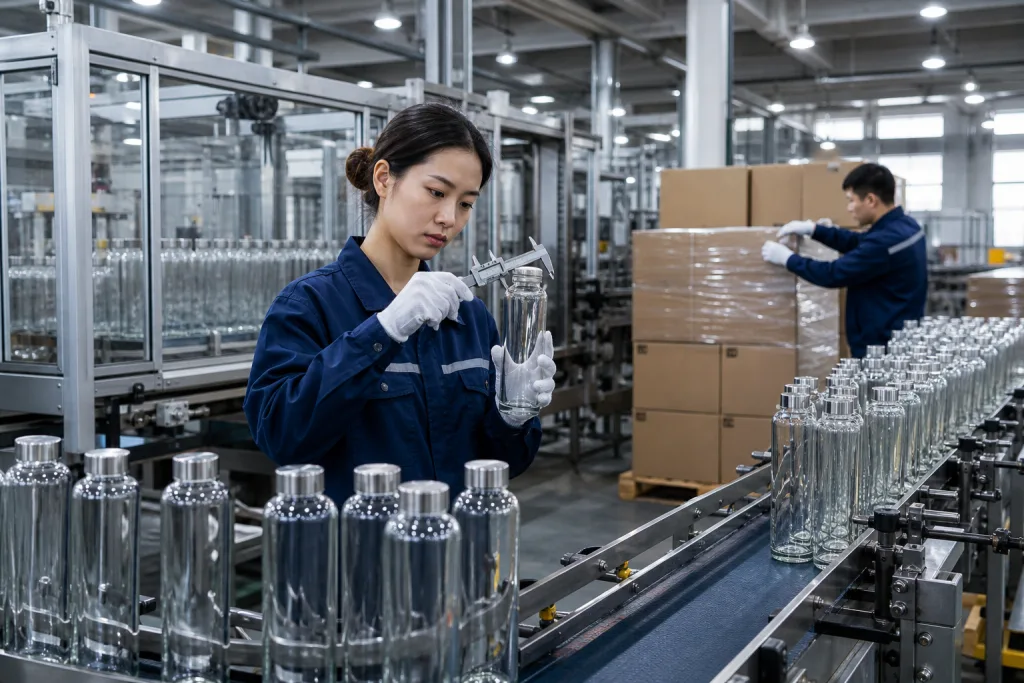
For a bulk glass water bottle, specify body diameter, total height, mouth opening, and weight tolerance. A common 500 ml borosilicate bottle runs about 65-70 mm in body diameter and 220-240 mm in height, depending on cap style. Five millimeters matters. We have seen subscription-box buyers reject cartons because the bottle plus insert tray sat 6 mm too high. If you sell online, weight hits postage tiers fast. A 500 ml glass bottle with silicone sleeve and bamboo-style cap usually lands around 300-420 g before packaging, so ask the factory to weigh 10 pcs and report the average, not one nice sample.
Ask your borosilicate glass bottle vendor for a technical drawing before tooling or sampling. The drawing should show thread dimensions, cap contact surface, gasket position, and sleeve groove if the design has one. If the bottle is borosilicate glass bottle customizable from an existing mold, cost and lead time are easier to control. If you need a new mold, budget roughly 20-35 days for tooling and first samples, plus tooling charges that can range from USD 800 to USD 2,500 depending on shape and complexity. One buyer once approved a drawing with a 54 mm mouth, then flagged the sample because their infuser needed 56 mm. The math doesn’t work after the mold is cut.
For wellness brands, hand feel is not decoration. A bottle that looks elegant but tips over easily will collect bad reviews. Check base diameter, center of gravity, and grip area with wet hands. We run this on the line with a filled bottle, a wet silicone sleeve, and a flat stainless worktable before we talk about mass production. This matters for yoga studios, spa retail, hotel wellness kits, and sustainable retailers selling to commuters.
Sleeve, cap, and sealing system
The bottle body gets the photo. The cap gets the complaint. On a custom borosilicate glass bottle, we ship stainless steel caps, PP caps, bamboo-covered caps, glass stoppers, sports lids, and tea infuser lids, and each one changes unit cost, leak risk, and the test list. Bamboo-looking caps sell well in sustainable retail, but on the line they are often a stainless steel or PP core with a bamboo outer shell. Say that plainly. If the buyer flagged it as “bamboo cap,” we correct the spec sheet before sampling, not after the first PO typo.
Write the sealing system in parts: cap material, inner liner, gasket material, gasket hardness, and thread type. For food-contact gaskets, silicone is the usual call. Ask for odor testing after hot water contact. We have seen cheap silicone smell rubbery the first time QC pulled the sample after a 90°C fill, and that is a bad surprise for retail. For leak performance, we run 100% water leak testing after assembly, not random checks only. This is the wrong question to ask if someone says, “Can we just spot test 10 cartons?” A carton of 48 bottles with two leaking units can kill the math on an online launch.
Sleeves need the same discipline. A silicone sleeve may cover 30%, 50%, or 80% of the body. The tall version protects better, costs more, and can hold water after washing if the grooves are deep. A cutout sleeve shows the fill level but adds mold complexity. For a borosilicate glass bottle customized with a Pantone silicone sleeve, expect a custom color MOQ of about 1,000-3,000 units per color depending on supplier. We check sleeve color under D65 light, not by saying “same as sample” and hoping for the best. That phrase has burned more than one buyer. Our press can hold the Pantone chip, but if the first shot comes in 1.5 mm off at the neck, the sleeve looks wrong at once.
If your product is sold as a promotional or corporate wellness item, the cap is where buyers read value. For a borosilicate glass bottle promotional order, a clean stainless cap and a one-color sleeve often beat an overdesigned lid that starts leaking after three months. We ship those with a 24-hour inverted leak check, and the bad lids show up fast. Fancy is fine. A leaky cap is not.
Decoration lines that survive use
A customized glass water bottle can carry branding by screen printing, heat transfer, decal, laser engraving on a metal cap, embossing on silicone, or paper insert packaging. The right choice starts with target shelf price and the wash label printed on the carton. For glass bodies, one-color screen printing is the line’s steady option. Clean result. Low scrap. Good for logos, ounce marks, and simple repeat patterns. On our 500 ml and 750 ml curved bottles, the operator checks the first 20 pcs against a Pantone card and a 0.2 mm registration mark; two-color logos can work, but the offset shows fast when the bottle diameter is not perfectly consistent.
For a borosilicate glass bottle custom project, ask how the print is cured and whether it passes an adhesion test. A cross-hatch tape test with 3M 600 tape tells more than a supplier promise. If the bottle will be sold as dishwasher safe, ask for dishwasher cycle testing, not just ink adhesion at room temperature. We have seen this go sideways: the buyer approved a bright white logo, then QC pulled the sample after 30 wash cycles because the heat dry step made the edge look grey. Around 70% of printed glass bottles we ship are still marked hand-wash recommended because strong detergent and heat drying can fade decoration.
Laser engraving is usually for stainless steel caps, not the glass body. It looks cleaner and avoids ink migration questions from retail QA teams. Silicone sleeve embossing or debossing lasts well, but the artwork must be bold. Fine text below 1.0 mm line width can fill in or look weak after molding; our mold room checks this with a digital caliper before cutting steel. If you are building a customizable glass water bottle line with 6 or 8 brand partners, keep the bottle and sleeve standard, then change the cap engraving or retail carton. The MOQ math works better.
Pricing varies by order size and artwork, but as a working guide, one-color logo printing may add USD 0.05-0.15 per unit, cap laser engraving around USD 0.08-0.20, and a custom molded silicone sleeve costs far more because of tooling. A borosilicate glass bottle wholesale quote that looks cheap often excludes decoration setup, Pantone matching, and pre-production samples. We once had a PO typo list “print included” while the buyer’s RFQ meant “print quoted separately”; that mistake cost 12 days before the deposit even arrived. Ask for FOB China pricing with each decoration line item separated.
Packaging for retail and e-commerce
Glass bottle packaging is part of the build, not a last-minute add-on. On our line, we check the print proof against the dieline before we cut the first kraft sheet. A store program for a distributor glass water bottle usually ships with a printed kraft box and a paper insert. An e-commerce order needs stronger drop protection, so we build with molded pulp, corrugated dividers, or an inner box with an outer master carton. If you sell on marketplaces, the carton also needs barcode placement, FNSKU labeling, and marks that match the inbound plan.
For a 500 ml bulk borosilicate glass bottle, a master carton often holds 24 or 48 units, depending on the bottle shape and the board spec. Heavier cartons cut unit handling cost, but warehouse teams drop and drag them, and that is where the breakage starts. We keep gross carton weight under 15 kg for glass drinkware when we can. QC pulled the sample and ran a simple drop check before packing the pilot lot. Ask your borosilicate glass bottle suppliers for a carton drop test plan. ISTA 1A is a solid reference for packaged products under 68 kg, but the test should match the channel.
Retail packaging also carries your sustainability claim. A lot of wellness buyers ask for plastic-free packaging, and the request is fair, but stripping out protection is the wrong question. A cracked bottle is not a green win. We run recyclable paper sleeves, molded pulp trays, soy-ink cartons, and water-based coatings for China production. If your retailer wants FSC paper, put it in the RFQ from day one because it changes the paper source and the paperwork. The buyer flagged a PO typo on the paper grade once, and it cost us two days.
For Amazon-style fulfillment or North American 3PL delivery, ask for scannable labels on at least two carton sides, country of origin marking, and carton sizes that stay consistent. One borosilicate glass bottle distributor program fell apart because receiving waited three extra days on mismatched labels. We ship plenty of these cartons, and the line knows the pain of a label placed 20 mm too low. Packaging discipline looks dull until it protects the launch date.
Inspection, compliance, and documents
Your quality plan should list the test method, sample size, and pass/fail line. For glass bottles, split factory process control from final third-party inspection. On the line, we run checks for glass clarity, bubbles, cracks, mouth ovality, cap fit, gasket placement, print position, and leak performance; a 0.5 mm mouth deformation is enough to cause returns on some screw caps. At final inspection, use AQL 2.5 for major defects and AQL 4.0 for minor defects unless your retailer sets a tighter level.
Define major defects in plain language. Leaking cap, sharp edge, visible crack, unstable base, wrong logo color, missing gasket, incorrect capacity, or foreign matter inside the bottle should be listed as major. Minor defects can include small acceptable bubbles, sleeve flash under a set length such as 1 mm, or light carton scuffing that does not affect barcode reading. No defect list? The inspector will guess, and we have seen this go sideways when the buyer flagged “wrong green” after QC had already released the shipment.
Compliance documents depend on the selling market. For Europe, request the glass food-contact declaration, silicone LFGB or relevant EU food-contact test reports, REACH statements for restricted substances, and packaging material declarations if your importer asks for them. For the U.S., ask for FDA-related food-contact information, Proposition 65 assessment if selling into California, and CPSIA only if the item is clearly for children. A kids bottle is a different file than an adult wellness bottle; last month QC pulled a sample with a cartoon sleeve, and the buyer had to switch the compliance route before mass packing.
Factory audits matter if you sell to chains. BSCI, Sedex, ISO 9001, or retailer-specific audits can apply, but not every borosilicate glass bottle manufacturer keeps all audit reports current. Be honest about your channel during the first RFQ. We run into this often in Zhejiang: a specialized glass plant can quote better on a 3,000 pcs MOQ, while an export partner may control testing, inspection, carton marks, and shipment files better. The cheapest quote is not always the cheapest shipment.
MOQ, pricing, and order planning
For a standard bulk glass water bottle using an existing mold, we usually quote MOQ at 1,000 units per design. Custom sleeve color, custom cap finish, or full retail packaging often pushes the workable MOQ to 2,000-3,000 units because the silicone sleeve shop and box printer each have their own minimum run. QC pulled a sleeve sample last month that was 1.2 mm short on height, and fixing it only made sense because the buyer had 2,400 units on the PO. If you need a fully customized borosilicate glass bottle shape, new mold cost, trial loss, and annealing risk make 5,000 units the cleaner starting point.
FOB unit pricing for a 500 ml borosilicate bottle can vary from about USD 1.40 to USD 3.80 depending on glass weight, cap, sleeve, decoration, packaging, and inspection requirements. A simple bottle with PP cap and one-color print sits at the low end. A borosilicate glass bottle customized with a tall Pantone silicone sleeve, stainless bamboo-style cap, printed retail box, and drop-tested pulp insert sits higher. Cheap quotes need checking. If a quote is 20% below the other 3 offers on your sheet, ask whether it excludes inner boxes, testing, export cartons, or logo setup; we have seen buyers flag this after the proforma because “white box” was typed as “bulk pack” on the PO.
Lead time should be planned backward from your shelf date. A practical timeline is 5-10 days for quotation and sample confirmation, 7-15 days for pre-production samples if decoration is involved, 25-35 days for mass production after approval, and 7-35 days for freight depending on air, rail, or sea. Our Hangzhou export team in Zhejiang can coordinate around 300,000 drinkware units per month across stainless steel, glass, and plastic lines, but glass schedules still depend on furnace capacity and decoration queues. The line does not care about your launch calendar; if the decal kiln is booked for 6 days, a late artwork file turns 35 days into 42 days fast.
If you are a borosilicate glass bottle distributor or one of several borosilicate glass bottle distributors building a seasonal range, do not split 1,000 units into 6 colors on the first order. Start with two core colors, prove sell-through, then add seasonal sleeves or cap finishes. We ship mixed cartons when the math works, but 167 pcs per color creates carton marking mistakes and leaves your warehouse with slow SKUs. For wellness brands, inventory discipline beats a beautiful catalog that ties up cash in bottles nobody reorders.
Send your glass bottle spec sheet for review
We will check capacity, sleeve, cap, packaging, MOQ, FOB pricing, and compliance gaps before you approve samples.
Frequently asked questions
What MOQ should I expect for a custom glass water bottle?
For an existing 500 ml or 750 ml mold, 1,000 units per SKU is a normal starting MOQ in China. If you need a custom Pantone silicone sleeve, printed retail box, or special cap finish, the practical MOQ often becomes 2,000-3,000 units because sleeve, carton, and cap suppliers each have minimum runs. A new bottle shape with private tooling is usually more sensible at 5,000 units or above. Smaller trial orders are sometimes possible, but the unit price may rise by 15-35% and decoration options become limited.
Is borosilicate glass always better than soda-lime glass?
For drink bottles, borosilicate is usually better because it handles temperature change and daily use more reliably. A borosilicate glass bottle bulk order is a good fit for wellness retail, tea infusion, office hydration, and premium gifting. Soda-lime glass can be cheaper and works for some cold-fill uses, but it is less forgiving with sudden temperature changes. You still need clear usage instructions. Even borosilicate glass should not be marketed as unbreakable, and caps, sleeves, and packaging often determine real customer satisfaction as much as the glass itself.
Can a borosilicate glass bottle be dishwasher safe?
The glass body can usually tolerate dishwasher conditions, but the full product may not. Printing, bamboo-covered caps, silicone sleeves, adhesives, and gaskets all need separate review. If you want to claim dishwasher safe, ask for testing through repeated wash cycles, such as 20 or 50 cycles, and check print adhesion, cap deformation, odor, and sleeve fit afterward. Many customized borosilicate glass bottle programs use “hand wash recommended” to protect decoration quality. That wording is less exciting for marketing, but it reduces complaints if your logo is printed on the glass.
How do I compare quotes from borosilicate glass bottle vendors?
Put every vendor on the same spec sheet: capacity measured to practical fill line, glass wall thickness, cap material, gasket material, sleeve height, logo method, box type, carton quantity, test requirements, Incoterm, and lead time. Then ask for FOB China pricing with line items for decoration, packaging, and tooling. Borosilicate glass bottle vendors may quote differently; one may include retail box and leak testing, while another quotes only the bare bottle. A 10-cent saving is not real if your breakage rate rises from under 1% to 4%.
What should sustainable retailers check before approving production?
Approve three things before mass production: a signed physical pre-production sample, a packaging drop test result, and a document checklist. For Europe, include food-contact documentation, REACH statements for sleeve and coatings, and carton material declarations if your retailer asks. For North America, check FDA-related food-contact information and Proposition 65 risk if selling in California. Also confirm country of origin marking, barcode quality, and carton labels. Sustainable retailers should not remove protective packaging without testing; one broken glass bottle wastes more carbon, freight, and customer trust than a well-designed paper insert.