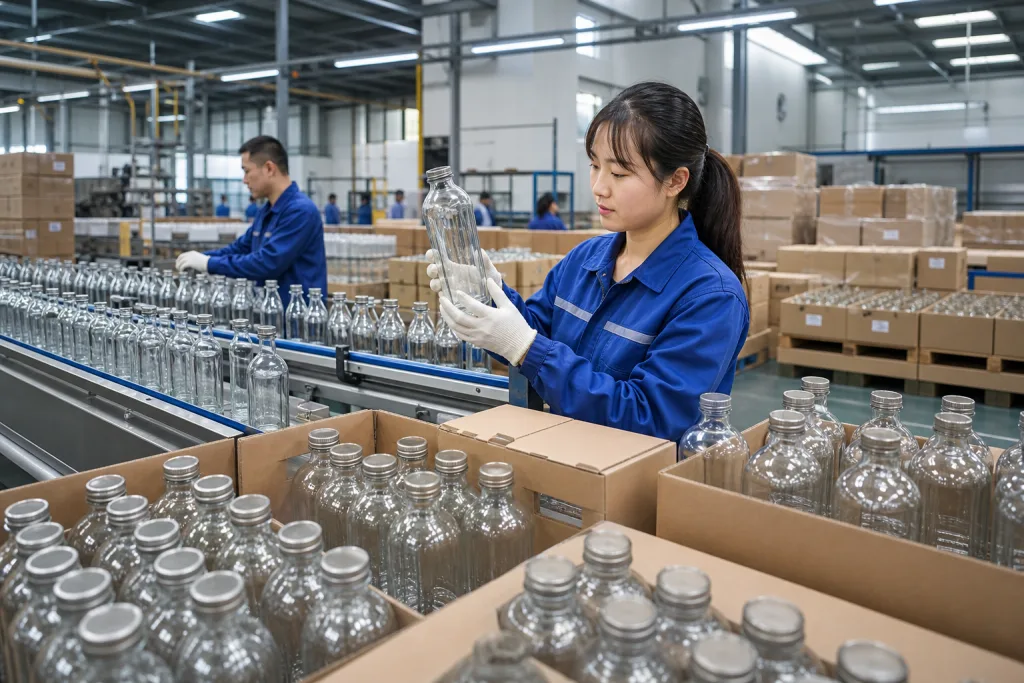
Key Takeaways
- A 500 ml bulk glass bottle should define glass weight, wall thickness, cap type, decoration area, and carton drop-test requirement before quoting
- For custom color printing, a realistic MOQ is 3,000-5,000 pcs per SKU, with 30-45 days production after sample approval
- Use AQL 2.5 for major defects and AQL 4.0 for minor defects on drinkware bulk inspections
- FOB Ningbo or Shanghai is usually cleaner than EXW when you need export cartons, pallet specs, and forwarder coordination
You do not buy a bulk glass bottle order by asking for “a nice 500 ml bottle” and waiting for quotes. That is the wrong question to ask. Last month we checked 5 supplier quotes for the same 500 ml drawing: glass weight ranged from 285 g to 360 g, cap lining was not the same, cartons changed from 24 pcs to 12 pcs, and one price excluded printing screens. The cheapest quote usually hides the missing line items.
Take a real case: a European beverage brand needed 18,000 printed glass bottles for a spring launch, with room to add a bulk growler and wholesale canteen line later. From our factory side in Zhejiang, China, we freeze the spec before price talks get serious: bottle weight, mouth finish in mm, cap type, print color, carton strength, test standard, and freight term. QC pulled the sample first. The buyer had typed “matte black cap” on the PO, while the approved sample used glossy black, and that small mismatch would have stopped the line for 2 days.
Start With The Actual Order
Assume you are sourcing 18,000 units of a 500 ml clear glass bottle with a bamboo-style screw cap, one-color logo, kraft retail box, and 12 pcs per master carton. You sell through specialty retail and online bundles, so the box needs to pass shelf display and courier handling, not pretend to be a luxury gift set. We would check the carton spec first: 5-layer K=A corrugated, drop test at 76 cm, and a barcode position that does not land on the box seam.
This is a normal bulk glass bottle project for China export, not a quick stock bottle grab. The same buyer might later add a bulk canteen, beer tumbler bulk item, or beer growler wholesale bulk program, but the first order has to prove the supplier can run print, packing, inspection, and booking without drama. At BottleForge Industrial in Hangzhou, Zhejiang, our practical planning point for decorated glass drinkware is 3,000-5,000 pcs per SKU, with monthly output around 320,000 finished drinkware units across stainless steel, glass, and plastic lines. QC pulled the sample last week for a similar order because the bamboo-color cap was 1.5 mm higher than the approved sample. Small miss. Big argument.
Your first decision is whether the bottle uses an existing mold. Existing molds reduce tooling risk and usually keep lead time at 30-45 days after pre-production sample approval. A private mold makes sense if you need a proprietary shoulder, embossed logo, or exact retail silhouette, but tooling can add USD 1,200-4,500 and 20-30 days before mass production starts. Ask this early. We have seen this go sideways when the buyer approved artwork first, then found the bottle diameter was 2 mm too wide for their Amazon insert tray.
For the quote, do not send only capacity and logo file. Send a short RFQ sheet with capacity, bottle height, diameter limit, cap material, target unit price, market, test requirement, packaging, Incoterm, and expected order date. Good suppliers in Zhejiang and elsewhere in China will answer faster because they are not guessing your hidden requirements. The wrong question is “what is your best price”; the better one is “can you run 18,000 pcs, one-color print, kraft box, 12 pcs per carton, with FDA or LFGB test, and ship before week 38?” Also check the PO carefully. We once had a buyer type 50 ml instead of 500 ml, and the merchandiser caught it only because the carton quantity looked impossible.
Freeze The Bottle Specification
Glass pricing follows grams as much as milliliters. A 500 ml bottle at 260 g is not the same product as a 500 ml bottle at 330 g. Heavier glass has a better hand feel and survives carton drops better, but it pushes up unit cost and CBM freight weight. For retail drinkware wholesale, we usually see 7 out of 10 buyers land around 280-340 g for a 500 ml bottle, depending on shape and cap. On the line, QC checks sample weight with a 0.1 g digital scale before we confirm the mold spec.
Put these details in writing: nominal capacity, brimful capacity, glass weight tolerance, wall thickness range, mouth inner diameter, cap thread standard, silicone gasket grade, and dishwasher claim. Do not accept “standard mouth” on a PI. We had one PO where the buyer wrote 55 mm outside diameter but forgot the 48 mm inner mouth requirement, and the tea infuser no longer fit. If the product will touch food or beverage, request LFGB or FDA food-contact material declarations, and for Europe check REACH expectations on coatings, inks, silicone, and any metal parts.
Decoration needs the same discipline. One-color silk screen on glass is economical, usually about USD 0.08-0.18 per location depending on print size and curing process. Decal printing costs more because it carries richer artwork and needs extra firing control. Laser engraving works on some coated surfaces; plain clear glass does not give the clean white mark new buyers often expect. We run a 3M tape test after curing, and if ink lifts at the shoulder radius, the buyer will flag it. If you are comparing wholesale drinkware quotes, decoration method differences can move the price by 8-20%.
Caps cause expensive surprises. Bamboo-look caps may be real bamboo over stainless steel, PP with wood texture, or stainless steel with bamboo veneer. They look similar in a product photo but age differently after 30 dishwasher cycles or two weeks in a damp warehouse. For canteen wholesale or wholesale canteen lines, PP caps may pass the price target. For a premium glass bottle, specify 304 stainless steel contact surfaces and food-grade silicone gasket if that is what your customer expects. Otherwise the math doesn’t work when returns start.
Price The Whole Landed Cost
A fair FOB China quote for a standard decorated 500 ml bulk glass bottle usually lands around USD 1.10-2.40, and the spread comes from glass weight, cap, print, box, and order quantity. A plain stock bottle in a white carton is a different job from a custom printed bottle with retail-ready packaging. We have seen a buyer chase USD 0.72, then the sample arrived at 310 g instead of the agreed 390 g and the cap liner failed torque testing. That is the wrong number to chase.
Split the quote into bottle, cap, decoration, inner packaging, master carton, pallet if needed, testing, and inland freight to port. For FOB Ningbo or FOB Shanghai, the supplier should handle export customs and delivery to the terminal. EXW looks lower on paper, but your forwarder then owns local pickup, paperwork, and factory follow-up, and that gets messy fast. For a first China order, FOB is the cleaner call. Ask for the breakdown line by line, even the carton tape spec and the 5 kg drop test result.
Freight changes the math more with glass than with stainless steel. A 40HQ container may hold about 45,000-65,000 pieces of 500 ml glass bottles, depending on carton size and pack-out. If you order 18,000 pcs, you are usually in LCL territory or you need to combine with other drinkware bulk items such as a bulk growler, beer tumbler wholesale project, or alcohol flask bulk order. We run mixed loads only when the cartons pass compression, and QC pulled a sample from the bottom tier after one buyer flagged crushed corners on arrival. If the carton spec is weak, the savings disappear in one shipment.
Payment terms should match risk. For a first order, 30% deposit and 70% balance before shipment is common. If you want inspection before balance payment, put that in the purchase order, not in a WeChat message. State whether the price includes retail barcode labels, FNSKU labels for marketplace fulfillment, or only neutral cartons. A small label change can still hold the line for 3 days if the PO typo goes into print and the warehouse starts labeling the wrong SKU.
Approve Samples Before Production
The golden sample is not a souvenir. It is the production reference sitting on the QC desk. For your 18,000 pc order, ask for at least three samples: one sealed on your side, one signed and kept by the factory QC team, and one reserved for the inspection company if you book SGS, BV, or another third party. Each sample should match the final bottle and cap assembly, including gasket material, logo size, logo position, retail box artwork, and carton marking format. We normally write the approval date on masking tape across the sample box; a missing “front logo 38 mm” note has caused more trouble than a late ship date.
Sampling normally takes 7-12 days for stock glass with custom printing, or 25-40 days if a new mold is involved. Before approving, check fill volume with a measuring cylinder, cap fit after 30 open-close cycles, logo adhesion, gasket or cap liner smell, and whether the bottle sits flat on a granite inspection plate. Small wobble matters. A rocking base seems minor in a sample room but becomes a customer complaint when 2% of units wobble on a table, and we have seen QC pull 47 pcs from one trial lot for this exact issue.
For alcohol-related lines, terminology matters. An alcohol flask wholesale product is usually stainless steel or glass pocket format, while a beer growler bulk project may be 1 L, 1.5 L, or 2 L with a swing top or screw cap. If you are planning beer growler in bulk or beer growler wholesale after the glass bottle order, test carbonation assumptions carefully with the actual closure and gasket, not a similar cap from the sample shelf. Not every decorative glass container is pressure-rated for carbonated beer. The wrong question is “does it look like a growler?” The better question is “what pressure did this mold pass, and where is the test record?”
Write sample approval in measurable language. Do not say “logo looks good.” Say “Pantone 3435 C, 38 mm wide, centered 72 mm below mouth, adhesion passes 3M tape test after 24 hours.” This is boring, but it prevents argument when mass production starts. We run the first-line check against that sentence, not against someone’s memory of a WeChat photo.
Build QC Into The PO
Your purchase order should spell out the inspection standard, not only quantity and price. For bulk glass bottle orders, we usually write AQL 2.5 for major defects and AQL 4.0 for minor defects, unless the buyer’s corporate manual is stricter. Critical defects stay zero tolerance: broken glass, sharp edges, contamination inside the bottle, missing gasket, or unsafe packaging. Put it on the PO. Last quarter QC pulled 8 bottles from a 315-piece sample lot and found glass dust inside 2 pieces after the rinse station, so the wording matters when we argue rework before shipment.
Major defects usually mean leakage, wrong logo color, severe print scratch, cap thread failure, cracked mouth, incorrect capacity, or retail box mismatch. Minor defects cover small bubbles within agreed limits, slight print dust, carton scuffing, or tiny cosmetic marks that do not affect use. Glass will have some bubbles and flow lines; the wrong question is “can you make it perfect?” A better PO says bubbles under 1.5 mm are acceptable, no more than 3 visible bubbles on the front face, checked at 50 cm under normal light.
Use three checkpoints, but define what happens at each one. First, incoming material inspection checks glass blanks, caps, gaskets, and boxes before decoration; we run calipers on mouth diameter and a go/no-go thread gauge on caps. Second, during-production inspection at around 20-30% completion catches logo and assembly problems before the line packs 40 cartons with the same mistake. Third, final random inspection checks packed goods against AQL before balance payment. If the order ships to North America or Europe, add carton drop testing such as ISTA 1A-style handling for parcel or retail distribution; a 12 kg master carton that survives the warehouse can still fail after courier handling.
For wholesale growler, growler bulk, beer growler wholesale bulk, or beer tumbler in bulk programs, set QC by product risk. A glass growler needs cap sealing and pressure-related caution, so we check gasket fit and do an inverted leak test after filling to the marked line. A beer tumbler wholesale bulk item needs coating adhesion, rim smoothness, and dishwasher-cycle claims if those claims appear on the sales page. The QC plan should follow the failure mode, not a generic checklist copied from another product. We’ve seen this go sideways when a PO said “standard inspection only” and the buyer flagged rough rims after 18 days at destination.
Packaging Is Not Decoration
8 out of 10 first-time buyers spend two weeks moving the logo 1 mm left and two minutes approving the carton. That is backwards for glass. Packaging protects your margin. A nice bottle that lands with 6% breakage is a bad buy, and QC pulled one sample last month where the bottle passed visual inspection but the inner box split at the glued seam.
For a 500 ml bulk glass bottle, we run one bottle per kraft box or bubble sleeve, then 12 or 24 pcs per five-layer master carton, with dividers when the bottle shoulder or cap area might touch during vibration. Carton material should be written on the PO, not guessed: five-layer corrugated board, 170 g outer liner, and edge crush strength matched to pallet stacking height. If you ship LCL, ask for stronger cartons because mixed cargo may be moved 6 to 9 times before final unloading; a full container usually sees fewer hands on the line.
Retail packaging affects scanning speed and warehouse labor. If you sell through online channels, fix the FNSKU or barcode position on the dieline, with a 3 mm quiet zone so the scanner reads it on the first pass. If you ship to distributors, carton side marks should show item number, quantity, gross weight, net weight, carton size, country of origin, and handling symbols, each placed where a forklift driver can see them after pallet wrapping. “Made in China” marking must be correct for customs and retail compliance; we once saw a PO typo that said “Made in Chian,” and the buyer flagged it after cartons were already printed.
This is where the best wholesale drink bottle suppliers separate themselves from trading-only quote collectors. A practical factory will ask how you sell: pallet to distributor, parcel to consumer, club retail, or gift set, because the answer changes carton strength and inner protection, and sometimes it should change the bottle shape. Small detail, big cost. At BottleForge in Zhejiang, we reject packaging plans that look good in a PDF but fail a 76 cm drop test on the second corner; we’ve seen this go sideways, and the math does not work once replacement glass, air freight, and customer claims start piling up.
Place The Order Without Guesswork
After samples, price, QC, and packaging are approved, send a PO that works like a control document. List SKU, quantity, unit price, Incoterm, port, payment terms, production lead time, approved sample date, artwork file version, packaging drawing version, inspection standard, and required shipping window. We also ask buyers to add carton size in mm and gross weight in kg if the packing was already confirmed, because the warehouse team will check it against the booking sheet. Need a partial shipment? Put it on the PO before the line is planned.
A realistic timeline for this order is straightforward: 3-5 days for final RFQ alignment, 7-12 days for printed samples, 2-4 days for buyer approval, 30-45 days for mass production, 2-5 days for final inspection and booking coordination. Ocean transit then depends on destination. China to West Coast North America may be around 14-22 days on water; China to major European ports often runs 28-40 days, excluding congestion. Last month, QC pulled the sample because the buyer approved “matte black lid” by email, but the PO still said “glossy black lid.” That one word cost 2 days.
If you plan to expand into canteen bulk, alcohol flask in bulk, wholesale growler, beer tumbler wholesale, or wider bulk drinkware after the first order, keep the same discipline. Create a spec sheet for each product family and reuse your QC language. We run separate records for glass thickness, mouth diameter, lid fit, print position, carton drop test, and AQL 2.5 result, because mixing standards between product families is where we’ve seen this go sideways. Future quotes move faster when the buyer is not rebuilding the same file from scratch.
The main point is not to make sourcing complicated. The job is to remove silent assumptions before money moves. A clear bulk glass bottle order lets the factory build correctly, lets your inspector judge fairly, and lets your finance team explain landed cost without apologizing later. If the PO, sample tag, and packing drawing do not match, the math doesn't work.
Send Your Bulk Glass Bottle Spec For Review
Share capacity, cap, logo, packaging, and target market. We will flag cost and QC risks before you place the order.
Frequently asked questions
What MOQ should I expect for a custom bulk glass bottle order?
For an existing mold with one-color printing, expect 3,000-5,000 pcs per SKU as a practical MOQ in China. If you need custom glass color, private mold, special cap tooling, or a full retail gift box, MOQ may move to 10,000 pcs or more. Some suppliers can sell 500-1,000 stock pieces, but the unit price and decoration cost are usually poor. For first orders, we often suggest 5,000-18,000 pcs because it gives enough quantity for stable printing, reasonable carton purchasing, and better FOB pricing without forcing a full container.
How do I compare quotes for drinkware wholesale when specs differ?
Normalize the quote line by line. Ask each supplier to state glass weight, cap material, gasket material, decoration method, packaging type, carton quantity, Incoterm, lead time, and testing included. A USD 1.20 bottle with 280 g glass and neutral box is not cheaper than a USD 1.55 bottle with 330 g glass, bamboo-stainless cap, printed retail box, and AQL inspection. For drinkware bulk buying, you should compare landed cost and defect risk, not only FOB unit price.
Can one supplier handle glass bottles, bulk canteen, and growler bulk programs?
Yes, if the supplier has mixed-material sourcing and assembly control, but you should still treat each category separately. A bulk glass bottle needs glass inspection, cap sealing, and breakage-resistant packaging. A wholesale canteen may require stainless steel grade checks, coating adhesion, and vacuum performance if insulated. A wholesale growler may need sealing tests and stronger carton dividers. You can consolidate shipments from Zhejiang or other China production areas, but do not use one generic QC checklist for all products.
What tests are important for beer growler wholesale or alcohol flask wholesale bulk?
For beer growler wholesale, confirm intended use first. If the growler is for carbonated beer, ask whether it is pressure-rated and request suitable sealing tests. Many decorative glass containers are not designed for pressure. For alcohol flask wholesale bulk, check food-contact compliance, leakage after 24 hours, cap thread durability, odor, and surface finish. For Europe, REACH and LFGB-related documentation may be requested. For North America, FDA food-contact declarations and Prop 65 review may be relevant depending on materials and coatings.
Should I buy FOB China or ask for door delivery?
FOB Ningbo or FOB Shanghai is a good default for experienced importers because the supplier handles export clearance and delivery to port, while your forwarder controls ocean freight and destination charges. Door delivery can be convenient for smaller orders, but make sure duties, taxes, customs brokerage, insurance, and delivery appointment fees are clearly included. For glass, also confirm who is responsible if cartons are damaged during LCL handling. For a first 18,000 pc bulk glass bottle order, FOB plus your own forwarder is usually the cleaner structure.