Key Takeaways
- A 3,000-piece bulk fruit infuser bottle order usually lands at USD 1.45-3.20 FOB China depending on material, lid, logo, and packaging
- Normal MOQ starts at 1,000 pieces for stock color with logo, 3,000-5,000 pieces for custom color, and 10,000 pieces for custom mold work
- Sampling takes 7-12 days for stock bottles and 18-30 days for new tooling or color matching
- Plan 35-55 days production after sample approval, plus 25-40 days ocean freight to Europe or North America
A bulk fruit infuser bottle looks simple until the quote sheet hits the desk. The infuser tube length, lid silicone ring, Tritan or PETG grade, logo method, 5-layer export carton, and AQL 2.5 inspection all move the landed cost. We had one buyer flag a USD 0.04 lid upgrade, then lose USD 0.11 per unit after carton crushing showed up in a drop test. For wellness brands and hydration startups, asking for the lowest unit price first is the wrong question to ask. Fix the bottle structure and order plan first.
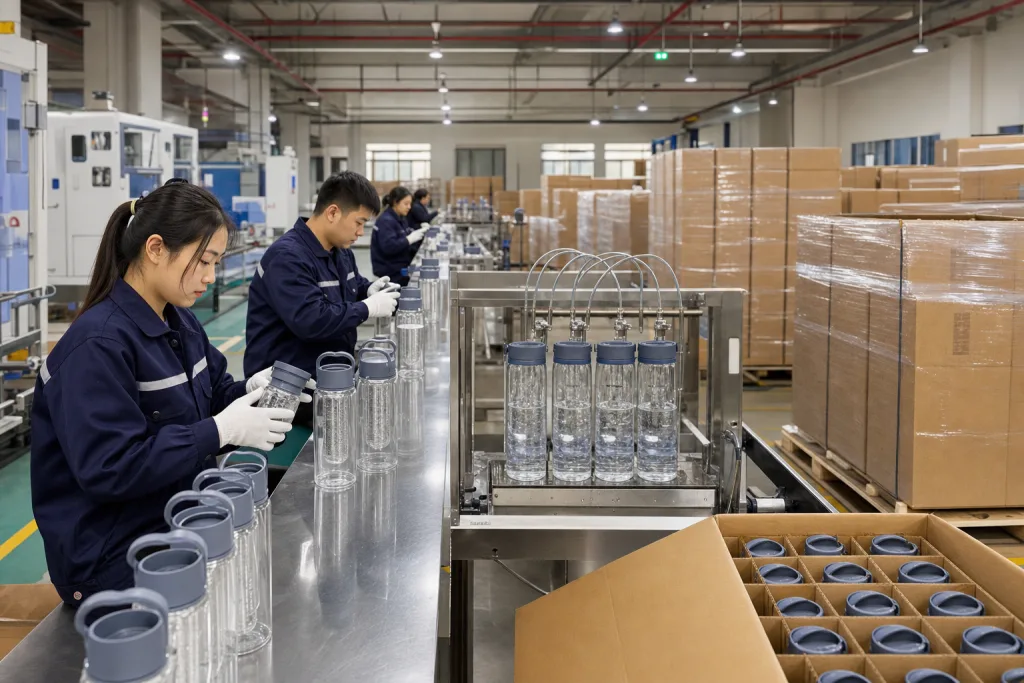
From our factory network in Zhejiang, China, a realistic custom infuser bottle project usually runs 35-55 days after artwork approval, not counting ocean freight. On the line, that means mold trial, logo sample, leak test at 100% water fill, carton test, then final QC before loading. If you need fruit infuser bottle bulk supply for a launch, retail program, or distributor test order, the money usually goes into material grade, packaging, and rework time, not the plastic body alone. We’ve seen this go sideways when a PO says “clear bottle” but the approved sample is smoke grey.
Start With The Bottle Structure
Before you compare quotations for a bulk infuser bottle, freeze the physical spec. “Factory infuser bottle” is too loose. On our quoting desk it can mean a Tritan plastic body with a removable fruit basket, borosilicate glass with a stainless tea strainer, a stainless steel bottle with an internal infuser, or a lower-cost PETG promotional bottle. Those 4 versions fall into different mold, packing, and compliance costs. Last month QC pulled 2 samples from the same buyer brief: one was Tritan, one was PETG. Same photo. Different price.
For wellness brands, the common custom fruit infuser bottle is a 650 ml to 800 ml Tritan body with a screw lid, silicone gasket, carrying loop, and removable PP or Tritan infuser tube. Wall thickness is usually 1.8-2.5 mm. A 1.5 mm wall saves resin, but it raises deformation risk during hot container loading and carton compression, especially when the line stacks 12 kg master cartons five layers high. If your buyer wants a premium shelf feel, chasing the thinnest wall is the wrong question to ask.
A bulk tea infuser bottle needs a different build. Tea buyers usually choose borosilicate glass at 2.0-2.5 mm wall thickness with a 304 stainless steel strainer. The unit cost is higher, breakage allowance matters, and the inner box needs stronger paperboard, not just a nicer print. We run the packed-unit drop test from 76 cm on 1 corner, 3 edges, and 6 faces before mass production for customized tea infuser bottle programs. We have seen this go sideways when a buyer approved the bottle but skipped the E-flute inner box.
Ask the factory infuser bottle supplier to quote from a written spec sheet, not only a photo. Your spec should state capacity in ml, material grade, lid material, gasket material, infuser diameter and length, temperature rating, logo area in mm, packaging method, and target market. A factory direct infuser bottle quote without these details is usually a placeholder, not a buying price. The buyer flagged this once after a PO typo showed “silicone lid” instead of “silicone gasket”; the math did not work after we corrected it.
FOB Cost Drivers You Can Control
The FOB cost of a bulk fruit infuser bottle is not one number. It is a stack of small decisions. For a 700 ml Tritan custom logo infuser bottle from China, a practical FOB range is USD 1.45-2.10 for a basic stock body, USD 2.10-3.20 for upgraded lid, custom color, better packaging, or more complex decoration. Glass and stainless custom tea infuser bottle models often run USD 2.60-5.80 FOB depending on wall thickness and strainer design. On our line, a 1.2 mm wall and a standard leak-tested lid will hold cost down; a buyer asking for a new spring clip or hinge usually pushes it up fast.
Material is the first driver. Tritan costs more than PETG or standard PP, but it gives better clarity, impact resistance, and food-contact credibility for Europe and North America. If you sell into EU retail, budget for LFGB or EU 10/2011 food contact testing. For the US, many buyers request FDA food-contact documentation and, for children-focused designs, CPSIA or ASTM-related review. REACH documentation may also be requested by larger European distributors infuser bottle buyers. This is the wrong question to ask if you only chase resin price. We check wall thickness with calipers at 1.2 mm, and QC pulled a sample last week because the neck finish was 0.3 mm off.
Decoration is the second driver. One-color silkscreen logo often adds USD 0.06-0.15 per unit. Laser engraving is common on stainless lids or metal sleeves and may add USD 0.10-0.30. Heat transfer or full-wrap printing can add USD 0.25-0.80 depending on coverage. A custom logo infuser bottle with a small vertical logo is cheap; a full retail lifestyle graphic is not. Our pad printer runs one color in about 8,000 pcs per shift, and the buyer flagged it when a PO typo called for Pantone 286 C but the art file showed 286 U. That kind of mismatch burns time.
Packaging can surprise new buyers. A plain polybag and export carton may be under USD 0.10 per unit. A color box with insert can add USD 0.25-0.60. For e-commerce, a stronger mailer box can add USD 0.45-0.90 but reduces damage claims. If you plan to sell through Amazon FBA or subscription boxes, tell the supplier early. FNSKU labeling, suffocation warnings, barcode placement, and carton weight limits all affect packing time and cost. We run a 12 kg carton cap for some lanes, and we have seen this go sideways when a buyer sent a 6 mm barcode shift on the packing spec.
MOQ Tiers That Actually Matter
MOQ is not just a factory rule. It comes from resin purchase lots, masterbatch color mixing, silk-screen setup, color box printing, and how the line is booked. In Zhejiang, China, our normal monthly capacity for plastic and glass infuser bottle lines is about 450,000-600,000 units/month, but a 1,200-piece custom infuser bottle order still has to wait for the right color change and assembly slot. Last month QC pulled 12 lids after a Pantone check because the blue shifted 1.5 shades after cooling.
For a stock bottle with one-color logo, 1,000 pieces is often workable. The unit price climbs because the screen plate, ink wash, carton label, and line changeover are spread across a small batch. At 3,000 pieces, pricing starts to make sense, and custom color may pass if the resin supplier accepts the color batch. At 5,000 pieces, a customizable fruit infuser bottle project can usually include body color matching, lid color matching, printed color box, and a stronger carton, for example 5-layer K=K instead of a thin B-flute export carton. At 10,000-20,000 pieces, we can talk about exclusive component changes, new lid texture, or a custom made infuser bottle mold. Below that, the math often does not work.
Private mold work sits in another tier. A new lid mold may cost USD 1,200-3,500. A full bottle body and lid tool can run USD 6,000-18,000 depending on cavity count and structure. Tooling lead time is normally 25-45 days before the first T1 sample, and the first sample is rarely perfect. We have seen T1 parts come back with a 0.3 mm lid flash and a sealing ring that failed the upside-down leak test after 30 minutes. If you are a hydration startup testing market fit, use an existing factory fruit infuser bottle mold first. Spend the money on branding, packaging, and compliance instead of a full custom mold too early.
Distributors fruit infuser bottle buyers usually get better value by consolidating SKUs. Three colors at 1,000 pieces each may cost more than one color at 3,000 pieces because every color needs resin weighing, barrel cleaning, first-piece approval, and separate carton marks. We run this every week. If you need variety, choose one shared body color and change lid colors or sleeves. It keeps purchasing flexible without creating factory setup waste, and the buyer will get fewer surprises when the PI and PO quantities are matched line by line.
Sampling Is Where Delays Begin
Sampling is not a formality. This is where 6 out of 10 bulk fruit infuser bottle projects lose two weeks because artwork, color chips, or packaging files arrive late. For a stock custom infuser bottle with logo, sample time is normally 7-12 days after you confirm artwork. If you need Pantone color matching on body or lid, add 5-10 days; the line will usually ask for a physical Pantone C card, not a phone-screen screenshot. If you need a custom box mockup with printed dieline, add another 3-7 days. We’ve seen this go sideways from one typo on a PO: “matte black lid” while the artwork file said “gloss black.”
A proper sample approval package should include the bottle, infuser basket, lid, gasket, packaging, barcode placement, and any insert card, with each part marked against the same item code. Check the lid torque by hand. Fill the bottle, invert it for 30 minutes, and shake it 20 times. Simple test. The gasket should not roll, twist, or fall out during washing. For a factory tea infuser bottle, check the strainer mesh edge under a fingertip and a 10x inspection loupe. A rough welded seam feels cheap and can create complaint photos quickly.
Logo approval needs practical thinking. On clear Tritan, white ink looks clean but can be hard to see when filled with lemon water. Dark ink is easier to read, but it can look heavy on a wellness product. For a custom fruit infuser bottle, ask for photos with the bottle empty, filled with water, and filled with fruit slices at about 70% capacity. The buyer often flags this after the sample, not before. You are approving the logo and the way the product looks in a customer’s hand.
Do not approve mass production based only on a digital rendering. At minimum, approve one physical pre-production sample. For orders above 5,000 pieces, we recommend a sealed golden sample signed by both sides, with one kept at the factory and one shipped to you. QC pulled the sample from our cabinet during AQL inspection, and that signed bottle settled a 2 mm logo-position dispute in five minutes. The math doesn’t work if you save 7 days on sampling and then lose 18 days on rework.
Production Timeline From PO To Shipment
A normal customized fruit infuser bottle run goes through four steps: pre-production, material prep, molding and decoration, then assembly and inspection. For a 3,000-10,000 piece order on an existing mold, plan 35-55 days after deposit and sample approval. We have shipped 5,000 pcs in 28 days before, but only when the resin, lids, and cartons were already on the shelf. The buyer asked for a 2-color logo and a 1.2 mm wall, and that stayed on track because the line never stopped.
Pre-production usually takes 3-7 days. That covers PO review, artwork sign-off, carton mark confirmation, and the actual schedule we run on the shop floor. One typo on a PO can slow everything down; we once had a carton mark printed with the wrong SKU and had to redraw the file before the printer slot opened. Material prep takes 7-15 days for resin, color masterbatch, gaskets, lids, and packaging. If the color box is custom printed, the packaging plant needs its own window, so a custom made infuser bottle with retail packaging is not the same job as a blank promo bottle.
Molding and component production normally takes 5-12 days, depending on quantity and cavity count. Decoration adds 3-10 days. Silkscreen is faster for one or two colors. Heat transfer, spray coating, or full-wrap effects take longer and give us more scrap at the line. We have seen a buyer push for full-wrap art on a 10,000 pcs order, then ask why the first-piece rate slipped. The math does not work that way. Assembly and packing take 4-8 days for most distributor infuser bottle orders.
Inspection should sit inside the calendar, not get stuffed at the end. A common inspection level is AQL 2.5 for major defects and AQL 4.0 for minor defects, though stricter retail buyers may require AQL 1.5. QC pulled the sample on a 50 cm drop test, checked capacity, leak test, logo adhesion, barcode scan, carton drop, color consistency, and random fitting of lids and infusers. If the product fails inspection, sorting and rework can add 3-10 days. That hurts, but a leaking bottle is a worse problem at the buyer's warehouse.
Freight, Duties, And Landed Cost
FOB China is only the first line on the cost sheet. For a distributor tea infuser bottle or fruit bottle program, we still price ocean or air freight, import duty, customs entry, truck delivery to the warehouse, cargo insurance, and carton relabeling if the buyer’s 3PL requires it. For North America and Europe, ocean freight from Ningbo or Shanghai often takes 25-40 days port to port, plus 5-12 days for customs and final delivery depending on season and port congestion. Air freight can arrive in 5-9 days, but it may add USD 1.20-3.50 per bottle for mid-size orders. The math doesn't work if your retail margin is thin. Last month QC pulled 3 master cartons from the line and the buyer flagged a PO typo: “FOB Shenzhen” instead of “FOB Ningbo.” That one word changed the freight quote.
Carton size matters. A 700 ml plastic infuser bottle might pack 24 pieces per export carton with carton weight around 9-12 kg. A glass customizable tea infuser bottle may pack 12-24 pieces because we add EPE sleeves, dividers, and a thicker 5-layer carton to reduce breakage. We run a carton drop test at 76 cm before mass packing for glass orders. Optimizing carton dimensions for pallet loading can save more money than arguing over USD 0.03 on the bottle body. Wrong fight. A carton that is 8 mm too wide can waste a full pallet row in the container.
Ask for HS code guidance early, then confirm it with your customs broker. Infuser bottles may fall under plastic drinkware, glassware, or stainless steel vacuumware categories depending on material and construction. Duty rates vary by destination and product type. If your supplier gives one duty percentage for every market, slow down. We have seen this go sideways when a stainless lid and plastic body were classified differently by the broker. China export paperwork is usually clean from our side, but import classification sits with the importer of record.
For startups, DDP quotes look easy because one number lands in the inbox. They can work for small trial orders, but ask line by line what is covered: duty and customs clearance on one side, destination port fees and final delivery on the other. If you ship to Amazon, check appointment fees, carton label format, and whether tailgate service is included. We ship repeat bulk infuser bottle orders on FOB Ningbo or FOB Shanghai with the buyer’s own forwarder more often because the cost trail is clearer. One buyer pushed back after a DDP quote missed a USD 85 warehouse appointment charge per delivery. Small charge. Bad surprise.
What Reliable Suppliers Put In Writing
A reliable factory direct infuser bottle supplier puts the boring items on paper. Our quotation sheet should state the material grade, capacity tolerance in ml, MOQ, unit price, any tooling charge, sample fee, sample lead time such as 7 days, mass production lead time such as 25 days after deposit, payment terms, packing method, carton size, gross weight, and FOB port. QC pulled one 750ml sample last month and found the carton mark missing the buyer’s SKU by one digit. Small mistake. Big delay. If these items are not written in the quote, you do not have enough detail to place the order safely.
For compliance, ask for documents that match your selling market. European wellness brands should check REACH, LFGB or EU food-contact testing, and recycling marks on the gift box or polybag if their retailer asks for them. North American buyers may need FDA food-contact statements, Prop 65 review for California, and CPSIA-related checks if the bottle is sold for children. BSCI, ISO 9001, or social audit files may be needed by larger retailers, but the wrong question is “Do you have all certificates?” Ask which certificate covers this exact material and color. We have seen buyers flag a report because the tested lid was PP, while the final lid on the line was Tritan.
Payment terms for a first custom logo infuser bottle order are usually 30% deposit and 70% balance before shipment after inspection. For long-term distributors tea infuser bottle programs, credit terms can be discussed after 3 to 5 clean orders, not after one email and a logo file. Most China factories will not offer open account terms to a first-time buyer. That is normal. Not a red flag. On our side, finance will not release production to the line until the deposit lands and the PO matches the proforma invoice, including color code and packing quantity per carton.
The best sourcing process is specific and a bit boring: approve the spec, approve the sample, approve the carton mark, confirm AQL, inspect the goods, then ship. If you are comparing 3 suppliers, do not compare only the first price. Compare whether they answered the same questions with numbers: 600ml or 650ml capacity, 1pc per white box or 24pcs per export carton, 12 days for sample approval or 18 days because of logo mold work. The math does not work if a customizable infuser bottle program starts cheap but leaves cost, lead time, and quality limits open after the deposit leaves your account.
Send Your Infuser Bottle Spec For Pricing
Share capacity, material, logo, packaging, quantity, and target market. We will return a practical MOQ, FOB cost, and lead-time range.
Frequently asked questions
What is the realistic MOQ for a bulk fruit infuser bottle order?
For a stock body with your logo, 1,000 pieces is usually the practical starting point. At that level, you can expect a higher unit price because printing setup, export cartons, and administration are spread over fewer units. For custom color, 3,000-5,000 pieces is more realistic because resin color matching and lid components need minimum batch quantities. For a custom made infuser bottle with new mold changes, 10,000 pieces or more is the better planning number. Some factories will quote lower MOQs, but they may use manual workarounds, mixed components, or higher prices. If you are a wellness startup, start with an existing factory infuser bottle mold and spend your budget on branding, packaging, and testing.
How much does a custom fruit infuser bottle cost from China?
A 650-800 ml Tritan custom fruit infuser bottle normally ranges from USD 1.45-3.20 FOB China for 3,000-10,000 pieces. The lower end usually means stock mold, simple lid, one-color logo, and plain packing. The higher end may include custom color, better gasket design, color box, full-wrap print, or upgraded carry loop. A glass custom tea infuser bottle with stainless strainer usually starts around USD 2.60 and can exceed USD 5.80 depending on packaging and wall thickness. These are FOB prices, not landed costs. You still need to add freight, duty, customs clearance, local trucking, and possible inspection costs. Always compare quotes using the same specification and packing method.
How long does production take after I approve the sample?
For an existing mold bulk infuser bottle, mass production normally takes 35-55 days after deposit and final sample approval. A simple one-color logo order can sometimes finish in 25-30 days if materials and packaging are already available. Custom color, printed retail box, full-wrap decoration, or larger orders can push the schedule toward 50-60 days. Sampling usually takes 7-12 days for stock items and 18-30 days when color matching or tooling is involved. Ocean freight from Zhejiang or nearby Ningbo/Shanghai ports to Europe or North America often adds another 25-40 days. Build your launch calendar backward from the retail date, not from the purchase order date.
Can I order a custom logo infuser bottle for Amazon or DTC sales?
Yes, but you need to specify e-commerce packing from the start. A custom logo infuser bottle for Amazon, DTC, or subscription boxes should have stronger individual packaging than a basic wholesale carton. Expect extra cost for a mailer box, barcode label, FNSKU label, suffocation warning if a polybag is used, and sometimes carton weight limits under 15-18 kg. You should also request carton drop testing and barcode scan checks during inspection. For Amazon FBA, confirm carton dimensions, units per carton, and label placement before production starts. Fixing FNSKU or carton mark errors after 5,000 units are packed can take several days and create unnecessary labor charges.
Which material is best for a customizable tea infuser bottle?
For a customizable tea infuser bottle, borosilicate glass with a 304 stainless steel strainer is the most accepted premium option. It handles hot tea better than ordinary plastic and gives a clean taste profile. Typical glass wall thickness is 2.0-2.5 mm, but packaging must be stronger to control breakage. Tritan can work for cold brew tea or fruit water, but you should be careful with high-temperature claims. Stainless steel bodies are durable, but the customer cannot see the fruit or tea infusion, which may reduce visual appeal for wellness brands. If your product story is detox water and fresh ingredients, a clear body is usually easier to sell.