Key Takeaways
- Typical MOQ starts at 1,000-3,000 pcs per model for stock molds and 5,000-10,000 pcs for custom shapes
- A 500 ml stainless bottle commonly ranges from USD 2.10-4.80 FOB Ningbo depending on structure and finish
- Normal bulk drinkware production takes 30-45 days after deposit and artwork approval
- Plan 3-7 days for pre-production samples and 1-2 days for AQL final inspection
A bulk drink bottle order looks simple until you ask for landed cost and a real ship date. Then the moving parts show up: 304 stainless thickness, lid gasket design, powder coating yield, logo process, carton drop test, AQL 2.5 inspection level, and whether the mold is already on our rack. We see this every week. A quote that is USD 0.30 lower can turn into 12 days of tooling, 3% coating rejects on the line, or a 5-ply inner box that fails after QC pulls the sample.
We manufacture drinkware in Zhejiang, China, and our view is blunt: cost is not one line, and lead time is not one promise. For wholesale drinkware used in retail, promotion, Amazon, or distributor stock, the right question is not “who is cheapest?” The math often does not work. You need to know where the money and days go before you place a PO, including MOQ, logo setup, 0.5 mm material changes, and the small typo in a color code that can hold a shipment for 2 days.
Start With The Real Buying Unit
If you search for a bulk drink bottle and compare by photo, the RFQ is already off track. Start with the buying unit. A 500 ml single-wall sports bottle, a 750 ml vacuum bottle, a bulk canteen, and a bulk growler do not carry the same factory cost. Steel weight, lid assembly, laser welding, carton CBM, and even the height under the powder-coating gun change the FOB price and the production calendar.
For stainless steel drinkware bulk orders, start with capacity, insulation type, mouth diameter, lid material, surface finish, and expected retail channel. A 600 ml vacuum bottle for corporate gifting can ship in a plain egg-crate carton with a logo box sticker. A retail item for Europe usually needs REACH documentation, barcode labels, color box artwork, and drop-tested export cartons; last month QC pulled a sample after the EAN code on the PO had one wrong digit. Small detail. Big delay. Those items affect cost and days, not just paperwork.
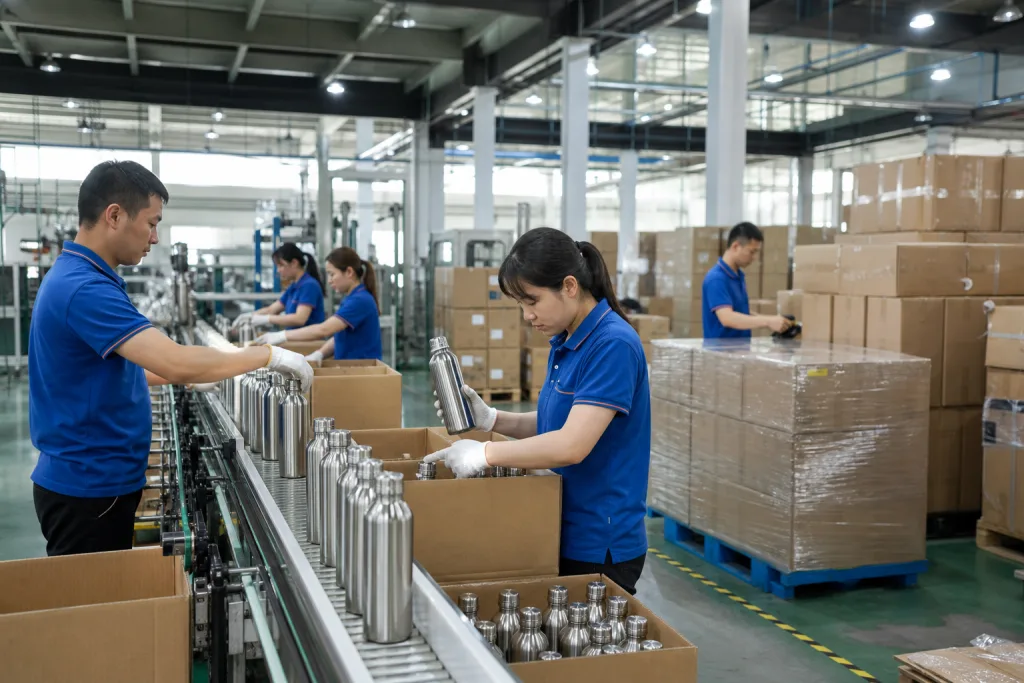
At our Hangzhou-area facility in Zhejiang, China, a standard production line can output about 450,000 stainless bottles per month across mixed SKUs. That number sounds safe on a spreadsheet, but we book capacity by body mold, coating line, lid assembly, and packing table. A 3,000 pc order using an existing bottle body can often run in 12 days after artwork approval. A 20,000 pc order with a new lid, Pantone powder coating, and retail packaging is closer to 25–35 days because the line has to reserve mold trial time and a full color-change slot.
Use clear product names in your RFQ. If you need canteen wholesale, say whether it is a military-style canteen, outdoor water canteen, or children’s strap canteen, and give the target capacity in ml or oz. If you need growler wholesale, state whether it is a beer growler, insulated growler, or screw-cap stainless growler; we have seen buyers ask for “64 oz growler” and then reject the first drawing because they meant a wide-mouth lid for draft beer filling. Precision cuts quote revisions. It also prevents the wrong sample from being made.
FOB Price Drivers Buyers Miss
The FOB price of a bulk drink bottle comes from material, process, finish, lid design, packaging, and compliance test cost. Stainless steel grade is the first line we check on the cost sheet. Most export bottles use 304 stainless steel for the inner wall. Some low-price single-wall models use 201 stainless steel for the outer body, but for North American and European retail we usually quote 304 inside and 304 or 201 outside based on the buyer’s shelf price. Wall thickness often sits around 0.4-0.5 mm for vacuum bottles, while heavier growlers may need 0.6 mm or more. Small change, big bill. Last month QC pulled a 0.38 mm body from the line against a 0.45 mm spec, and the buyer flagged the weight before we even sent the pre-shipment photos.
A plain single-wall 750 ml sports bottle can sit around USD 1.40-2.40 FOB Ningbo in a 3,000 pc order. A 500 ml double-wall vacuum bottle often lands at USD 2.10-4.80. A 1.9 L beer growler bulk order can range from USD 6.50-12.50 depending on handle, cap, vacuum performance, and coating. Alcohol flask bulk orders are usually cheaper per unit, often USD 0.95-2.20 for common 6 oz to 8 oz shapes, but gift boxes can eat the saving fast. We’ve seen this go sideways: one PO had “matte black gift box” typed in the remark field, not the packaging line, and the buyer expected it included in the bottle price.
Decoration is another price driver, and this is where buyers often compare the wrong quotes. One-color silk screen may add USD 0.08-0.18 per piece. Laser engraving can add USD 0.12-0.35 depending on logo size. Full-wrap heat transfer or water transfer can add USD 0.45-1.20, plus setup time and higher defect risk. Powder coating costs more than spray painting, but it gives better grip and a tougher finish when the curing oven is set right. We run a 180-200°C cure window on most matte coatings, and if the hanger mark shows near the base, QC will pull the sample before packing.
Packaging is not free. A white box may add USD 0.10-0.25. A printed retail color box can add USD 0.25-0.60 or more. For wholesale drink bottle shipments, stronger 5-ply export cartons are worth the extra cents if your goods will pass through 2 or 3 warehouses before retail delivery. The math does not work if a USD 0.18 cheaper carton leads to crushed corners and an AQL 2.5 finding at final inspection.
MOQ Tiers And What They Mean
MOQ is not a factory trick. It is tied to coil cutting, coating line setup, logo jig setup, and carton printing plates. For wholesale drinkware using existing molds, 1,000 pcs per color can work for simple stainless or black finishes if we run it with a regular line slot. For custom Pantone powder coating, 3,000 pcs per color is more realistic, because the powder room needs a full changeover and QC pulls color panels under D65 light before mass production. For a new bottle body or new lid, expect 5,000-10,000 pcs because tooling, first-shot samples, and trial production need to be spread across enough units.
For canteen bulk projects, MOQ depends on whether the mold already exists. A standard 1 L outdoor canteen may start at 2,000-3,000 pcs. A custom body with a molded plastic cap, strap, or silicone boot can move to 5,000 pcs quickly; we have seen a strap buckle add 12 days because the buyer wanted a matte finish but the PO only said “black.” The bottle is not the whole job. For wholesale canteen programs sold through outdoor distributors, spare caps, straps, and replacement boots need their own inventory plan, or the math does not work after the first shipment.
For growler bulk and wholesale growler orders, the MOQ is often higher because large-capacity bodies consume more steel and take more rack space through production, coating, and packing. Beer growler wholesale bulk buyers should plan 1,000-2,000 pcs for an existing 64 oz style, and 3,000-5,000 pcs if the cap, handle, or finish is not standard. On the line, a 64 oz body also slows carton packing because one master carton may hold 6 pcs instead of 24 pcs for smaller tumblers. Beer tumbler wholesale bulk orders are easier because 12 oz, 16 oz, and 20 oz tumbler molds are common, and we ship those sizes every month.
MOQ also changes with order mix. If you order 6 colors at 500 pcs each, that is not the same as 3,000 pcs in one color. Each color needs line cleaning, powder changeover, color approval, and separate defect tracking; QC once pulled a sample lot because one beige color showed pinholes above AQL 2.5 after the second bake. For a first order, fewer colors and one logo method usually gives you a better unit cost and a safer schedule. This is the wrong place to test every SKU at once.
Timeline From RFQ To Shipment
A realistic bulk drink bottle timeline starts before production. RFQ clarification usually takes 1-3 working days if you send capacity, material, logo file, packaging request, test standards, and destination port in one shot. If the brief is thin, we spend a day chasing basics like 500ml versus 750ml, and a typo on the PO can turn a clean quote into a week of back-and-forth. That is the wrong way to buy.
Existing mold samples usually take 3-7 days if there is no custom color. Custom logo samples take 5-10 days. A new mold sample can take 15-30 days, depending on bottle body complexity and whether the lid has injection-molded parts. QC pulled the sample on one job and the lid torque was off by 0.8 N·m, which is why we push for a physical pre-production sample on serious wholesale drinkware programs. A digital rendering cannot prove coating adhesion, lid fit, vacuum performance, or carton strength.
Mass production for standard drinkware wholesale orders is usually 30-45 days after deposit and sample approval. On an 8-cavity line, that window is normal for a run like 20,000 to 50,000 pcs. In peak season, especially before summer promotions and Q4 retail, plan 45-60 days. If you need third-party lab testing for LFGB, FDA, REACH, or a retailer spec, add 7-15 days based on the lab queue and how many materials they pull apart. The math does not work if testing sits at the end.
Final inspection usually takes 1 day on-site, but booking a third-party inspector can need 3-5 days of notice. We run AQL General Inspection Level II, with common limits such as Critical 0, Major 2.5, Minor 4.0 unless the buyer sets a different bar. On one 3,000 pcs order, QC flagged a 1.5 mm carton print shift before loading, which saved a claim later. After inspection, loading and customs declaration from Zhejiang to Ningbo or Shanghai port typically need 2-5 days.
Ocean freight sits outside factory lead time, but procurement teams still have to price it in. Ningbo to Los Angeles may be 14-25 days port-to-port in normal conditions. Ningbo to Rotterdam or Hamburg is often 30-40 days. We ship on time and still see buyers miss launch dates because they forgot vessel cut-off and inland drayage. If you sell seasonal products, the factory ship date is not your warehouse receiving date.
Decoration, Packaging, And Hidden Days
About 70% of bulk drinkware delays we see come from artwork and packaging, not metal forming. A PNG logo is not production-ready. For silk screen, laser engraving, pad printing, or heat transfer, send AI, EPS, or PDF vector artwork with Pantone references; our prepress guy checks line thickness down to 0.2 mm before film output. If you need FNSKU, EAN, UPC, suffocation warning, recycling marks, or multilingual instructions, put them into the packaging file before sample approval. We once had a PO say “UPC on bottle,” while the buyer meant “UPC on color box.” That typo cost 3 days.
Silk screen works well for simple logos and large runs, especially 1-color marks under 60 mm wide. Laser engraving lasts and looks clean on stainless or powder coating, but large artwork slows the line; a 90 mm wrap logo is not the same job as a 25 mm front mark. Heat transfer suits multi-color graphics, but QC has to run tape testing and hot-water soaking before we trust it. For alcohol flask wholesale bulk or beer tumbler in bulk, engraving is common because buyers position them as gifts. For beer growler in bulk, a large front logo usually works better with screen printing or laser, depending on the finish. The wrong question is “which decoration is cheapest?” Ask which one survives the buyer’s shelf and return policy.
Packaging lead time matters. Plain cartons can move fast, often 2-3 days after size confirmation, but printed color boxes usually need 7-12 days after artwork approval. If your distributor requires GS1 barcode verification, carton drop testing, or inner pack labeling, put those days into the calendar before deposit. For Amazon-oriented orders, carton size, weight, FNSKU placement, and polybag rules need sign-off before mass packing starts; QC pulled a sample last month because the FNSKU was 8 mm too close to the box edge. Re-labeling 5,000 cartons after inspection is expensive and annoying. We ship cartons, not excuses.
For the best wholesale drink bottle result, freeze the artwork before deposit. Changing a logo size after the pre-production sample can reset film output, screen making, color matching, and packaging print approval. That is how a 35-day order becomes a 50-day order without anyone touching the bottle mold. We have seen this go sideways: the bottle line was ready, the 304 stainless bodies were packed in WIP racks, and the whole order waited 12 days for one revised instruction leaflet.
Compliance And Inspection Costs
For Europe and North America, compliance belongs in the landed-cost sheet, not in a side note. Stainless steel drink bottles often need food-contact testing: LFGB for Germany-focused buyers, FDA-related food-contact expectations for the United States, and REACH checks for powder coating, silicone rings, PP lids, and plastic straws in Europe. If you sell children’s bottles, ASTM, CPSIA, small parts, lead, cadmium, and phthalate requirements depend on age grade and sales market. We once had QC pull a kids’ straw lid because the silicone tip measured under the buyer’s small-parts limit on the caliper. Cheap fix before packing. Expensive fix after delivery.
A basic third-party lab test for one bottle model may cost USD 250-800. A broader test plan with coating, silicone gasket, plastic lid, printed ink, and packaging materials can exceed USD 1,000. On a 1,000 pc order, the buyer usually pushes back and says the test cost kills the margin. I get it, but the math doesn't work if one container gets held or a retailer issues a chargeback. If you are buying drinkware wholesale for regulated retail channels, ask for recent reports, then check the report against the exact steel grade, lid material, coating color, and logo ink you are ordering. We have seen a PO say “matte black,” while the old report covered glossy blue; the buyer flagged it during document review.
Factory audits are a separate cost. Some buyers need BSCI, Sedex, ISO 9001, or retailer-specific audits before they release the deposit. Confirm audit availability early, not 7 days before shipment. Zhejiang has a mature drinkware and hardware supply base, but not every China factory keeps batch records, incoming material logs, and corrective-action files in order. A clean sample room proves almost nothing. We run into this during audits: the showroom looks sharp, then the auditor asks for the 304 stainless coil traceability record and the office spends 40 minutes looking for one stamped folder.
Inspection cost is usually USD 200-350 per man-day in China through common third-party agencies. For 10,000 pcs, that is a small cost per unit. For mixed orders such as alcohol flask in bulk, beer tumbler bulk, and canteen wholesale in one shipment, use a larger sample pull because each SKU fails in different places: flask cap leakage, tumbler coating scratches, canteen strap stitching, carton drop damage. We prefer inspections before final balance payment, with sealed golden samples available for comparison. The line knows the drill. QC pulled the sample, checked the logo position with a 0.5 mm ruler, and rejected one batch last month because the print sat 3 mm lower than the approved sample.
How To Negotiate Without Creating Risk
Negotiating a bulk drink bottle order should not mean squeezing the unit price first. The better move is to decide which costs can come out and which parts are locked. If you push for USD 0.20 off a vacuum bottle without a signed spec sheet, the factory might cut carton burst strength from 5-ply to 3-ply, reduce powder coating thickness by 8-12 μm, shorten inspection time, or swap the stainless grade unless 304 stainless is written on the PI. We have seen this go sideways. QC pulled a sample once where the cup looked fine, but the inner wall grade failed the handheld XRF check.
There are safer cuts. Use an existing mold. Start with 1-2 colors. Choose laser engraving or one-color silk screen instead of full-wrap artwork, especially when the logo has thin 0.3 mm lines that break on curved bottles. Use a standard lid if it passes your leak test; we run 10 pcs upside down for 30 minutes before signing off. Move from 1,000 to 3,000 pcs per SKU only when your forecast supports it, because dead stock costs more than the discount. Combine a wholesale canteen and beer tumbler wholesale order only when both use the same inner box, master carton, and AQL 2.5 plan. If packaging and inspection are different, the math does not work.
Payment terms change the quote. A normal first order is 30% deposit and 70% balance before shipment after inspection. Repeat buyers with 4-6 clean shipments can ask for better terms, but the line still needs cash for steel, lids, cartons, and coating before production starts. FOB Ningbo or FOB Shanghai is usually cleaner than EXW because export handling is already included. DDP works for some small importers, but your procurement team should still check the freight, duty, and tax assumptions behind the number. One buyer once flagged a USD 0.14 “DDP saving”; after we checked the forwarder sheet, the destination tax was simply missing.
The best suppliers ask detailed questions before quoting alcohol flask wholesale, beer growler wholesale, or drink bottle wholesale programs. Good sign. Not a stall. If you want stable landed cost and stable delivery, make the specification plain and hard to misread: material grade with test standard, capacity tolerance in ml, finish sample, logo method, packaging drawing, AQL, compliance documents, incoterm, and target ship date. We once delayed a PO because “matte black” was typed as “mate black” on the artwork file, and the buyer was glad we caught it before the coating line started.
Get a costed bulk drink bottle quote
Send capacity, quantity, logo, packaging, and destination. We will return practical FOB pricing, MOQ, sample timing, and production lead time.
Frequently asked questions
What is a normal MOQ for a bulk drink bottle order?
For existing stainless steel bottle molds, a normal MOQ is 1,000-3,000 pcs per model, usually with a minimum per color. If you need custom Pantone powder coating, 3,000 pcs per color is more realistic because of coating line setup and powder waste. A custom bottle body or new lid can require 5,000-10,000 pcs to justify tooling and trial production. For small items such as alcohol flask wholesale bulk orders, MOQ can sometimes start at 2,000 pcs, while large beer growler wholesale bulk orders often start around 1,000-2,000 pcs for existing molds. The most efficient first order is one model, one finish, and one decoration method.
How much should I budget for wholesale drinkware samples?
For stock samples without logo, many factories charge USD 20-50 per piece plus courier cost. Custom logo samples normally cost USD 50-150 depending on laser engraving, screen printing, or coating work. If you need a new mold sample, tooling and sample development can range from USD 800 to several thousand dollars, especially for custom lids or unusual shapes. Courier delivery to Europe or North America often adds USD 40-100. Sampling usually takes 3-7 days for stock items, 5-10 days with logo, and 15-30 days for new tooling. Do not skip physical samples for retail orders.
Can I mix bulk canteen, tumbler, and growler styles in one order?
Yes, but mixed orders are not automatically cheaper. A canteen bulk order, beer tumbler in bulk, and beer growler bulk order may use different production lines, cartons, inspection checklists, and packaging files. You may save on export handling and container space, but each SKU still has its own MOQ and setup cost. For example, 1,000 pcs of a canteen, 1,000 pcs of a tumbler, and 1,000 pcs of a growler may not price like 3,000 pcs of one bottle. If the styles share the same logo, carton structure, and destination, combining them makes more sense.
What inspection standard should I use for drinkware bulk orders?
Most importers use AQL General Inspection Level II for final random inspection. A common setting is Critical 0, Major 2.5, Minor 4.0, but you can tighten it for premium retail or loosen it for low-cost promotional goods. Inspection should cover leakage, vacuum performance, coating defects, logo position, capacity, odor, sharp edges, lid fit, barcode scanning, carton markings, and drop condition. For a 5,000 pc order, the inspector may check around 200 pcs depending on the AQL table. Keep an approved golden sample at the factory so disputes are based on evidence, not opinion.
What is the usual lead time from China to my warehouse?
Factory production in China is commonly 30-45 days after deposit and sample approval for standard wholesale drinkware. Add 3-10 days for samples before that, and 2-5 days for export handling after inspection. Ocean freight from Ningbo to the U.S. West Coast is often 14-25 days port-to-port, while Ningbo to major European ports is often 30-40 days. Customs clearance, rail or truck delivery, and warehouse booking can add another 5-14 days. For seasonal retail launches, plan backward from your required warehouse date, not from the factory completion date.