Key Takeaways
- A practical bulk coffee travel mug MOQ starts at 1,000 pcs for stock shape and 5,000 pcs for private mold adjustments
- 304 stainless steel at 0.45-0.55 mm outer wall is the normal export-grade choice for coffee travel tumblers
- Plan 25-35 days production after sample approval for logo orders from Zhejiang, China
- AQL 2.5/4.0 inspection should cover leak test, vacuum retention, coating adhesion, and carton drop test
A bulk coffee travel mug looks simple until you approve the wrong sample. Then the claims start: lids seep in commuter bags after a 30-minute tilt test, powder coating gets rubbed through on the carton corner, logos sit 3 mm off-center, and 48 cartons land with no FNSKU or retail barcode. QC pulled the sample, and the buyer flagged it. For coffee brands and corporate-gift buyers, the mug is not just packaging. It sits on someone’s desk every day.
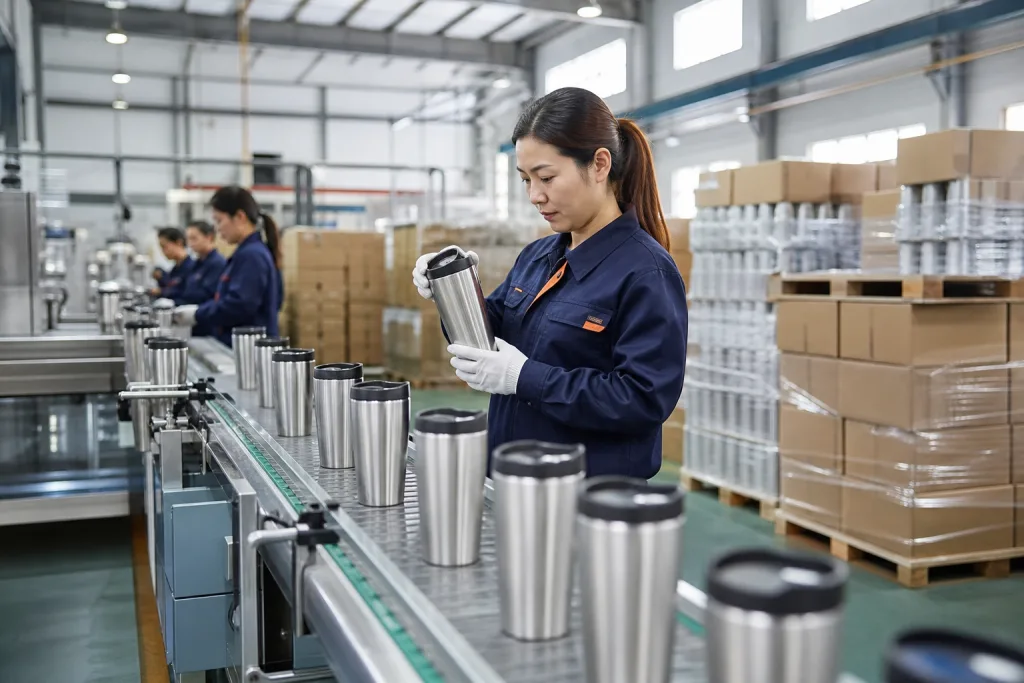
At our Zhejiang, China factory, we run travel tumbler projects by spec sheet, not by catalogue photos. A 20 oz coffee mug custom made for a loyalty program does not need the same lid, wall thickness, gift box, or MOQ planning as a 12 oz executive gift set. We check the caliper reading, lid fit, logo position tolerance, carton mark, and FOB Ningbo cost before we open molds or print. Pretty photos sell fast; bad specs cost more.
Capacity Is A Cost Decision
The first spec buyers lock onto is capacity: 12 oz, 16 oz, 20 oz, 24 oz, or 30 oz. That choice changes steel weight, carton count, lid diameter, and freight. A 12 oz bulk coffee mug usually comes in at 230-280 g. A 20 oz bulk coffee tumbler often sits around 320-390 g, depending on wall thickness and lid style. On a 5,000 pcs order, that spread hits the landed cost hard. We run the same check on the floor with a digital scale at 1 g resolution, because the math does not care about mood.
For coffee brands, 12 oz and 16 oz are easier to place next to beans, capsules, and subscription boxes. For corporate gifts, 20 oz is the safer default; it feels solid and still fits most cup holders. A 30 oz bulk travel tumbler looks strong in a catalog, but it pushes carton size up and often misses the daily office coffee use case. The buyer flagged this on one PO last quarter: 30 oz sounded good on paper, then the sample tray would not fit the desk drawer.
Ask your coffee mug supplier for both rated capacity and practical fill capacity. Rated capacity is measured to the rim. Practical fill capacity leaves headspace under the lid, often 20-35 ml less. If the carton says “20 oz” and the user can only pour 18.8 oz before spillover, QC will hear about it fast. We check that with a 50 ml graduated cylinder at the line, not by guessing.
For a coffee mug in bulk order, cup holder fit matters just as much. A base diameter of 68-74 mm works for most passenger cars in Europe and North America. Wider bodies sit fine on a desk, then turn into a pain on the commute. We have seen this go sideways with a 76 mm base: the sample passed the desk test, then failed in a compact car console. If you sell through gift distributors, stable geometry beats a novelty shape every time.
Steel Grade And Wall Thickness
For a bulk coffee travel mug, we spec inner 304 stainless steel, outer 201 or 304 stainless steel. Inner 304 is the one that sits with hot coffee, milk, acidity, and repeated washing, so we do not cut corners there. We have seen buyers ask for 201 inside to shave cost, and that is the wrong place to save money. On the line, QC checks weld beads and thread starts with a 10x loupe, and 201 shows trouble sooner in those spots, especially for Europe and North America.
Wall thickness matters more than most buyers think. A standard travel tumbler runs 0.40-0.50 mm for the inner wall and 0.45-0.55 mm for the outer wall. Go too thin and you might save USD 0.10-0.20 per unit, then pay for dents, vacuum sealing rejects, and extra claims later. We check thickness with a digital micrometer at 4 points per cup, and a buyer once flagged a PO that asked for 0.35 mm inner wall. The math did not work.
Vacuum insulation should be written by performance, not by the words “double wall.” We test with hot water at 95°C in a 20-25°C room, and a good 16-20 oz tumbler should still stay above 55°C after 6 hours if the lid is closed. Test the finished cup, lid and all, because a 2 mm gasket or a loose cap changes the result fast. QC pulled the sample on one run after a lid swap, and the hold time dropped right away.
Surface finish belongs in the same spec sheet. Powder coating is the usual call for coffee mug promotional products because it gives solid color coverage and a better grip, while spray painting is cheaper but chips sooner. Stainless polish is the safer choice when the buyer wants a clean look and less Pantone drama. We run cross-hatch adhesion testing with tape and check color against Pantone or buyer-approved limit samples on the coating line. If a buyer wants low price and a soft-touch color at the same time, that brief usually goes sideways.
Lid Engineering Prevents Complaints
The lid is where a lot of coffee mug customized jobs go sideways. Buyers stare at logo size, but the end user checks two things: does it leak, and does the drinking slot stay clean after a week in a bag. We run slide lids, flip lids, and screw lids on the line. A slide lid is fine for desk use, but it is not 100% leakproof. A flip lid seals better only when the silicone plug sits tight. A screw lid gives the best seal, and it also adds cost and changes how the cup opens with one hand.
For commuter cups, put the leak test in the spec: 80°C water, filled to 90% capacity, inverted for 30 minutes, no continuous dripping. That is the test we run on the bench with a timer and a tray under the sample. For promo orders, “spill-resistant” is the cleaner claim. “Leakproof” invites trouble. A distributor selling to offices can live with that. A retail brand selling online gets hit with returns, and the math does not work.
Silicone quality decides whether the lid feels cheap. Ask for food-contact silicone, LFGB or FDA-grade based on the market. The gasket should pop out for cleaning, then lock back in without falling out after 5 washes. We check lid open-close on 500 cycles for new tooling; QC pulled one sample last month and the plug shifted after 320 cycles, which is a bad sign. If the buyer wants repeat orders, this test is not optional.
For private label programs, put spare lids into the carton plan early. Retail buyers lose lids. Corporate users break sliders. We usually set spare lids at 1-3% of mug quantity and pack them separately, which saves the distributor from an emergency air shipment later. We once caught a PO typo that listed 300 spare lids instead of 30; the buyer flagged it before production, and that small fix saved a lot of noise at packing.
Logo Method Changes The Product
A coffee mug custom project is not done because an AI logo file landed in our inbox. The decoration method changes rub life, unit price, sample lead time, and sometimes compliance paperwork. We run five common options on the line: laser engraving, silk screen printing, heat transfer, UV printing, plus 3D or embossed marks on private molds. Last month QC pulled a 30 oz sample where the logo looked fine on PDF, but the real cup curve squeezed the last 4 mm of text.
Laser engraving looks clean on powder-coated stainless steel and survives daily handling because it cuts through the coating and shows the metal underneath. No peeling. Corporate-gift buyers usually like it because it feels quiet and premium. The catch is color; laser is normally one-tone. Silk screen fits simple one- or two-color artwork and keeps the math workable on a bulk travel mug order, but do not send 0.6 mm slogan text and expect it to print sharp. We usually ask for about 1.2 mm line height or more, and our screen master will flag thin strokes before film output. Heat transfer and UV printing handle richer artwork, but they need tighter setup control and a real abrasion test, not just a nice photo under office lights.
For coffee mug promotional products, a 45 x 60 mm print area is common on a tapered 16 oz tumbler. Full-wrap printing works, but alignment gets picky near the seam and body curve. The buyer often asks, “Can you make it 360 degrees with no shift?” Wrong question. Ask what shift is acceptable: 1.5 mm is different from 4 mm when the artwork has a vertical barcode or a straight city skyline. On matte powder coating, white ink sometimes needs two passes, or it turns gray after curing in the oven.
Sampling should be physical, not only digital. Our Zhejiang production team normally provides a logo sample in 7-10 days after artwork confirmation for stock shapes. For coffee mug custom made projects involving new lid color, special coating, or adjusted body shape, sample time can move to 15-20 days. We have seen this go sideways: a buyer skipped the printed sample to save one week, then rejected 3,000 pcs because the gold logo matched the PO wording but not their Pantone chip. Cheap week. Expensive fix.
Packaging Must Match The Channel
Packaging is not decoration. It drives breakage rate, warehouse handling, barcode scans, and whether your coffee mug private labeling order looks ready for retail shelves. For a corporate-gift order, we run a white box or kraft box with one-color printing; our packing line checks the dieline with a 300 mm steel ruler before mass packing. A coffee brand selling through online channels usually needs a color box, instruction sheet, warning label, barcode, and master carton marks that match the purchase order word for word. One buyer once had “matte black” on the PO and “matt black” on the carton mark file. QC pulled the sample before printing, which saved 1,200 boxes from scrap.
For Amazon-style or 3PL fulfillment, lock FNSKU or barcode placement before artwork approval. The label area should stay flat and scannable, usually 40 x 30 mm or larger. Small detail. Big headache. If you add a sleeve, make sure it does not cover recycling marks, country of origin, or importer information. For North America and Europe, “Made in China” marking should be visible and consistent on the retail box and master carton. We check this with a handheld barcode scanner at pre-shipment inspection, and the buyer will flag it fast if the FNSKU sits across a box corner.
Carton strength matters for drinkware. A standard master carton might hold 24 pcs of 16 oz tumblers or 20 pcs of 20 oz tumblers, depending on box size and inserts. We usually use 5-ply export cartons for sea freight. If the order is going to a coffee mug distributor with 2 or 3 warehouse transfers, ask for a carton drop test: 10 drops from 76 cm for retail packaging or an equivalent ISTA-style check. Cheap cartons save a few cents. The math doesn't work when one crushed corner turns into a chargeback, photo proof request, and 18 days of claim emails.
For gift sets, confirm whether the mug ships with a straw, brush, booklet, coffee sample, or insert card. Accessories change packing labor and inspection points; a straw brush adds one more count check, and a booklet needs a separate AQL table if the buyer cares about printing defects. If you need coffee mug customizable inserts for different clients under one purchase order, separate SKU codes and carton marks prevent warehouse confusion. We’ve seen this go sideways when 3 client cards shared the same outer carton mark.
MOQ, Price, And Lead Time
A realistic quotation needs three inputs: product spec, branding spec, and order structure. At BottleForge Industrial in Hangzhou, Zhejiang, we run about 450,000 stainless travel tumblers per month across stock and custom projects. For a stock-shape bulk coffee travel mug with one-color logo, MOQ is usually 1,000 pcs per design; our laser jig holds the cup at 0.3 mm logo position tolerance on repeat orders. For custom powder color, plan on 2,000-3,000 pcs because the coating line needs a clean color run. For coffee mug private labeling with retail box and matched Pantone coating, 3,000 pcs is a cleaner planning number. New mold work normally starts around 5,000-10,000 pcs depending on body and lid complexity. Small orders sound easy. The math doesn't work once tooling, color changeover, and pre-production samples are counted.
FOB China pricing varies with capacity, steel weight, lid, coating, and packaging. As a practical range, a 16 oz stainless vacuum tumbler may quote around USD 3.20-5.20 FOB Ningbo for normal custom logo orders. A heavier 20 oz model with better lid and retail box may fall around USD 4.20-6.80. Last month QC pulled a 20 oz sample that looked fine in photos, but the inner wall was 0.32 mm instead of the requested 0.40 mm, and the lid failed the 45-degree leak check. If a coffee mug factory direct quote sits far below that range, check steel grade, wall thickness, lid sealing, and whether testing is included.
Production lead time after approved sample is normally 25-35 days for logo orders. Add 7-10 days for sampling, and before Q4 we quote 35-45 days instead of pretending the line is empty. Sea freight to the US West Coast can be 18-28 days port to port, while Europe often takes 30-40 days depending on route. Corporate-gift buyers with fixed event dates should work backward by at least 75-90 days. We have seen this go sideways when a PO showed “matte black” but the artwork file said “Pantone 426C”; the buyer flagged it after sample approval, and 6 days disappeared before the coating card was signed.
If you compare a coffee mug supplier list or coffee mug supplier directory, do not sort only by unit price. Ask each coffee mug factory to quote the same packaging, same AQL, same logo method, same Incoterm, and the same test requirements, then put the answers in one sheet with carton size and gross weight. This is the wrong question to ask: “Can you beat USD 3.00?” Better question: “Can you meet this spec at AQL 2.5 with 304 stainless, retail box, and LFGB or FDA testing?” Otherwise you are comparing four different products with one shared photo.
Testing Before Balance Payment
Inspection is the last gate before balance payment, and this is where small choices turn into chargebacks. For a bulk coffee mug or bulk travel tumbler order, we usually advise third-party or buyer-side inspection under AQL before the container is released. A common setting is AQL 2.5 for major defects and 4.0 for minor defects, with critical defects at 0. Critical defects include sharp edges, wrong material, serious leakage, unsafe odor, or broken glass accessories if included. On the line, QC pulled 200 pcs from a 6,000 pcs lot last month and found 3 lids with flash over 0.6 mm on the drinking slot. Small defect. Big argument.
The inspection checklist should cover capacity by measuring cup, net weight on a digital scale, appearance under 6000K light, logo position with a 0.5 mm tolerance mark, color comparison against the approved PMS chip, lid fit, leak test, vacuum retention, coating adhesion, barcode scan, carton mark, and packing count. For powder-coated mugs, add tape adhesion and rub testing. We run 3M 600 tape on coated samples, then check peel marks before the inspector signs the report. For laser engraving, check burrs and logo contrast. For silk screen, check pinholes, misregistration, and scratch resistance after curing. Do not inspect only the pretty samples from the top carton. That is how bad cartons get shipped.
Compliance depends on market. Europe buyers often ask for LFGB, REACH, and sometimes food-contact declarations. North American buyers may request FDA food-contact documentation, California Proposition 65 review, and ASTM-related physical safety checks for certain gift channels. If the tumbler is for children, requirements become stricter, so do not treat a kids’ mug as a normal adult coffee mug in bulk. We have seen a buyer flag a 350 ml kids’ tumbler because the PO said “adult promo cup” while the artwork had a cartoon bear and straw lid. The paperwork must match the product.
A good coffee mug oem manufacturer will accept a clear inspection plan before production starts. A weak supplier will call it unnecessary or expensive. The math does not work. Testing might add USD 180–350 per inspection, but one failed 40HQ can lock up USD 25,000 in stock, freight, repacking labor, and customer claims. For coffee mug distributors managing repeat customers, consistent AQL records make reorders easier because both sides know what “acceptable” means. We ship faster when the buyer approves the inspection points before mass production, not 2 days before balance payment.
Send Your Travel Tumbler Spec For Factory Review
Share capacity, logo method, quantity, packaging, and delivery market. We will return a practical FOB quote and sample plan.
Frequently asked questions
What is the best size for a bulk coffee travel mug order?
For coffee brands, 12 oz and 16 oz are the most practical because they match daily coffee habits and keep FOB cost controlled. For corporate gifts, 20 oz is often safer because it feels more substantial and works for commuting. A 16 oz stainless vacuum tumbler usually weighs 280-350 g, while a 20 oz version may reach 320-390 g. If you are ordering 5,000 pcs, that extra weight affects carton size and freight. We usually suggest starting with 16 oz for retail coffee bundles and 20 oz for conference, employee, or client gift programs.
Can I get a coffee mug customized with my logo at 500 pcs?
Sometimes, but 500 pcs is not ideal for factory pricing. For a stock coffee mug custom order, our normal MOQ is 1,000 pcs per logo design. At 500 pcs, setup labor, film charges, packing work, and export handling are spread across too few units, so the unit price can rise by 20-40%. If you need a trial run, choose an existing body color, one-position laser engraving, and standard white box packaging. For custom coating, retail box, or coffee mug private labeling, plan 2,000-3,000 pcs to get stable production and better cost.
How do I know if a coffee mug manufacturer uses real 304 stainless steel?
Ask for a material declaration and include material verification in your inspection plan. Inner 304 stainless steel is the normal requirement for hot coffee contact. A third-party lab can perform composition testing if the order value justifies it, and spot checks can be arranged before shipment. You should also ask whether the outer wall is 201 or 304 stainless steel, because both are used in the industry. For Europe, pair this with LFGB or food-contact documentation. For North America, request FDA food-contact supporting documents and keep records by SKU and production batch.
What logo method is best for coffee mug promotional products?
Laser engraving is the safest for long-term durability on powder-coated stainless steel. It will not peel and works well for executive gifts or coffee brand merchandise. Silk screen printing is better when you need a colored logo at a lower cost, especially for 1-2 color artwork. UV printing and heat transfer can handle complex graphics, but you should approve a physical sample and test abrasion before mass production. For most bulk coffee tumbler programs above 1,000 pcs, we recommend laser for premium orders and silk screen for budget corporate-gift campaigns.
What lead time should coffee mug distributors plan before a campaign?
For a standard bulk coffee travel mug with logo, plan 7-10 days for sampling and 25-35 days for mass production after sample approval. Add inspection time, export booking, and sea freight. A safe full timeline is 75-90 days before your event or retail launch, especially if shipping from China to Europe or North America. Q4 orders should be started earlier because coating lines, carton suppliers, and vessel space get tight. If you need retail packaging, FNSKU labels, or multiple coffee mug private label versions, add another 5-10 days for artwork checking and packing control.