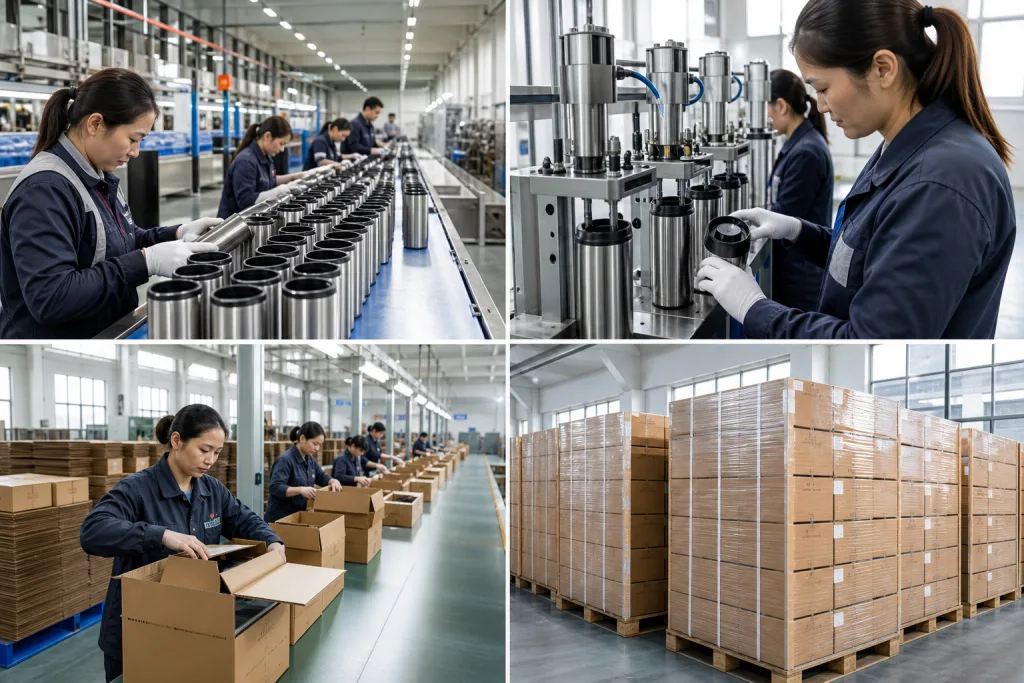
Key Takeaways
- For a bulk coffee mug, decide the use case first: retail, corporate gift, or promotional products. That choice changes MOQ, lid, and decoration.
- A standard 16 oz vacuum tumbler usually uses 304 stainless steel, 0.4-0.5 mm wall thickness, and a 60-80 μm powder coat for a durable finish.
- Expect 25-35 days for production on a normal China order, with sample lead time around 5-7 days and MOQ often starting at 500-1,000 pcs.
- For US and EU sales, ask for FDA, LFGB, REACH, and AQL 2.5/4.0 documents before you approve a bulk coffee tumbler order.
If you are buying a bulk coffee mug for retail or a corporate program, the first decision is not “which tumbler looks nice.” Wrong question. You are choosing leak rate, logo durability after 50 dishwasher cycles, heat retention, carton CBM, and the landed cost your warehouse will see on the receiving sheet. A bulk coffee travel mug for a café shelf is not the same spec we ship for a 5,000 pcs conference giveaway.
The fastest way to burn budget is to treat every coffee mug in bulk like a generic promo cup. A Zhejiang coffee mug factory will ask about lid style, powder coating thickness, logo method, inner carton pack, and compliance before price, because a slide lid, laser logo, and 24 pcs master carton do not cost the same as a PP flip lid with one-color silk print. We see this go sideways when a PO says “black logo” but the artwork file is Pantone 426C and QC pulled the sample under a D65 light box. If you buy from China factory direct, define the use case first. The buyer who does that usually gets the better mug and the cleaner margin.
Decide the job before the product
The smartest bulk coffee mug order starts with the job on the buyer’s desk. A coffee brand going DTC or retail needs a bulk coffee tumbler with a premium finish, 4 to 6 hours of heat retention in the lab, and packaging that can survive shelf handling. A corporate-gift buyer usually asks for a bulk travel mug with a clean logo print, a carton under 15 kg, and a price that does not break the campaign budget. A distributor often cares less about an extra feature and more about repeat stock, steady color matching, and fewer dented cartons after LTL delivery. We see this on the line: QC pulled 32 pcs last month because the gift box corners crushed during a 1.2 m drop test.
Before you ask for quotes, put the use case into numbers. Will it be 12 oz, 16 oz, or 20 oz? Is leak resistance mandatory, or is splash-resistant enough for desk use? Will the customer use it in a car cup holder? If yes, we run the base around 2.7 to 2.9 inches, then check it with a simple cup holder gauge before tooling approval. Skip these decisions and the supplier will quote a generic coffee mug custom made for an average buyer. Not for your channel. We once had a PO typo list “16 oz slim” while the artwork file showed a 20 oz body, and that single mismatch cost 3 days before pre-production sample sign-off.
There is no single right answer, but there is a wrong one: picking the cheapest sample and assuming it fits every sales channel. The math does not work. A coffee mug distributor serving office programs may accept a simple push-on lid because reorder speed matters more than premium feel. A coffee mug private label brand cannot take that shortcut. That brand may need a screw lid, matte powder coating, and a logo area tested after 200 dishwasher cycles so the print does not rub off. If you are buying coffee mug promotional products, choose the fewest features that still protect your brand. If you are building a premium line, accept the higher unit cost when the body feels better in hand; buyers flagged thin 0.4 mm walls for us before, even when the outside looked fine in photos.
Practical rule: decide channel first, then capacity, then lid, then decoration. Reverse that order and you usually overpay for the wrong spec.
Choose steel, wall, and finish carefully
For a serious bulk coffee mug, we start with 304 stainless steel on the inner wall. That is what we run on most export orders. QC checks incoming coils with an XRF gun before the line starts. You will still see cheaper builds in the market, but if the buyer is checking food-contact specs, 304 is the cleaner starting point. The outer wall can also be 304, or a lower grade on some budget structures. We had a PO once that just said “stainless steel”; the buyer flagged it before sampling, and that is the wrong question to leave open. If the order is going to North America or Europe, ask the supplier exactly what sits inside and outside.
Wall thickness is where a lot of bulk coffee mug projects go sideways. We check 0.4 to 0.5 mm with a micrometer at the forming station. Go thinner and the cup dents, feels light in the hand, and loses heat faster. Go thicker and the weight climbs fast, which hurts carry comfort and pushes freight. For a 16 oz bulk coffee travel mug, a double-wall vacuum body with a clean seam and solid weld gives the best trade-off. On one run, a buyer pushed for 0.35 mm to shave cost; the math did not work once we looked at dent claims and rework.
Finish is a buying decision, not decoration. A powder coat at 60-80 μm usually takes scratches better than a thin paint layer, and it gives a better base for laser engraving or one-color print. We check coating thickness with a gauge on the line, because a sample can look fine and still be short by 10 μm. Gloss pops on a sales sheet; matte hides fingerprints after the first week in an office. If the program needs shelf appeal, a smooth satin finish can support a higher retail price without moving the base metal cost much. For desk use, I would pick matte. The buyer will notice the scuffs before they notice the shine.
- 304 stainless steel: our default for retail and gift orders
- Wall thickness: 0.4-0.5 mm for a balanced feel
- Powder coat: 60-80 μm for wear resistance
- Typical capacities: 12 oz, 16 oz, 20 oz, 24 oz
The lid decides daily satisfaction
Buyers often spend all their time on the cup body and leave the lid for later. Wrong call. On the line, the lid decides whether a 12 oz bulk coffee mug rides in a laptop bag, fits a car cup holder, and still feels good at the first sip. A cheap lid can kill a good cup. We have seen a 0.3 mm flash line on a slider edge turn into a return complaint after the first week.
For a corporate gift run or coffee mug promotional order, a push-on lid with a sliding closure is fine if the job is splash control and a friendly price. For a retail bulk coffee tumbler, a screw lid or a tighter press-fit lid with a silicone ring usually wins. If the buyer says the mug is for commuters, a lockable opening makes sense. If it sits on desks, simpler tooling and a 1.2 mm lid wall can keep the cost down. The wrong question is “what is cheapest?”; ask what the mug must do on day 90.
Ask your coffee mug factory to show lid resin data and a leak check report. PP is common. Tritan costs more, looks clearer, and holds up better in a display box. Silicone seals should sit flat, not twist in the groove during assembly. If the lid is transparent, check haze and flow marks under a 600-lux light box. If it is opaque, check texture and mold flash at the rim. We pull random samples and tip them at 90 degrees for 5 minutes; if a lid still leaks, the carton will not save it. For China export loads or warehouse consolidation, that turns into claims and rework fast.
Drink opening size changes the user feel more than most buyers expect. A narrow sip hole cuts splash, but coffee drinkers feel it is slow. A wider opening feels easy and also raises spill risk. For a bulk travel mug aimed at commuters, the middle size usually ships better. Let the buyer choose the trade-off. On a recent PO, one line item came in as “lido” instead of “lid”; that typo still had to be fixed before we cut steel.
Decoration is a margin decision
A coffee mug custom order is never just logo printing. Decoration sets the setup charge, sample lead time, reject rate, and the first feel when the buyer opens the carton. For a coffee mug custom made for retail, we might quote laser engraving on a powder-coated body, silk screen with a 0.18 mm mesh, UV print, or a full-color wrap tied to the brand guide. For a coffee mug customized for a corporate program, one 45 mm logo on one side is often enough. Last month a buyer asked for a 4-color wrap on a curved 600 ml tumbler, then flagged the price; the decoration choice, not the cup, caused the jump.
Laser engraving lasts and works well on coated stainless bodies. The line checks engraving depth with a simple caliper after the first 20 pcs, because weak contrast becomes a complaint after retail lighting hits the shelf. Silk screen is economical for one or two colors, but it needs a flatter print window and clean film setup. UV print gives more color room, but the unit price rises and the surface must stay controlled during curing. If you compare coffee mug suppliers, ask them to quote decoration apart from the mug body. A coffee mug factory direct price should show the base cup, the print method, and the packing line item. If it does not, the math does not work.
For high-volume coffee mug private labeling, the cheapest decoration is often the wrong question to ask. We have seen this go sideways: a low-cost print passed the desk review, then QC pulled the sample after 3M tape testing because the edge lifted near the seam. A slightly higher-cost laser logo can cut rejects and return claims. For coffee mug promotional products, a simple one-color print on a stock tumbler often wins because it keeps the MOQ low and the schedule tight. If you need the item for trade shows or seasonal gifting, a factory in Zhejiang can often produce a sample in 5-7 days and a production run in 25-35 days, but only if the artwork is final and the packaging spec is fixed.
Do not forget packaging. A custom insert, gift box, or FNSKU label can add USD 0.08-0.35 per pc, depending on paper weight, barcode placement, and whether we run individual polybags. It can also save labor at your warehouse. If you sell on Amazon or through a distributor, packaging decisions belong in the quote from day one; we once lost 2 days because the PO said “white box” while the carton mark file showed kraft box.
Check compliance before you place the order
If you source from China, check compliance before you release the deposit. A solid coffee mug manufacturer should tell you which papers match your sales market, and you should ask for them before mass production approval. For Europe, LFGB and REACH are common asks. For the US, buyers usually want FDA-related food-contact confirmation plus traceability on 304 stainless steel, PP lid material, silicone rings, powder coating, and logo ink. If the mug goes into a retail chain, ask for test reports from SGS, Intertek, TÜV, or BV, not a one-page factory self-declaration. We had one buyer flag a report because the item photo showed a 350 ml mug while the PO said 500 ml. Small mismatch. Big delay.
Quality control matters just as much. A practical acceptance standard for a bulk coffee mug order is often AQL 2.5 for major defects and AQL 4.0 for minor defects, but your tolerance should match the sales channel. A 10,000 pcs promotional order may accept two small paint specks on the bottom. A coffee mug private label launch at $18.99 retail usually cannot. Define what counts as a major defect: leaking lid, crooked logo over 1.5 mm, heavy dent, visible contamination, or bad color match outside the approved Pantone range. Put that list into the purchase order. Do not leave it to “factory standard”; we have seen this go sideways when QC pulled the sample and the buyer called a 2 mm logo shift unacceptable.
Ask the coffee mug factory about specific testing. Common checks include drop tests from 1.0-1.2 m, vacuum performance tests, dishwasher cycle checks if you plan to claim washability, and coating adhesion tests with 3M tape or a cross-cut tester. For a China export order, also confirm carton strength, drop-pack method, and humidity protection if the sea route is 28 days instead of 12 days by air. Zhejiang factories that ship regularly to the US and EU usually understand this, but you still need it written down. We run compression checks on 5-ply export cartons because wet cartons at Ningbo port are not rare in July. If you are a coffee mug distributor, the target is simple: cut claims before the first container leaves China.
One useful habit is to request pre-production samples and keep one sealed approval sample in your office. Mark the lid, body, logo position, color, and packing with a date and signature. It saves arguments later if the mass run drifts.
MOQ, lead time, and landed cost
The cheapest unit price is not the cheapest order. The number that matters is landed cost: mug, logo process, carton, inner box, freight, duty, and any prep labor at the warehouse. We see buyers chase USD 0.08 off the FOB price, then lose USD 0.22 because the 5-layer carton was changed to a thin 3-layer carton and arrived crushed. One buyer flagged this after QC pulled 12 cartons from the pallet and found 3 with corner damage. If the lid needs hand assembly or each tumbler needs a barcode sticker, the math changes fast. A solid coffee mug supplier should break out each cost, not hide everything inside one neat FOB line.
For stock travel tumblers, we usually quote 500 to 1,000 pcs per color for simple logo work. For a full coffee mug oem manufacturer project with a custom lid, special body shape, or new mold, MOQ can move to 3,000 pcs or more. Per color matters. Ask it early. A PO that says “3 colors, 1,000 pcs” can mean 1,000 total to the buyer but 1,000 pcs per color to the factory, and we have seen that typo stop a job for 2 days. A Zhejiang factory with a monthly output of 500,000 units can still refuse a small custom project if the tooling does not justify the line time on the polishing and powder-coating line.
Lead time is usually 5-7 days for samples, 25-35 days for normal production, and 32-45 days if you need custom packaging, third-party testing, or a new insert tray. Freight timing also matters. A bulk travel mug order moving by sea from China can take 18-32 days port to port, then another 3-7 days for customs and local delivery if the documents are clean. Do not plan a retail launch on the factory finish date. That is the wrong date to use. Ask for an incoterm that matches your team’s setup. FOB works well when you already have a freight forwarder. DDP can simplify a smaller launch, but only if the supplier has shipped that route before and the HS code, carton marks, and commercial invoice all match.
When you compare coffee mug suppliers, compare the same spec line by line: steel grade, wall thickness in mm, lid material, logo process, carton strength, test standard, and packing method. Otherwise you are comparing different products and calling them the same quote. We have seen this go sideways. Margins get burned there.
Use a supplier list, not a guess
If you are searching through a coffee mug supplier list or a coffee mug supplier directory, treat it as page one, not the decision. The real filter is factory capability. Ask for photos of actual tooling, the powder coating booth, the laser marking station, and the packing line with carton drop-test records. We run into this often: a coffee mug supplier quotes in 4 hours, then cannot explain the weld seam, lid tolerance, or AQL system. That is not ready for a serious brand order.
Ask whether they are a coffee mug factory, a trading company, or a coffee mug distributor. A distributor is fine if they control something useful, such as local stock, design service, or inspection. But know who owns the mold, who checks the QC line, and who pays if the logo print shifts by 2 mm. Small detail, big argument. If you need coffee mug factory direct pricing, verify that the source is the manufacturer, not a sales office forwarding screenshots. A factory in Zhejiang or elsewhere in China should answer basic process questions, such as liner thickness in mm or lid material grade, without sending every question back through sales.
For a brand planning repeat orders, continuity beats a one-time low bid. The math does not work if the second batch fails shelf matching. A good supplier keeps Pantone records, stores coating formulas, and tracks lid versions by batch number; we ship repeat tumbler orders using sample tags, color swatches, and retained lids from the approval room. That is how you avoid remaking a cup because batch two looks warmer under a D65 light box. If you are building a long-term line of coffee mug promotional products or retail tumblers, choose a partner that can move from 3,000 pcs to 50,000 pcs without changing the product you approved.
That is the difference between buying a mug and building a program.
Spec your bulk coffee mug with real numbers
Send your size, lid, logo, and packing target. We will turn it into a factory-ready quote from Zhejiang, with clear MOQ, lead time, and compliance.
Frequently asked questions
What MOQ should I expect for a bulk coffee mug order?
For a standard stock bulk coffee mug with a one-color logo, many factories in China start around 500 to 1,000 pcs per color. If you want a custom lid, special mold, or full coffee mug custom made design, MOQ often moves to 3,000 pcs or more. The exact number depends on tooling, decoration method, and carton packaging. A coffee mug factory direct quote should show whether MOQ is per design, per color, or total order quantity.
What is the best material for a bulk coffee travel mug?
For most retail and corporate gift programs, 304 stainless steel is the safest choice for a bulk coffee travel mug. It gives you better corrosion resistance and a cleaner sales story than lower-grade options. A common build is 0.4-0.5 mm wall thickness with a double-wall vacuum structure. If you want a lighter or lower-cost promotional item, you can adjust finish and lid style, but the inner steel should still be specified clearly in the PO.
How long does production take in China?
For a normal bulk coffee tumbler order, sample lead time is usually 5-7 days and mass production is often 25-35 days after sample approval and deposit. If you need a new mold, custom packaging, or third-party lab testing, add more time. Sea freight from China can add several weeks depending on the route, so if your launch date is fixed, build a buffer. A Zhejiang factory with a stable export line can move fast, but only when artwork and specs are final.
Which logo method is best for coffee mug private label orders?
If you want a durable coffee mug private label finish, laser engraving is usually the safest option on coated stainless steel. It resists scratching and looks premium. For budget-sensitive coffee mug promotional products, silk screen is cheaper and works well for one or two colors. UV print gives more color flexibility but can raise cost and QC risk. The right method depends on your channel: retail usually needs a stronger finish; corporate gifting can often accept simpler decoration.
What quality checks should I ask for before shipment?
Ask for pre-production samples, in-line QC, and final inspection under AQL 2.5 for major defects and 4.0 for minor defects. For a bulk coffee mug, also request leak testing, drop testing from 1.0-1.2 m, logo placement checks, and carton drop-pack review. If you sell into the US or EU, ask for FDA-related food-contact documents, LFGB if needed, and REACH where applicable. That is the practical baseline for a serious coffee mug manufacturer.