Key Takeaways
- Most bulk children water bottle projects need a 500 ml to 650 ml size, with MOQ starting at 2,000 to 3,000 units per color.
- Ask for RFQ pricing on bottle, lid, print, carton, and testing separately so you can compare children water bottle wholesale quotes correctly.
- A practical sample check includes leak testing at 24 hours, drop testing from 1.2 m, and lid-cycle testing at 3,000 to 5,000 opens.
- For school and import orders, insist on REACH, CPSIA or ASTM F963 where relevant, plus AQL 2.5 for critical defects in bulk.
If you are buying a bulk children water bottle order for a school district, retail program, or importer launch, the bottle body is the easy part. The trouble usually starts with the lid, safety files, carton count, and the landed price after printing, polybag, inner box, and freight. A 500 ml kids bottle can look clean on a catalog page, then fail in real use if the cap leaks at the silicone plug, the straw sits 8 mm too low for younger children, or the artwork gets stopped during REACH or CPSIA review. We have had QC pull samples after a 30-minute inverted leak test because 7 pieces out of 80 showed moisture around the flip-top hinge. Small issue. Big delay.
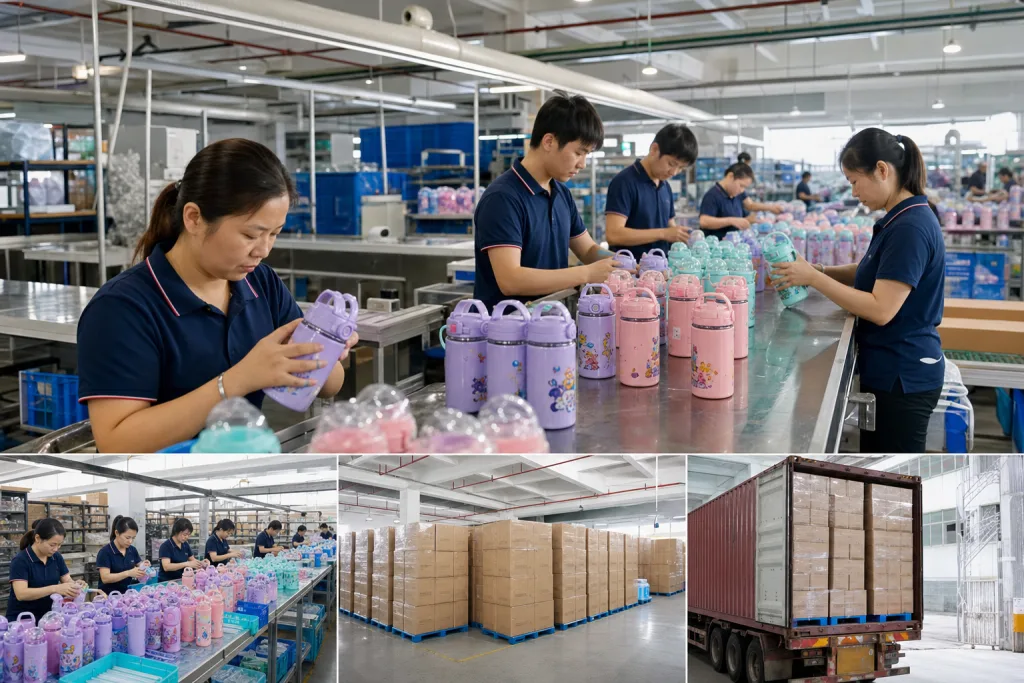
At BottleForge in Zhejiang, we see the same buying mistake about 20 times each spring: the buyer starts with Pantone color and logo size, then finds out the order needs a 25-day lead time instead of 35 days, a 24 pcs carton instead of 36 pcs, or a safer closure because schools reject sharp pull-tabs. A good children water bottle manufacturer should help you write the RFQ, confirm the pre-production sample, and turn that into a clean PO without guessing on MOQ, packing, or test reports. We run the line better when the spec is clear. That is how you buy bulk children water bottle orders in China without paying for avoidable mistakes.
Start With the Use Case
Before you ask any children water bottle supplier for a quote, pin down where the bottle will live. A bulk school water bottle for first graders is a different job from a retail custom kids water bottle for a summer campaign. On our line, we ask one blunt thing first: does it need to fit a 75 mm backpack pocket or a lunch tray holder? Younger users usually need a shorter straw, a one-hand push lid, and a body that stays steady in a side pocket. Older kids can handle a flip-top or sports cap, but the grip still needs to feel soft and the mouthpiece has to clean fast.
Write the brief in plain terms. State the age range, target quantity, preferred material, and whether the order is for school lunch use, after-school sports, or children water bottle promotional giveaways. If you are a children water bottle distributor, name the sales channel too, because the carton spec changes when we move from classroom packs to retail shelf display. Last month, QC pulled a sample because the buyer flagged a PO typo on “500ml” versus “500 ml” and the artwork file did not match. In Zhejiang, one mold can run three builds, but only when the use case is locked down.
Use this first document as your sourcing filter:
- Age group: 3-5, 6-8, or 9-12
- Capacity: 350 ml, 500 ml, 650 ml, or 750 ml
- Material: Tritan, PP, stainless steel, or glass with sleeve
- Printing: silk screen, UV, heat transfer, or laser on metal parts
- Compliance: FDA, CPSIA, REACH, LFGB, EN71 where needed
If your brief is vague, every children water bottle manufacturer will give you a different answer. If your brief is specific, a custom children water bottle turns into a clean project instead of a guessing game. This is the wrong question to ask if you start with color before use case. We have seen it go sideways when a buyer asked for a “kids bottle” with no MOQ, then the sample room built a 650 ml body while the sales file said 500 ml.
Write an RFQ That Prices Reality
A serious RFQ saves time on both desks. We price faster when the bottle, decoration, packaging, and tooling are split into separate lines, because a one-color logo on a flat 35 mm panel is a different job from full-wrap printing or a custom molded cap. Ask for FOB Ningbo or FOB Shanghai, not a loose unit price. If you want a custom made kids bottle with a new lid or base shape, make the supplier list tooling, sample fee, and mold timing. We have seen a PO say “same as sample” while the buyer expected a new silicone carry loop; QC pulled the sample, and the cap drawing had no loop at all.
For a bulk kids bottle order, the RFQ should include the line items buyers often forget:
- Bottle body material and wall thickness, such as 0.8 mm Tritan or 0.35 mm 304 stainless steel inner wall
- Lid type with gasket material named, plus straw length, straw diameter, and whether spare straws are packed
- Logo method with print area size, Pantone code, and whether the artwork crosses a curve or seam
- Packaging choice with board grade or box size, whether it is white box, color box, or PDQ
- Carton count per master carton, carton drop test requirement, and pallet stack height if the forwarder has a limit
Ask for separate pricing at 2,000, 5,000, and 10,000 units. Good. This shows where the real break sits for children water bottle wholesale. In China, the gap between MOQ and scale pricing can change the quote; on a simple molded bottle, you may see 8 to 15 percent better pricing at 10,000 units versus 2,000 units. The lowest line is not always the right target. For a school district buyer, the math does not work if a cheap lid has no replacement gasket, because one missing 18 mm silicone ring can turn into 600 parent complaints after delivery.
At our Zhejiang plant, a standard production line can handle 120,000 units per month on common kids bottle models, with a normal lead time of 25 to 35 days after sample approval. The line runs 6 cavity molds on several plastic lids, and we check straw fit with a simple go/no-go gauge before packing. That capacity matters if you are planning a back-to-school launch or a citywide program, because 12 days lost on artwork approval can push shipment from late July into mid-August.
Treat the Sample Like a Contract Draft
Do not approve a sample just because the color looks close under office light. Put it under a D65 light box, match it to the Pantone code on the PO, and check the bottle the way a 7-year-old will use it. If you are sourcing a customizable children water bottle, ask for the same print position, lid color, straw, gasket, and retail box planned for mass production. A sample with the wrong cap or a temporary logo is fine for checking shape, but the math does not work for PO approval.
When the sample arrives, check these points in order, and write the results on the sample tag:
- Leak test the bottle on its side and upside down for 24 hours, with the gasket seated by hand, not adjusted by the line supervisor
- Drop test from 1.2 m onto a hard floor, once filled and once empty, then check the hinge pin and base ring for cracks
- Open and close the lid 50 to 100 times by hand; if it feels tight at cycle 30, the buyer will flag it later
- Check odor, stain resistance, and edge smoothness around the mouth with a 0.2 mm feeler gauge and a white cloth wipe
- Confirm print adhesion after hot water and mild detergent, then run a tape pull test on the logo edge
For a children water bottle customized for schools, ask the factory to send a pre-production sample made with the final artwork file, production ink, and the gasket from the bulk material lot. If you are ordering from a children water bottle vendor in China, archive the sample approval email with front, side, bottom, lid, and carton photos. That email should state the approved size, weight, print location, carton spec, and exception items such as “blue cap accepted, logo 3 mm higher than drawing.” In a real export file, that sample becomes the reference when QC pulled the sample and the buyer says the logo moved.
For large programs, request two samples: one for internal approval and one sealed reference sample with a signed label across the opening. We ship these in separate polybags so nobody swaps the lid during counter-sample review. It is cheap insurance on a 5,000-unit bulk children water bottle order.
Lock the PO Line by Line
The PO is where control slips first. One typo on our side or yours can stop packing for half a day. Do not write only the quantity and unit price. A proper PO for a bulk kids water bottle needs every control point that affects quality, lead time, and customs clearance. If the bottle is a custom school water bottle, the PO should read like a shop-floor checklist, not a casual purchase note. We have seen a buyer flag a 1,200 pcs order that showed 12,000 pcs on the draft. The math does not work.
Use line items such as:
- Product name and capacity, with the exact size, such as 350 ml, 450 ml, or 600 ml
- Material grade and color code, including body, lid, and straw if they differ
- Logo method, print size, and Pantone reference, for example silk screen, 45 mm, Pantone 186 C
- Packaging spec, inner box count, master carton count, and carton mark format
- Test standard: AQL 2.5 for major defects, 4.0 for minor defects
- Certification documents: REACH, CPSIA, LFGB, or food contact declaration
- Replacement parts policy for lids, straws, and seals, including spare quantity and order lead time
This is also where you lock the commercial terms. If you are buying from a children water bottle supplier in China, state FOB, payment schedule, and whether tooling is prepaid or amortized into unit price. We run into trouble when a PO leaves out Incoterms and the freight forwarder books the wrong term by default. A normal structure is 30 percent deposit and 70 percent against copy of bill of lading, but school district buyers sometimes push for net terms through a local distributor. That only works if someone owns the cash gap. On the packing table, one missing payment clause can become a three-day hold.
For custom logo kids bottle orders, ask the factory to confirm overrun tolerance and under-run tolerance in writing. A practical tolerance is plus or minus 3 percent on finished quantity, but never assume it is automatic. QC pulled the sample from carton 18 last week because the PO said “red” and the print file showed a Pantone code instead. Small gap, big noise. China factories ship cleaner when the PO is tight. Vague POs create rework fast, especially when the same line is running three children water bottle custom colors in Zhejiang at once.
Check Compliance Before Bulk Production
For North America and Europe, compliance is not a final carton-stage checkbox. If you are buying a bulk children water bottle for children under 12, check both the base material and the decoration before we run mass production. Tritan, PP, stainless steel, and glass each raise different questions on food contact, impact risk, ink adhesion, and heavy metals. A children water bottle promotional item for a school event still gets treated like a retail product when it touches drinking water and moves in 5,000 or 20,000 pcs lots. We have seen this go sideways when a buyer approved the bottle body but forgot the heat-transfer print; QC pulled the sample after the 3M tape test and the artwork ink needed a separate migration review.
Ask the children water bottle manufacturer for the actual test report number, not a sales promise. For Europe, look for REACH and LFGB where relevant. For the U.S. market, ask about CPSIA and ASTM F963 if the item is marketed as a child product. If a metal bottle is involved, confirm coating safety, lead limits, and phthalate restrictions before the powder-coating line starts. If a straw or seal uses silicone, request the material grade and migration status; “food grade” written on a PI is not enough. Good children water bottle suppliers should show food-contact declarations within 24 to 48 hours, and a serious children water bottle factory will not push you to skip them. The math does not work if you save USD 180 on pre-production testing and then hold 12,000 pcs at the warehouse door because the buyer flagged the report date.
In Zhejiang, export-focused factories deal with these files daily, but you still need to ask early. China stays a competitive sourcing base because resin suppliers, mold shops, printing vendors, testing labs, and carton plants are often within a 2-hour truck run from Hangzhou. That speed only helps when the paperwork is ready before the deposit turns into steel cutting or material booking. If your school district needs supplier audit records, ask for BSCI, ISO 9001, or comparable factory documentation before you place the order. Check the company name, address, report holder, and product description against the PO; we once saw “kids battle” typed instead of “kids bottle” on a draft certificate, and the buyer’s compliance team rejected it. Better to reject a weak document set on day 2 than repair it after customs or a compliance review on day 28.
Manage Production, Packing, and Shipment
Once the bulk order is approved, the job moves to line control. A children water bottle wholesale order should not start mass production until we have 3 signed items on the board: the sealed sample, the approved AI/PDF artwork file, and the packing diagram. If you are working with a children water bottle distributor, ask for weekly status photos from the actual line, not showroom samples. If you are working direct with a children water bottle vendor, ask for a production calendar that shows molding, printing, assembly, QC, packing, and container loading; on one 18,000 pcs order, the buyer changed the straw color after pad printing started, and the schedule moved from 12 days to 18 days. The math did not work.
A useful factory control plan looks like this:
- Incoming material check on resin, stainless steel, and gasket batches, with lot numbers recorded before they enter the warehouse
- First-article approval at the beginning of printing and assembly, including logo position checked by caliper in mm
- Inline inspection every 2 to 3 hours, with QC pulling samples for leak test and lid torque check
- Final inspection using AQL 2.5 for major defects and AQL 4.0 for minor defects, with scratches, color shade, odor, and barcode scans logged
- Carton drop test and pallet stability check before loading, especially for 24 pcs and 48 pcs case packs
If you are shipping to Amazon or a retail DC, the carton markings and barcode labels matter as much as the bottle. No shortcut here. A children water bottle distributor supplying schools may need case-pack counts of 24 or 48 units, while a children water bottle retailer may need shelf-ready packaging with FNSKU applied on the correct panel. We have seen this go sideways when the PO said “blue lid” but the artwork file named “blue lead”; QC caught it before carton sealing, but it still cost half a shift. That is why a bulk school water bottle order should be planned around the destination. In China, even a small packaging change, such as switching from 5-ply white carton to kraft carton or adding a 60 mm barcode label, can shift the production schedule by 2 to 4 days, so confirm the final carton spec before the factory starts mass packing.
When the truck leaves the Zhejiang factory gate, your job is not over. Ask for loading photos, container seal number, gross weight, and one sealed master carton from the shipment archive. We run this archive carton with the same tape, label, and inner packing as the shipped goods, then hold it for at least 90 days. That gives you a clean record if the buyer flags short count, crushed cartons, or mixed colors later.
Send your spec and get a real factory quote
We can price your bulk children water bottle order, confirm samples, and align packaging for schools or retail before production starts in Zhejiang.
Frequently asked questions
What MOQ should I expect for a bulk children water bottle?
For standard molds, a realistic MOQ is 2,000 to 3,000 units per color and per logo setup. If you want a custom lid, new handle, or branded packaging, the MOQ often moves to 5,000 units because the factory needs to recover setup time. In China, a children water bottle factory may quote lower on a stock model, but the real total depends on print colors, carton type, and testing. For a school district order, I would rather see a clean 3,000-unit MOQ with stable quality than an unrealistically low quote that changes later.
Which material is best for school use?
For a bulk school water bottle, Tritan is usually the most practical when you want clear visibility, light weight, and decent impact resistance. A good Tritan body is often around 0.8 mm wall thickness and works well for children aged 6 to 12. Stainless steel makes sense if insulation matters, but it adds weight and cost. For younger children, PP can work if the design is simple and the lid is easy to clean. Ask the children water bottle supplier for food-contact documents and confirm the material grade before approving samples.
How long does custom production take in China?
For a stock mold with custom logo kids bottle decoration, normal lead time is 25 to 35 days after sample approval and deposit. If you need a new mold or custom lid, add 20 to 45 days for tooling and correction. A children water bottle manufacturer in Zhejiang with a mature line can produce around 120,000 units per month on common models, but that does not remove the need for planning. Freight booking, carton revision, and compliance documents can each add several days if you leave them late.
What should I test on a sample before bulk approval?
Test leakage for 24 hours, then do a 1.2 m drop test on a hard surface. Open and close the lid at least 50 times, check for sharp edges, and confirm the print still looks clean after hot water and mild detergent. If the bottle has a straw, check airflow and bite comfort. For a children water bottle customized for schools, I also recommend checking the carton count and barcode position because packing mistakes are expensive to fix after mass production starts.
How do I compare children water bottle wholesale quotes fairly?
Compare the full landed offer, not just the unit price. The quote should show bottle body, lid, print, packaging, testing, and shipping terms such as FOB or EXW. A quote that is USD 0.18 lower on paper can become more expensive once you add logo setup, export cartons, and replacement parts. For a children water bottle distributor, the real comparison is between total landed cost, defect risk, and the factory's ability to repeat the same quality on the next 10,000 units.