Key Takeaways
- For borosilicate glass, confirm wall thickness at 1.8-2.2 mm for common 500-750 ml bottles before approving tooling
- A practical MOQ for custom logo glass bottles is 1,000-3,000 pcs per color or sleeve type
- Use AQL 2.5 for major defects and 4.0 for minor defects, with separate drop-carton testing
- Retail packaging often adds USD 0.18-0.55 per unit but can cut transit breakage by 30-60%
A cracked silicone sleeve, a bamboo lid that seeps at the thread, or a 4 mm logo shift can kill a wellness launch faster than a delayed vessel. Glass looks clean on a Shopify page. On the line, a bulk borosilicate glass bottle order has weak points: mouth tolerance, sleeve fit, carton drop strength, and how the cap gasket sits after torque testing at 8–10 kgf·cm.
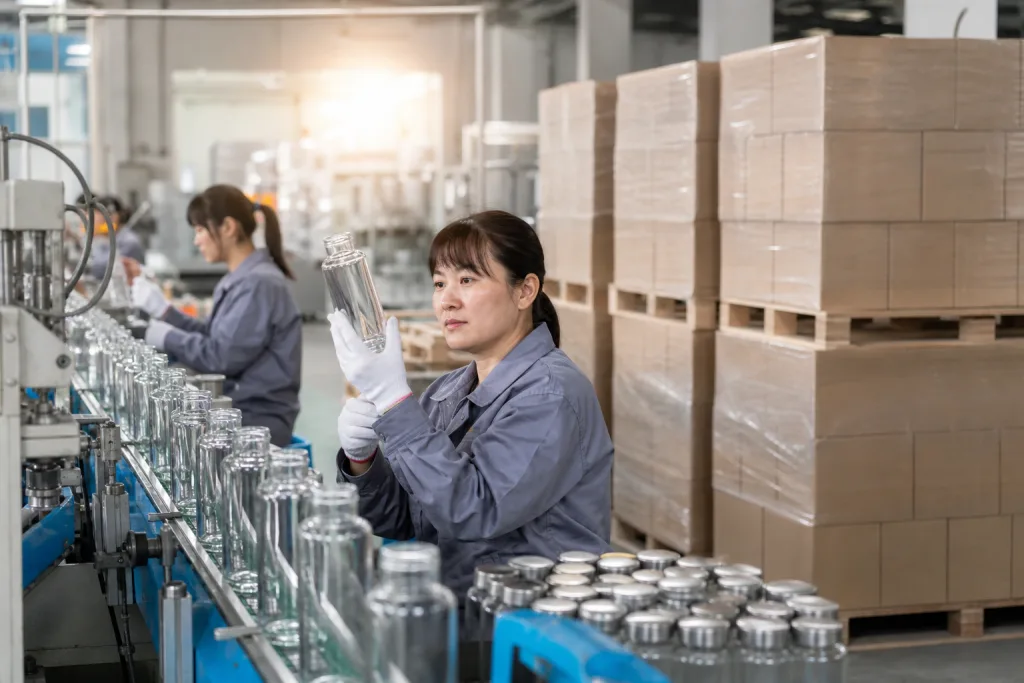
We manufacture drinkware in Zhejiang, China, and the painful cases usually do not come from bad intent. They come from drawings with no neck ID, packaging specs that only say “safe for export,” and QC plans copied from 304 stainless bottles. We have seen this go sideways: QC pulled 32 samples from a 3,000 pcs run and found lid leakage after a 30-minute inverted test. If you want borosilicate glass bottle bulk supply for retail shelves, gift sets, or subscription kits, spec around breakage before production starts.
Glass breaks before anyone admits it
The first failure mode is plain: breakage. The fight usually starts after delivery. The buyer says the borosilicate glass bottle supplier used weak packing; the factory says the forwarder crushed the cartons with a clamp truck. We have seen both. On one 20 GP order last year, QC pulled 12 cartons from the line and found two neck cracks before packing, so arguing after arrival is the wrong question to ask. Lock the packing method before you push for the final FOB price.
For a 500 ml to 750 ml bulk glass water bottle, we run checks on bottle contact points, inner box paper weight, and export carton burst strength. A thin white tuck box looks clean for a sustainable retailer, but 300 gsm paper will not survive courier sorting or Amazon-style mixed pallet movement by itself. If the bottle has a silicone sleeve, it helps side impact; it does almost nothing when the neck hits the insert gap or the base lands on a carton seam.
A sensible baseline is an individual kraft or white box with a molded pulp or corrugated insert, packed into a 5-ply export carton with carton gross weight under 15 kg. For e-commerce sets, ask for a 76 cm drop test on one corner, three edges, and six faces. For wholesale pallet shipments, carton compression matters more than one dramatic drop. Simple test: stack five loaded cartons overnight and check whether the bottom carton has sunk more than 8 mm.
Do not accept the phrase standard export packing without photos, carton dimensions, and a test method. A borosilicate glass bottle vendor in China can quote USD 0.08 cheaper by removing the insert. The math does not work. If 3% of bottles arrive broken on a 5,000 pcs PO, that is 150 customer complaints, and the retailer will charge back the shelf price, not your factory cost.
Wall thickness is not a decoration
Borosilicate is chosen because it handles thermal shock better than ordinary soda-lime glass, but it is still glass. We have seen complaints start with a nice light hand sample, then 12 cartons into mass production QC finds the base at 3.4 mm, the rim at 1.6 mm, and the shoulder pulled off-center by the forming mandrel. A custom borosilicate glass bottle needs measured ranges, not only capacity and height.
For most wellness and sustainable retail programs, 1.8-2.2 mm wall thickness works for 500 ml and 750 ml formats. Go below 1.8 mm and side-impact risk jumps when the bottle hits a tiled floor during drop testing. Go too thick and the math doesn't work: higher glass weight, higher carton gross weight, and a bottle that buyers stop calling “daily carry.” Check the rim. A mouth opening around 32-45 mm is common, but the sealing face needs to stay flat enough for the silicone gasket; our QC team checks this with a digital caliper and a simple leak test after lid assembly.
Ask the borosilicate glass bottle factory for a technical drawing showing capacity tolerance, total height, body diameter, mouth inner diameter, mouth outer diameter, weight range, and wall thickness tolerance. If the supplier only sends a lifestyle render, do not issue the purchase order yet. The buyer flagged this on one 750 ml project because the PO said “wide mouth,” while the drawing showed 38 mm inner diameter and the filter basket needed 42 mm.
At our Zhejiang facility, a typical glass bottle program runs 80,000-120,000 units/month depending on sleeve work and printing complexity. That output only helps when the control plan is written down and the line knows which sample is the master. For a borosilicate glass bottle customized with sleeve, lid, and logo, approve golden samples, then keep one sealed reference sample at the factory and one at your office; we label ours with item code, revision date, and approved weight range before mass production starts.
Lids leak when tolerances drift
The glass body gets the showroom attention. The lid creates 7 out of 10 after-sales complaints we see on bottle programs. Bamboo caps crack when the blank is overdried, stainless lids dent when the sheet gauge is too light, PP lids warp after hot-fill testing, and silicone rings get twisted by hand assembly at the packing table. A borosilicate glass bottle custom order should treat the lid as a working assembly with measured fit, torque, and gasket compression, not a decorative add-on.
The common lid structures are bamboo outer with stainless or PP inner, full stainless steel, PP flip lid, or screw cap with carry loop. For wellness brands, bamboo looks natural, but it needs moisture control and clean finishing. We run bamboo incoming checks at 8% to 12% moisture with a pin meter; above that, the cap may shrink after 30 days in a dry warehouse. Poor coating shows up fast too, usually as dark stains or hairline splits within 1 mm of the rim. A lid leak test belongs in production QC, not on one golden sample from the sales office.
Our usual test is simple: fill the bottle to 90%, close the lid by normal hand force, invert for 10 minutes, then roll it horizontally for 2 minutes. For sports or travel positioning, add a 30-minute side-lay test. If the product is sold as leakproof, define the method and pass rate on the PO. We have seen this go sideways when a buyer wrote “no leaking” but did not state angle, time, fill level, or sample size; QC pulled the sample, the buyer flagged it, and both sides argued over 2 drops on the carton liner.
For gasket material, food-grade silicone is the normal choice. Ask for LFGB, FDA, or relevant food-contact documentation based on your sales market. For Europe, REACH and food-contact compliance should be lined up before the container leaves Ningbo or Shanghai, because chasing paperwork after sailing usually costs 5 to 12 days. China suppliers can provide documents, but state the target market clearly and match it to the SKU list; one typo on a PO, such as “US” instead of “EU,” can send the wrong test report into your customer file.
Customization fails at small details
A borosilicate glass bottle customizable program usually covers screen printing, decal, laser engraving on a metal lid, sleeve color matching, custom box, hang tag, barcode label, or retail insert. The costly failures are small: Pantone 186C printed closer to 185C, a logo tilted 2 mm after the jig slipped, print placed 12 mm too low, barcode below scanner grade C, sleeve color different from the approved sample, or carton mark missing the distributor SKU. QC sees this.
Screen printing on glass is clean and cost-effective for one to two colors. A typical logo setup fee may run USD 40-80 per color, with unit print cost around USD 0.05-0.18 depending on size and quantity. We run a curved screen fixture on the line; if the artwork is wider than the safe print area, the edge will stretch on a 65 mm bottle body. Decals handle richer graphics, but they add cost and need controlled curing. Laser engraving works well on stainless caps. Bamboo engraving is different: the grain changes cap to cap, and the buyer should accept natural color variation before PO approval.
If you are ordering a customized glass water bottle for retail, send vector artwork, Pantone references, logo placement in millimeters from the base or shoulder, and clear print area limits. Do not write “same as mockup” unless the mockup has dimensions. This is the wrong question to ask after mass production starts. A 3D render can hide the curve distortion that appears on the actual bottle, so we usually ask for a flat AI/PDF file and mark the position with a caliper reading, such as 78 mm from bottle base to logo bottom.
For private label and promotional projects, we suggest a pre-production sample after artwork confirmation, even if it adds 5-7 days. For a borosilicate glass bottle promotional order of 2,000 pcs, skipping that sample may save a week but can expose you to a full reprint. The math does not work. We have seen this go sideways when a PO had one typo in the barcode number and QC pulled the sample only after cartons were printed. If you are a borosilicate glass bottle distributor managing several retail accounts, lock one shared brand standard sheet so every reorder matches the first shipment.
Compliance paperwork arrives too late
A common failure is treating “borosilicate glass” as a compliance shortcut. It isn’t. The glass body matters, but the test report decides whether the buyer’s QA desk releases the PO. We have seen a German retailer hold 6,000 pcs because the cap paint was tested, but the silicone gasket was missing from the file. Wellness brands and sustainable retailers often ship the same SKU into 3 markets, so one custom glass water bottle order may need U.S. food-contact paperwork, EU files for Germany or France, and a retailer RSL sheet.
Ask your borosilicate glass bottle manufacturer for food-contact test reports covering the glass, lid components, silicone gasket, coating, and printed areas if ink can touch hands or mouth. Check the sample name, material color, and model number against the PO; one typo like “350ml” instead of “500ml” can get the file rejected. For the EU, buyers often request LFGB or EU 1935/2004 related testing, plus REACH for restricted substances. For the U.S., FDA food-contact suitability is commonly requested. If the bottle is for children, the rules become stricter and may involve ASTM or CPSIA checks.
BSCI, Sedex, ISO 9001, or similar factory audits do not prove product safety. They say something about management systems or social compliance. Useful, yes. Not enough. This is the wrong question to ask if the buyer wants to know whether the bamboo lid glue, powder coating, or silicone ring passed migration testing. A serious borosilicate glass bottle supplier keeps factory audit files separate from product compliance files, and QC should be able to pull both folders before final inspection.
Timing matters. Third-party testing can take 7-12 working days, longer if a report fails and the component must be changed. Build that into the launch calendar. We run production fast, but labs do not bend time because the vessel booking is Friday. If your retailer requires documents before issuing a vendor number, test approved production materials, not a random showroom sample from last year’s shelf. We have seen this go sideways: the buyer approved a clear bottle sample, then the line used a new colored sleeve, and the whole report set had to be reopened.
MOQ and price hide the tradeoffs
Price pressure causes bad calls in borosilicate glass bottle wholesale sourcing. We see it every month. You receive three quotes, one is USD 0.35 lower, and it looks like a win. Then QC pulled the sample and found a 0.45 mm thinner carton wall, no individual box, a generic lid, no leak test record, and a sleeve color picked from stock. The unit price was not comparable.
For a basic 500 ml borosilicate bottle with standard lid and simple one-color logo, a realistic MOQ is often 1,000-3,000 pcs. For a custom sleeve color, custom mold, or multi-color retail packaging, expect 3,000-5,000 pcs or more. FOB China pricing can range widely, but 7 out of 10 retail-ready programs we quote land around USD 1.80-4.20 per unit before ocean freight, duties, and local handling. Gift box sets, infusers, or premium bamboo caps raise that number, and the math does not work if the buyer wants 800 pcs with a new Pantone sleeve and a die-cut box.
Lead time from a Zhejiang, China factory is usually 25-40 days after deposit and sample approval for repeatable designs. New molds or unusual caps can add 15-25 days. If a borosilicate glass bottle vendor promises 12 days for a fully customized launch during peak season, ask what they are skipping. We run the annealing oven schedule tight in September, and one delayed silicone gasket batch can turn 25 days into 38 days.
Compare quotes line by line: glass thickness, lid material, gasket material, sleeve grade, printing method, inner box, carton spec, AQL level, testing, and Incoterm. FOB Ningbo and EXW Hangzhou are not the same landed cost. Small line item, big bill. A good borosilicate glass bottle manufacturer should explain the tradeoffs instead of pretending every spec can be premium and cheap at the same time; we have seen this go sideways when a PO typo changed “individual kraft box” to “bulk pack” and the buyer flagged it only after cartons reached the forwarder.
Inspection must match glass risk
QC for glass should not be copied from metal tumblers. This is the wrong question to ask. A dented stainless bottle may still sell at a 15% discount. A cracked glass bottle is scrap, and it can cut a user. We split the checklist into cosmetic issues like bubbles and print scratches, functional issues like lid wobble or gasket shift, safety issues such as cracks and sharp rims, plus packaging issues found after a 1.2 m carton drop test.
Use AQL 2.5 for major defects and 4.0 for minor defects as a practical commercial baseline. Critical defects, including sharp edges, visible cracks, broken glass, severe contamination, or failed leak testing, should be zero tolerance. We run capacity with a 1,000 ml measuring cylinder, check weight on a 0.1 g digital scale, test lid fit by hand and then with a simple leak jig, confirm gasket placement, print position within the approved mm tolerance, sleeve fit, barcode scan, carton marks, and drop-carton results. For borosilicate glass bottle distributors, add assortment checks if multiple colors or SKUs ship in one container; we have seen one PO typo turn “matte blue 24 cartons” into mixed blue and green cartons on the line.
Ask for inline QC photos when glass bodies arrive, after lid assembly, after printing, and before carton sealing. A final random inspection helps, but it is late. If the sleeve color is wrong at 80% completion, QC only confirms the loss. It does not prevent it. Last season a buyer flagged a gray silicone sleeve that looked warm beige under warehouse lights; QC pulled the sample beside the Pantone card before carton sealing, and we fixed 36 cartons instead of reworking 420 cartons.
For a borosilicate glass bottle manufacturers shortlist, ask how they handle rejects. Are cracked bodies destroyed in a separate bin? Are cosmetic seconds mixed into B-grade stock? Are replacement lids, gaskets, and sleeves packed in marked polybags? The answers tell you more than a glossy catalog. A reliable borosilicate glass bottle supplier in China will accept a clear checklist because it cuts arguments, protects the line, and keeps repeat orders moving.
Send your glass bottle spec before you buy
Share capacity, lid, sleeve, logo, packaging, market, and target price. We will flag the risky parts before sampling.
Frequently asked questions
What MOQ should I expect for a bulk borosilicate glass bottle order?
For a standard bottle shape with one-color logo, a realistic MOQ is usually 1,000-3,000 pcs. If you need a custom silicone sleeve color, printed retail box, or a non-stock lid, plan for 3,000-5,000 pcs. A fully new mold can require 10,000 pcs or a separate tooling charge. Some borosilicate glass bottle vendors will quote 500 pcs, but the unit cost is normally high and customization choices are limited. For wellness brands testing a new SKU, we often suggest starting with an existing 500 ml or 750 ml mold, then adding logo, sleeve, and packaging customization before investing in a new shape.
Is borosilicate glass better than regular glass for water bottles?
For reusable drinkware, borosilicate glass is usually the better choice because it has stronger thermal shock resistance than common soda-lime glass. That matters when users add warm water, wash bottles in hot water, or move between cold and room-temperature environments. It does not mean the bottle is unbreakable. Wall thickness, base design, annealing quality, packaging, and lid fit still matter. For a custom glass water bottle sold through sustainable retail, borosilicate also gives a better quality story, but you should avoid overstating claims. It is heat-resistant glass, not impact-proof glass. A silicone sleeve can reduce side-impact damage, but it will not protect every drop.
How much does a customized borosilicate glass bottle cost?
For most 500-750 ml retail-ready bottles, FOB China pricing often falls between USD 1.80 and USD 4.20 per unit, depending on glass weight, lid type, sleeve, logo process, box, and testing requirements. A simple one-color printed bottle with standard cap sits near the lower end. Bamboo lid, silicone sleeve, custom box, insert, and barcode labeling push cost upward. Ocean freight, duty, domestic trucking, and retailer prep are not included in FOB pricing. When comparing borosilicate glass bottle suppliers, make sure every quote includes the same carton spec, logo method, AQL inspection level, and compliance document scope.
Can I use borosilicate glass bottles for promotional campaigns?
Yes, but promotional does not mean careless. A borosilicate glass bottle promotional order still needs leak testing, logo approval, carton protection, and realistic delivery timing. For event giveaways, 1,000-2,000 pcs with screen printing is common. Lead time is usually 25-35 days after artwork and sample approval, plus shipping. If the campaign has a fixed event date, confirm whether you are shipping by sea, air, or courier before approving the PO. Air freight can cost more than the bottle on low-volume urgent orders. For best results, keep the design simple: stock bottle shape, one-color logo, standard lid, and a protective individual box.
How do I choose between borosilicate glass bottle manufacturers in China?
Do not choose only by the lowest unit price. Ask for a drawing with tolerances, recent food-contact test reports, packaging photos, AQL inspection standards, production lead time, and references for similar export orders. A serious borosilicate glass bottle manufacturer should explain wall thickness, lid structure, gasket material, and carton drop-test method without hesitation. For Europe and North America, also ask about REACH, LFGB or FDA-related documentation, and retailer labeling support such as SKU, barcode, or FNSKU labels. If you are a distributor glass water bottle buyer, choose a factory that can repeat colors and packaging across reorders, not just make one attractive sample.