Key Takeaways
- A practical MOQ for custom bulk blender bottle projects is usually 3,000-5,000 pcs per color
- Standard PP shaker bottles often land at USD 1.10-2.40 FOB China depending on lid, logo, and packaging
- Allow 35-55 days from artwork approval to shipment for repeat orders, longer for new molds
- The cheapest quote often excludes testing, retail packaging, AQL inspection, and stronger export cartons
A bulk blender bottle order looks simple until the first price sheet lands. One supplier quotes USD 1.35, another quotes USD 2.20, and both say “custom logo included.” They are usually pricing different resin grades, shaker balls, lid seals, carton burst strength, inspection levels, or delivery terms. Last month QC pulled two 600ml samples from the line: same logo, but one lid gasket was 1.8 mm and the other was 2.4 mm. Big difference.
If you are buying bulk drinkware for a fitness brand, supplement company, corporate program, or distributor, the wrong question is “who is cheapest?” Your job is to lock a cost structure that survives sampling, artwork changes, production delays, and pre-shipment inspection. We run most blender bottle projects from 3,000 to 50,000 pcs per PO, and a small typo like “matte black” instead of “black PP” can add 12 days to sampling. From our factory base in Zhejiang, China, the numbers below are the ranges we see buyers actually work with.
Start With The Bottle Cost
For a standard 600-800 ml bulk blender bottle, the first cost line is material, then mold cycle time, lid design, and the small accessories packed inside the carton. A basic PP body with a screw lid, flip cap, mixing ball, and one-color print is usually around USD 1.10-1.55 FOB Ningbo or Shanghai at 10,000 pcs. If the buyer asks for thicker wall PP or Tritan-style clarity, plus a leak-resistant carry loop, embossed ml/oz marks, and a better silicone ring, the same bottle often moves to USD 1.80-2.40. We run this costing from the BOM sheet, not from a photo. Last month QC pulled a pre-production sample where the lid gasket was 0.4 mm under spec, and that small ring was the reason the bottle failed the upside-down leak test.
The body wall matters. A cheap promo bottle may use roughly 1.2-1.5 mm wall thickness in key areas. A stronger retail bottle may be 1.8-2.2 mm, with more resin weight and less hand flex. Buyers often push us on logo cost first; this is the wrong question to ask if the plastic weight is still open. A 15 g difference in plastic weight across 20,000 pcs is not cosmetic; it is resin on the scale, cartons on the pallet, and money on the PO. On the line, we check wall thickness with a digital caliper at the shoulder and grip area because those two points show weak molding fast.
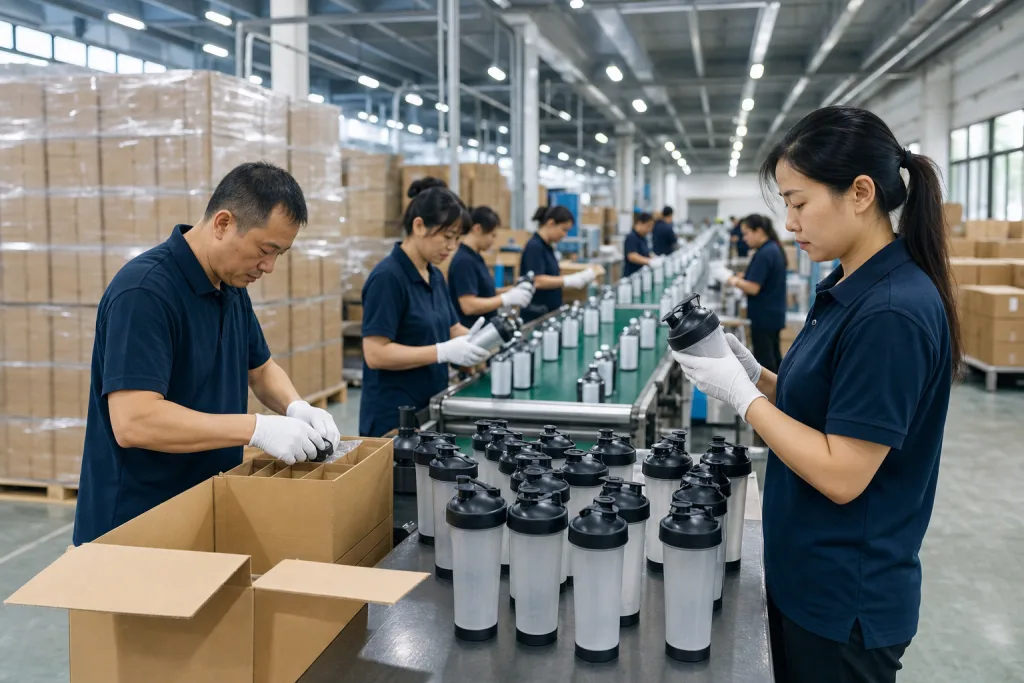
Shaker balls and grids also change the quote. Stainless steel whisk balls cost more than PP mixer grids, but they give a stronger fitness-retail feel and are easier to show on a supplement brand’s side panel. If you sell the best wholesale drink bottle to gyms or supplement brands, this small part affects perceived value. We have seen this go sideways when a buyer approved a PP grid in the sample but the retail team expected a steel ball after seeing the mockup. One part. Big complaint. Our packing table usually checks the ball or grid by weight count per inner box before sealing, because missing mixers are the kind of defect end users notice in 10 seconds.
At BottleForge Industrial in Zhejiang, our normal monthly drinkware output is about 450,000-600,000 units across shaker bottles, tumblers, canteens, growlers, and stainless items. That capacity helps, but it does not cancel the math: better material, tighter lids, and heavier cartons cost more. We ship from Ningbo or Shanghai, and a carton that gains 1.8 kg after a lid upgrade will show up in freight planning. The buyer may only see a few cents on the unit price, but our warehouse sees the CBM, the drop-test result, and the pallet height before the container is booked.
MOQ Tiers Change Unit Price
MOQ is where new buyers usually read the quote wrong. We can mold 500 pcs on the floor, sure, but the line still needs the injection machine set, color masterbatch weighed, silk-screen mesh prepared, artwork checked, and export cartons packed. That work does not shrink much just because the order is small. For custom bulk blender bottle projects, a realistic MOQ is usually 3,000 pcs per color for existing molds and 5,000 pcs per color if the Pantone match is tight or the lid assembly has extra parts like a flip cap, spring, or silicone gasket.
A normal tier looks like this: 3,000 pcs sits at the highest unit price, 5,000 pcs saves a little, 10,000 pcs is where the saving starts to show, and 30,000 pcs is where resin purchasing and line changeover time begin to matter. The gap between 3,000 and 10,000 pcs may be USD 0.12-0.28 per unit. The gap between 10,000 and 30,000 pcs is often smaller unless we also adjust the carton size, inner bag, or pallet loading. Last month QC pulled a 600 ml shaker sample because the carton mark showed 24 pcs while the PO said 48 pcs, and that kind of packing mismatch can erase the price saving fast.
The same math applies when you source canteen bulk, wholesale canteen, growler bulk, or alcohol flask bulk programs. Drinkware bulk pricing is not one magic MOQ. It depends on color count, decoration method, carton configuration, and whether we can run the items together without washing the hopper or changing fixtures every few hours. A buyer asking for 2,000 black bottles, 2,000 blue bottles, and 2,000 red bottles may pay more than a buyer taking 6,000 black bottles. The math doesn't work when three small colors create three setup records, three first-article checks, and three chances for color drift under the light box.
If you are building a mixed wholesale drinkware order, ask for a tiered quote by SKU and color. Combining bulk canteen, bulk growler, beer tumbler bulk, and shaker bottles in one shipment may reduce freight per unit, but it does not always reduce factory unit cost unless materials and production lines are compatible. We ship mixed containers often, but PP shaker bodies, stainless growlers, and painted beer tumblers do not share the same line, tooling, or inspection table. Ask the supplier to mark which items can be run together. Simple question. It prevents a messy quote.
Logo And Packaging Add Up
Decoration is never a single line on the cost sheet. For a bulk blender bottle, we usually quote silkscreen printing first, then price heat transfer for full-wrap graphics, in-mold label when the MOQ supports new tooling, sticker label for short runs, sleeve packing for retail sets, or laser marking on a metal whisk ball or lid trim. One-color silkscreen on one side may add USD 0.05-0.12. Two-sided or multi-color printing can reach USD 0.15-0.35, especially when the logo sits 3 mm from raised measuring marks and the print jig has no room to drift.
Retail packaging changes the math fast. A plain polybag and export carton is cheap. A custom color box can add USD 0.18-0.45 depending on 350 gsm versus 400 gsm paperboard, matte lamination, inner tray, barcode label, and whether we pack 24 pcs or 48 pcs per master carton. If you need FNSKU labels for marketplace fulfillment, add labor and a labeling control step. It is small per unit, often USD 0.03-0.08, but the math does not work when QC finds one swapped SKU after 86 cartons have already been sealed for a Europe warehouse booking.
For drinkware wholesale, packaging has to survive handling. Cheap cartons look good on a spreadsheet. A weak 5-ply carton may pass the first quote comparison and fail during transport, especially after two forklift transfers and a wet container floor. We usually recommend export cartons around 12-18 kg gross weight for plastic shaker bottles, with carton dimensions that keep stacking stable. For stainless items like bulk growler, beer growler wholesale, or alcohol flask wholesale, dividers and thicker cartons are not optional if you want low dent rates; we have seen 0.5 mm sidewall dents turn into a buyer claim on arrival photos.
Artwork approval also affects lead time. If your logo file is a low-resolution PNG, somebody must redraw it in AI or PDF, and that can add 1 day before sampling even starts. If your brand color is specified as “dark green,” you will get arguments. Use Pantone codes, confirm print size in millimeters, and approve a digital proof before sample printing. QC pulled one sample last month where the PO said 65 mm logo width, the artwork note said 56 mm, and the buyer flagged it only after the first pre-production print.
Testing And Compliance Budget
For buyers in Europe and North America, compliance is not decoration. A shaker bottle touches food, and our line often sees protein powder residue, lemon water, or 70°C hot water used during cleaning tests. For plastic bottles, discuss FDA food-contact requirements, EU 10/2011, LFGB where needed, BPA-free documentation, and REACH for lid pigments, PE bags, or printed cartons. For children’s drinkware, ASTM and CPSIA questions may enter the project. Ask before tooling. We once had QC pull a PP lid sample because the PO said “sports cup,” while the artwork showed a child under age 3.
Testing cost depends on the selling market and exact material. A basic food-contact test package may run from USD 250-800 per material and color family. If you use Tritan body material, PP lids, silicone gaskets, stainless balls, UV coating, and 3 lid colors, the lab quote is no longer one line item. The math changes fast. A buyer who tests only the bottle body but ignores the gasket has not controlled the risk; we have seen silicone rings fail odor checks after 24 hours in warm water.
Factory audits matter for larger distributors. BSCI, ISO 9001, or customer-specific audits do not make a bottle leakproof, but they show whether the factory has process discipline: injection records, resin batch cards, torque gauges, and signed packing checks. In China, export drinkware factories vary widely. Some are trading companies with good English and no production floor. Others, especially in manufacturing clusters around Zhejiang, keep molding, assembly, and packing under tighter control. This is where buyers get fooled—the sample room looks clean, but the carton sealing table tells the truth.
Quality inspection should be quoted clearly. For bulk blender bottle orders, we normally suggest a pre-shipment inspection using AQL 2.5 for major defects and AQL 4.0 for minor defects, unless your brand standard is stricter. Checkpoints should include leakage, cap torque, print adhesion, odor, body scratches, color match, barcode scan, carton drop condition, and quantity count. We run a 30-minute upside-down leak test on pulled samples, then check the cap torque with a handheld torque meter before sealing cartons. Budget USD 250-350 per inspector-day if you hire a third party in China.
Lead Time By Project Stage
A workable lead-time plan starts before the purchase order. For an existing mold bulk blender bottle, expect 3-7 days for quotation and artwork checking if your specs are complete: capacity, plastic grade, logo size in mm, Pantone code, packing method, and target MOQ. Physical samples usually take 7-12 days for plain stock colors and 10-18 days for custom color with logo. International sample shipping adds another 3-6 working days. Missing artwork slows everything. Last month QC pulled the sample because the buyer’s PO said “black lid,” but the AI file showed a navy lid ring.
After sample approval and deposit, mass production commonly takes 25-35 days for 5,000-20,000 pcs. Add 5-10 days if the order has 4 body colors, retail boxes with barcode stickers, or a busy season before summer promotions. A repeat order with no artwork change can move faster, often 30-40 days total from deposit to vessel loading. A first order with color matching, revised samples, and third-party testing is safer at 50-70 days. We run the line faster when the color masterbatch is approved before deposit; waiting until production week is where the math doesn't work.
New mold projects are different. If you want a proprietary lid, custom body shape, or patented-looking mixer system, tooling may take 30-45 days before mass production starts. Tooling cost for a plastic shaker bottle set can range from USD 4,000-18,000, depending on cavities, lid complexity, and surface finish. Ask for the mold drawing. On the factory floor, we check the first T0 samples with a caliper at the thread, leak-test the lid for 30 minutes, then mark the sink areas with tape. Do not start new tooling if your launch window is already tight.
The same timeline discipline applies to adjacent items: beer growler in bulk, beer tumbler wholesale bulk, alcohol flask wholesale bulk, or growler wholesale programs. Different products run on different lines, so one late cap, gasket, or gift box can hold the whole container. We’ve seen this go sideways when a buyer pushed blender bottles for 28-day shipment, then added canteen wholesale and wholesale growler SKUs that needed 18 days just for powder coating. If your container combines wholesale growler, canteen wholesale, and blender bottles, set the shipping date based on the slowest SKU, not the fastest quote.
Freight Terms And Cash Flow
Most Chinese drinkware quotes come as FOB, usually FOB Ningbo or FOB Shanghai for Zhejiang factories like ours. Under FOB, we handle local trucking, export declaration, and loading at the port; you still pay ocean freight, destination charges, duty, customs clearance, trucking, and warehouse handling. A buyer once sent a PO with “domestic delivered” in the remarks and asked why the freight line was missing. That is the wrong question to ask.
For plastic bulk blender bottle orders, cartons are bulky but light. Freight is charged by volume, so carton size and pack count move the math fast. A 700 ml shaker bottle packed 48 pcs per carton can take far less container space than the same bottle in oversized retail boxes packed 24 pcs per carton. We checked one run on the line with a tape measure and found a 62 x 42 x 38 cm carton beating a prettier box by a clear margin. On a 20,000 pc order, that can shift landed cost by several cents per unit.
Payment terms hit cash flow right away. A common term is 30% deposit and 70% balance before shipment. For an established buyer, some factories will talk about a partial balance against a bill of lading copy, but a first order is not a credit line. QC pulled the sample, the finance desk waited for the deposit, and the booking held until both were in. We have seen buyers plan launch dates around a retailer’s payout and then get stuck. Align the payment schedule before you issue the PO.
For wholesale drinkware programs, landed cost is the number that counts. Add unit price, logo, packaging, testing, inspection, freight, duty, and inland delivery. A bottle that is USD 0.12 cheaper FOB can still end up higher once you move to a larger carton, fail inspection, or miss the vessel and ship by air. The buyer flagged a typo on one PO that changed the pack count, and that one line changed the whole margin. Run the full math before you approve the order.
Quote Requests That Get Answers
A good RFQ saves days. Don’t send “price for bulk blender bottle” and expect a clean quote. Send capacity, material preference, target market, MOQ expectation, logo method, packaging, testing needs, delivery term, and launch date. If you already sell drinkware wholesale, add your current defect tolerance, carton size limit, and max carton weight; one US buyer capped us at 13.5 kg because their warehouse team rejected heavier cartons. Less guessing, faster pricing.
Use a simple specification table: 700 ml PP body, screw lid with flip cap, stainless whisk ball, one-color logo 60 x 40 mm, Pantone body color, individual polybag, 48 pcs per export carton, FOB Ningbo, 10,000 pcs, EU food-contact test required, AQL inspection before shipment. That request can be quoted properly. The line can check mold availability, pad-print fixture size, and carton CBM before sales sends a number. A vague request usually gets a cheap placeholder price, and the math doesn’t work once real packaging and testing are added.
If you are also sourcing beer tumbler in bulk, beer growler wholesale bulk, alcohol flask in bulk, or bulk canteen items, separate the specs by product. Do not force one supplier to quote everything from one sentence. Some factories are strong in plastic injection; others run better stainless vacuum insulation, with different leak-test machines and polishing labor. We’ve seen this go sideways when a buyer mixed PP shaker bottles and 304 stainless tumblers on one PO line, then asked why the sample lead time was 12 days vs 18 days. A practical China sourcing plan can use one coordinated shipment, but not necessarily one production line.
At BottleForge Industrial, our export team in Zhejiang prefers uncomfortable details early: target price, required certification, whether the order is for retail or promotion, and what happens if the shipment is seven days late. Say it early. Last month QC pulled the sample after the logo artwork showed 60 x 40 mm on the PO but 50 x 35 mm in the AI file. That honesty helps us say yes, no, or “change this spec” before you lose three weeks on samples that never had a commercial chance.
Send Your Blender Bottle Specs For A Real Quote
Share capacity, material, logo, packaging, MOQ, and market. We will return FOB pricing, lead time, and practical cost-saving options.
Frequently asked questions
What is the normal MOQ for a custom bulk blender bottle?
For existing molds, the practical MOQ is usually 3,000 pcs per color. If you need Pantone color matching, custom lid components, or a more complex logo, 5,000 pcs per color is more realistic. At 10,000 pcs, factories can usually improve resin purchasing and line efficiency, so the unit price may drop by USD 0.12-0.28 compared with a 3,000 pc run. Below 1,000 pcs, most custom work becomes inefficient unless you accept stock colors, stock packaging, and a simple one-position print.
How long does a first order take from China?
For a first bulk blender bottle order from China, plan 50-70 days from confirmed artwork to vessel loading if sampling, color matching, and testing are included. A plain sample can take 7-12 days, while a logo sample may take 10-18 days. Mass production after deposit is normally 25-35 days for 5,000-20,000 pcs. Add time for third-party inspection and export booking. Repeat orders with the same spec can often ship in 35-55 days, depending on season and material availability.
Can I combine blender bottles with canteen or growler products?
Yes, but treat each item as its own production project. Bulk blender bottle, bulk canteen, wholesale growler, and beer tumbler wholesale orders may use different materials, molds, workshops, and packing methods. Combining them in one container can reduce freight per unit, especially for bulky drinkware bulk shipments, but it does not automatically reduce factory unit cost. Ask for separate unit prices, separate production lead times, and one consolidated shipping plan. The shipment date should be based on the slowest item, not the easiest shaker bottle.
Which tests should I request for blender bottles?
For Europe, discuss EU 10/2011 food-contact testing and REACH where relevant. For the U.S., ask about FDA food-contact compliance. If the item is used by children, ASTM and CPSIA requirements may apply. A useful test plan covers the bottle body, lid, silicone gasket, colorants, and stainless whisk ball if included. Basic testing often costs USD 250-800 per material group, but the exact scope depends on your market. Also run a pre-shipment inspection with leakage, odor, print adhesion, barcode, and carton checks.
What price should I expect for wholesale drinkware shaker bottles?
A standard PP shaker bottle for wholesale drinkware programs often falls around USD 1.10-2.40 FOB China, depending on capacity, wall thickness, lid design, mixer type, logo, and packaging. A basic promotional bottle with one-color print and polybag sits near the low end. A retail-ready bottle with heavier body, stainless whisk ball, color box, barcode, and stricter inspection moves toward the high end. Always compare quotes on the same FOB term, same carton packing, same test requirement, and same AQL standard.