Key Takeaways
- 304/18-8 stainless steel is the usual buyer-safe baseline; expect 0.4-0.6 mm wall thickness for vacuum bottles
- Typical custom MOQ is 3,000 pcs, with 25-35 days production after sample approval
- A good BPA-free stainless steel bottle should pass REACH, LFGB, FDA, and insulation tests before shipment
- For kids, schools, hotels, and restaurants, lid design matters as much as steel grade because leak risk drives complaints
If you are sourcing a BPA-free stainless steel bottle, the real decision is not “stainless or not.” It comes down to three points: grade, structure, and use case. A 500 ml retail bottle needs different tooling, coating, and margin math than a BPA-free stainless steel bottle for schools or a hotel amenity set. Get that wrong and you pay for returns, weak insulation claims, or customs trouble. We’ve seen a buyer push a school order through with the wrong lid spec, and the line had to stop for a new silicone gasket before QC could clear it.
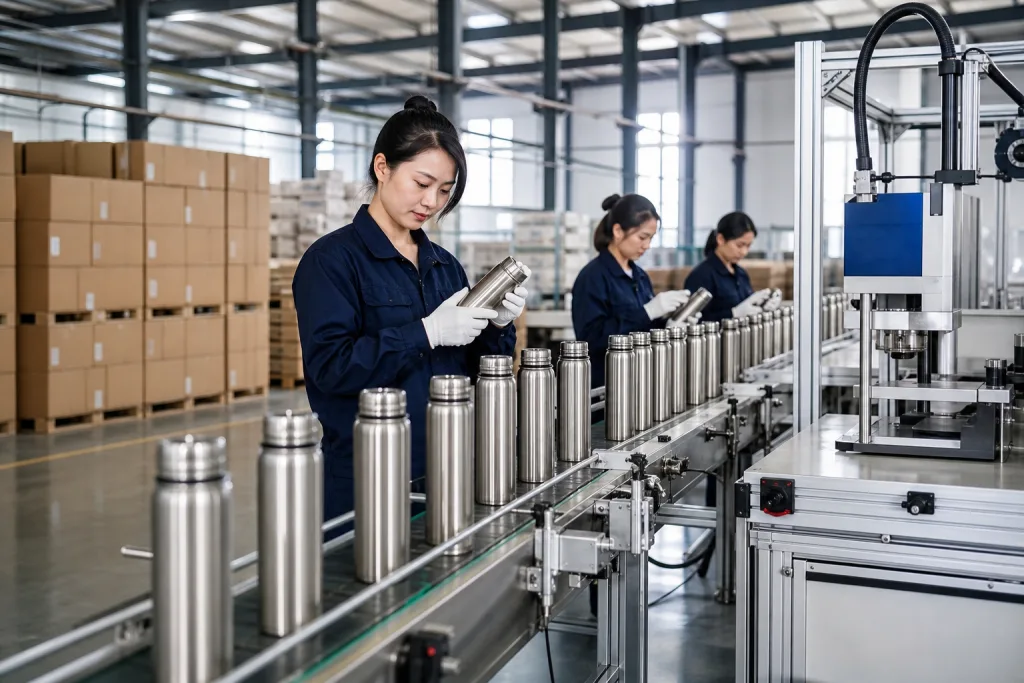
From our factory in Zhejiang, we see buyers lose time by starting with artwork and color charts instead of specs. That is the wrong order. Start with 18/8 stainless steel, confirm whether you need single-wall or 304 double-wall vacuum, then lock the finish, lid, and test standard. A serious supplier in China should quote MOQ, lead time, AQL, and monthly capacity up front. At BottleForge Industrial, we run up to 220,000 units per month with a 3,000-piece MOQ on most custom vacuum bottles, and that is the baseline you should compare against. One PO typo on “18/8” versus “18/10” can stall a shipment for 7 days, and nobody wants that mess at the port.
Start with the end use
Before you talk finishes or laser logos, pin down who will use the bottle. A BPA-free stainless steel bottle for kids is a different job from a BPA-free stainless steel flask for outdoor retail. School buyers push for low leak risk, low weight, and a mouth that a 6-year-old can clean without help. Hotel buyers care about shelf look, breakage in transit, and whether the bottle fits a room-service cart. Restaurant buyers want a thermal bottle that keeps its finish after 6 months of dish runs.
We ask one question first: where does the bottle live for 12 months? If it is going into a school program, choose a 350-500 ml BPA-free stainless steel water bottle for schools with a one-hand lid and a silicone straw or flip top. On a retail SKU, a 500-750 ml vacuum bottle with a matte powder coat usually sells better; the margin is cleaner and the shelf hit is stronger. For hotels, we ship a 300-400 ml BPA-free stainless steel bottle for hotels with custom packaging, and QC pulled the sample to check carton fit on a 5 mm insert. For restaurants, the bottle needs stain resistance, dishwasher tolerance, and a lid that does not hold odor.
There is no universal spec. We had a buyer flag a PO that mixed a kids’ straw lid with a hotel carton, and the math did not work. If a supplier says one model covers every end use, they are hiding the risk, not solving it.
Pick the steel and wall structure
The BPA-free part is mostly the lid and the seals. Steel itself does not carry BPA. The real call is the grade. For export orders, 304 stainless steel, also called 18/8, is the default. If the bottle is going into wet-salt use or a harsh coastal market, 316 gives better corrosion resistance, but the cost jumps 18-30% and most programs do not need it. We had a buyer ask for 316 on a school bottle. The math did not work.
For a single-wall BPA-free stainless steel water bottle, we usually run 0.35-0.5 mm body thickness. A vacuum insulated build uses 0.4-0.6 mm for the inner and outer shells. Go thinner and the line starts seeing dents in carton drop tests. Go thicker and the weight climbs fast, which is a bad fit for a BPA-free stainless steel water bottle for kids. For a BPA-free stainless steel tumbler or a BPA-free stainless steel flask, ask for the exact gauge, not just the capacity on the art file. A 500 ml bottle with a 0.5 mm 304 body usually lands around 260-340 g in a vacuum build, depending on the lid and base. QC pulled one at 318 g last week.
Buyer rule: if the factory cannot tell you steel grade, gauge, and vacuum retention test method in the first quote, keep moving.
Good factories in Zhejiang and across China will state whether the steel is food-contact certified and whether the liner is passivated after forming. That passivation step is not flashy, but it changes taste and corrosion performance. We ship enough lids to know this: a PO typo on the liner note can turn into an acid test failure if nobody catches it before production.
Choose the right lid
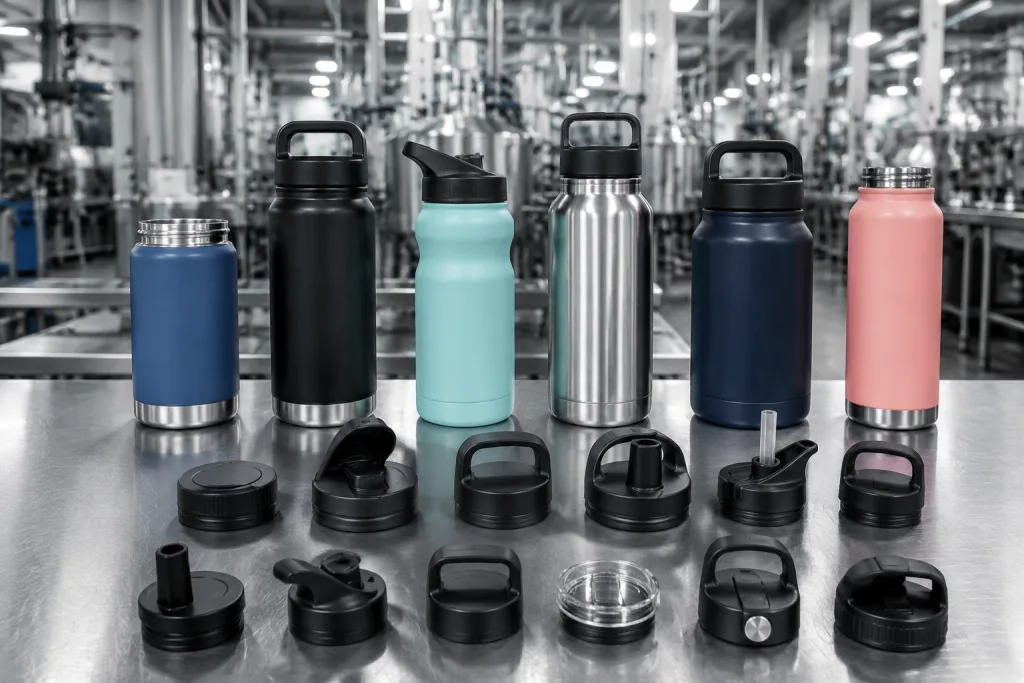
The lid decides whether a bottle earns repeat orders or lands in the complaint file. A vacuum body with a bad lid is still a bad bottle. For a BPA-free stainless steel bottle for schools, we run three lids the most: flip lids, push-button lids, and straw lids with a lock. For younger kids, a soft silicone spout and a plain carry handle cut breakage. On one school order, QC pulled the sample after the handle pin failed at 18 kg pull force. For retail, a screw-on lid with a stainless cap or a bamboo-look top sells well, but the seal needs a 3,000 open-close cycle test, not a “looks fine” check on day one.
Material-wise, the lid body is usually PP, Tritan, or ABS, with silicone gaskets. The BPA-free claim covers every plastic part, not just the outer shell. If you are buying a BPA-free stainless steel bottle for restaurants or hotels, skip lids with too many corners; they trap water and food residue. A simple threaded lid with a food-grade silicone seal is easier to wash and holds up better in commercial dishwashers. We had a buyer flag a PO typo once—“dish washer safe” versus “dishwasher safe”—and the spec fight took longer than the sampling.
- Leak test target: 24 hours inverted at 40°C
- Drop test target: 1.2 m onto concrete, 3 sides
- Cycle test target: 3,000-5,000 lid operations
Those numbers are not decoration. They decide whether the carton goes out or comes back. We ship against them, and the line knows it.
Match insulation to the channel
Not every buyer needs vacuum insulation, and that is where procurement can save real money. A single-wall BPA-free stainless steel water bottle is lighter, cheaper, and easier to wash on the line. We ship those for gyms, summer promos, schools, and low-price retail. Vacuum insulation is a different animal: hot drinks stay hot for 6-12 hours and cold drinks stay cold for 12-24 hours, depending on fill level and room temperature. That is the right spec for travel, premium gifting, and hotel minibars.
For a BPA-free stainless steel tumbler, the use case matters more than heat retention. Coffee buyers usually ask for 4-6 hours of heat hold and a lid that does not splash when the cup is in a car cup holder. For a BPA-free stainless steel flask in a gift set, buyers usually want a slimmer body, cleaner polish, and a tighter shoulder so the carton closes at 310 mm, not 318 mm. If you are ordering a BPA-free stainless steel bottle for hotels, ask the real question: will guests use it only in-room? If yes, single-wall or light vacuum is often enough, and the landed cost can drop 12-20% versus a heavy insulated model.
One practical point from our Zhejiang export team: ask for thermal test conditions, not just claimed hours. QC pulled the sample with 95°C water and a 20°C room, then checked the lid after 6 hours. A claim without the test temperature is marketing, not a spec.
Budget around real landed cost
Many buyers start with an ex-factory price and stop there. That is the wrong question. A 500 ml BPA-free stainless steel bottle may quote at USD 2.10-3.80 FOB China, depending on wall structure, lid type, coating, and print method. Add carton, master carton, inland freight, and ocean or air, and landed cost can move by 20-45%. We had one PO where the buyer missed a USD 0.18 inner box charge and the margin disappeared on 8,000 pcs. Build the full cost before you approve artwork.
Here is the pricing spread we see from China factories: a simple single-wall bottle with one-color print can sit under USD 2.50 FOB at 3,000 pcs, while a powder-coated vacuum bottle with laser logo and custom box often lands at USD 4.20-6.80 FOB. A BPA-free stainless steel bottle for kids usually costs less on steel but more on lid complexity and safety testing. A BPA-free stainless steel water bottle for schools often wins on volume, so buyers push for tighter carton counts and fewer SKUs. For restaurants and hotels, the packaging can matter more than the bottle itself because the bottle sits in a room setup or on a table display. QC pulled the sample, checked the lid torque, and we caught a 1.5 mm print shift before shipment. Many buyers ask for the bottle price first; the math doesn't work that way.
Ask your supplier for a split: steel body, lid, decoration, packaging, and test fee. That is where the money sits.
Test for compliance and repeatability
If you are shipping into Europe or North America, compliance is the first box to tick. For drinkware, ask for REACH, LFGB where relevant, FDA food-contact declarations, and a migration-test report if the lid or coating uses colored plastics. On one 500 ml bottle run, QC pulled the sample and the lid insert failed after heat cycling at 70°C. If the bottle has a vacuum structure, check insulation after heat and cold cycling. For kids’ bottles, the bar gets higher fast: small parts, choking risk, lid pull strength, and cycle life on the cap hinge all need to be on paper.
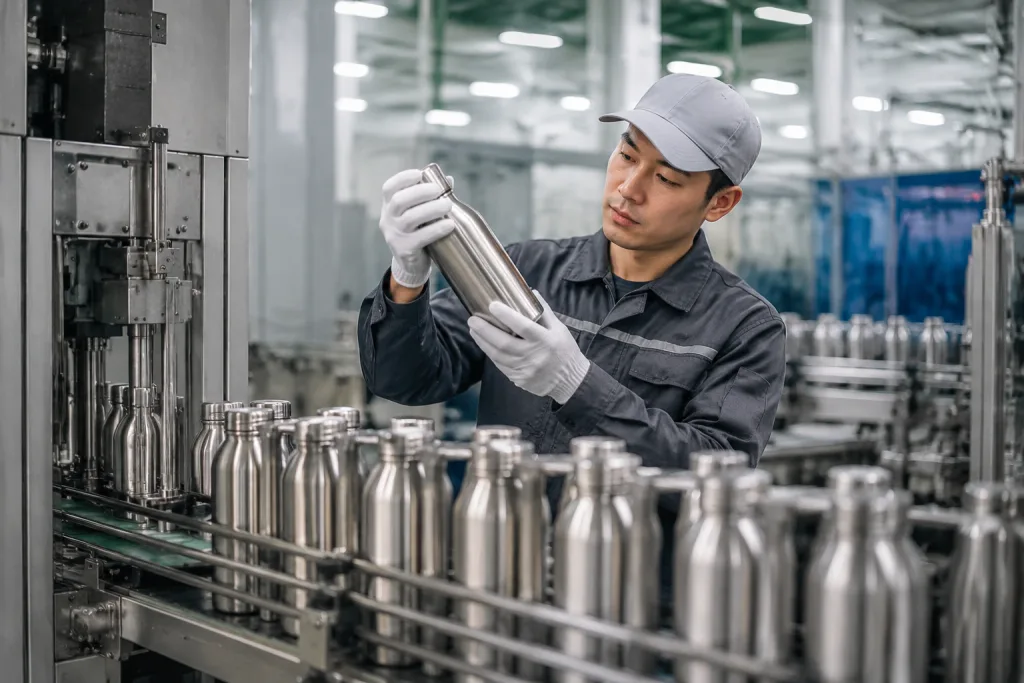
Quality control should be specific, not fuzzy. A Zhejiang supplier should quote an AQL plan, usually AQL 2.5 for major defects and 4.0 for minor defects on general consumer drinkware. We also look at export cartons with drop test and box compression, because a clean bottle in a crushed carton still becomes a chargeback. For custom logo orders, set a color tolerance target such as ΔE under 2.0 for repeat runs. The buyer flagged a PO typo once—“sliver” instead of “silver”—and the proof was fine, the carton art was not. If you want the same branding on a 12-month program, you need numbers, not hope.
China has deep manufacturing capacity in this category, but depth does not mean the same thing as repeatability. We run incoming checks on steel thickness, gasket hardness, vacuum leakage, and logo placement. A caliper on the line, a durometer for the seal, and a simple 24-hour leak test catch more trouble than a polished sample ever will. A supplier who pushes back on that is the wrong supplier to trust.
Use the right bottle by channel
Different channels need different bottles. Retail buyers usually pick a 500-750 ml BPA-free stainless steel bottle with powder coat and laser logo because it reads premium on shelf and the margin still works. For e-commerce, keep the SKU count tight; we had a buyer flag a PO because the photo showed the wrong lid seal, and that cost two rounds of relabeling. For schools, a BPA-free stainless steel water bottle for schools usually works best with a simple internal straw or direct sip lid, 350-500 ml capacity, and one spare seal packed in the box.
For hotels, a BPA-free stainless steel water bottle for hotels can sit on the desk as part of the room setup or go into a minibar set. We often see 400-500 ml on the spec sheet because it looks clean and does not crowd the tray. For restaurants, a BPA-free stainless steel water bottle for restaurants needs to survive repeated handwashing and still look decent after 30 days on the table. If you are building a premium line, a BPA-free stainless steel tumbler fits takeaway coffee programs, while a BPA-free stainless steel flask works for gifting and seasonal sets. QC pulled the sample with a 0.3 mm lid gap once, and the buyer rejected it on sight.
The right question is not which bottle looks fanciest. It is which one holds up to the use pattern and still leaves room for your target margin. We run that check against the channel first, then the decoration, then the carton size.
Send your specs and get a factory quote
Share capacity, lid type, target market, and logo method. We will quote MOQ, lead time, and compliance support from Zhejiang.
Frequently asked questions
Is stainless steel automatically BPA-free?
The steel body is not the issue; BPA is found in certain plastics and resins used in lids, seals, and liners. A proper BPA-free stainless steel bottle should have food-grade PP, Tritan, or silicone parts that are also BPA-free. Ask for a material declaration on every non-metal component. For export orders, we usually recommend confirming REACH or FDA food-contact paperwork, plus a lid seal test. If your bottle is for kids, schools, or restaurants, that documentation matters more because those channels see heavier use and higher complaint risk.
What is the usual MOQ for custom BPA-free stainless steel bottles?
For most custom vacuum models, MOQ is 3,000 pieces per color or print version. For simpler single-wall styles, some factories can start at 1,000-2,000 pieces, but unit cost rises sharply. In Zhejiang, serious factories often quote 25-35 days for production after sample approval, plus 7-20 days for sea freight depending on destination. If you want multiple logos, mixed lids, or a gift box, expect the MOQ to move upward because each extra option adds assembly and QC time.
Should I choose 304 or 316 stainless steel?
For most BPA-free stainless steel bottle projects, 304 stainless steel is the right choice. It is the standard 18/8 food-grade material, good for daily hydration, retail, schools, hotels, and general promotions. 316 has better corrosion resistance and can be useful in harsher environments, but it usually adds 18-30% to material cost. If you are not dealing with acidic, salty, or highly corrosive content, 304 gives better value. In many China factories, 304 is also easier to source consistently at scale, which helps keep lead times stable.
What tests should I request before shipment?
At minimum, ask for leak testing, insulation testing if it is vacuum insulated, lid cycle testing, and food-contact compliance documents. For Europe, REACH and LFGB are commonly requested; for the US, FDA food-contact declarations are standard. A practical QC package should also include AQL inspection results, carton drop test results, and vacuum retention checks. If the bottle is for kids or schools, add small-parts and durability checks. For a custom run, ask the factory to keep one approved golden sample sealed and signed by both sides.
What is a realistic FOB price for a custom order?
A simple single-wall custom bottle may start around USD 1.80-2.80 FOB China at higher volumes, while a powder-coated vacuum bottle with laser logo and custom box often lands around USD 4.20-6.80 FOB. The exact price depends on capacity, steel thickness, lid complexity, and decoration method. A BPA-free stainless steel bottle for hotels or restaurants can cost more on packaging than on the bottle itself. Always ask for a line-by-line quote so you can see whether the extra cost comes from the lid, the coating, or the printing.