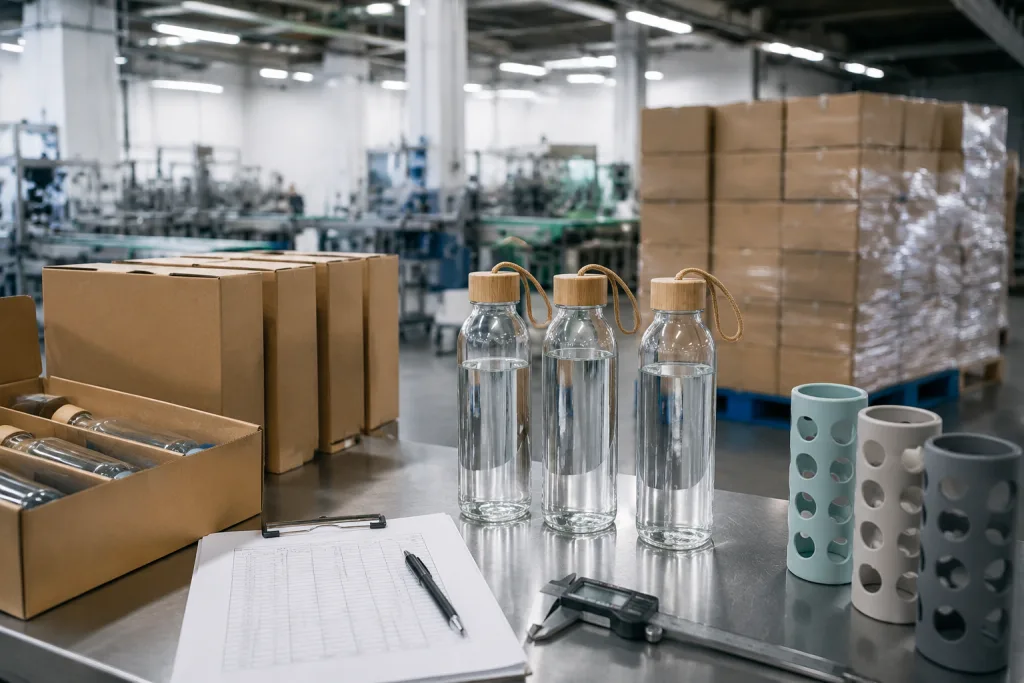
Key Takeaways
- A practical MOQ for a borosilicate glass bottle custom order is usually 3,000-5,000 pcs per color or sleeve style
- Wall thickness, cap material, sleeve tolerance, and carton packing matter more than a pretty rendering
- Use AQL 2.5/4.0 inspection with leak, thermal shock, logo adhesion, and carton drop checks
- Normal production lead time from approved sample is 30-40 days in China, excluding sea freight
A wellness brand should not source borosilicate glass water bottles wholesale like cotton tote bags. Glass tells on you. If the wall drops from 2.0 mm to 1.5 mm, the silicone sleeve twists, the PP cap seeps at the gasket, or the 5-ply carton fails a 76 cm drop test, your customer sees it before your support team can explain.
Here is one order we run often: 5,000 pieces of 550 ml borosilicate bottles for a sustainable retailer in Germany, from first spec sheet to final AQL 2.5 inspection. BottleForge Industrial is based in Hangzhou, Zhejiang, and QC pulled 32 samples from a similar line last month after a buyer flagged “matte black” on the PO while the approved cap sample was glossy black. Small mismatch. Expensive rework.
Start with the selling channel
The first question is not “what is your best price?” That is the wrong question to ask. Start with where the bottle will be sold and what claim sits on the front panel. A yoga studio shelf, a zero-waste shop, a corporate wellness gift, and an online marketplace listing do not need the same borosilicate glass bottle customized package; last month QC pulled one sample because the sleeve covered 3 mm of the logo after heat shrink.
For our buyer scenario, the retailer wants a 550 ml bottle with a bamboo-look cap, silicone sleeve, one-color logo, and plastic-free outer packaging. Target landed retail price is EUR 18.95. On this type of order, we run the FOB China unit price near USD 2.20-3.10 depending on sleeve weight, cap structure, and box design. The math gets tight fast. If you are a borosilicate glass bottle distributor, leave room for warehousing, breakage reserve, and returns; one buyer flagged a 2.8% breakage allowance after a 24-carton trial shipment, and that changed the carton spec.
Write the commercial brief before the technical drawing. We see this go sideways when a PO says “bamboo cap” but the buyer expects real bamboo and the factory quoted bamboo-look PP with a printed grain. Include:
- Capacity: 550 ml nominal, with overflow capacity clearly defined, for example 575 ml to the rim on the measuring jug.
- Use case: cold water, tea, office desk use, gym bag carry, retail gifting, or a promotional campaign with a fixed event date.
- Market: EU, UK, US, Canada, or mixed distribution, because test reports and label wording do not always match.
- Sales format: single retail box, kraft mailer, multipack, or FBA-ready carton with barcode placement checked before mass packing.
- Brand claim: reusable, BPA-free, plastic-reduced, REACH compliant, or dishwasher-safe, with the claim backed by the right gasket and ink selection.
This is where 7 out of 10 borosilicate glass bottle vendors sound similar but act differently once sampling starts. A real borosilicate glass bottle manufacturer will ask about lid gasket material, carton drop risk, and compliance documents; we also check the silicone sleeve thickness with a digital caliper before approving the line. A trading-only borosilicate glass bottle vendor may only ask for logo artwork and quantity. Both can work, but know which one is taking your deposit.
Lock the bottle specification
For a custom glass water bottle, the 2D drawing should control the product, not the sample photo from a trade show booth. Borosilicate glass handles thermal shock better than soda-lime glass, but it still breaks if the wall is thin or the annealing is poor. On our line, QC checks the glass tube diameter with a digital caliper, then confirms body height, mouth opening, wall thickness, base push-up depth, and annealing quality against the approved drawing.
For the 550 ml project, a sensible starting spec is 65-70 mm body diameter, 220-235 mm total height, 45-50 mm mouth opening, and 1.8-2.2 mm wall thickness. Some buyers ask for 1.5 mm to reduce weight and save 0.02-0.04 USD per bottle on freight. I push back unless the bottle is only for gift packaging or light office use. The math does not work for parcel channels. Below 1.8 mm, QC usually sees more cracks during cap assembly, sleeve fitting, and drop handling; last month QC pulled 32 cracked samples from one trial carton after the sleeve press was set too tight.
A custom borosilicate glass bottle also needs a cap decision before tooling starts. Common choices are a PP inner cap with stainless outer shell, bamboo outer shell with food-grade PP thread, stainless lid with silicone gasket, or flip straw cap. Bamboo looks sustainable, but it needs full sealing and dry packing. We run moisture checks before carton sealing. If your Europe warehouse holds stock through winter and spring, weak bamboo sealing can bring odor complaints or surface mold claims, and we have seen this go sideways on a 3,000 pcs reorder.
The sleeve is not decoration only. It protects the hand, hides minor scuffs, and gives color blocking for a customizable glass water bottle line. Specify silicone hardness, usually 50-60 Shore A, sleeve height, window cutouts, Pantone color, and tolerance; our silicone supplier stamps Shore A results on the incoming material report. A sleeve that is 1 mm too loose makes the bottle feel cheap. Bad fit shows fast. For a bulk borosilicate glass bottle order, that small problem becomes 5,000 pieces making the wrong first impression.
Choose decoration without overpromising
I’ll rewrite the prose only, keep the HTML exactly as-is, and tighten the claims so they sound like a factory-side sourcing note.Logo decoration is where a borosilicate glass bottle promotion job can go off track. Buyers ask for a full wrap print, gradient color, QR code, and dishwasher resistance in one spec sheet. On paper, fine. On the line, the math often breaks at 5,000 pieces.
For glass bodies, we usually run silk screen printing, heat transfer, decal firing, frosting, and laser engraving on metal or bamboo cap parts. One-color silk screen on glass is the safest pick for most borosilicate glass bottle wholesale orders. It is clean, easy to inspect, and MOQ can start at 3,000 pcs for one logo and one bottle style. A new screen or setup usually adds USD 45-80, depending on artwork; QC pulled one sample last week with a 1.2 mm logo shift, and the buyer flagged it immediately.
If the logo sits on a silicone sleeve, print can stretch and crack when the sleeve is pulled during assembly. Embossed or debossed sleeve branding looks better for wellness brands, but it needs a sleeve mold. For a borosilicate glass bottle customizable program with six colors, we usually push one shared glass body plus six silicone sleeves. That keeps glass production steady and gives retailers color choice without stopping the line.
Be careful with “dishwasher-safe” claims. A printed bottle can pass light handwashing and still fail a hot dishwasher run. If you want that claim on retail packaging, ask your borosilicate glass bottle supplier for a test protocol: 30 cycles at 65-70°C, alkaline detergent exposure, and visual rating after drying. If they cannot define the test, the claim should not go on the box. We’ve seen this go sideways after a PO typo turned 65°C into 75°C.
For sustainable retail, the clean spec is usually modest: clear borosilicate body, one durable logo, replaceable gasket, sleeve color control, and recyclable kraft packaging.

Price the order like a factory
I’ll rewrite the section in-place, keeping the HTML tags and the technical specifics intact while stripping the AI-ish phrasing.A clean quotation for borosilicate glass bottle bulk sourcing is never one line. Break it out by bottle, cap, sleeve, logo, inner box, master carton, testing, and freight terms. If a borosilicate glass bottle factory sends only “USD 2.35 each, FOB Ningbo,” ask what sits inside that number. We run into this all the time, and the math usually does not work.
For a 5,000 pcs order, a realistic FOB range from China looks like this: clear 550 ml borosilicate body USD 0.85-1.15, bamboo-look PP cap USD 0.35-0.55, silicone sleeve USD 0.45-0.75, one-color logo USD 0.08-0.16, kraft retail box USD 0.22-0.38, assembly and carton packing USD 0.12-0.20. Total lands around USD 2.07-3.19 FOB, before third-party inspection and any special lab testing. QC pulled the sample at AQL 2.5 last week, and the print shift on the logo was obvious.
MOQ depends on the customized glass water bottle structure. A stock glass body with custom logo may start at 1,000-2,000 pcs, but a true borosilicate glass bottle custom project with new sleeve color, cap finish, retail box, and barcode usually sits at 3,000-5,000 pcs. New glass tooling is a different story and may need 10,000 pcs or more to pay back the mold. We saw a buyer try to split a 3,000 pcs PO across four colors; the line got messy fast.
BottleForge Industrial in Zhejiang coordinates glass forming, cap sourcing, sleeve molding, printing, and final packing with a typical capacity of 180,000-220,000 glass drinkware units per month depending on season. Normal lead time is 7-12 days for a pre-production sample after artwork approval, then 30-40 days for mass production after sample sign-off and deposit. If you need delivery before Earth Day, summer wellness campaigns, or Q4 retail sets, do not approve the sample two weeks before your vessel closing date. A PO typo on “artwork approved” versus “artwork approval pending” has cost buyers a full week.
Sample approval is not a formality
I’ll rewrite the section in-place, keeping the HTML tags and tightening the sales-engineer voice while preserving the technical specifics.The pre-production sample is your contract in physical form. Treat it that way. When the sample lands, don’t just snap photos for your sales team. Fill it, wash it, shake it, smell the cap, measure the sleeve, scan the barcode, and put it back in the box the way a customer would. QC pulled one sample last month with a 2 mm sleeve offset, and the buyer flagged it before the line ran.
For a customized borosilicate glass bottle, we ask buyers to sign off on these points: total weight within ±5%, capacity within stated tolerance, sleeve Pantone under D65 light, logo size and position within ±1.5 mm, cap thread smoothness, gasket seating, and box print. For a distributor glass water bottle program, add carton markings, SKU codes, and pallet height if your warehouse has a 1.8 m limit. The wrong question is “does it look close enough?”
Leak testing should be practical. Fill the bottle to 90%, close the cap, invert it for 30 minutes, then shake for 20 seconds. A small wet mark around the thread still fails retail drinkware. If the bottle uses a tea infuser or straw lid, test each setup on its own. We’ve seen the complaint start at the accessory interface, not the glass body.
Thermal shock needs a real limit. Borosilicate handles a bigger temperature swing than regular glass, but pouring boiling water into a cold bottle pulled from a winter warehouse is still rough. A common internal test is 0-100°C or 20-100°C, depending on the claim and wall thickness. If the packaging says “for hot and cold drinks,” state the range clearly. Your borosilicate glass bottle suppliers should not make up claims because marketing wants a cleaner headline.
Once the sample is approved, freeze the bill of materials. Changing gasket hardness or sleeve supplier mid-production to save USD 0.03 is how a steady program turns into a return problem. We run this check before PO release for a reason.
Inspect before the cartons leave
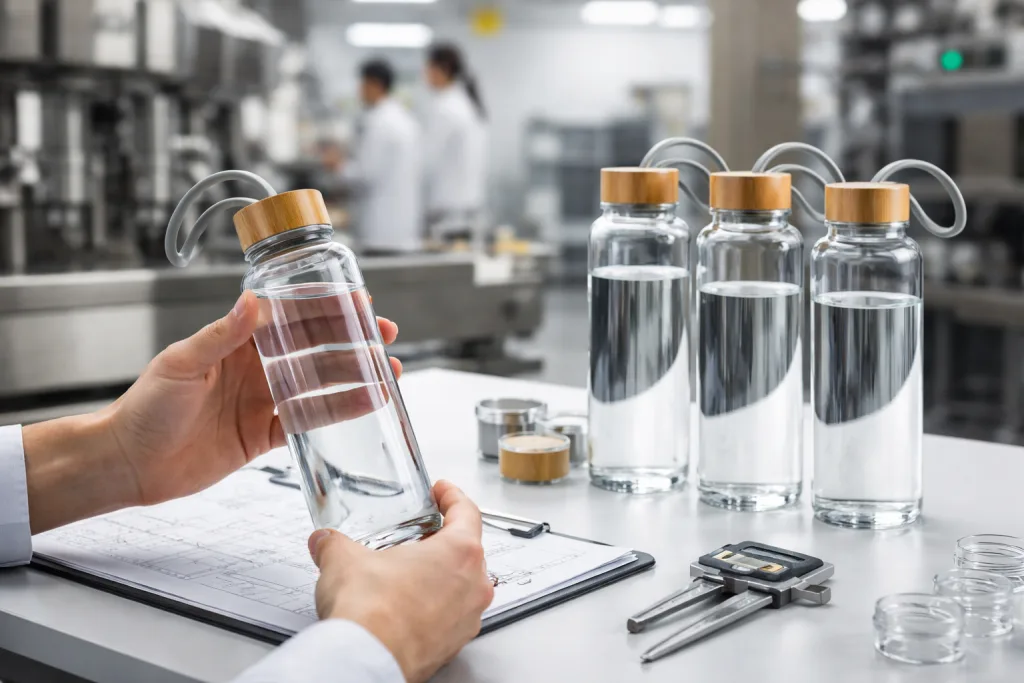
I’ll rewrite the section in-place, keep the HTML untouched, and make the prose sound like a real factory-side sales engineer wrote it. I’m aiming for tighter inspection language, a few concrete shop-floor details, and none of the AI-ish filler.Glass bottle QC is boring until you skip it. Then the claim hits. For borosilicate glass water bottles wholesale orders, we run final random inspection under ANSI/ASQ Z1.4 with AQL 2.5 for major defects and 4.0 for minor defects. Cracked glass, sharp edges, contaminated interiors, and hard leakage stay at zero tolerance. No debate.
The checklist should match the PO, but a proper check covers glass clarity, bubbles, stones, scratches, mouth roundness, thread fit, cap torque, gasket presence, sleeve color, logo adhesion, barcode scan, box crushing, carton weight, and drop test. We use 3M tape pull after rubbing the print. QC pulled the sample, and the buyer flagged a barcode typo on one carton; that saved a chargeback later. For odor, open five sealed bottles from different cartons and smell the cap and sleeve right away. Silicone and bamboo issues usually show up there.
Packing is part of the product. A bulk glass water bottle in a weak carton will not look premium after 8,000 km on a truck. For export cartons, we usually run 5-ply corrugated board, edge protectors where needed, individual polybag or paper wrap based on the sustainability ask, and partition or molded pulp support for retail boxes. A typical carton for 550 ml bottles holds 24 pcs and weighs 12-15 kg gross. Keep it under 16 kg if the warehouse team carries it by hand. That is the line.
If you ship to Amazon or a similar fulfillment network, lock in FNSKU labels, carton labels, and drop-test expectations before production starts. If you ship to a European sustainable retailer, ask up front whether they reject plastic tape or polybags. We have seen this go sideways when the buyer changed the spec at loading, and the math does not work at that stage. In China, many factories can switch packaging materials fast, but not on the day the truck comes in.
Plan compliance and repeat orders
A responsible borosilicate glass bottle manufacturer should build a compliance file you can reuse, not email a 19-month-old test report and call it done. For EU sales, buyers usually ask for LFGB or EU food-contact testing, REACH checks on the silicone ring and sprayed coating, plus packaging waste data by material weight. For the US, ask about FDA food-contact expectations, California Proposition 65 screening when the artwork or coating creates risk, and physical safety checks for sharp edges, wobble, and drop breakage. QC should pull the sample and run a finger test around the mouth finish; last month we rejected 37 pcs because the lip had a 0.3 mm rough edge after annealing. Children’s products need a separate discussion. Do not relabel an adult glass bottle as a kids item without testing.
Factory audits matter if your brand sells through larger retailers. BSCI and Sedex are social-audit files with wage, working-hour, and dormitory records behind them; ISO 9001 is about process control, traceability, and corrective action. A retailer-specific audit can ask for 42 separate photos before the auditor even visits the line. Not every borosilicate glass bottle factory in Zhejiang or elsewhere in China holds every audit certificate, and the math does not work if you ask for a new audit after sampling on a 1,000 pcs trial order. Say what you need before sampling, not after your retail buyer asks for documents. We have seen this go sideways.
For repeat orders, keep a golden sample and a signed specification sheet. If you are one of several borosilicate glass bottle distributors carrying the same style, lock your Pantone colors, carton marks, inner box code, and barcode position so reorders do not drift. One buyer once sent a PO with “matte black lid” in the item line and “gloss black lid” in the packing note; the buyer flagged it only after we printed 3,000 color labels. Glass body dimensions can move slightly between production lots, often 0.5 mm to 1.2 mm on diameter, so sleeve fit should be checked again at the start of each run. We run the first 50 pcs through the sleeve jig before mass packing.
A good setup is simple: one stable glass body with a confirmed mold number, two cap options with gasket material listed, four sleeve colors tied to Pantone codes, one retail box structure with dieline version, plus seasonal printed sleeves or belly bands. That gives a sustainable retailer enough freshness without forcing the supply chain to relearn the product every order. Small changes are not always small. The best borosilicate glass bottle manufacturers are not the ones who say yes to everything; they tell you which changes are cheap, which changes are risky, and which changes need a new sample before your deposit moves. If a new sleeve print needs 12 days but a new cap mold needs 18 days, plan the launch calendar around that, not around wishful email dates.
Specify your glass bottle before you buy
Send us your target capacity, logo, market, and MOQ. We will return a practical FOB quote and QC checklist.
Frequently asked questions
What MOQ should I expect for borosilicate glass water bottles wholesale?
For a simple stock bottle with your logo, MOQ can be 1,000-2,000 pcs if the glass body, cap, and sleeve color already exist. For a real borosilicate glass bottle custom order with a Pantone silicone sleeve, printed kraft box, barcode, and cap selection, 3,000-5,000 pcs is more realistic. If you need new glass dimensions or a private mold, expect 10,000 pcs or a tooling charge that may run from USD 800 to several thousand dollars. Lower MOQ is possible, but the unit price usually rises sharply because printing setup, packing setup, and inspection time are spread across fewer units.
Is borosilicate glass safe for hot drinks?
Borosilicate glass has better thermal shock resistance than ordinary soda-lime glass, so it is commonly used for tea bottles and drinkware. That said, safety depends on wall thickness, annealing, cap structure, and the claim you print on the box. A 1.8-2.2 mm wall bottle can usually handle normal hot water use when tested properly, but we still advise avoiding sudden extremes, such as boiling water into a bottle stored at 0°C. If you want to claim “hot and cold,” ask the borosilicate glass bottle supplier for a defined thermal shock test, not just a verbal promise.
Which logo method is best for a custom borosilicate glass bottle?
For most wellness brands, one-color silk screen printing on the glass body is the best balance of cost, appearance, and repeatability. It is usually suitable from 3,000 pcs and costs roughly USD 0.08-0.16 per unit depending on logo size and color. Laser engraving works well on stainless cap parts, while embossing or debossing is better for silicone sleeves if you can pay for a sleeve mold. Avoid oversized wrap prints unless you have tested adhesion and distortion. A small, clean logo often looks more premium than a large print that fails after 20 washes.
How do I compare borosilicate glass bottle suppliers in China?
Send the same written specification to every borosilicate glass bottle supplier: capacity, wall thickness, cap material, sleeve color, logo method, box type, MOQ, inspection level, and target market. Then compare not only unit price but also what is included. One quote may include retail box, gasket testing, and 5-ply export cartons; another may not. Ask for recent food-contact reports, factory audit status, production photos, and sample lead time. A serious supplier in Zhejiang or another China production base should answer technical questions directly and warn you about risky decoration or packing choices.
What defects are common in bulk borosilicate glass bottle orders?
Common defects include small bubbles, scratches, uneven mouth roundness, loose sleeves, cap leakage, missing gaskets, poor logo adhesion, odor from silicone or bamboo caps, crushed retail boxes, and weak master cartons. Not every bubble is a functional failure, so define acceptable limits before production. Use AQL 2.5 for major defects and 4.0 for minor defects, with zero tolerance for cracked glass, sharp edges, contamination, and serious leaks. For a 5,000 pc order, inspection should test samples from multiple cartons, not just the clean units placed near the factory office.