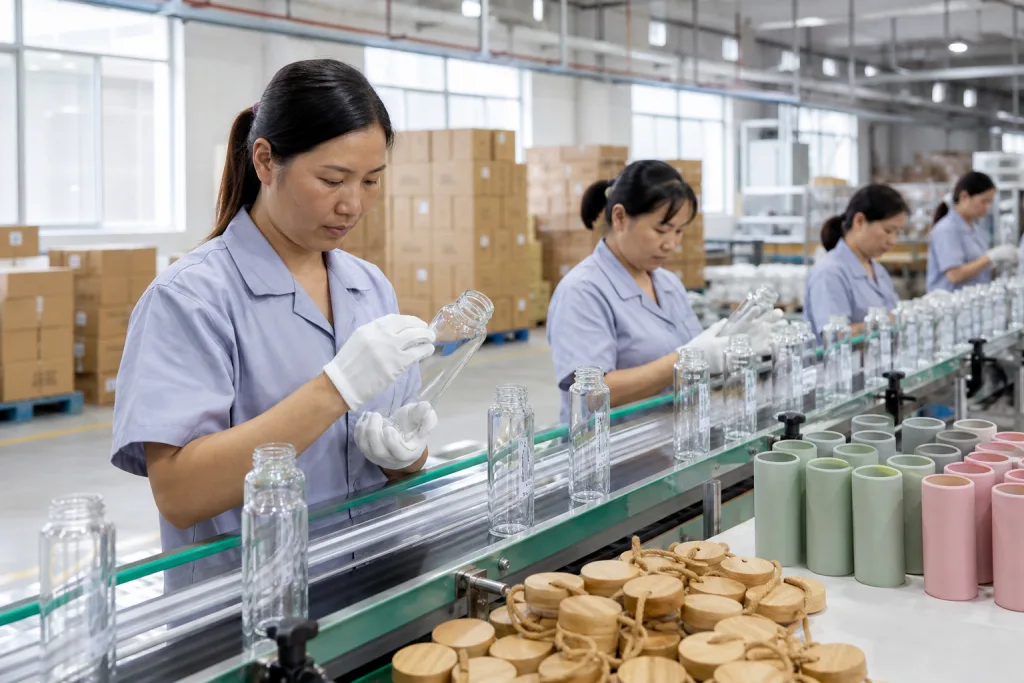
Key Takeaways
- Typical borosilicate glass water bottle wholesale pricing lands around USD 1.25 to 3.80 per unit at 3,000 pcs MOQ, depending on cap, sleeve, and print complexity
- A 1.8 mm to 2.2 mm wall is a practical baseline for retail; 2.5 mm gives better perceived durability but adds weight and freight cost
- Most private label programs in Zhejiang, China need 25 to 35 days lead time, with samples in 7 to 10 days after artwork confirmation
- For wellness and sustainable retail, the right spec is usually more important than the lowest unit price, because breakage and returns erase margin fast
If you are sourcing borosilicate glass water bottle wholesale, glass is the easy part. The real work is choosing wall thickness, cap system, decoration method, and packaging so the bottle clears transit, looks good on shelf, and still protects your margin. We had one buyer flag a 1.2 mm wall as too thin after QC pulled the sample from a 1 m drop test. They were right.
A spec-first comparison saves time. A solid borosilicate glass water bottle manufacturer in Zhejiang, China will ask about drop risk, hot-fill temperature, retail price, and sales channel before the quote goes out. At BottleForge Industrial, our Hangzhou factory runs about 120,000 units per month, with standard MOQ at 3,000 pcs and a normal lead time of 25 to 35 days after sample approval. We ship faster when the PO is clean; one typo on a cap color code can hold the line for a full day. For wellness brands and sustainable retailers, the math only works when the bottle spec matches the job.
What to compare first
Buyers usually start with shape or color. Wrong first filter. Open the spec table first, then compare what moves cost, breakage, and sell-through.
Use these core lines in your shortlist:
- Capacity: 350 ml, 500 ml, or 750 ml. The 500 ml SKU is the one we ship most for wellness retail; it fits a 24-case carton without wasting headspace.
- Wall thickness: 1.5 mm, 1.8 mm, 2.2 mm, or 2.5 mm. We run a caliper on the line, and 2.5 mm adds freight fast; thicker does not automatically mean safer.
- Cap material: bamboo, stainless steel, PP, or silicone loop cap.
- Decoration: one-color silk screen, laser logo, frosted finish, or full wrap print. QC pulled a sample last month with a 3 mm shift, and the buyer flagged it right away.
- Packing: egg crate, color box, mailer box, or gift tube. One PO typo on “mailer” turned into a reprint, so we check the carton code before we release production.
For borosilicate glass water bottle wholesale programs, the spec table should also show ASTM or LFGB testing status, plus REACH compliance for Europe. If your buyer wants a borosilicate glass water bottle private label line, ask for the decoration area in millimeters, not just “custom logo.” We see this go sideways when a logo looks fine on paper but misses the centerline by ±2 mm across 10,000 units.
Practical rule: if your retail price is under USD 18, do not overbuild the bottle. A heavy glass body with a premium bamboo lid can look clean on a sample table, but the freight math does not work once breakage and carton weight hit the invoice.
Spec table by use case
Head-to-head comparison only works when the use case is locked. A yoga studio buyer does not want the same bottle we ship for a DTC sustainability brand. On our line, that split shows up fast in wall thickness, cap choice, and carton size.
| Use case | Best spec | Why it fits | Wholesale note |
|---|---|---|---|
| Yoga and wellness retail | 500 ml, 2.2 mm wall, bamboo lid | Premium hand feel, easy to hold, good shelf presence | USD 1.85 to 2.65 at 3,000 pcs |
| Eco gift sets | 500 ml, frosted body, silicone sleeve, gift box | Better grip, lower break risk, easier to gift | USD 2.40 to 3.80 depending on packing |
| Amazon and marketplace | 350 ml or 500 ml, simple cap, mailer box | Lower damage rate, cleaner FNSKU labeling | Keep carton count efficient for FBA |
| Retail chain rollouts | 500 ml, 1.8 mm to 2.0 mm, one-color logo | Holds cost and appearance together at scale | Best for borosilicate glass water bottles bulk |
The wrong question is “what looks best?” We’ve seen that go sideways. A 2.5 mm wall bottle can blow up dimensional weight for e-commerce, and a 1.5 mm wall version can look flimsy in a store and trigger returns. The right borosilicate glass water bottle manufacturer should steer you to a spec that cuts visible breakage and freight waste.
If you are comparing a borosilicate glass water bottle supplier in China, ask for drop-test data from 80 cm or 100 cm, not vague claims. QC pulled the sample, we checked the corners, and that number tells you more than any brochure line.
Price, MOQ, and margins
Let’s talk numbers. Procurement cares about the math, and the math does not lie. A standard borosilicate glass water bottle wholesale quote usually breaks down like this: plain bottle body at USD 0.85 to 1.40, cap at USD 0.18 to 0.60, one-color print at USD 0.06 to 0.15, and retail-ready packaging at USD 0.25 to 0.90. Once we add QC, carton loading, and inland China freight, the landed factory price can jump by USD 0.12 to 0.38 per set. On one PO, the buyer flagged a missing cap spec in 0.01 mm terms, and the whole quote had to be redone.
At our Hangzhou plant in Zhejiang, the usual MOQ is 3,000 pcs per design. For custom packaging, 5,000 pcs gives cleaner pricing on the line, and we see fewer price swings between reorders. For a private label project, expect:
- Sample lead time: 7 to 10 days
- Mass production: 25 to 35 days
- Unit price range: USD 1.25 to 3.80
- Carton breakage target: under 1.5% at loading QC
The cheapest quote is usually the wrong question. If one borosilicate glass water bottle factory is USD 0.20 lower but cannot hold cap fit tolerances, you will pay for it in leakage claims and air freight rework. QC pulled the sample on our torque tester, and a loose cap showed up at 0.6 N·m instead of the 0.9 N·m spec. I would take a steady cap torque spec, clean logo placement, and documented AQL 2.5 over a paper saving every time.
For larger borosilicate glass water bottles bulk orders, tooling amortization across multiple SKUs can make sense. We ship this way when a buyer wants 350 ml, 500 ml, and 750 ml under one borosilicate glass water bottle branded line, and the numbers work better if the same mold family carries all three. A typo on a PO once listed 750 ml as 7500 ml, and that one line nearly blew the shipment up. If you already know the lineup, spread the tooling cost; if you do not, the math gets ugly fast.
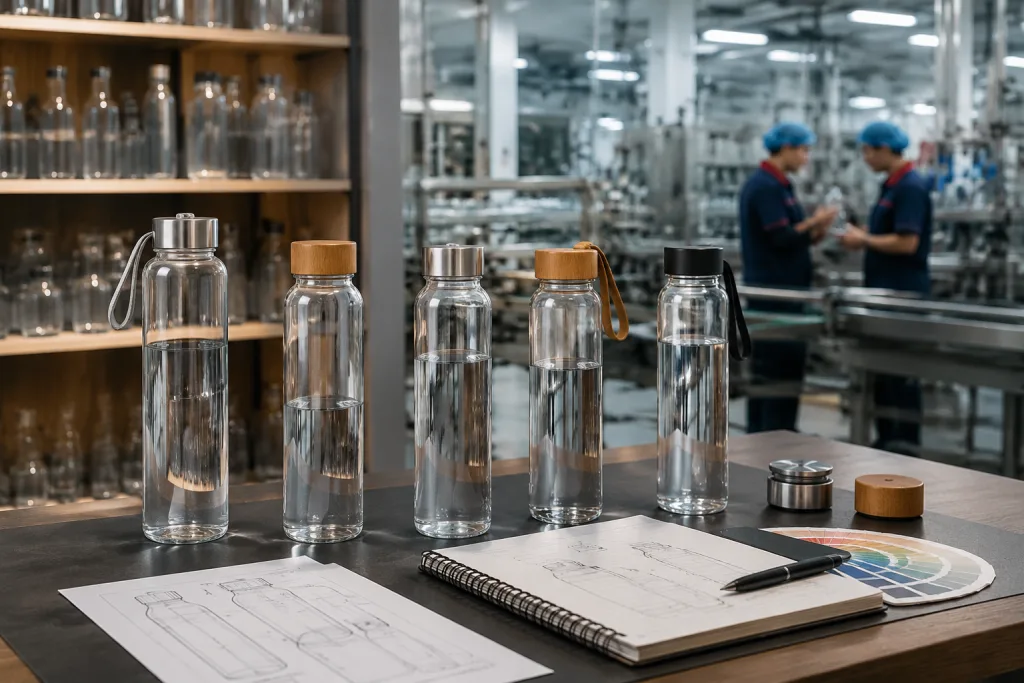
Custom options that matter
Most buyers ask for more design freedom than they can actually sell. We see the math miss on the line all the time. Borosilicate glass water bottle custom work should lock in the parts customers touch every day.
The custom options that pay back are:
- Logo method: silk screen for a simple mark, laser engraving for a clean premium look, or decal for multi-color artwork.
- Cap build: bamboo top with stainless insert, full stainless cap, or leak-resistant PP cap when you need tighter cost control.
- Surface finish: clear, frosted, tinted, or gradient spray. Frosted bottles usually move faster in wellness channels.
- Accessory set: silicone sleeve, tea infuser, carry strap, or spare gasket.
For borosilicate glass water bottle custom orders, keep print height under 35 mm unless the artwork is dead simple. Bigger prints start to look crowded on glass. QC pulled a sample last week with a 42 mm logo, and the buyer flagged it right away. If you need a borosilicate glass water bottle OEM or borosilicate glass water bottle ODM program, ask for a line drawing first, with the exact neck finish, cap thread, and decoration zone before sample run.
Do not assume every feature adds sales. A sleeve helps grip and cuts breakage, but it adds one more part number and one more assembly step. A bamboo lid looks good, yet if your buyers care more about dishwasher use than appearance, stainless or PP wins. We’ve seen this go sideways on a 12-day pilot because the PO said “natural cap” and the buyer meant “easy to wash.”
Compliance and testing basics
OMP sees both packages, but `4.12.1` shadows the worktree’s duplicate skill names. I’m disabling the older `[email protected]` plugin so the visible skills come from the worktree `[email protected]`.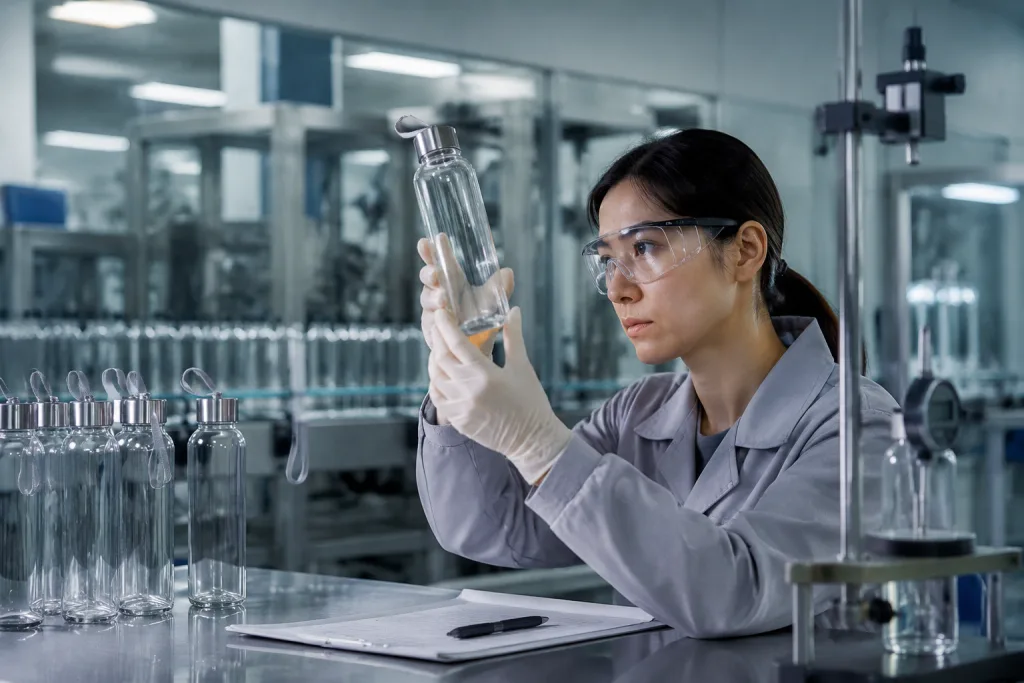
How to choose a factory
If you want reliable borosilicate glass water bottles custom production, choose the factory the same way we check a line before a peak order: process, capacity, and failure control. A polished website means little. We once saw a supplier with a nice homepage miss a 20,000-piece PO because their annealing kiln ran 14 hours behind.
Check these points:
- Monthly output: can the borosilicate glass water bottle factory produce at least 100,000 units per month without missing lead time?
- Sampling speed: can they turn around corrected samples in under 10 days?
- QC discipline: do they inspect cap torque, logo alignment, and body scratches on every lot? We run torque checks with a small tester on the packing table.
- Export fit: do they understand carton markings, palletizing, and retailer label needs like FNSKU?
A reliable borosilicate glass water bottle supplier should tell you where the risk sits. If the bottle is thin, say it. If the cap gasket is the weak point, say that too. We had a buyer flag a 1.2 mm wall on a 500 ml bottle, and the math was right: it shaved cost, but the breakage rate jumped in drop tests. Good factories in China do not promise zero breakage. They promise a controlled defect rate and a clear inspection plan.
If you are comparing borosilicate glass water bottles private label vendors, ask for previous export markets, average carton breakage, and whether they can support mixed-color caps across one order. A PO typo on cap color can burn a week. Ask one more thing: did QC pull the sample from the line or from a hand-picked carton? That is usually the difference between a usable commercial line and a pretty sample that never scales.
Get a factory quote for your bottle spec
Send your capacity, cap style, and target price. We’ll match the right borosilicate glass water bottle wholesale setup from Zhejiang, China.
Frequently asked questions
What is the best wall thickness for borosilicate glass water bottle wholesale orders?
For most retail programs, 1.8 mm to 2.2 mm is the sweet spot. At 1.5 mm, the bottle feels light but can look fragile. At 2.5 mm, you get a more premium hand feel, but the bottle gets heavier and freight cost rises. If you sell through wellness studios or gift retail, 2.2 mm usually gives the best balance. For Amazon or DTC shipping, 1.8 mm with a sleeve often performs better on landed cost. A good borosilicate glass water bottle manufacturer in Zhejiang, China should let you compare both weights before confirming tooling.
What MOQ should I expect from a borosilicate glass water bottle supplier?
A realistic MOQ is 3,000 pcs per design for standard custom work. If you need a new cap, unique packing, or multiple print colors, the MOQ can move to 5,000 pcs. Smaller quantities are possible, but unit price usually jumps by 15% to 30%. For borosilicate glass water bottles bulk buying, the factory should also tell you whether MOQ applies per SKU or per color. That detail matters when you plan private label launches across several retail channels.
How much does a borosilicate glass water bottle custom project cost?
Most borosilicate glass water bottle custom projects land between USD 1.25 and 3.80 per unit at 3,000 pcs, depending on bottle size, cap, printing, and packaging. A plain 500 ml bottle with a basic lid can be near the low end, while frosted glass, bamboo cap, silicone sleeve, and gift box move it higher. Tooling may be extra if you need a new mold or a special cap finish. In Zhejiang, China, packaging often decides the final price more than the glass body itself.
Can borosilicate glass water bottles be used for hot and cold drinks?
Yes, borosilicate glass is designed for thermal resistance, which is why it is popular for hot tea and cold water. Still, the bottle design matters. A thin neck, poorly seated gasket, or cheap decorative coating can fail even if the glass itself is fine. Ask the factory for thermal shock testing and dishwasher resistance data. For branded retail, you want a bottle that survives real use, not just a lab claim. Many buyers in Europe and North America request documentation before approving borosilicate glass water bottles wholesale.
What should I ask before choosing a borosilicate glass water bottle factory?
Ask about monthly capacity, sample lead time, AQL standard, decoration control, and export documentation. A serious borosilicate glass water bottle factory should give you a clear answer on output, usually at least 100,000 units per month for an established plant, plus 7 to 10 day samples and 25 to 35 day mass production. Also ask whether they handle REACH, LFGB, and carton labeling in-house. If they cannot explain leak testing or cap torque, keep looking.