Key Takeaways
- A practical MOQ for a borosilicate glass bottle custom order is 1,000-3,000 pcs per color or decoration
- FOB China pricing usually ranges from USD 2.20-6.50 depending on glass thickness, cap, sleeve, and packaging
- A new customized borosilicate glass bottle project normally needs 35-55 days after artwork approval
- Carton drop protection, AQL inspection, and REACH/LFGB paperwork should be budgeted before deposit
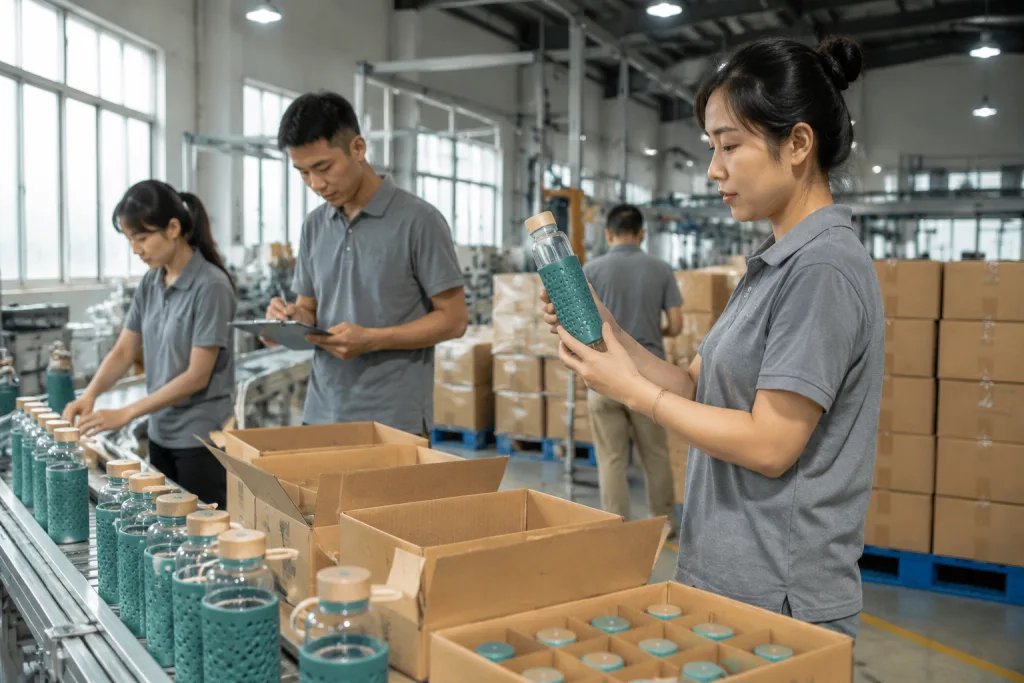
If you sell into wellness, refill, yoga, spa, zero-waste retail, or corporate gifting, glass gives a cleaner shelf look than plastic and feels less commodity than most metal bottles. Borosilicate glass water bottle custom sourcing is also less forgiving than a logo print on stainless steel. A 0.5 mm miss on the silicone sleeve, cap thread, or inner carton clearance is enough to turn a tidy pre-production sample into breakage claims after sea freight. QC pulled one 500 ml sample last month because the sleeve sat 1.2 mm high near the shoulder. Small gap. Big problem.
From our Zhejiang export desk, new buyers usually ask 3 questions first: real MOQ, why one quote is USD 2.10 while another is USD 5.80, and whether delivery to Europe or North America is 32 days or 52 days. Fair questions, but price alone is the wrong question to ask if the carton spec is weak or the cap mold is shared with a cheaper line. We run this math with wellness brands and sustainable retailers before sampling, including glass thickness, sleeve tooling, logo method, AQL 2.5 inspection, and a 1.2 m drop-test carton check.
Where the bottle cost starts
A borosilicate glass bottle quote usually starts with five cost blocks: glass body, cap set, sleeve or grip, decoration, and retail packaging. For a standard 500-750 ml single-wall borosilicate body, the glass part often sits around USD 0.85-1.80 FOB China, depending on diameter, height, wall thickness, and whether we can run an existing mold. The caliper tells the story. A 2.0-2.2 mm wall feels better in the hand, but it costs more than a 1.5 mm body and adds carton weight fast when we load 24 pcs per master carton.
Caps get underestimated. A simple bamboo-pattern PP cap with silicone seal may add USD 0.30-0.55. A real bamboo cap with stainless insert can add USD 0.55-1.10, and QC will still pull samples to check moisture marks, thread fit, and silicone ring compression. If you ask for a tea infuser, carry loop, stainless strainer, or leakproof push cap, we are no longer talking about the same BOM. For wellness brands, the cap is where the sustainability story looks credible or starts looking like a sticker on a cheap part. We have seen buyers push back over USD 0.18 here, then lose the premium shelf feel they wanted.
Packaging comes next. A plain white inner box may cost USD 0.12-0.25. A four-color kraft retail box with insert and barcode usually runs USD 0.35-0.80, before any drop-test upgrade. Do not save USD 0.10 on weak packaging for Amazon FBA or distributor glass water bottle sales; the math doesn't work after the first broken-bottle claim. Last month, the buyer flagged a corner-crush issue after a 76 cm drop test, and we changed the E-flute insert before mass packing. Our Hangzhou, Zhejiang team usually quotes standard export carton packing and upgraded mail-order packing, so you can compare landed risk instead of chasing the lowest unit price.
MOQ tiers that change pricing
For borosilicate glass bottle bulk orders, MOQ is not a random factory rule. It comes from logo screen setup, cap MOQ from the hardware vendor, silicone sleeve Pantone matching, color box plate charges, and the 40-60 minutes we lose when the line changes from one bottle height to another. A realistic starting MOQ for a custom glass water bottle is 1,000 pcs if you use our existing bottle shape, existing cap, one logo, and simple packaging. At this level, the unit price is higher because the screen, fixture, and first-article QC cost are spread across fewer pieces. The math is tight.
At 3,000 pcs, the cost sheet usually looks cleaner. We can run silicone sleeves in one matched batch instead of asking the sleeve workshop to stop for a small color lot, and the carton factory is less likely to add a small-order surcharge for 5-layer export cartons. At 5,000-10,000 pcs, the FOB price may fall 8-18% compared with 1,000 pcs, depending on how much of the bottle is customized. For a full borosilicate glass bottle customized project with new mold, new cap tooling, and exclusive box design, 10,000 pcs is a more honest planning number. We had one buyer ask for a private mold at 2,000 pcs; QC pulled the sample, the cap fit was off by 0.4 mm, and the project had no budget left to fix the tooling properly.
- 1,000 pcs: existing mold, simple logo, higher unit cost, good for retailer test runs where the buyer accepts limited cap and sleeve options.
- 3,000 pcs: practical MOQ for most borosilicate glass bottle promotional or wellness brand launches, with better room for Pantone sleeve matching and printed box control.
- 5,000 pcs: better sleeve colors and retail packaging, plus stronger freight efficiency because we can load cartons with less empty space.
- 10,000 pcs+: suitable for distributor borosilicate glass bottle programs and exclusive tooling, especially when the PO includes a new cap, new sleeve texture, or gift box insert.
BottleForge Industrial handles monthly drinkware output of about 480,000 units across stainless, glass, and plastic lines through our Zhejiang and partner China production network. For glass, we prefer fewer rushed SKUs and cleaner QC over chasing tiny trial orders that are not stable. We ship better that way. Last month, one PO even had “borosilicate” typed two ways in the artwork file, and the buyer flagged it only after our pre-press check caught the mismatch.
Decoration choices and setup fees
A borosilicate glass bottle customizable program can look clean on a mockup and still hit four stations on the line. The lowest-cost decoration is usually one-color silkscreen on the glass body, often USD 0.08-0.20 per piece plus USD 40-80 screen setup per color. We run this with a 120T mesh screen, and QC checks logo height with a steel ruler before packing. It suits bold logos, measurement marks, wellness slogans, or a retail line name. Tiny gradients fail. Photographic artwork is the wrong direction for direct screen print on curved glass.
Laser engraving shows up more on stainless caps, bamboo caps, or metal sleeves than on clear glass. Expect USD 0.15-0.45 per piece depending on position and run time; a 20 mm cap logo usually runs faster than a side mark near the thread. Heat-transfer decals or firing decals give richer color on glass, but cost rises and rejects follow. We have seen decals go sideways when the buyer approved a 0.3 mm outline on the PDF and then flagged slight color shift after firing. For premium customized glass water bottle projects, decals may add USD 0.35-0.90 per piece and 3-7 extra production days.
Silicone sleeves move the price too. A stock sleeve color with logo print is manageable at 1,000-3,000 pcs. A Pantone-matched sleeve, debossed logo, or full wrap pattern may require 3,000 pcs per color and USD 80-250 in setup. Ask 4 borosilicate glass bottle vendors for quotes only after you lock the same decoration method, print size, and sleeve coverage. The buyer flagged it once because “logo included” on the PO meant a 30 mm one-color print, while their artwork pack showed two-sided sleeve print, cap engraving, and retail box print. The math doesn't work if those are treated as one line item.
For sustainable retailers, the cleanest commercial setup is often: existing 550 ml or 750 ml glass body, one-color logo on sleeve, laser mark on cap, and FSC-style kraft box artwork.
Tooling and sample timing
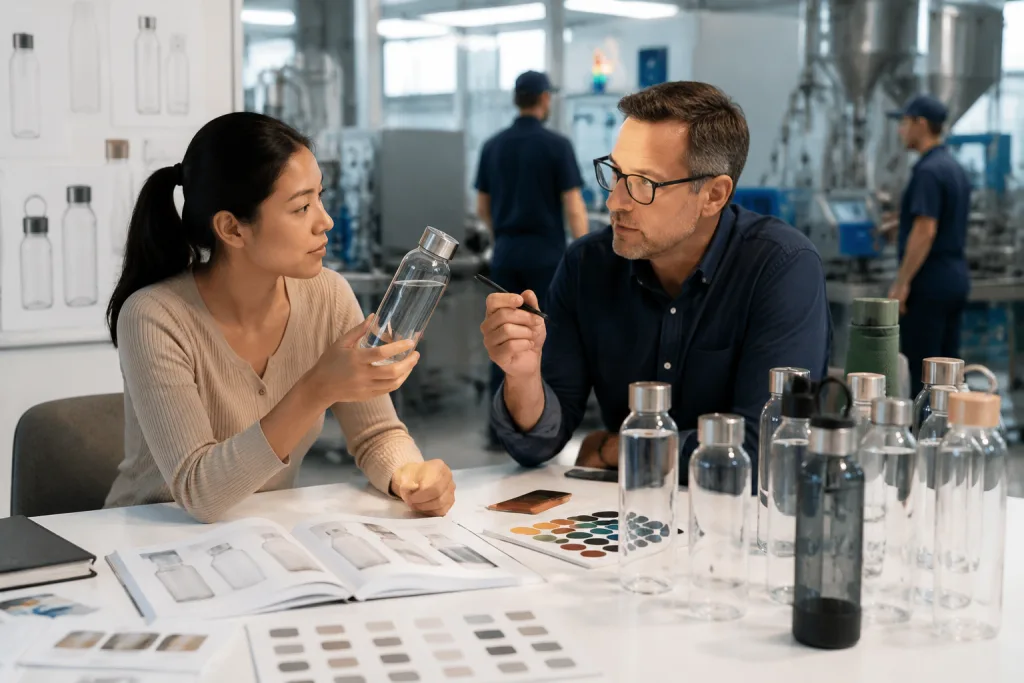
If you use an existing body shape, sampling moves fast. A borosilicate glass bottle manufacturer can usually send plain stock samples in 3-7 days, then decorated pre-production samples in 7-12 days after artwork confirmation. International courier to the US, Canada, UK, or EU normally adds 3-6 days. In our sample room, QC pulls the bottle, checks mouth OD with a digital caliper, then weighs it on a 0.1 g scale before packing. So plan about 14-21 days before you hold a correct sample in your hand.
Tooling changes the calendar. A new glass mold for a custom borosilicate glass bottle body may cost USD 800-2,500 and need 15-25 days before first trial pieces. A custom cap mold may cost USD 1,200-4,000 depending on construction. A new silicone sleeve mold is often USD 300-900. These numbers move with shape, thread detail, and sleeve thickness, but the timing is the part buyers underestimate. We cannot put the line on the production board until tooling is approved; the math does not work if the first trial pieces arrive after your carton artwork deadline.
For most borosilicate glass bottle manufacturers in China, mass production lead time is 25-40 days after deposit and sample approval. If the bottle includes custom packaging, barcodes, hang tags, or 4 sleeve colors across multiple SKUs, plan 35-55 days. Before Q4, schedules can slip another 7-14 days because the glass furnace slot, sleeve molding machine, carton printing, and final packing crew all need to line up. We ship from Ningbo or Shanghai; one buyer once flagged a PO typo where “matte black sleeve” was written as “matt back sleeve,” and that small mistake held the packing list for 2 days.
Do not approve tooling from a 3D rendering only. Ask for real sample photos, weight, capacity tolerance, cap leak test result, and packaging drop-test notes. QC should run a 24-hour inverted leak test and a carton drop test from 76 cm if retail packaging is involved. Borosilicate glass is heat-resistant, not magic. We have seen this go sideways when the box insert left only 2 mm clearance at the shoulder, or when a tight cap pushed unevenly on the bottle mouth during transport.
Compliance, testing, and QC costs
A responsible borosilicate glass bottle supplier should talk test standards before deposit, not after the PI is stamped. For European buyers, common files include LFGB food-contact testing, REACH checks for restricted substances, and EU 1935/2004 declaration support when the retailer asks for it. For North American programs, buyers often ask for FDA food-contact references, California Proposition 65 screening, CPSIA if the bottle is sold for children, or ASTM-related packaging expectations. Last month a buyer flagged one PO because the silicone sleeve color was changed from PMS 5483C to PMS 548C, and that small typo meant the old sleeve report no longer matched the order.
Third-party testing is not free. A basic food-contact test package usually costs USD 250-700 per material set. If your bottle uses borosilicate glass, silicone sleeve, PP or stainless cap, bamboo cover, and printed ink, each material needs a separate look; the lab will not treat them as one bottle just because they sit in one carton. We run report checks against the BOM line by line, down to the cap gasket and the ink on the 35 mm logo area. A professional borosilicate glass bottle vendor should tell you which components already have valid reports and which need fresh testing under your order.
Quality control needs a budget. No shortcut here. We use AQL inspection logic such as AQL 1.5 for critical appearance or leakage issues and AQL 2.5/4.0 for minor defects depending on buyer agreement. Typical checks include actual capacity with a calibrated measuring cylinder, wall thickness by digital caliper, mouth finish, cap torque, leak test sampling, sleeve fit, print adhesion, carton drop test, barcode scan, and metal detector control if required by your retailer. On the line, QC pulled the sample after finding a 0.6 mm chip on the inner mouth; the math does not work if you discover that after 18,000 pcs are packed.
For bulk glass water bottle orders, a pre-shipment inspection from a third-party agency usually costs USD 180-350 per man-day in China. That is cheap compared with rejecting a container after arrival in Rotterdam, Hamburg, Los Angeles, or Toronto. We have seen this go sideways when a buyer saved one inspection day and then argued over cloudy glass, loose caps, and crushed 5-ply cartons at destination. Glass defects are visible to consumers immediately, so QC should sit inside the order price from day one, not be treated as optional decoration.

Freight and landed cost reality
Borosilicate glass bottle wholesale orders are bulky and easy to break compared with stainless tumblers. We see it on the packing table every week. A 500 ml bottle with sleeve and box may weigh 330-520 g before master carton. A 750 ml unit may reach 450-700 g. That weight can wipe out a USD 0.20 factory discount in one freight quote. When you compare borosilicate glass bottle suppliers, ask for carton size in mm, gross weight, pieces per carton, pallet loading data, and the actual packing photo, not just FOB price. Last month QC pulled one 24 pcs carton and found 2 bottles touching at the shoulder because the divider slot was cut 3 mm too wide.
FOB Ningbo or FOB Shanghai is common for Zhejiang and East China factories. From our Hangzhou side, Ningbo usually feels cleaner for scheduling, but Shanghai sometimes wins when the forwarder has space. Sea freight to Europe or North America changes fast, but a rough planning range for LCL shipments is USD 80-180 per CBM before local charges. A full 20 ft container may hold roughly 18,000-28,000 boxed glass bottles depending on size and packing. A 40 ft HQ may hold around 45,000-60,000 units. Air freight for a launch event is where the math often breaks; we had one buyer ask for 1,200 gift sets by air, and freight came in higher than the bottles. Use air for samples or emergency top-ups only.
For sustainable retailers, carton design affects both the carbon claim and the cost sheet. Overbuilt foam inserts protect well, but they create waste and can make a “eco” bottle look dishonest when the customer opens the box. Molded paper pulp, kraft dividers, and snug inner boxes are better choices when the line has tested them, not when a supplier just says “no problem.” We run 1.0 m drop testing on export cartons before we trust a new insert. A good borosilicate glass bottle distributor program usually standardizes one or two carton structures across several SKUs to reduce damage and speed replenishment. Too many carton types slows packing.
Always calculate landed cost per sellable unit, not per shipped unit. This is the wrong question to ask if you only compare unit FOB. If your damage allowance is 1.5%, inspection cost is USD 0.05 per unit, and upgraded packaging adds USD 0.22 but reduces breakage from 3% to under 0.8%, the “expensive” packaging may be the cheaper commercial decision. We have seen this go sideways when the PO says “standard export carton” and nobody defines the burst strength, inner divider thickness, or AQL check point for cracked glass.
A realistic ordering calendar
Here is the calendar we would hand to a new borosilicate glass bottle distributor planning a spring retail launch. Week 1 is specification work: capacity in ml, lid type with gasket material, sleeve material and thickness, logo method with print size in mm, packaging style with box grade, target price, compliance market, plus expected annual volume. A clean RFQ lets the borosilicate glass bottle manufacturer quote in 24-72 hours because our sales sheet, BOM table, and glass line schedule all match. “Eco bottle, best price” is the wrong question to ask. Last month one buyer sent that exact brief, then flagged the quote because the lid was bamboo instead of PP.
Weeks 2-3 are sampling and artwork. You approve the custom glass water bottle body, cap, decoration position, Pantone sleeve color, retail box dieline, barcode, and carton marks; the carton mark file should match the PO, not a WhatsApp screenshot. QC pulled one sample in January where the logo sat 6 mm too close to the silicone sleeve edge. We fixed it before mass production. If tooling is needed, add 2-4 weeks here. Weeks 4-8 are mass production for normal existing-mold orders: material preparation, glass production or allocation, cap assembly, sleeve molding, decoration, packing, and internal QC, with the line checking mouth diameter by caliper before packing starts.
Week 8 or 9 is pre-shipment inspection and balance payment. Sea freight then adds about 28-40 days to 6 common European ports and 18-35 days to 5 North American West Coast routings, with inland delivery extra. Port cutoffs move. We’ve seen this go sideways when the buyer paid balance on Friday afternoon and expected the container to catch a Monday vessel. For a safe first order, start 90-120 days before your required retail shelf date. Reorders can be faster, often 30-45 days ex-factory if materials are stable and artwork does not change.
The strongest buyers give annual forecasts but release firm purchase orders in controlled batches. That lets a borosilicate glass bottle factory reserve cap components, sleeves, and cartons without forcing you to hold 3 months of slow inventory. We run this with a simple rolling forecast sheet, down to carton quantity and sleeve color code. If your project needs multiple colors, start with two core SKUs, or three only if each color clears MOQ by itself. More colors look good on a presentation deck; the math doesn’t work when they split MOQ, slow packing, and leave you with 400 units of the weak color.
Send your bottle spec for a costed quote
Share capacity, logo method, packaging, MOQ, and target market. We will return a practical FOB quote with timeline and QC notes.
Frequently asked questions
What is the MOQ for a borosilicate glass water bottle custom order?
For an existing bottle mold with simple logo decoration, the practical MOQ is usually 1,000 pcs per design. If you need Pantone-matched silicone sleeves, printed retail boxes, or several cap colors, plan 3,000 pcs per color. A fully customized borosilicate glass bottle with new body tooling, exclusive sleeve, or custom cap is more realistic at 5,000-10,000 pcs. Some factories advertise 300 pcs, but the unit price, decoration stability, and packaging options are usually poor. For wellness retail, 1,000 pcs is acceptable for a market test; 3,000 pcs is the level where FOB cost and quality control become more balanced.
How much does a custom borosilicate glass bottle cost FOB China?
Most standard 500-750 ml custom borosilicate glass bottle projects fall between USD 2.20 and USD 6.50 FOB China. A basic bottle with stock cap, one-color print, and white box may be near the low end. Add a silicone sleeve, bamboo cap, tea infuser, laser engraving, kraft retail box, and upgraded drop protection, and the price can move above USD 5.00. Tooling, testing, inspection, and freight are separate unless clearly included. Always ask whether the quote is FOB Ningbo, FOB Shanghai, or EXW, because local transport and export handling can change the comparison.
Is borosilicate glass strong enough for retail and promotional use?
Borosilicate glass has better thermal shock resistance than ordinary soda-lime glass, so it suits tea, infused water, and wellness use. It is still glass, so impact protection matters. For retail and promotional orders, we recommend 1.8-2.2 mm wall thickness where the design allows, a silicone sleeve for grip, and retail packaging tested by carton drop procedure. A leak test and mouth inspection are also important because cap fit controls consumer experience. If the bottle will be mailed individually, use mail-order packaging, not only standard export inner boxes.
Can you support barcodes, FNSKU labels, and distributor packaging?
Yes, but the packing instruction must be confirmed before mass production. For borosilicate glass bottle wholesale or distributor programs, we can apply EAN/UPC barcodes, carton labels, FNSKU stickers, suffocation warnings for polybags if used, and outer carton marks. For Amazon-style delivery, we normally recommend individual retail boxes plus master cartons that meet weight and drop expectations. Label application may add USD 0.03-0.12 per unit depending on position and quantity. Send label files early, because changing carton marks after packing creates rework and delay.
How do I compare borosilicate glass bottle suppliers fairly?
Give every supplier the same specification sheet: capacity, diameter, height, wall thickness target, cap material, sleeve type, decoration size, box style, test requirements, MOQ, and delivery port. Then compare FOB price, sample timing, mass lead time, carton data, test reports, AQL plan, and tooling ownership. A lower quote may exclude retail packaging, use thinner glass, or assume no third-party testing. Good borosilicate glass bottle suppliers answer with numbers: USD cost, days, MOQ per color, carton CBM, and defect control method. Avoid vendors who only reply with catalog photos and “best price.”