Key Takeaways
- For borosilicate glass water bottle bulk, confirm 1.8-2.2 mm wall thickness before comparing FOB prices
- A realistic MOQ is 1,000-3,000 pcs per color or logo for standard molds
- Silicone sleeves improve grip but add USD 0.35-0.80 per bottle and another color-control step
- Use AQL 2.5/4.0 inspection and carton drop testing before balance payment
If you are buying borosilicate glass water bottle bulk for a wellness brand, supplier search is not the bottleneck. The bottleneck is locking the spec before quotation: 1.8 mm or 2.2 mm glass wall, stainless or bamboo cap, sleeve thickness in mm, logo process, carton drop-test level, and the test standard your buyer will accept. We run calipers on the sample bench for this reason. If the brief says “premium glass bottle” and nothing else, 5 borosilicate glass bottle supplier quotes will describe 5 different bottles.
BottleForge Industrial ships from Hangzhou, Zhejiang, and we see the same issue with sustainable retailers in Europe and North America. A nice sample clears the brand meeting, then the bulk order shows the real problems: 5-ply cartons that crush at the corner, caps with 0.3 mm thread play, or a logo that rubs off after 50 cycles in a tape test. QC pulled the sample; the buyer flagged it. A practical sourcing plan catches these points before deposit, not after 3,000 pcs are packed.
Start with the product risk
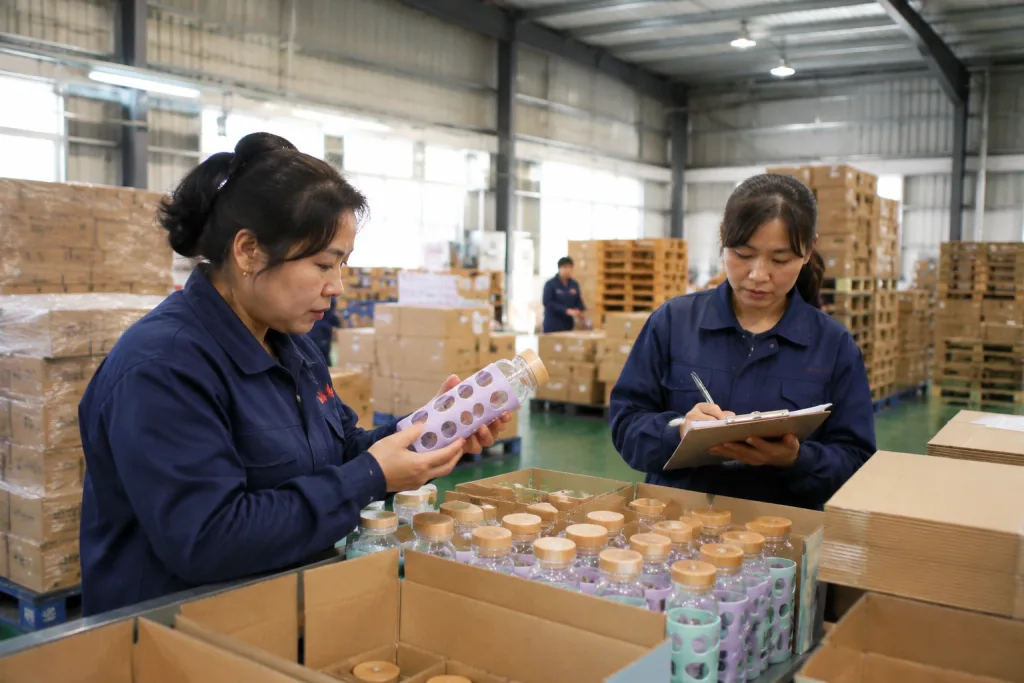
Borosilicate glass sells because it feels cleaner than plastic, handles 95°C tea and chilled drinks better than ordinary soda-lime glass, and matches the sustainability brief most wellness buyers send us. Glass is still glass. The first sourcing decision is not the logo; it is how much breakage risk you accept for a slimmer, lighter bottle. On our packing table, QC pulled 32 samples from one trial carton last month and flagged two rim chips after a 76 cm drop test.
For a bulk glass water bottle program, we ask buyers to lock four items before decoration: capacity, glass wall thickness, cap system, and protective sleeve. A 550 ml bottle with a 2.0 mm wall is a different commercial product from a 750 ml bottle with a 1.6 mm wall, even when the outside shape looks close in photos. Thin glass cuts cost and carton weight, but it gives less margin during filling, warehouse stacking, and courier delivery. The caliper does not lie. We run wall checks at the shoulder and base, because a 0.3 mm weak spot is where cracks usually start.
For wellness brands selling through retail stores, a silicone sleeve is often worth the cost. It reduces surface scratches, improves grip, and gives the buyer a clean color story on shelf. For online sellers, the sleeve also hides small cosmetic variation that would trigger refund photos from end users. The trade-off is simple: more SKUs and slower packing. If you need a borosilicate glass bottle customized in six sleeve colors, expect pre-production approval to move from 12 days to about 18 days, especially when Pantone matching needs two rounds. We have seen this go sideways when a PO says “sage green” but the approved chip is closer to PMS 5575C.
As a China-based borosilicate glass bottle manufacturer, we prefer to discuss the use environment early. Yoga studio giveaways, pharmacy retail, hotel minibar, and premium wellness subscription boxes should not share one specification. This is the wrong question to ask: “Can you make it cheaper?” Ask where it will be filled, packed, dropped, and complained about. The bottle can be borosilicate, custom glass water bottle, and attractive, but if the cap leaks in a gym bag, the buyer remembers the wet towel, not the glass grade. On the line, we torque-test caps at 8 kgf·cm before we ship because one loose gasket can ruin a full carton.
Choose glass, cap, and sleeve specs
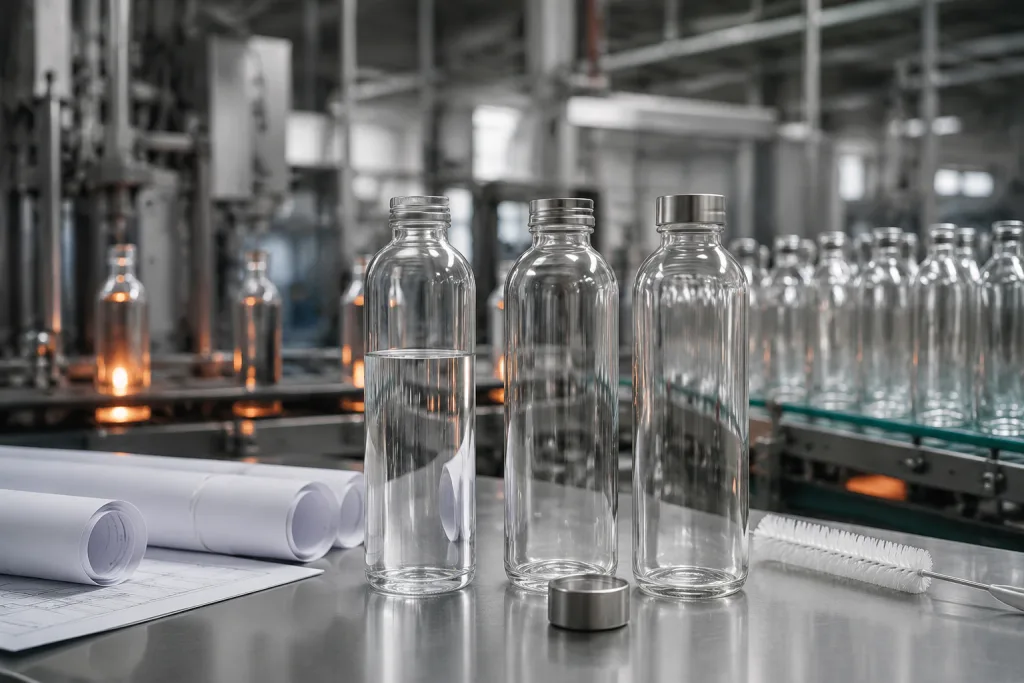
The main glass spec should be high borosilicate, usually 3.3 expansion coefficient material. It handles thermal shock better than soda-lime glass. It still breaks. For drinkware, we normally run 1.8-2.2 mm wall thickness, checked with a digital caliper at the mouth, shoulder, and lower body. Below 1.8 mm, the bottle looks nice in a catalog but feels risky when QC taps it on the inspection table. Above 2.2 mm, weight jumps, and the freight math starts hurting on 12 kg export cartons.
Cap choice changes the whole user feeling. Bamboo caps photograph well and suit eco retail, but they need a food-grade inner liner, usually PP or stainless steel, because bamboo should never be the sealing surface. Stainless steel caps feel tougher and support a premium price point. PP caps cut cost for promo orders where the buyer is chasing MOQ and landed cost. On our line, QC pulled 32 samples from a 500 ml order last month and found 2 slow leaks because the silicone gasket was seated 0.6 mm off center. Ask whether the cap is leak-tested with the gasket installed, not just hand-tightened for photos.
Sleeves are not decoration only. A full-height silicone sleeve protects more surface area, but it hides the glass and makes fill-level checking harder for gyms and office users. A half sleeve keeps the bottle clean-looking and costs less, but drop protection is weaker at the shoulder and base. Neoprene sleeves work for bundle packs and distributor borosilicate glass bottle programs; the sewing tolerance needs control, and textile color approval should be separate from glass approval. We have seen this go sideways when a buyer approved Pantone on the bottle print, then rejected the sleeve because the fabric batch looked 1 shade warmer under a D65 light box.
- Common capacities: 350 ml, 500 ml, 550 ml, 750 ml, and 1,000 ml.
- Typical glass wall: 1.8-2.2 mm for retail bottles, measured at 3 body points before packing.
- Cap options: bamboo with PP or stainless liner, stainless steel for premium sets, PP for cost control, or flip lid for sports use.
- Useful tests: leak test with silicone gasket installed, thermal shock check, coating adhesion by tape pull, and carton drop test before mass packing.
A good borosilicate glass bottle factory will push you to define these items on the quotation sheet. If a supplier quotes only by capacity and photo, this is the wrong question to ask; the low price is usually hiding a lighter glass body, a thinner gasket, or a weaker 5-layer carton. We ship samples with a spec sheet for a reason. One typo on a PO, such as “550 ml” entered as “500 ml,” can waste 10 days before the buyer even notices the mold drawing is wrong.
Decide what custom really means
About 7 out of 10 buyers who ask for a borosilicate glass bottle custom project are not asking for the same thing. Custom has levels. The lowest-cost option is a stock bottle with a logo. Next is a stock bottle with matched sleeve color, cap color, and retail box artwork. After that, we change accessories: strap length, tea infuser mesh, or cap structure. Full custom mold is the costliest route and ties up the line the longest; last month QC pulled a 550 ml trial bottle because the shoulder radius was 1.2 mm off the drawing.
For most sustainable retailers, a customizable glass water bottle based on an existing mold is the safer first order. Sampling is faster, tooling risk is lower, and reorder work is cleaner. At BottleForge Industrial in Zhejiang, our standard MOQ for a custom borosilicate glass bottle with logo is usually 1,000 pcs, while sleeve color matching is more comfortable at 2,000-3,000 pcs per color. A new glass mold can require USD 1,500-4,500 tooling cost depending on shape and complexity, and it usually adds 25-35 days before mass production. We have seen buyers ask for a new mold on a 1,200 pcs launch order; the math doesn't work after mold cost, sample rounds, and carton drop-test time.
Decoration needs a practical choice, not a pretty catalog answer. Screen printing works best for one or two solid colors, and it suits wellness logos with clean lines; we run a 180-mesh screen for most simple bottle marks. Laser engraving on a stainless cap lasts well, but it will not give the same look on the glass body. Decals handle detailed artwork, but firing or curing must be controlled, and curved wraparound artwork raises rejects when the seam drifts by 2-3 mm. For a borosilicate glass bottle promotional order, we usually recommend one-color screen print with a branded kraft box. It looks credible and keeps the unit cost under control.
If your brand depends on soft colors, send Pantone references and approve physical samples, not digital renders alone. Silicone, paper, bamboo, and glass reflect color differently under the same light box; our QC table uses D65 lighting, and even then the buyer sometimes flags a sleeve that looked correct on PDF. A borosilicate glass bottle customizable across several parts is possible, but each part needs its own tolerance and approval standard. Get that signed before bulk. It prevents arguments later.
Compare prices without fooling yourself
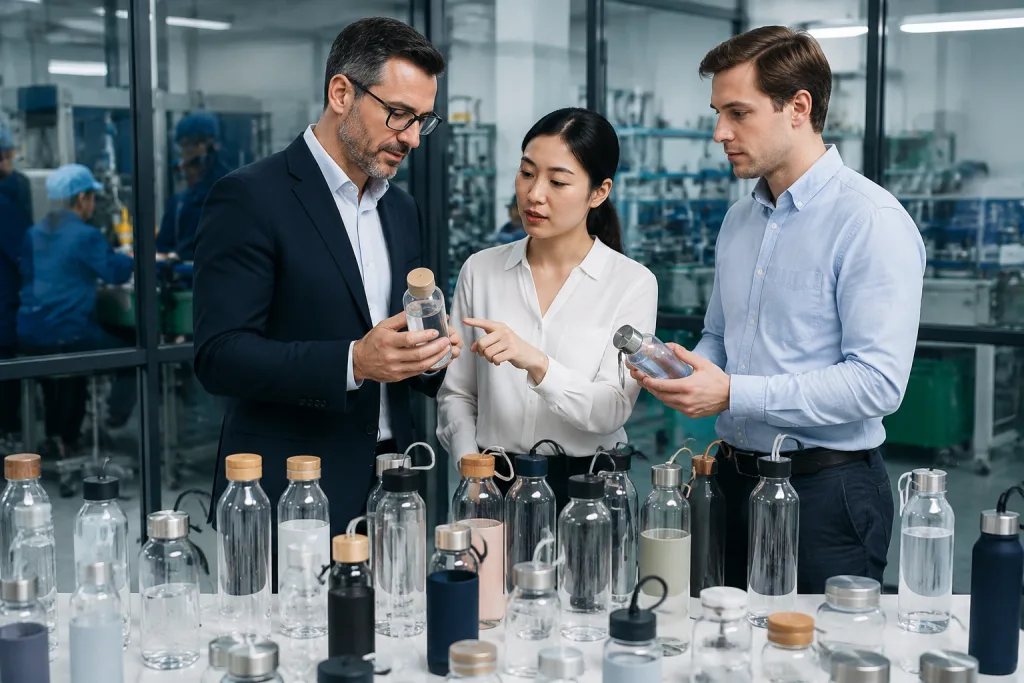
FOB pricing for borosilicate glass bottle bulk jumps because each factory is quoting a different bottle, even when the photo looks the same. A basic 500 ml high borosilicate bottle with PP cap and simple carton packing may sit around USD 1.20-1.80 FOB China at volume. Add bamboo cap, silicone sleeve, one-color logo, retail box, and stronger export carton, and the same size can move into the USD 2.20-3.60 range. For a 750 ml customized glass water bottle, expect more glass weight, higher freight, and often a higher defect allowance; last month QC pulled a 750 ml sample at 238 g, while the buyer’s old spec was only 210 g, so the carton weight changed before we even talked about logo cost.
Do not compare a borosilicate glass bottle vendor only by the first unit price. That is the wrong question to ask. Ask for glass weight in grams, wall thickness in mm, cap material with grade, gasket material, packing method, carton quantity, and gross weight. If one quote packs 48 pcs per carton and another packs 24 pcs with dividers, the ex-factory price is not the full story. We have seen a USD 0.15 saving disappear after a drop-test finding: 3 cracked bottles from a 1.2 m carton test, all at the shoulder.
Payment terms also matter. Common terms from China are 30% deposit and 70% before shipment after inspection. For repeat distributor glass water bottle orders, some suppliers may discuss staged shipment or credit insurance, but new buyers should plan around standard terms. Production lead time for standard borosilicate glass bottle wholesale orders is typically 30-45 days after deposit and sample approval; with decal printing and retail box approval, we usually plan 38 days instead of pretending 30 days is safe. Our Hangzhou coordination team works with production lines that can handle about 300,000 drinkware units per month across stainless steel, glass, and plastic categories, but glass decoration still needs careful scheduling. The line stops fast when a PO says “matte black sleeve” and the approved sample is dark grey.
Cheap is not a sourcing strategy. A clear bill of materials is.
If you want a serious comparison between borosilicate glass bottle manufacturers, send the same RFQ table to each supplier. Include capacity, glass thickness, cap spec, sleeve thickness, logo size in mm, packaging details, certification request, incoterm, destination port, and annual forecast. We run cleaner comparisons when the RFQ says “500 ml, 2.0 mm wall, bamboo cap, FDA gasket, 1C logo 35 x 20 mm, 24 pcs/carton with dividers” instead of “please quote best price.” The answers will be more honest.
Check compliance before artwork approval
For Europe and North America, compliance is not a paperwork chase after the line has packed 12,000 bottles. Set the test plan before the pre-production sample. For EU buyers, we usually see LFGB food contact testing, REACH checks for restricted substances, and local packaging waste rules on the checklist. For the United States, buyers often ask for FDA food-contact material declarations, California Proposition 65 review, and CPSIA points if the bottle is sold for children. QC needs this before artwork approval, because changing ink after the silk-screen plate is made is slower than most buyers expect.
The bottle body, cap liner, silicone gasket, sleeve, ink, coating, and retail box can each raise a compliance question. Testing only the borosilicate glass body is the wrong question to ask. If the bamboo cap has varnish, test that coating. If the silicone sleeve is bright red or black, ask for heavy metal and restricted substance checks; we have seen red sleeves fail because the pigment supplier changed one batch. If the bottle includes a straw or infuser, put those parts on the material list, down to the 304 stainless strainer or PP straw length in mm.
For quality control, use AQL inspection, not a quick video from the packing table. A normal Level II inspection with AQL 2.5 for major defects and 4.0 for minor defects is common for retail drinkware. Major defects include leaking caps, cracked glass, sharp edges, wrong logo, heavy printing defects, and incorrect packing. Minor defects include small cosmetic marks inside the agreed limit, for example one dot under 0.5 mm outside the logo area. QC pulled the sample. The buyer flagged it. You should also request carton drop testing, especially for e-commerce orders or distributor warehouses that open cartons and repack mixed SKUs.
BSCI, ISO 9001, and similar audits help, but they do not replace product testing. Audit files tell you how the factory is managed. They do not prove your borosilicate glass bottle customized order will pass handling or match your market rules. Put the required tests, inspection standards, and exact document wording on the purchase order; we once saw a PO typo change “Prop 65 label required” to “Prop 65 label reviewed,” and the math did not work when cartons were already sealed.
Plan logistics for fragile inventory
Glass bottles export fine, but bad packing gets expensive fast. A bulk borosilicate glass bottle order should be packed around the break points we see on the line: glass touching glass, cap pressure on the mouth, and carton crush at the bottom layer. For retail bottles, we run individual box packing or paper wrap with dividers, then a five-layer export carton. If you choose a kraft retail box, check 350 gsm vs 400 gsm paper, insert fit, barcode position, and whether the carton passes a 1.2 m drop test. QC pulled one 750 ml sample last month because the silicone sleeve edge rubbed through the box corner after vibration.
For Amazon or other marketplace routing, confirm FNSKU labeling, carton labels, suffocation warnings for polybags, and master carton weight limits before production packing starts. Do not ask the factory to relabel 3,000 cartons after the goods are sealed. The math does not work. For distributor borosilicate glass bottle programs, pallet height and mixed-SKU carton markings matter more than shiny retail packaging. Your warehouse team will thank you if each carton shows SKU, color, capacity, quantity, gross weight, and production batch. We once had a PO with “matte black” typed as “mate black,” and the buyer flagged it only after 186 cartons were printed.
Ocean freight usually works better for borosilicate glass bottle distributors, but air freight still makes sense for launch samples or urgent replenishment. Glass is bulky and heavy, so calculate landed cost by carton volume, not just unit FOB. A 750 ml bottle with sleeve and gift box may take 0.032 CBM per carton, while a simple 500 ml bottle may sit near 0.021 CBM. Small FOB gaps can hide a freight problem. We ship by sea for most repeat orders because air freight on glass often kills the margin before the product reaches the shelf.
Ask your China supplier for a packing specification with carton dimensions, pieces per carton, net weight, gross weight, and CBM before you approve the order. Send it to your forwarder before deposit payment if the order is over 1,000 pcs. This gives them enough data to estimate freight, duty, and warehouse receiving costs. It also prevents the common surprise where the bottle price looks acceptable, but the landed cost breaks the margin. We have seen this go sideways when a buyer approved the bottle sample but never checked the 48 x 36 x 32 cm carton size.
Build a repeatable supplier process
The sourcing process for borosilicate glass bottle suppliers should be boring, written down, and easy to repeat. Start with a one-page spec sheet with capacity, glass thickness in mm, cap material, sleeve color code, carton drop-test requirement, then ask for the quotation. After that, approve a physical sample, lock a signed golden sample, and run pre-shipment inspection before final payment. Skipping sample approval can save 7 days, but we have seen it burn a 90-day selling season when QC pulled the sample and found the logo 4 mm off center.
For a first order, keep the range tight. One bottle size, one cap, two sleeve colors with Pantone numbers, and one logo method is enough to test demand. Simple sells first. After you have sell-through data from 30 or 60 days, move into seasonal colors with fixed MOQs, gift sets with tested inner trays, infuser versions, or a customized borosilicate glass bottle with a new silhouette. Wellness brands often ask for 6 colors on the first PO; this is the wrong question to ask if the decoration line minimum is 1,000 pcs per color.
A professional borosilicate glass bottle manufacturer should push back before the deposit leaves your account. If your logo sits too close to the bottle curve, the print will distort; if the sleeve cutout is too wide, the bottom corner loses protection. If the box window is thin PET, breakage risk goes up in a 1.2 m carton drop test. If your requested MOQ is below the decoration line minimum, the math doesn't work. BottleForge Industrial works from Zhejiang because we can reach export cartons, logo printing, silicone sleeve molding, and third-party inspection teams within a short truck run, but even here in China, clean orders come from disciplined approvals.
When you evaluate borosilicate glass bottle vendors, judge the reply quality, not the reply speed alone. A useful supplier asks about sales channel, retail price, packaging style, compliance market, and reorder timing. A weak supplier asks only for quantity and target price, then sends a recycled quote sheet with the wrong cap photo; we once saw a PO typo list 500 ml while the approved sample was 550 ml. If you want a custom glass water bottle program that can grow, treat the first purchase order as the start of a product line, not a one-time giveaway.
Get a glass bottle quote with real specs
Send your capacity, logo, sleeve color, packaging, and target market. We will return a practical FOB China quotation and MOQ.
Frequently asked questions
What is the normal MOQ for borosilicate glass water bottle bulk orders?
For standard molds, a practical MOQ is 1,000 pcs per logo. If you need a custom silicone sleeve color, 2,000-3,000 pcs per color is more realistic because silicone mixing and color matching have setup loss. For a new glass mold, most factories in China will want a higher commitment, often 5,000 pcs or more, plus tooling cost. Small trial orders below 500 pcs are possible only from existing stock, with limited decoration options and higher unit price. If you are launching a wellness retail line, start with one size and two colors rather than six SKUs.
How much does a custom borosilicate glass bottle cost FOB China?
A basic 500 ml borosilicate glass bottle with PP cap can be around USD 1.20-1.80 FOB China at volume. With bamboo cap, silicone sleeve, screen-printed logo, individual kraft box, and export carton, many orders land around USD 2.20-3.60 FOB. A 750 ml bottle costs more because of glass weight and carton volume. Prices change with exchange rate, energy cost, decoration, rejection allowance, and packaging. Always compare glass weight, wall thickness, cap material, packing quantity, and carton CBM. A cheap quote without those details is not a reliable quote.
Is borosilicate glass safe for hot drinks?
High borosilicate glass has better thermal shock resistance than ordinary soda-lime glass, so it is suitable for many hot and cold drink uses. That does not mean you should pour boiling water into a chilled bottle or put the bottle on direct heat. For retail claims, avoid exaggerated wording and request thermal shock testing from the supplier. Also check the cap liner, silicone gasket, sleeve, and printing ink, because food-contact safety is not only about the glass body. For EU markets, buyers often request LFGB and REACH-related documentation; for the US, food-contact material declarations and Prop 65 review may be needed.
Which logo method is best for a customized glass water bottle?
For most wellness brands, one-color screen printing on the glass body is the best balance of cost, appearance, and MOQ. It works well for clean logos and simple text. Decals are better for complex multi-color artwork, but they increase process time and can have more cosmetic rejects on curved surfaces. Laser engraving is excellent on stainless steel caps, not usually the main method for glass branding. For promotional orders, consider printing on the bottle plus a branded retail box. Before mass production, approve a physical pre-production sample and run tape adhesion or rub testing on the decoration.
How do I reduce breakage in wholesale glass bottle shipping?
Start with the packaging specification, not the freight booking. Use individual boxes or dividers, avoid glass-to-glass contact, and pack in five-layer export cartons. For e-commerce or distributor handling, request a carton drop test, commonly around 1.2 m depending on carton weight and buyer standard. Keep carton weight reasonable, often under 15-18 kg for easier warehouse handling. Confirm pieces per carton, carton dimensions, gross weight, and CBM before production. If bottles have bamboo caps, protect cap tops from compression marks. A USD 0.20 stronger packing upgrade can save more than it costs.