Key Takeaways
- Start glass specs at 3.0-3.5 mm borosilicate wall thickness for most retail bottles
- A practical MOQ is 1,000 pcs per color or logo for stable factory scheduling
- Use AQL 2.5 for major defects and AQL 4.0 for minor cosmetic defects
- Plan 30-45 days mass production after artwork, deposit, and approved pre-production sample
A borosilicate glass vacuum insulated bottle supplier should not send one shiny sample and park the hard questions until mass production. Ask for the glass grade, vacuum gap spec in mm, cap material, print limits, carton drop result, and who pays for SGS or Intertek testing. We run this check before quoting. Last month QC pulled a sample with a loose silicone ring after a 1.2 m drop test, even though the sample looked perfect on the buyer’s desk.
From Zhejiang, China, we see buyers lose 8% to 15% of order value on unclear spec sheets, not on unit price. A canteen customized for retail shelves is not the same as one for corporate gifting or a distributor program with mixed cartons. The right spec line tells you if the bottle can survive freight, meet EU or North American compliance, and protect your margin. “Can you make it cheaper?” is the wrong question to ask when the PO says 500 ml but the artwork file says 520 ml. That typo goes sideways fast.
Glass body specification
The first line on the spec sheet should read borosilicate glass, not “high quality glass.” We run high borosilicate glass for drinkware because it takes thermal shock better than soda-lime glass. For 350 ml to 750 ml bottles, a workable buyer spec is 3.0-3.5 mm wall thickness, checked with a digital caliper at the mouth, shoulder, and base. Below 2.5 mm, the bottle looks slim in photos but gives less safety margin in parcel drops and retail shelf handling.
Borosilicate glass is not magic. Pour boiling water into a cold bottle, then drop it on tile, and it will still break. What you are paying for is better temperature-change resistance and cleaner taste transfer than lower-grade glass. In one tea canteen order, QC pulled the sample after annealing and found stress marks under the polariscope; the buyer’s later complaint would have sounded like “it cracked with hot tea,” but the cause was process control, not the glass name. Wall thickness, annealing control, and printed use instructions all matter.
Ask the borosilicate glass vacuum insulated bottle supplier to define capacity as full capacity and usable capacity. A 500 ml full-capacity bottle may only feel right at 450-470 ml after the cap and filter are fitted. This is not a trick. It is geometry. Put both numbers on your purchase order; we have seen one PO typo list 500 ml usable capacity, then the buyer flagged the first carton sample because the lid displaced 35 ml.
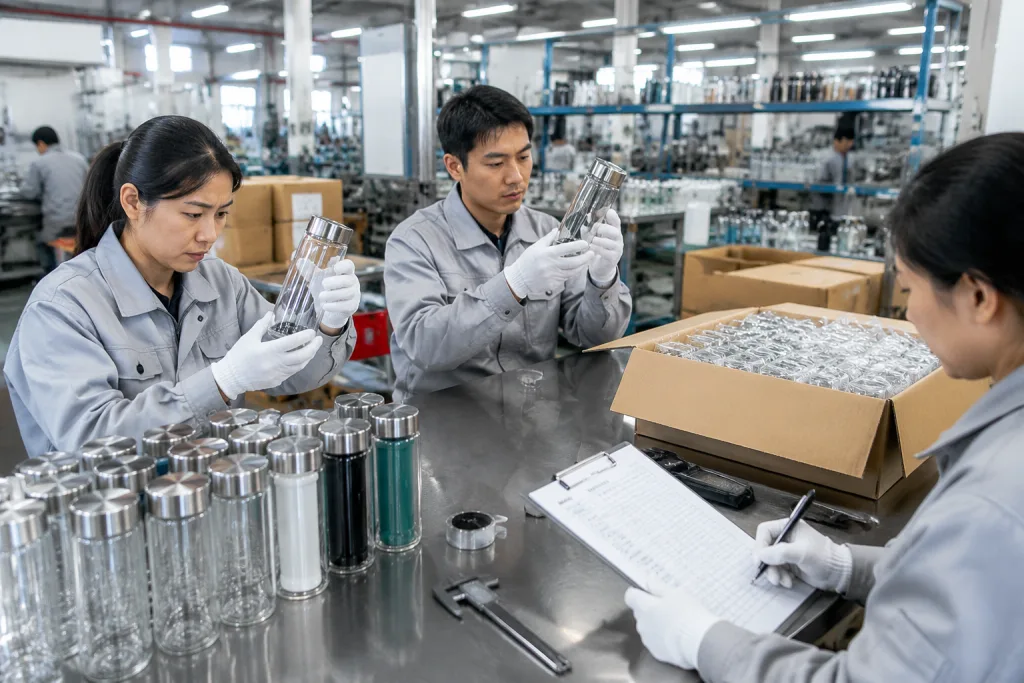
For retail or distributor canteen lines, specify surface tolerance in plain words: no sharp rim, no visible bubbles over 1.0 mm in the drinking area, no cracks or chips, and no rocking on a flat surface. We check rocking on a granite inspection plate, not on a packing table with tape stuck to it. A serious canteen factory in China should show inspection photos and defect boards from the line. A clean showroom sample is not enough; the math does not work if 2% of shelf stock gets returned for rim chips.
Vacuum structure and insulation claims
“Vacuum insulated glass bottle” needs tight wording on the spec sheet. We see 2 constructions on the line: double-wall borosilicate glass with a vacuum gap, or a glass inner liner inside an outer stainless steel shell. They sell differently. All-glass double wall looks premium under a light box, but QC pulled 3 cracked rims last month after cap torque was set too high. Glass liner plus steel shell survives rougher handling, but the buyer loses the clear-glass look and the BOM changes fast.
Do not accept insulation claims like “keeps hot all day” unless the test method is written. This is the wrong question to ask. A workable spec is: fill with 95°C water at 20°C ambient temperature, close cap, measure after 6 hours with the same probe depth each time. Depending on capacity and construction, a borosilicate glass vacuum bottle may hold above 50-60°C after 6 hours. Stainless steel vacuum bottles usually perform better, so don’t promise glass like an outdoor thermos if your Amazon reviews will compare it with steel. We run this check with a calibrated thermometer, and one buyer flagged a 7°C gap between our lab reading and their warehouse test because the cap was opened twice.
For a customized growler or distributor growler project, capacity makes the risk bigger. Larger glass bodies are heavier, harder to anneal evenly, and cost more to pack safely. A 1,000 ml glass vacuum growler may look good in a catalog, but it needs real drop testing and carton engineering before you promise online delivery. We’ve seen this go sideways: one 1,000 ml sample passed the beauty check, then failed a 76 cm corner drop because the EPE insert left 4 mm too much play at the shoulder.
The vacuum line on your spec sheet should include leakage rate and visual checks. We use hot water aging for retention drift, temperature retention sampling with recorded start and end readings, plus cap seal tests after torque setting. For a Zhejiang production run of 1,000-5,000 pcs, you should expect a defined sampling plan, not “we checked everything.” AQL inspection plus a smaller functional test sample is the practical way to control cost without pretending every bottle was lab-tested. We ship after the line signs off; if the PO says “glass vaccum bottle” with a missing “u,” we still confirm the actual vacuum structure before opening molds.
Caps, seals, and drinking parts
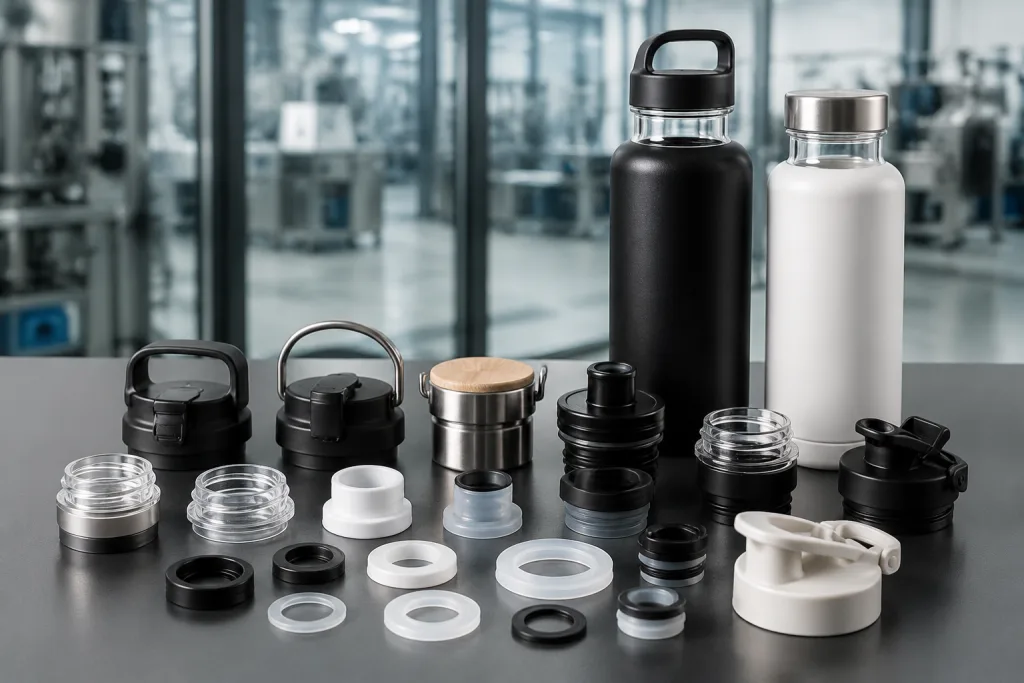
Caps cause more after-sales noise than the glass body. We’ve seen a clean photo sample fail on the line because a 1.8 mm silicone ring rolled in the groove, the thread tolerance had too much play, or the infuser rattled after a 1-meter carton drop test. The cap BOM should list every food-contact part by model: PP, Tritan, 304 stainless steel, silicone, bamboo, or aluminum alloy. No guessing.
For Europe, ask for food-contact compliance aligned with LFGB or EU 1935/2004 where applicable. For the United States, discuss FDA food-contact expectations and, for children’s items, whether ASTM or CPSIA-related checks apply. European buyers also ask for REACH on restricted substances when coatings, paints, or soft-touch finishes sit on the cap. Last month QC pulled a black soft-touch lid because the coating spec on the PO said “matte rubber,” but the lab needed the exact paint code.
Do not leave silicone hardness blank. For most bottle seals, 50-60 Shore A is common. Too soft, it deforms. Too hard, users complain about leaks after a week in a backpack. We run 20-30 open-close cycles on the sample cap with a torque feel check, then look for thread shaving and gasket creep. If you are sourcing canteen promotional items, assume 70% of end users will never read the instruction card, so the seal design must survive casual tightening and one-handed closing.
When comparing canteen suppliers, ask whether replacement caps can be ordered separately. This is where the math often breaks. A spare cap MOQ of 500 pcs is better than remaking 3,000 bottles because one corporate customer needs accessories for a second warehouse. Good canteen vendors keep cap tooling, gasket ID/OD, and thread drawings documented by model number. We ship spare caps in 5-layer cartons with divider boards, because loose caps in a polybag are how scratches and buyer complaints start.
Decoration limits that affect logos
Custom drinkware buyers often put the logo line at the bottom of the RFQ, then expect it to be simple. That is the wrong question to ask. Borosilicate glass is picky on ink adhesion, firing temperature, and curved-surface registration; our printing master checks the jig gap with a 0.2 mm feeler gauge before the line starts. We run silk screen printing for simple logos, decals for photo-style artwork, laser marking on stainless caps, color coating when shelf color matters, sleeve packaging for low-risk branding, and acid-etch style effects only after checking the destination market rules.
Silk screen works best for one or two colors. Cheap and clean. On a cylindrical 500 ml glass bottle, a practical print area is about 60 x 90 mm before the logo starts to stretch near the edge. Full wrap printing needs a visible seam allowance; if the buyer asks for a perfect 360-degree join, the math does not work. On one canteen custom project, QC pulled the sample because 5 pt care text filled in after firing, so we moved that wording to the color box and kept the bottle logo larger than 6 pt.
Decals carry gradients, small icons, and multi-color brand art better than screen print, but they add cost and need firing control on the kiln chart. Color coating gives strong shelf impact, yet it changes scratch resistance and can trigger extra compliance testing. Say “dishwasher safe” early if that is the claim. We have seen this go sideways: a buyer approved a matte coating, then asked for 500 dishwasher cycles after the PO was signed. For most coated or printed glass bottles, hand-wash recommended is the safer retail wording unless the actual dishwasher cycle test passes.
For customizable drinkware and customizable canteen programs, keep artwork rules in your vendor file: Pantone number, logo size, placement tolerance of ±2 mm, and acceptable color variance. A canteen vendor in China can hit a Pantone target on paper, but transparent glass, white coating base, and firing time can shift the final shade. Our QC team checks pre-production samples in a D65 light box, not beside the office window. Always approve that sample under neutral lighting before mass production, and check the PO too; we once caught “Pantone 186 C” typed as “189 C” before the first 3,000 pcs went to print.
Packaging, drop tests, and freight
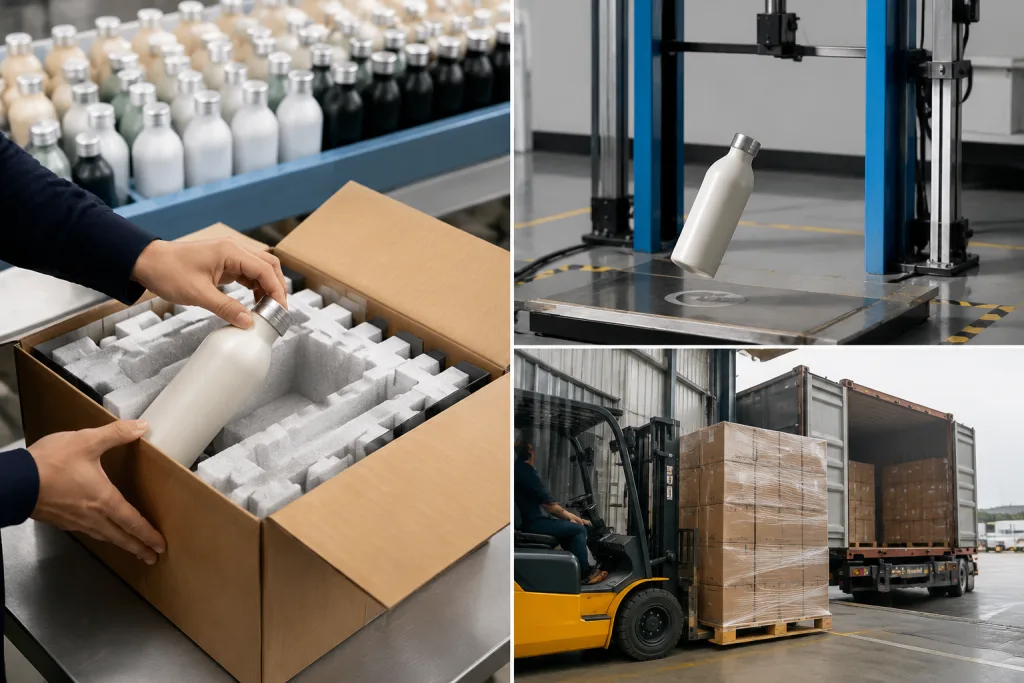
Glass drinkware is won or lost in packaging. A low FOB price means little if 6% of the order breaks in courier distribution. For single retail bottles, we usually pack bottle in polybag or paper wrap, fitted insert, color box, inner carton, then export master carton. Simple stack. On heavier customized drinkware, molded pulp or EPE inserts often justify the extra USD 0.20-0.60 per unit; last month QC pulled a 750 ml sample where the shoulder touched the color box wall by only 3 mm, and that pack failed on the second edge drop.
Your packaging spec should state carton dimensions, gross weight limit, and drop-test target. Do not leave this to “factory standard.” For B2B wholesale shipments on pallets, carton survival is different from direct-to-consumer parcel delivery; a 5-ply K=K master carton that survives pallet loading can still get crushed in courier sorting. If the order will go to Amazon FBA or similar fulfillment, ask for FNSKU labeling, carton weight below the required limit, and barcode scannability. We run a handheld scanner on the packed carton, not just on the artwork PDF. A distributor drinkware order that ships from warehouse to stores can use different packaging than an e-commerce launch, and the buyer usually flags this only after the first freight bill lands.
We typically push buyers to run a 1A or ISTA-inspired internal drop sequence for glass items: corner, edge, and face drops at a height matched to carton weight. It is not a substitute for certified lab testing, but it catches weak inserts before you ship a container. The wrong question is “can we make the box cheaper?” Ask whether the insert still holds the bottle after 10 drops. On the line, we mark the test carton with a black Sharpie, weigh it on a platform scale, then open it after each drop to check glass dust, cap dents, and movement inside the tray.
For FOB Ningbo or Shanghai, packaging volume affects freight more than buyers expect. A 500 ml bottle in an oversized gift box may reduce carton loading by 15-25%. The math does not work. That loss can erase the savings from choosing a cheaper canteen supplier, especially when one 40HQ drops from about 18,000 units to 14,500 units because the gift box is 12 mm taller than needed. If you are building a distributor canteen range, ask your supplier to quote both standard box and compact box options with units per carton. We ship both, but we always show carton CBM on the PI so nobody argues later over “unexpected” freight.
Compliance and factory controls
A serious borosilicate glass vacuum insulated bottle supplier should be able to talk through AQL, batch traceability, and social audits without calling three managers into the room. For most export drinkware orders, we run AQL 2.5 for major defects and AQL 4.0 for minor defects. Critical defects get zero tolerance on the checklist: cracked glass after annealing, sharp lip edges above the rim, unsafe contamination inside the liner, or leakage during the 30-minute inverted test. QC pulled one sample last month with a 0.6 mm chip under the silicone sleeve. It failed.
Factory documents depend on your sales channel. European retailers often ask for BSCI, REACH, LFGB, and packaging heavy metal compliance, with the supplier name and material description matching the PO. North American buyers usually request FDA food-contact declarations, Prop 65 review for California exposure, and CPSIA-related files when the bottle is sold for children. One report does not cover every decoration, cap, color coating, and silicone part. We have seen this go sideways when a buyer approved a clear glass sample, then switched to matte pink spray coating 12 days before shipment and expected the same LFGB file to cover it.
In Zhejiang, China, our standard export workflow is incoming material check, glass body inspection under the LED light table, decoration inspection with 3M tape test, assembly check, leak test sampling, final AQL inspection, and carton loading photos. BottleForge Industrial can support around 300,000 drinkware units per month across stainless steel, glass, and plastic lines, with typical MOQ at 1,000 pcs per logo for glass bottle projects. On the line, we record carton weight, barcode scan results, and sleeve fit; a 1.5 mm sleeve gap is not “close enough” for retail shelf orders.
Ask any canteen manufacturers you compare to show their actual inspection form. It should list defect names and acceptance limits, not just “QC passed.” For canteen promotional campaigns, one late failure can damage the whole event schedule, so the factory control plan matters more than a USD 0.05 discount. The math does not work if 20,000 bottles arrive two days before the school opening event and 600 caps leak in the warehouse check.
MOQ, pricing, and production timing
For a custom canteen or borosilicate glass vacuum bottle, MOQ is not just a sales rule. It comes from glass body stock, logo screen setup, cap color matching, carton printing, and how we book the line. For standard clear glass with a simple one-color logo, a realistic MOQ is 1,000 pcs per logo. Custom mold, custom color coating, or private cap design can move MOQ to 3,000-5,000 pcs. Last month QC pulled 12 random glass bodies with a caliper, and a 0.4 mm wall-thickness gap was enough to stop us from mixing two batches.
FOB pricing changes with capacity, bottle structure, cap, and packaging. As a rough factory range, a 500 ml borosilicate glass bottle with basic cap and one-color logo may sit around USD 3.20-5.80 FOB China. Double-wall vacuum construction, bamboo cap, infuser, premium gift box, and tested coating push the cost up fast. The math doesn't work if a quote is 25% below the market; check glass thickness, inner tray strength, carton grade, and whether testing is included. We have seen buyers flag this at final inspection when the gift box paper was 250 gsm instead of the 350 gsm shown on the approved sample.
Production timing should be written in calendar days, not “about one month.” Normal flow is 5-7 days for artwork and digital proof, 7-12 days for pre-production sample, and 30-45 days for mass production after deposit and sample approval. Ocean freight to Europe or North America then adds several weeks. Work backward from the launch date and leave room for inspection rework. Simple example: if the buyer needs goods in the warehouse on May 20, a 12-day sample delay versus an 18-day delay can kill the promo window. It happens.
For canteen distributors, the smartest first order is often not the largest order. Start with 1,000-2,000 pcs across one or two proven SKUs, check packaging breakage, read customer reviews, then scale. We ship better repeat orders when the first PO is clean: logo file named correctly, Pantone code confirmed, AQL 2.5 written, and barcode position marked on the dieline. A reliable canteen manufacturer will prefer that over a rushed oversized first PO with unclear artwork, loose compliance wording, and no inspection standard. We once had a PO typo showing 10,000 lids but 1,000 bottles; nobody wants to find that on packing day.
Send your bottle spec for a factory quote
Share capacity, logo, packaging, target market, and order quantity. We will check feasibility, MOQ, FOB price, and realistic production timing.
Frequently asked questions
What MOQ should I expect from a borosilicate glass vacuum insulated bottle supplier?
For standard models, expect 1,000 pcs per logo or color as a workable MOQ. If you need a custom cap color, special coating, printed gift box, or a fully customized canteen mold, the MOQ can move to 3,000-5,000 pcs. Some canteen suppliers will accept 500 pcs, but the unit price often rises because decoration setup, carton printing, and QC time are spread over fewer units. For a first distributor drinkware order, 1,000-2,000 pcs is usually enough to validate packaging, breakage rate, and market response without locking too much cash in inventory.
Is borosilicate glass safe for hot drinks and tea?
Yes, properly made borosilicate glass is commonly used for hot drinks because it handles thermal shock better than soda-lime glass. The safe performance still depends on wall thickness, annealing, cap design, and user instructions. For most 350-750 ml bottles, we recommend 3.0-3.5 mm wall thickness and clear instructions such as pre-warming the bottle, avoiding sudden freezer-to-boiling-water changes, and not overfilling. If the bottle includes a stainless infuser, confirm the steel grade is 304 and that silicone seals are food-contact compliant. Hot drink safety is a system, not only a glass material claim.
Can I put my logo on a glass vacuum insulated bottle?
Yes, but choose the decoration method based on the artwork. One-color logos are usually best with silk screen printing. Multi-color artwork may need decal printing or packaging-based branding. Laser engraving works on stainless caps or metal accessories, not directly as a normal logo method on clear glass. A realistic placement tolerance is about ±2 mm on curved glass. Fine text below 6 pt may blur or distort, especially on coated surfaces. For canteen promotional programs, approve a physical pre-production sample before mass production, not only a PDF proof.
What tests should I require before shipment?
At minimum, require visual inspection under AQL 2.5 major and AQL 4.0 minor, leak test sampling, cap open-close checks, print adhesion checks, and carton drop testing. For Europe, discuss LFGB, EU 1935/2004, REACH, and packaging compliance. For North America, ask about FDA food-contact expectations and Prop 65 review where relevant. If selling online, add barcode scanning and carton label checks. For glass items, do not skip packaging validation. A product can pass food-contact testing and still fail commercially if 4-6% of units arrive broken.
How do I compare quotations from different canteen vendors?
Put every quote into the same spec format before comparing price. Check capacity, glass wall thickness, single-wall or double-wall vacuum structure, cap material, silicone grade, logo method, retail box type, carton quantity, test reports, AQL inspection, and FOB port. A USD 0.30 cheaper quote may use thinner glass, lighter cartons, or exclude compliance testing. Ask each canteen vendor to confirm production lead time, MOQ, sample cost, and whether spare caps are available. The best canteen supplier is not always the lowest price; it is the one with fewer hidden changes after deposit.