Key Takeaways
- Specify borosilicate 3.3 glass, annealing control, and thermal shock testing at 80-100°C delta
- Use AQL Level II with critical 0, major 1.5, minor 4.0 for distributor drinkware orders
- Plan 35-45 days production after artwork approval for customized drinkware with tooling
- Do not approve canteen customized projects without drop, leak, carton, and logo adhesion tests
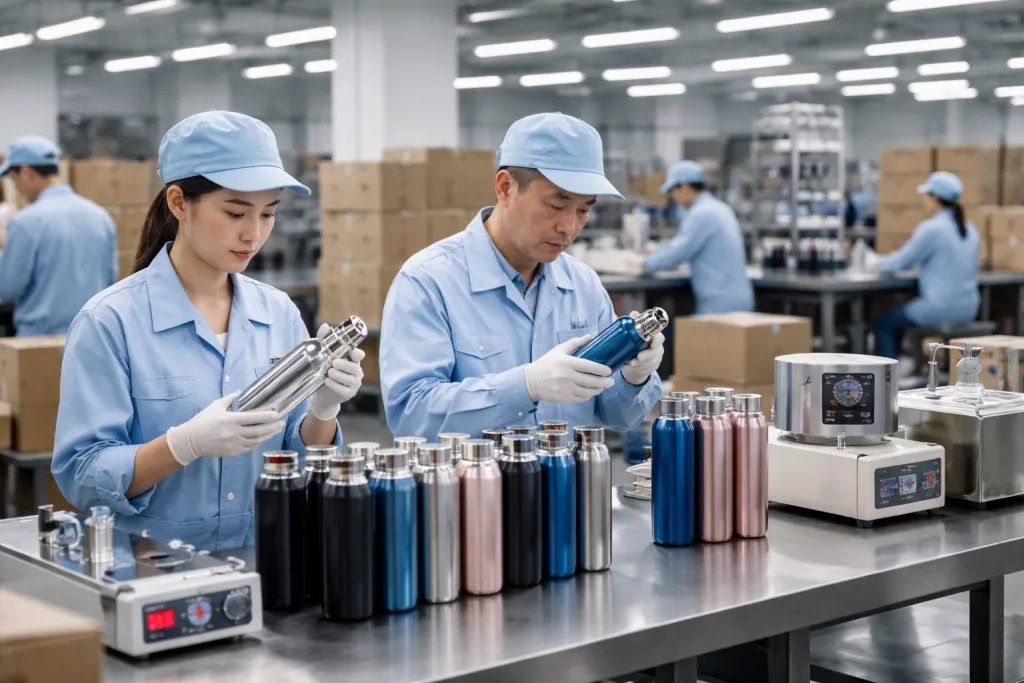
A borosilicate glass vacuum insulated bottle looks simple on a quotation sheet. On the line, it is not simple. We run glass forming, vacuum sealing, stainless or plastic hardware, silicone gasket fit, logo work, and export packing under one SKU, then expect it to survive a 1.2 m drop test, container vibration, retail shelf handling, and a customer pouring boiling water straight in.
If you are choosing a borosilicate glass vacuum insulated bottle manufacturer in China, the cheapest FOB line is the wrong question to ask. The risk is a loose spec. At our Hangzhou, Zhejiang facility, QC has pulled samples with vacuum loss after 24 hours, glass cracking after 95°C hot fill, lids leaking at the thread, logos failing the 3M tape test, and color boxes that looked fine at the factory gate but got crushed in courier transit. We have seen this go sideways.
Vacuum failure starts with vague construction
The first failure mode is assuming every double-wall glass bottle is a true vacuum insulated bottle. It is not. We see this on RFQs every month: the buyer writes “double wall glass” on the PO, then expects thermos performance. Some factories make decorative double-wall borosilicate bottles with air between the walls. They look premium on a showroom shelf, but the heat loss is fast and uneven. QC pulled one 420 ml sample last season that dropped from 95°C to 54°C in 6 hours. That is not vacuum insulation. If you sell through a canteen distributor or distributor drinkware channel, that wording gap turns into return claims within 2 or 3 weeks.
For a true borosilicate glass vacuum insulated bottle, make the supplier define the build: inner borosilicate glass wall, outer glass or protective shell, vacuum cavity, sealing point, lid material, gasket material, base protection. Ask for the vacuum retention method and the acceptance standard. Get it in writing. A practical test is filling with 95°C water, closing the lid, and measuring temperature after 6 hours at 20-25°C ambient. We run this with a calibrated probe thermometer, not a hand touch test at the packing table. The pass number depends on capacity and wall design, but it must be locked before mass production.
We normally recommend borosilicate 3.3 glass because its coefficient of thermal expansion is about 3.3 × 10^-6/K. Cheaper soda-lime glass is the wrong material for hot-fill vacuum bottles; the math does not work when the bottle sees boiling water, cold rinse, then carton compression. For custom drinkware programs in Europe and North America, your purchase order should state borosilicate 3.3, food-contact grade silicone, and material compliance for LFGB, FDA, REACH, or the applicable market requirement. One buyer once sent a PO with “boro glass” only, and the line stopped for 2 days while purchasing corrected the material spec.
One more point: vacuum performance is not only a lab claim. It is a production stability issue. On a 10,000-unit order, even a 2% weak-vacuum rate means 200 angry end users. We have seen this go sideways when the pre-production sample passed, but inline testing was skipped after lunch shift. Put vacuum testing into the inline and final QC plan, not only the pre-production sample. For AQL 2.5 inspection, we still tell buyers to add a separate heat-retention check, because a shiny bottle with weak vacuum will pass appearance inspection and still fail in the customer’s hand.
Glass cracks when stress is ignored
The second failure mode is delayed cracking. The sample passes on Monday. The first shipment looks clean at unpacking. Then 3 weeks later the buyer sends photos: cracks after hot tea, ice water, or a dishwasher cycle. Most cases are not from one big impact. We usually find residual stress from forming, weak annealing, uneven wall thickness, or a sharp step near the mouth and base. QC pulled one 500 ml sample last season and the polariscope showed stress lines right under the shoulder. That batch looked sellable. It was not.
For a canteen custom project, ask the canteen manufacturer to confirm wall thickness tolerance and annealing control in writing. A common borosilicate bottle wall is around 1.2-1.8 mm, depending on capacity and shape. Thicker is not automatically safer; if one side is 1.2 mm and the opposite side is 1.8 mm, the math does not work. We check this with a digital thickness gauge before the line moves to packing. A tall 750 ml customized canteen with a narrow waist may look elegant in a rendering, but it is harder to form consistently than a straighter cylinder.
Thermal shock testing should be written into the spec. We suggest at least a 80°C temperature difference test for standard hot beverage use, and 100°C delta for more demanding retail claims. Spell out the method: sample quantity, starting temperature, transfer time, water volume, and what counts as failure. One buyer once accepted “heat proof” on a PO, then argued about cracking after launch. Wrong question. If the canteen factory only says high temperature resistant, that is not a test standard.
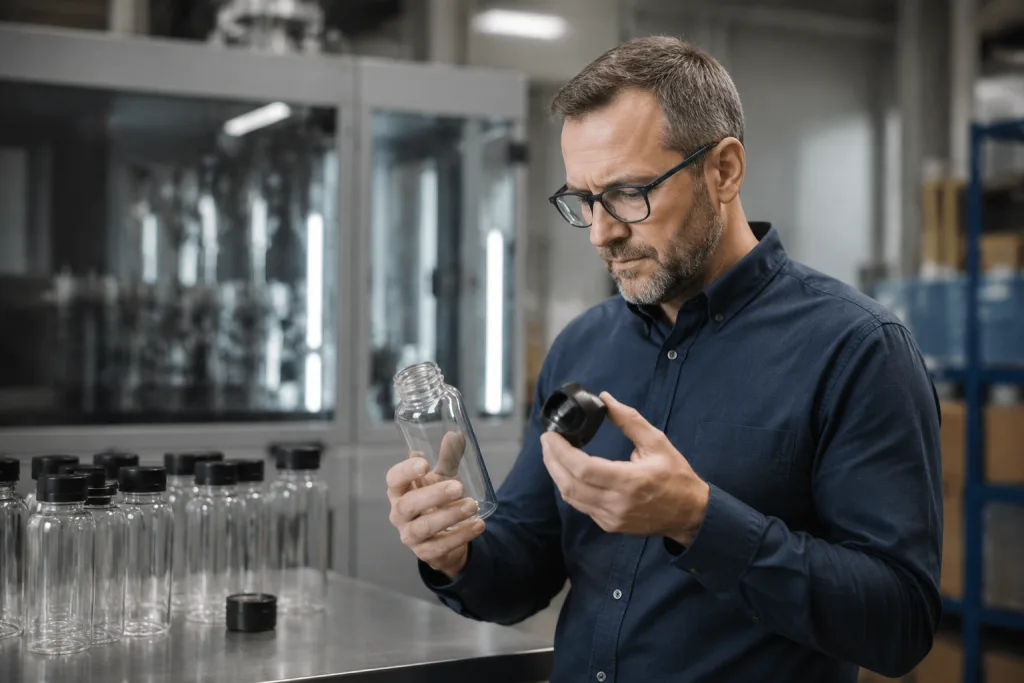
Check the mouth finish as well. Chips, micro-cracks, and rough sealing surfaces create safety risk and leakage complaints. For B2B buyers, this is where AQL matters. Use AQL critical 0 for broken glass, sharp edges, and contamination. Major defects like visible bubbles, deformation, unstable standing, or lid mismatch can sit at 1.5. Minor cosmetic defects can be 4.0 if your brand position allows it. On our side, we run a fingertip check plus visual inspection under a 600 lux lamp; if the buyer flagged “metal taste” but QC finds a chipped glass lip, the lid is not the problem.
Lids leak before bottles fail
About 7 out of 10 “glass body leak” complaints we see are lid problems. The third failure mode is gasket compression: the golden sample seals cleanly, then mass production drifts after the PP lid shrinks 0.2-0.4 mm out of the mold. A vacuum glass bottle often uses PP, stainless steel, bamboo, or aluminum lid components with a silicone sealing ring. Each material behaves differently under thread tolerance, shrinkage, and closing torque. QC pulled the sample, and the bottle was fine.
If you are sourcing from canteen suppliers in China, do not approve the lid only by appearance. This is the wrong question to ask. Define the thread type, gasket hardness, gasket diameter, lid torque, and leak test on the PO, not only on a WeChat message. We run a simple factory leak test: fill the bottle to 90% capacity with room-temperature water, tighten it to the defined torque using a torque meter, lay it horizontally for 30 minutes, then shake or invert it for another 3 minutes. For premium customizable drinkware, we prefer warm water at 60°C because heat expansion exposes weak gasket design fast.
Lid material also affects compliance. Bamboo lids look natural, but wood moisture content and coating must be controlled; we have rejected bamboo caps at 14% moisture when the buyer’s spec was below 10%. Stainless lids feel durable, but internal plastic contact surfaces still need food-grade confirmation. If the bottle is sold as sustainable drinkware, do not let the marketing claim outrun the test report. We’ve seen this go sideways.
For distributor canteen programs, spare parts matter. A canteen vendor may quote a low FOB price and then have no replacement gasket plan. The math doesn't work when a USD 0.03 silicone ring creates a USD 18 chargeback. For orders above 5,000 units, specify 1-2% spare silicone rings and 0.5% spare lids, packed separately in a marked polybag carton. It costs little and keeps small after-sales issues from becoming chargebacks.
Decoration fails under real handling
The fourth failure mode is decoration that looks fine in a product photo but comes off in the buyer’s hand. Borosilicate glass has a smooth, chemically resistant surface, which is good for tea and lemon water, bad for weak logo ink. A customized drinkware buyer asks for silkscreen, heat transfer, decal, laser marking on the stainless cap, or sleeve printing; each process needs its own fixture and curing window. On the line, we check adhesion with a 3M 600 tape pull before QC signs the sample.
For single-color logos, silkscreen is still the clean choice, with a setup cost around USD 50-80 per color and position. For complex artwork, decal or heat transfer may look sharper, but the curing temperature and dwell time cannot stress the glass wall or affect the vacuum area. This is where we have seen projects go sideways. If you are developing canteen promotional products for events, state the real handling test on the PO: 3M tape test, 50-cycle hand-wash simulation, alcohol rub, or dishwasher exposure. Do not assume dishwasher safe unless the ink system and lid assembly are tested for it; last month QC pulled a sample after 22 dishwasher cycles because the white ink edge started lifting near the bottom radius.
Color matching is another trap. Pantone on paper does not equal Pantone on transparent or frosted glass. For custom canteen and customizable canteen orders, approve a physical color chip or a pre-production sample, not a WeChat photo under 6500K factory lights. Photos are not enough. At BottleForge Industrial in Zhejiang, we normally freeze artwork after the pre-production sample and require written approval before bulk printing; one buyer once flagged a PO typo where “matte black” became “mate black,” and that small word would have changed the ink finish.
MOQs depend on decoration. A plain stock bottle may start from 1,000 units. Custom logo can also start at 1,000 units if the body is available and the printing jig is already on our rack. New mold, custom growler size, or customized growler shape may require 3,000-5,000 units because glass forming setup and fixture costs are higher than standard stainless drinkware. The math does not work at 500 pieces when we need a new forming mold, a curved screen frame, and two rounds of pre-production samples.
Packaging is part of the product
The fifth failure mode shows up after the factory says the goods are finished. Glass bottles punish lazy packing. We have seen a carton pass our clean Hangzhou warehouse stack test, then crack after 2 LCL transfers and one UPS parcel sort in the United States. Your packaging spec should read like an engineering requirement, not a last-page artwork note on the PO.
Start with the unit pack. Most borosilicate vacuum bottles need a kraft box or printed color box with molded pulp, EPE, or paper inserts locking the shoulder, base, and lid; QC checks the gap with a 1.5 mm feeler card before we approve the insert. A bare bottle in a thin tuck box is a bad fit for growler or canteen distributors shipping mixed cartons. We run 5-ply export corrugated for most master cartons, with ECT matched to the loaded weight, and we try to keep gross weight under 15 kg per master carton for fragile glass drinkware. Above 18 kg, the math usually breaks during hand loading.
Testing should include a carton drop test based on ISTA-style logic, even if you do not pay for a full certified ISTA protocol. Use 1 corner, 3 edges, and 6 faces at 60-76 cm depending on carton weight, then open the box on the QC table and check for broken glass, lid deformation, scuffed decoration, and retail box crushing. Fast test. No guessing. If you ship e-commerce singles, run a separate mailer drop test; a master carton pass tells you almost nothing about one bottle bouncing through parcel delivery.
Labeling matters too. For Amazon FBA drinkware, confirm FNSKU labels, suffocation warnings for polybags, carton weight labels, country of origin marking, and scanner readability after carton sealing; last month a buyer flagged one PO because “Made in China” was placed under the carton tape seam. A good canteen supplier asks these questions before production. A weak one waits until the forwarder rejects the shipment, and then everyone loses 3 days re-labeling cartons at the warehouse.
Spec sheets beat factory promises
The last failure we see is simple: the buyer orders from a friendly quote, not from a controlled spec sheet. A capable borosilicate glass vacuum insulated bottle manufacturer should accept written requirements without acting annoyed. If the factory skips test methods, material grades, or defect definitions, stop there. Last March, QC pulled a 500 ml sample from the line and found a 0.6 mm lip waviness that sales had called “acceptable” in WeChat. Price pressure is normal in China export manufacturing, but silence on QC gets expensive fast.
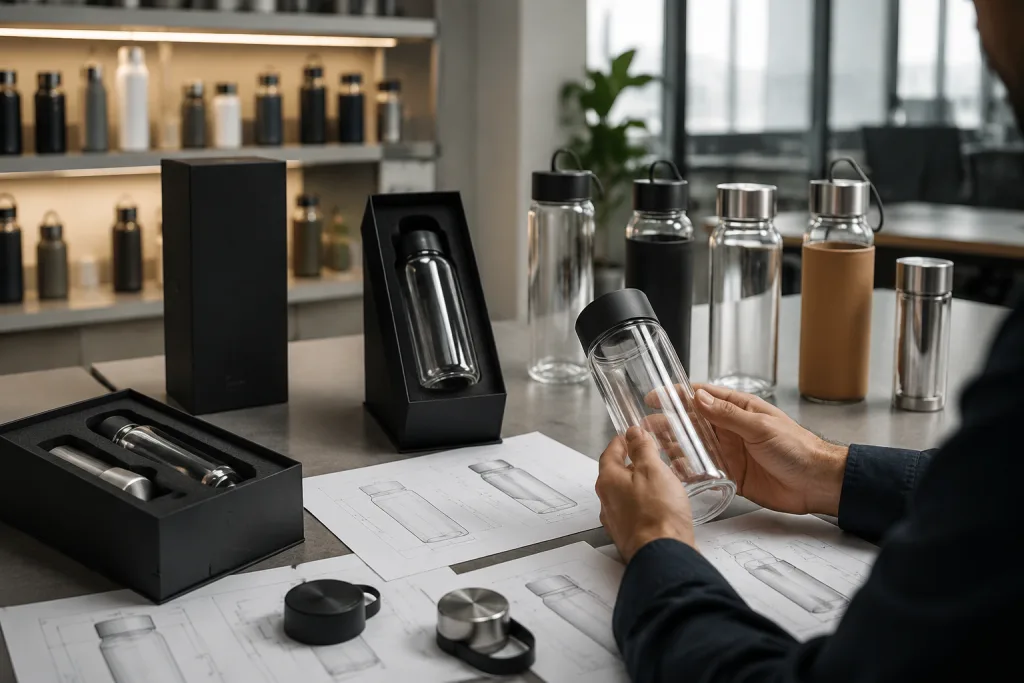
Your RFQ should state capacity, dimensions, target weight, glass grade, lid material, silicone standard, insulation target, thermal shock test, leak test, decoration method, packaging method, compliance market, barcode or FNSKU needs, and inspection standard. Do not send a one-line “best price” email. We run better when the buyer gives a 2D drawing with tolerance, carton drop-test requirement, and barcode placement in mm; one Amazon PO even had the FNSKU typed with one missing digit, and the buyer flagged it only after pre-shipment photos. Ask whether the factory is BSCI audited, whether it uses ISO 9001-style process control, and whether food-contact reports are issued by recognized labs such as SGS, TÜV, Intertek, or equivalent local CNAS-accredited labs.
At our Hangzhou plant, typical lead time for standard custom logo glass vacuum bottles is 35-45 days after deposit and artwork approval. Monthly drinkware output across glass, stainless, and plastic lines is about 300,000 units, but borosilicate vacuum projects need tighter scheduling because annealing, vacuum sealing, and decoration cannot be rushed. The line manager will not thank you for moving a decal approval by 3 days after the kiln schedule is locked. FOB Ningbo or Shanghai is common for Zhejiang shipments, with Ningbo usually cleaner for our truck routing from Hangzhou.
For canteen vendors and canteen manufacturers, the buyer relationship should be technical, not just transactional. A practical factory will push back when your shape is too fragile, your logo sits 8 mm too close to the curve, or your target price cuts out the EPE sleeve that protects the inner glass during a 1.2 m drop test. That pushback protects your margin. We have seen this go sideways when a buyer saved USD 0.18 on packaging and then fought a 6% breakage claim at destination. If you need a canteen customizable program that sells for more than one season, build the order around failure prevention first and decoration second.
Send your glass vacuum bottle spec for review
We will check structure, MOQ, decoration, packaging, and QC risks before you commit to tooling or bulk production.
Frequently asked questions
What MOQ should I expect for a borosilicate glass vacuum insulated bottle?
For an existing mold with one-color logo, a realistic MOQ is 1,000 units per SKU. If you need a custom canteen shape, special lid tooling, new capacity, or a customized growler body, expect 3,000-5,000 units. Color box printing may also create its own MOQ, often 1,000-2,000 boxes depending on the paper supplier. Be careful with factories offering 100-unit custom glass vacuum orders at normal wholesale pricing. They may be using stock goods without proper vacuum testing, or they may charge high setup fees hidden in the unit price.
How do I compare quotations from different canteen suppliers?
Put the quotations into the same structure: capacity, glass grade, lid material, gasket material, decoration, packaging, test standard, FOB port, and lead time. A USD 0.30 cheaper quote may exclude molded pulp inserts, thermal shock testing, spare gaskets, or full-color retail boxes. For borosilicate glass vacuum bottles, packaging alone can change cost by USD 0.20-0.60 per unit. Also compare payment terms and inspection rights. A serious canteen manufacturer should accept pre-shipment inspection under AQL Level II and provide material declarations before shipment.
Can borosilicate glass vacuum bottles be used for promotional drinkware?
Yes, but the design must match the channel. Canteen promotional orders for corporate gifts often prioritize logo clarity and individual gift boxes. Retail distributor drinkware programs need stronger packaging, barcode labeling, and more consistent cosmetic grading. Event giveaways may accept simpler lids and one-color printing, while premium branded custom drinkware may need decal artwork, bamboo or stainless lids, and stricter AQL. For promotional use, we recommend approving 20-30 pre-production samples if the order is above 5,000 units, especially when the logo wraps around curved glass.
What tests should I require before shipment?
At minimum, require visual inspection, capacity check, lid fit check, leak test, vacuum retention test, thermal shock test, logo adhesion test, and carton drop test. For food-contact markets, request FDA or LFGB-related material reports for glass, silicone, and plastic contact parts. For Europe, REACH screening may be needed for coatings, inks, and external components. Use AQL critical 0 for broken glass, sharp edges, contamination, and serious leakage. For a 10,000-unit order, also ask for inline inspection after the first 10-20% of production so defects are corrected before the whole batch is packed.
Is a glass vacuum bottle better than stainless steel for distributors?
It depends on your market. Borosilicate glass gives a clean taste, a premium transparent look, and strong appeal for tea, fruit infusion, office, and wellness channels. Stainless steel is usually more impact resistant and easier for outdoor sports. For a canteen distributor selling to corporate, retail, or lifestyle accounts, glass can earn a higher perceived value but needs better packaging and clearer use instructions. If your customers throw bottles into gym bags or cars, stainless may reduce returns. If taste neutrality and visual presentation matter more, borosilicate glass is a strong option.