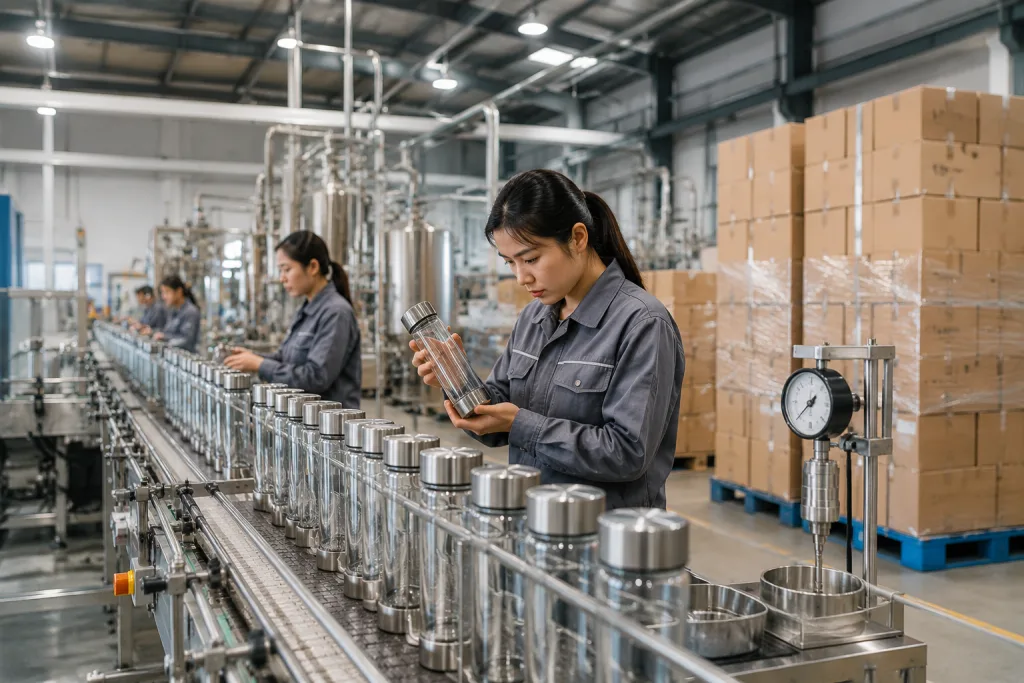
Key Takeaways
- A serious borosilicate glass vacuum insulated bottle factory should quote MOQ from 3,000 pieces, not “flexible” with no numbers.
- Ask for AQL inspection terms, REACH documents, and vacuum retention test data before you approve mass production.
- For custom drinkware, expect 25-35 days lead time after sample approval and artwork confirmation.
- If you need canteen custom or custom growler programs, confirm lid tooling, packaging, and breakage controls before booking FOB pricing.
If you are sourcing a borosilicate glass vacuum insulated bottle factory, do not treat it like a normal drinkware buy. It is not. Borosilicate glass cracks in transit if the inner pack is weak, vacuum retention depends on process control, and margin vanishes fast when the factory cannot hold coating thickness, lid fit, and breakage rate. In Zhejiang and across China, the strong suppliers know this; the weak ones just throw out a low quote and hope your QC misses the rest.
You need a factory that can handle custom drinkware without turning every order into a lab exercise. That means a real MOQ, stable lead time, documented tests, and enough capacity for repeat reorders. At BottleForge Industrial in Hangzhou, we run 80,000 units per month, with a typical MOQ of 3,000 pieces and lead time around 25-35 days after sample approval. The buyer who only stares at the sample usually gets burned.
What You Are Really Buying
When buyers ask for a borosilicate glass vacuum insulated bottle factory, they think they are buying a bottle. They are buying process control. Glass forming, vacuum sealing, lid assembly, decoration, packing, and export compliance all sit on the line. If one station slips, the order gets noisy fast. We have seen a sample look clean on the table, then fail a carton drop test or come back with lid torque issues at the warehouse.
The practical way to judge a canteen factory is to break the product into parts you can measure. Borosilicate inner glass needs steady wall thickness, usually 1.2 mm to 1.8 mm depending on design. Vacuum insulation has to hold target performance after thermal cycling. Caps should survive at least 300 open-close cycles in normal use. QC pulled the sample on one run and found a 0.3 mm wall swing; that is the wrong question to ask if you only look at artwork. For retail, Amazon, or distributor drinkware channels, these numbers decide return rate.
- Ask what glass grade they use and how they verify it.
- Request the vacuum leak test method and pass rate.
- Confirm lid material, gasket grade, and spare-part support.
- Check carton count, inserts, and ship test requirements.
The Q&A Buyers Ask First
Q: Is borosilicate glass the right choice for insulated bottles? Yes. If the buyer wants clear glass, lower odor transfer, and better thermal stability than soda-lime glass, borosilicate is the safer call. It is still glass, so we run heavier packaging and drop checks, but premium custom drinkware usually lands better on shelf and supports a higher retail tag. For brand owners and canteen distributors, that margin math matters.
Q: What is a realistic MOQ? For a factory that actually runs customized canteen and custom canteen programs, 3,000 to 5,000 pieces per SKU is normal. We have seen PO typos turn `300` into `3,000`, and that kind of mistake changes the whole quote. Smaller orders are possible, but the unit price climbs and decoration choices get cut back. A canteen promotional order can go lower if the print stays simple and the carton is standard.
Q: How long does production take? Sample approval plus production usually takes 25-35 days for repeat orders. New mold work, custom closures, or special packaging can push that to 45 days. QC pulled the sample twice on one line because the lid torque was off by 0.4 N·m, and that is the kind of detail that adds time. If a canteen vendor promises 12 days on a fully custom build, ask what they are skipping.
Q: What should FOB pricing include? Spell out whether the quote covers the inner box, master carton, silkscreen or laser marking, and drop-tested packaging. A good canteen supplier breaks out the bottle, lid, decoration, and export carton so you can compare line by line. The buyer flagged it once when a quote hid the carton cost in the unit price, and the math did not work. If the supplier is vague here, the final landed cost will surprise you.
Checklist Before You Quote
Before you send RFQs, lock the product brief. The fastest way to burn 12 days is asking a borosilicate glass vacuum insulated bottle factory for “a premium bottle,” then drip-feeding cap color, logo position, and insert artwork after the line has already quoted. We’ve seen this go sideways. Send a one-page checklist with Pantone code, logo size in mm, target MOQ, and packing style; QC pulled one sample last month because the PO said matte black lid but the artwork file showed glossy black.
Use a procurement checklist tied to how the bottle will sell. For distributor canteen, distributor growler, or distributor drinkware programs, ask for the actual pack format: 1 pc color box, 24 pcs master carton, or shelf-ready tray. For retail or e-commerce, define FNSKU label size, carton outer dimensions, gross weight limit, and Amazon prep rules before sampling. If you want canteen customizable options, mark which parts can change and which parts stay fixed, such as the 500 ml mold, lid thread, silicone gasket, and print area. The buyer flagged it once: “same bottle, different cap,” but the cap changed the leak-test result at 0.6 MPa.
- Material: borosilicate glass body, lid material with surface finish, plus gasket grade and color.
- Capacity: 350 ml, 500 ml, 750 ml, or custom volume with tolerance in ml.
- Decoration: screen print with Pantone code, laser engraving size in mm, decal position, or full wrap artwork file.
- Performance: heat retention target and cold retention target, with test method, starting water temperature, and room temperature recorded.
- Compliance: REACH, food contact declaration, packing list format, and the name your importer needs on the documents.
- Packaging: individual box, mailer, master carton, drop test requirement, and carton mark layout.
Do not forget the commercial side. If your customer is a canteen distributor or canteen manufacturer buying from a third-party factory, they care about reorder stability, not a new trick every season. This is the wrong question to ask: “Can you make it look more premium?” Ask whether the Zhejiang factory can repeat the same shade, print density, and lid compression on the next 20,000 pieces. We run a torque check on the lid and compare print density against the approved sample; a 1 mm logo drift is enough for some buyers to reject the carton.
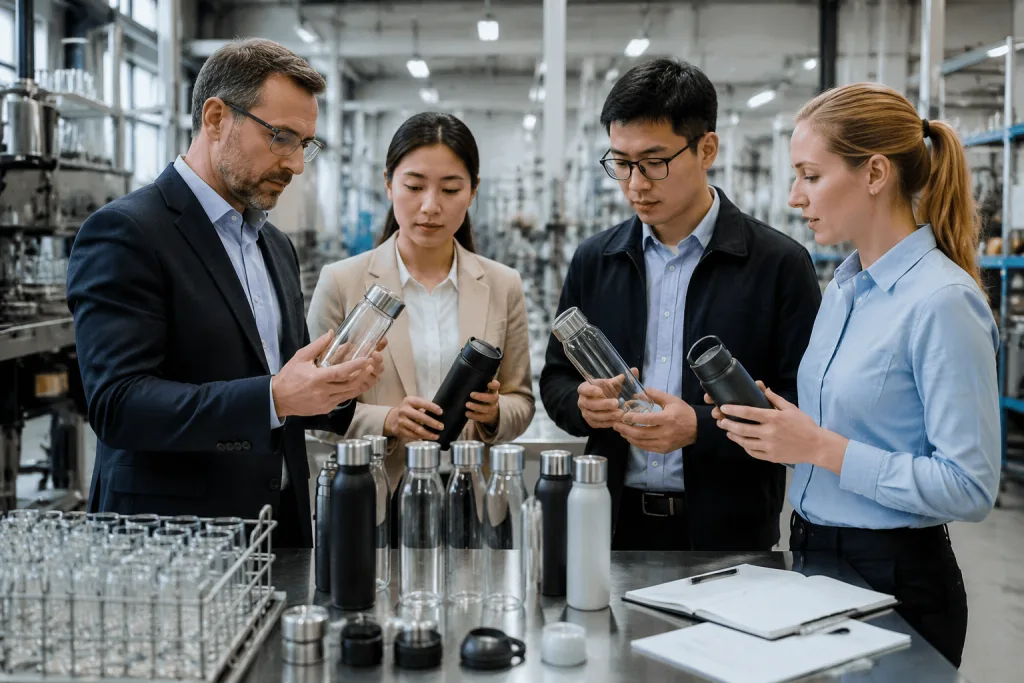
Testing That Protects Margin
Good procurement is not about the pretty first sample. It is about what happens after 3,000 bottles get packed, stacked, and bounced through a truck. A borosilicate glass vacuum insulated bottle factory should run a clear test stack: vacuum leak test, hot-water retention test, cold-water retention test, lid torque test, carton drop test. On our line, QC pulls bottles after vacuum pumping and checks the pressure hold before the outer carton is sealed. If the supplier cannot state the method, test time, water temperature, and sample size, the report is just decoration.
For export orders, ask for an inspection plan tied to AQL. Buyers often use AQL 2.5 for major defects and 4.0 for minor defects on finished goods, while 6 retail accounts we worked with last year asked for tighter limits on logo position and lid fit. For glass items, separate breakage from sealing defects. A 1.5 mm chip on the mouth is not the same problem as a vacuum failure after filling with 95°C water. This is where chargeback fights start, and we have seen this go sideways when the PO only says “glass defect.”
Strong factories in China do not just say “pass QC.” They show you what was measured, at what temperature, on how many pieces, and what happens if the sample fails.
If you are sourcing customized drinkware at scale, ask whether the factory runs in-process checks every 2 hours or only checks finished goods at the end. Ask how often they calibrate torque tools and thermometer probes; our QC room keeps a torque meter log, and the buyer once flagged a missing calibration sticker before they even checked the bottles. Ask for traceability by batch code. Boring questions protect margin. They keep a canteen promotional program from turning into 18 days of claims emails and replacement cartons.
Customization Without Chaos
Customization is where 8 out of 10 buyers make the spec harder than the order needs to be. Twenty options look good in a deck. They create slow lines, mixed cartons, and arguments during final inspection. For a canteen custom program, we usually run one bottle shape, two lid colors, one logo method, one packaging format, and one spare gasket rule. That is enough. Last month a buyer asked for four lid finishes on a 3,000 pcs trial order; the math did not work after we counted the color-change time on the assembly bench and the extra 12 cartons needed for sorting.
For custom growler or customizable growler programs, check whether the glass wall thickness and neck geometry can take the cap style you want. A 1.8 mm neck difference can turn a good cap into a leaking cap. For customized canteen or customizable canteen projects, ask if the decoration area crosses the insulation seam or sits on the inner-wall curve. QC pulled the sample on one job because the logo looked straight on the artwork but bent 3 mm after firing. For custom drinkware, a good factory should tell you when a requested decoration will rub, peel, or become unreadable after sea freight. We've seen this go sideways. Bad decoration does not just hurt the first order; it kills the reorder.
Decoration choices do not cost the same. Silkscreen works well for one-color or two-color logos, especially when we can hold the print area within a flat 45 mm window; laser engraving lasts, but the mark can look weak on smoked or dark glass; decals handle detailed artwork but often add handwork and push lead time from 12 days to 18 days. If you are a canteen vendor serving several accounts, build a modular spec sheet: fixed bottle, fixed lid fit, changeable artwork file, and clear carton marking rules. We ship cleaner that way. It also lets canteen suppliers, canteen vendors, and brand owners change branding without paying for a new mold every season.

Working With China Properly
Buying from China is not hard if you respect how the line works. A Zhejiang factory can move fast once the spec is locked, but it will not fix a loose brief. Give us the wall thickness, lid material, logo size in mm, carton drop-test requirement, and target FOB port. Samples then move in 7 days instead of 14 days. We see buyers lose a week because the PO says “silver lid” while the artwork shows brushed gunmetal. If you want a real canteen manufacturer, ask for factory photos, machine list, export history, and monthly output. Sales decks are cheap.
For European and North American buyers, due diligence should include BSCI if social compliance matters to your account, plus REACH and food-contact declarations where applicable. If your channel is retail, ask about barcode placement, master carton marks, and whether the factory can print FNSKU labels without slowing packing. One Amazon buyer flagged a 3 mm barcode shift after QC pulled the sample from the packed carton, not from the photo table. That matters. If you are a canteen distributor managing several SKUs, ask whether the supplier can combine custom canteen and custom drinkware lines into one shipment. The math does not work if 6 SKUs ship as 6 half-empty LCL bookings.
Do not ignore communication speed. Fast replies are not a decoration. A supplier that answers in two hours during sampling and then disappears for three days during production is not a real partner. The better canteen suppliers in China send QC photos, packing counts, and shipment drafts before you chase them. We run this with a simple pack-out sheet: SKU, carton quantity, GW, NW, carton size, and CBM checked before booking. That is what you want from a factory in Zhejiang or any serious export base in China.
Send your spec. We will price it correctly.
If you need a borosilicate glass vacuum insulated bottle factory in Zhejiang with stable output, clear QC, and practical customization, send drawings and target quantities.
Frequently asked questions
What is the typical MOQ for a borosilicate glass vacuum insulated bottle factory?
For a serious export factory, MOQ is usually 3,000 to 5,000 pieces per SKU. If you need special decoration, custom packaging, or multiple lid colors, the MOQ can rise to 8,000 pieces. Smaller test orders are possible, but your unit price usually jumps 15% to 30%.
How do I know if the vacuum insulation is real and not just marketing?
Ask for a defined hot and cold retention test, including starting temperature, ambient temperature, test duration, and pass criteria. A capable factory should provide sample data from 5 to 10 units and explain its leak testing method. If they cannot show a repeatable method, treat the claim as unverified.
Can I order a customized canteen with my own logo and packaging?
Yes. Most canteen customized projects support silkscreen, laser marking, or decal decoration, plus custom inner boxes and master cartons. Expect a sample fee of about USD 50 to 150 depending on artwork and packaging, then a production lead time of 25-35 days after approval. For more complex packs, add 7 to 10 days.
What compliance documents should I request for Europe and North America?
At minimum, request food-contact declarations, REACH-related material confirmation, and test reports for the actual materials used. If your buyer requires social compliance, ask for BSCI status or equivalent. For retail programs, also request carton markings, barcode data, and packing lists that match your warehouse requirements.
How do I compare FOB quotes from different canteen suppliers?
Compare the same build, not just the same bottle shape. Check whether the quote includes decoration, inner box, master carton, spare gasket, and palletization. A difference of USD 0.35 per unit can disappear once you add packaging or test costs, so ask for a line-item quote before you choose a canteen vendor.