Key Takeaways
- MOQ for a borosilicate glass vacuum insulated bottle custom often starts at 1,000 to 3,000 units per color in China.
- Typical factory lead time is 25 to 35 days after sample approval, with 500,000 units/month capacity at a strong canteen factory.
- Borosilicate glass is better for clarity and taste neutrality, but the outer shell, lid sealing, and drop risk matter more than the glass alone.
- For distributor drinkware programs, a clean spec table beats vague supplier quotes and cuts back-and-forth by 30% or more.
If you are buying a borosilicate glass vacuum insulated bottle custom, the real question is not whether it looks premium. The real question is whether it survives 2-meter drop tests, holds temperature for 6 to 12 hours, and still leaves a clean logo panel after we set the lid, carton, and print file. In Zhejiang and across China, factories will quote bottles that look close on paper, but wall thickness, glass grade, and lid tolerance decide whether you get a stable SKU or a returns headache.
This guide compares the common build options side by side, because a custom drinkware program lives or dies on spec control. If you are a brand owner, distributor, or canteen buyer looking at canteen customized or customizable drinkware programs, you need a practical way to judge which version fits retail, corporate gifting, or promo volume. We ship these every week from Hangzhou, and the line tells you fast where the trouble starts: MOQ, lead time, thermal test results, and whether your artwork holds up after QC pulled the sample.
What you are really comparing
Buyers asking for a borosilicate glass vacuum insulated bottle custom usually mean one of three builds: a true double-wall glass bottle, a glass-lined insulated bottle, or a hybrid with borosilicate inner glass and a protective outer shell. Those are not the same product. We have seen a buyer approve the wrong sample from one glossy photo, then the line had to rework the lid and the carton at MOQ 3,000. If you source from a canteen manufacturer in Zhejiang or elsewhere in China, ask for cutaway drawings, wall thickness, and vacuum process notes before you talk about logo placement.
The useful comparison is not style alone. Compare the spec sheet line by line:
- Glass grade: borosilicate 3.3 is the standard for thermal shock resistance.
- Wall thickness: 1.8 mm to 2.5 mm is common; 1.6 mm cuts cost, and QC pulled the sample after a drop test at 1.5 m cracked the shoulder.
- Vacuum structure: true vacuum between walls, not an insulating sleeve.
- Lid system: PP, stainless, bamboo, or Tritan, each seals differently on the torque gauge.
- Decoration method: silk screen, laser, ceramic decal, or wrap label, depending on whether you need canteen promotional or retail-grade finishes.
Spec table mindset: if a canteen vendor cannot state borosilicate grade, insulation time, and carton drop test results, you are comparing sales sheets, not bottles. We had a PO with a typo on the insulation claim once, and the buyer flagged it before production; that is the wrong question to ask. For distributor canteen programs, the math does not work if the numbers are not on the page.
Spec table: glass vs hybrid builds
Here is the working comparison buyers ask for on the first call. Use it before you send a sample request, or you will end up comparing the wrong two structures.
| Spec | All-glass insulated bottle | Glass inner + protective shell | Use-case fit |
|---|---|---|---|
| Weight | Lower, usually 280 to 420 g for 350 to 500 ml | Higher, often 380 to 550 g | Retail gift boxes vs daily carry |
| Break resistance | Moderate | Better | Distributor drinkware, travel kits |
| Branding area | Clean, wide glass surface | More limited by shell geometry | Custom logo programs |
| Thermal shock | Good if borosilicate 3.3 | Good, with added protection | Hot-fill and cold-fill use |
| Retail price | USD 3.20 to 5.80 FOB | USD 4.10 to 7.20 FOB | Mid-market and premium sets |
The table shows the trade-off fast: low price is not the same as low risk. If the buyer’s team wants a bottle that can take rough handling, a canteen customized with a protective shell cuts breakage claims. If the brand sits in tea, wellness, or gift retail, the all-glass build often wins because the product looks cleaner and the drink is visible. We’ve seen mixed-channel buyers split the order into two SKUs, and that is usually the right call. A single bottle rarely fits every shelf.
On our Zhejiang line, QC pulled the sample in 7 to 10 days, then mass production usually runs 25 to 35 days after approval. That timing matters when the PO says “ship before campaign launch” and the buyer flags it two weeks later. If you are planning a seasonal drop, sample control is not a nice-to-have. It is the part that keeps the schedule from slipping.
Where borosilicate wins, and where it does not
Borosilicate glass earns its spot because it stays stable, keeps taste neutral, and takes heat shock better than soda-lime glass. We run hot-water tests at 100°C on the line, and the sample that keeps coming back clean is usually borosilicate. That is why it fits coffee, tea, herbal infusions, and flavored water. If the brief calls for drinkware that will not hold odors or stain from colorants, borosilicate is the right starting point. It also photographs well, which matters for Amazon, DTC, and distributor catalogues.
Still, do not oversell it. This is glass. Drop resistance is limited, and if your buyers expect gym-bag abuse or courier handling, a custom growler in stainless will beat it on toughness. We had a buyer flag a 1.2 m drop spec on a PO and the math did not work; the bottle failed before decoration even mattered. For a canteen custom program, borosilicate is best when you want premium perception, clean taste, and a calm brand story. It is the wrong choice for rugged field use.
Buy glass for product perception and flavor neutrality. Buy steel when the priority is abuse tolerance.
A smart canteen factory will say the same thing, even if it costs the order. QC pulled the sample, checked the cap torque at 0.8 N·m, and the real issue was channel fit, not decoration. That honesty saves you from forcing one bottle type into three different sales channels. If your buyers include canteen distributors, corporate gift houses, and retail chains, define channel fit first, then decorate the bottle.
Branding options that actually hold up
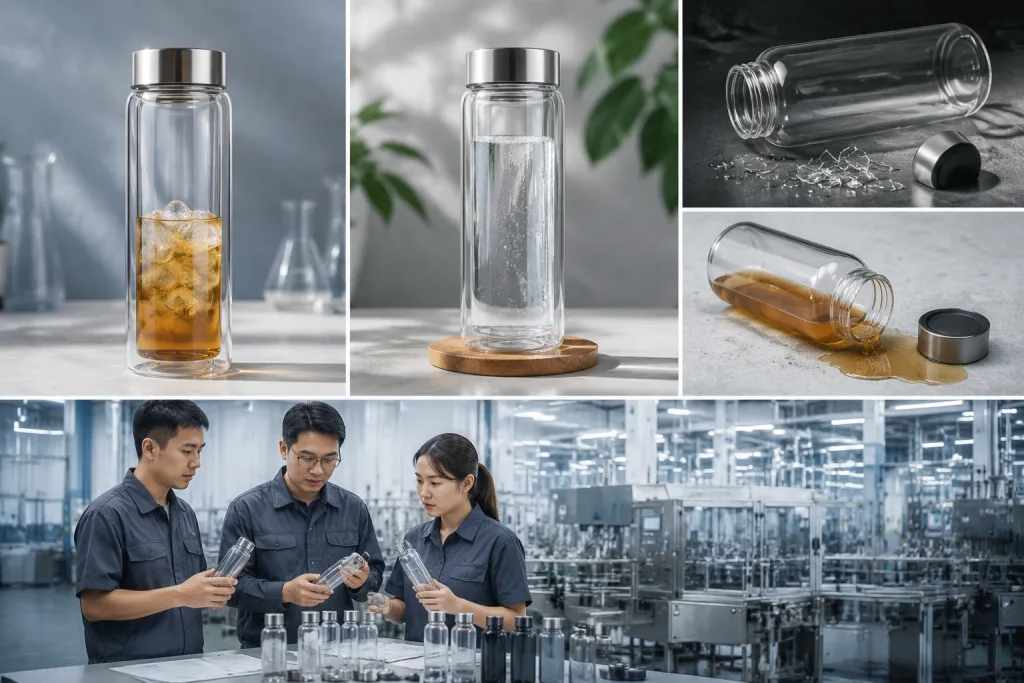
Decoration is where a lot of canteen suppliers get casual, and buyers pay for it later. On borosilicate glass, the usual winners are silk screen, frosted etching, laser on the lid, or a fired decal if you need stronger abrasion resistance. For a borosilicate glass vacuum insulated bottle custom, treat the bottle wall and the cap as two branding zones; they take different abuse in wash tests and friction, and the line will show it fast.
What to specify
- Logo size: keep screen print within 40 to 70 mm wide for most 350 to 500 ml bottles.
- Color count: one to two spot colors is safer for mass production.
- Finish: matte frost, clear glass, or tinted shell depending on shelf impact.
- Dishwasher expectation: if you need 50-cycle durability, say so upfront.
For canteen customized and customized drinkware programs, the lid usually gives more reliable branding than the glass body. Laser engraving on stainless caps is cleaner than forcing complex art onto curved glass, and we ship fewer reworks that way. If you are building a distributor canteen line for three territories, that flexibility matters because you can localize branding without changing the core bottle tooling.
One caution: if your artwork is too small, your canteen vendor may simplify it without telling you. Ask for a print proof with exact Pantone reference, placement height, and edge clearance; QC pulled the sample at 1.5 mm once and the buyer flagged it right away. That is standard practice in serious China sourcing, and it prevents ugly surprises.
Use-case fit by buyer type
The right bottle follows the channel. A premium lifestyle brand wants one spec; a canteen distributor serving offices or schools wants another. If you push the same bottle into all three, the math does not work on price, breakage, or perceived value.
- Retail brands: use a cleaner silhouette, 350 to 500 ml, with a premium carton and one-color branding. We often run 45 mm neck tooling for this group because the shelf look matters.
- Corporate gifting: put the gift box, lid branding, and lead time first. A buyer once flagged a 3-day carton delay and killed the order.
- Promotion: keep artwork simple and use a lower-cost cap to hit USD 2.80 to 4.50 FOB on larger volumes. QC pulled the sample twice when the print shifted 1.5 mm.
- Distributor programs: ask for carton master data, barcode area, and spare part availability. One PO typo on carton count can snowball into a warehouse claim.
If you are sourcing canteen promotional stock, the bottle needs to be easy to replenish. Stable tooling, repeatable decoration, and a supplier who can hold the same spec on the next reorder matter more than a fancy concept. Change the lid three times and you create packing trouble, loose spare parts, and QC noise.
For a customized growler or customizable growler request, the focus changes. You care about volume, neck diameter, and seal strength. A glass insulated bottle works for tea and cold brew, but if the program handles carbonation or rough transit, test the closure harder than the bottle body. We have seen that go sideways on a 2,000 pcs run.
MOQ, QC, and factory reality
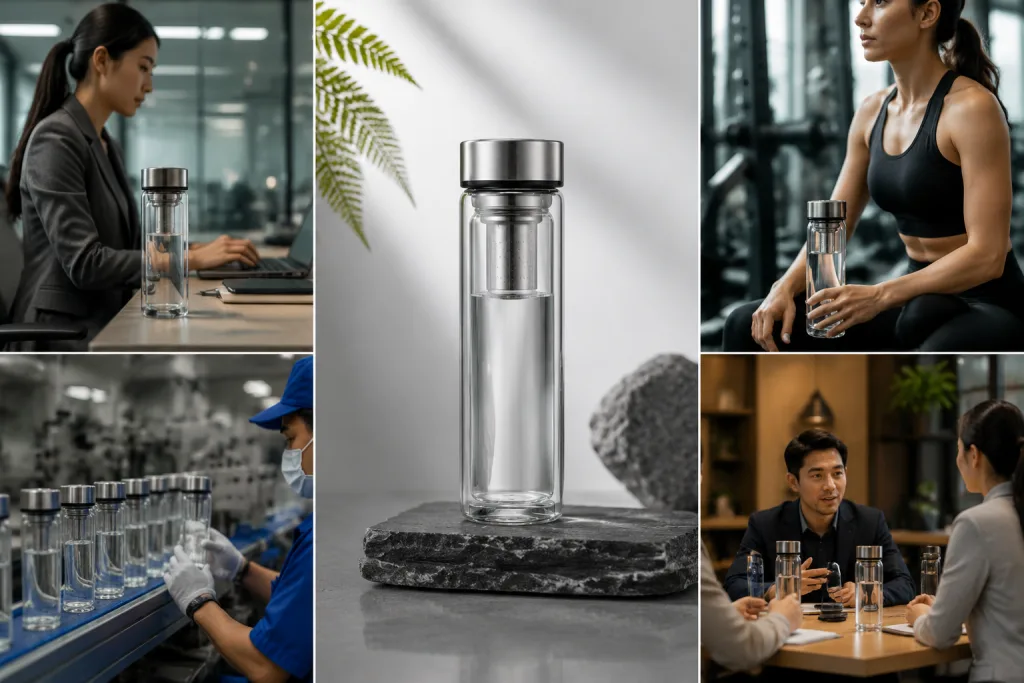
Buyers usually ask for price first and QC later. That is backward. On the line, the quote only means something when it sits on top of a clear inspection standard. For a borosilicate glass vacuum insulated bottle custom, MOQ usually lands at 1,000 to 3,000 units per design and color. We have also run a 500-unit trial for a cautious buyer, but the unit price moved up fast. If a supplier says there is no MOQ, ask where the decoration, carton, and spare-part cost is hiding.
What you want in writing:
- AQL: AQL 2.5 major, 4.0 minor for appearance and function. QC pulled the sample at 9:20 a.m., and that number had to match the PO.
- Leak test: 100% on assembled units before packing. If the buyer flags one wet carton, the whole lot gets attention.
- Drop test: carton and sample verification, especially for export to Europe and North America. We use a 76 cm corner drop on outer cartons for export checks.
- Compliance: REACH for applicable materials, plus food-contact declarations and any requested ASTM or ISO references. The wrong question is “can you pass?”; the real question is “which material declaration is attached to this lot?”
A serious canteen factory in Zhejiang will also state monthly output. In our case, production capacity reaches 500,000 units per month across several drinkware lines, which matters when a distributor canteen program jumps from 8,000 to 80,000 pieces. That capacity means little if sample sign-off is sloppy. We have seen a 2 mm artwork shift turn into a full reprint. Most defects start with vague artwork, not bad glass.
If you are comparing canteen manufacturers or canteen suppliers, ask how they handle broken units, spare lids, and replacement glass. One PO typo on the lid code can stall a shipment for 12 days. Their answer tells you more than the brochure does.
Request a factory quote with real specs
Send your target volume, artwork, lid style, and market. We will quote from China with clear MOQ, lead time, and QC terms.
Frequently asked questions
What is the MOQ for a borosilicate glass vacuum insulated bottle custom order?
For most factory programs in China, expect 1,000 to 3,000 units per design and color. Some canteen vendors will quote 500 pieces for a test run, but the unit price usually rises by 15% to 30% because decoration, cartons, and setup cost are spread across fewer bottles. If you need multiple lid colors or mixed artwork, each variation can trigger its own MOQ. For distributor drinkware programs, it is smarter to lock one core spec first, then add secondary SKUs after sell-through data comes in.
How long does production usually take?
Once you approve the sample, typical lead time is 25 to 35 days for mass production in a Zhejiang canteen factory, plus shipping time. Sampling usually takes 7 to 10 days if the structure is standard and the logo is simple. If you request custom molds, multiple color lids, or special packaging, add 5 to 15 days. For canteen promotional launches, build in an extra week for pre-shipment inspection and carton testing so you do not miss your ship date.
Is borosilicate glass safe for hot and cold drinks?
Yes, if it is true borosilicate 3.3 and the wall thickness is controlled. It handles thermal shock better than soda-lime glass, which is why it works for tea, coffee, and chilled drinks in the same SKU. The weak point is usually the closure or the neck area, not the glass chemistry itself. Ask your canteen manufacturer for temperature test data, lid seal details, and any compliance documents you need for North America or Europe.
Which branding method lasts longest on glass?
For the bottle body, fired decal or high-quality screen print usually lasts better than cheap ink prints, especially after repeated washing. For lids, laser engraving on stainless is the most durable. If your artwork is simple and you want a clean premium look, frosting or etching also works well. A canteen supplier should tell you whether the print survives 30 to 50 dishwasher cycles and whether the bottle body or lid is the better branding surface for your design.
Should I choose glass or stainless for custom drinkware?
Choose borosilicate glass when flavor neutrality, product visibility, and a premium look matter most. Choose stainless when impact resistance, outdoor use, or long thermal retention matters more. For a custom growler program, stainless usually wins. For tea, fruit water, and gift retail, glass often sells better. Many canteen distributors carry both because one channel wants appearance and another wants durability. That split is normal and often more profitable than forcing one build into every market.