Key Takeaways
- Most borosilicate glass vacuum insulated bottle bulk programs start at 3,000-5,000 units with 30-45 day lead times
- A usable spec should call out borosilicate glass thickness, vacuum performance, lid material, and leak test standard
- FOB China pricing for a 500-750 ml bottle often sits around USD 3.20-7.80 depending on decoration and packaging
- Ask for AQL 2.5/4.0 inspections, REACH paperwork, and drop-test data before you approve production
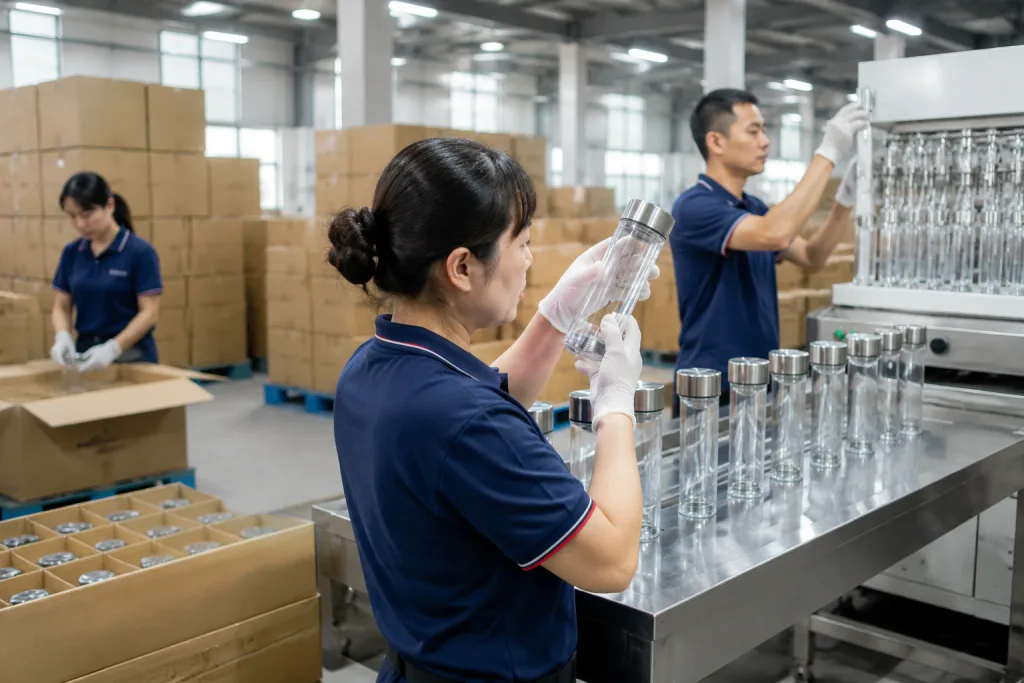
If you are sourcing a borosilicate glass vacuum insulated bottle bulk order, the real question is not how premium it looks. The real question is whether the bottle gets through forming, assembly, transit, and the first 30 days in a customer’s hands without claims eating your margin. Glass plus vacuum insulation looks clean on paper; on the line, we check wall thickness, seal integrity, leak rate, coating adhesion, and carton strength before we ship a single carton.
We build drinkware in Zhejiang, China, so we see where programs slip. A buyer flags the cap first, then QC pulls the sample and finds a hot-fill leak at 60°C, or the PO says 3,000 units while the target freight window is 35 days. That math does not work. If you are comparing drinkware wholesale offers, you need a working checklist, not sales copy. The sections below cover the questions brand owners and procurement managers send us every week.
What buyers ask first
Procurement teams often ask the wrong thing first: “Can you quote the bottle?” That’s too loose. For borosilicate glass vacuum insulated bottle bulk supply, one supplier may quote only the inner glass bottle, while another includes the stainless outer shell, cap assembly, silicone seal, paper insert, and retail carton. We’ve seen landed cost move 18-30% on that gap alone.
Start with the structure. Borosilicate glass is picked for thermal shock resistance and cleaner taste, but the build has to be defined. On a 500 ml bottle, we usually see a 1.2-1.8 mm glass wall, 304 stainless outer parts, and a PP or Tritan lid. If you buy for wholesale drinkware channels, ask for the neck finish, lid torque range, and seal hardness. A vague drawing is the wrong question to ask.
Here is the minimum buyer checklist:
- Capacity in ml and usable fill volume
- Glass wall thickness and borosilicate grade
- Vacuum insulation target, if any, or whether the term is decorative
- Lid material, gasket material, and leak standard
- Decoration method: silk screen, laser, decal, or foil
- Packing method for bulk drinkware shipping
If a supplier cannot put these points on one sheet, they are not ready for canteen wholesale or drinkware wholesale work. On our line in Zhejiang, QC pulled the sample against a spec sheet, not a product photo, and that is how it should run.
Borosilicate and vacuum basics
Buyers use “vacuum insulated” loosely, but glass drinkware needs a tighter read. Pure borosilicate glass bottle bodies are common; true heat retention comes from the structure. We see double-wall borosilicate with a vacuum gap, and we also see glass paired with a stainless sleeve or outer shell. If you want a premium SKU, get the thermal claim in writing and ask for the test method.
Ask for a retention chart at 95°C fill temperature, ambient 20-25°C, with readings after 1 hour, 4 hours, and 6 hours. QC pulled a sample last month and the buyer flagged the chart because the test start temp was 88°C, not 95°C. A real factory will not promise miracle numbers. The math does not work. Glass-insulated builds can hold heat well, but they still trail a full stainless steel tumbler. That gap matters if your customer wants the best wholesale drink bottle for commuting or office use.
Check the practical side too. Borosilicate handles heat better than soda-lime glass, but it still needs careful handling. In our Zhejiang plant, we run two glass programs: premium retail and promotional bulk canteen or wholesale canteen. The retail line may use 3.3 mm wall glass, molded sleeves, and heavier gift boxes. The bulk line may focus on carton count and lower breakage rates. That is a sourcing choice, not a quality downgrade.
Do not approve a “vacuum insulated” claim unless the supplier can define the structure, test method, and failure criteria in one line item.
Pricing and MOQ reality
Let’s talk numbers. Procurement cares about them, and the line does too. For borosilicate glass vacuum insulated bottle bulk orders, MOQ usually starts at 3,000 units for a standard shape and 5,000 units for custom molds or custom color lids. If you want a mixed-color run, we split by color on the packing table, and that pushes the real MOQ up fast. A 500-unit trial sounds nice on paper; the setup fee and higher unit price usually kill the math.
For FOB Zhejiang or FOB Ningbo pricing, a basic 500 ml model often lands around USD 3.20-4.60 at 3,000 units. Add laser logo, custom packaging, and upgraded lid hardware, and the quote moves to USD 5.50-7.80. If you want a beer tumbler bulk version or a beer growler wholesale bulk format with a more complex closure, the price jumps sooner because the glass is heavier and the cap has more parts. The same applies to alcohol flask bulk and alcohol flask wholesale designs, where seal integrity matters more than shelf looks. QC pulled the sample at 1.8 mm wall thickness once, and the buyer flagged the breakage risk immediately.
Watch quotes that look too clean. One supplier may quote the bottle only; another may include inner box, master carton, drop-test foam, and FNSKU labeling. If you sell on Amazon, those items are not optional. Ask for a line-by-line quotation and compare the same scope. We’ve seen this go sideways when a PO typo left out carton marks, then the buyer blamed the factory after the freight bill came in. Across Zhejiang factories, the cost structure changes a lot depending on whether the line is running wholesale drinkware or export retail packaging.
Useful price drivers:
- Glass weight and wall thickness
- Lid material and sealing complexity
- Printing colors and decoration area
- Retail carton quality and drop protection
- Carton count per master box
Testing before you pay
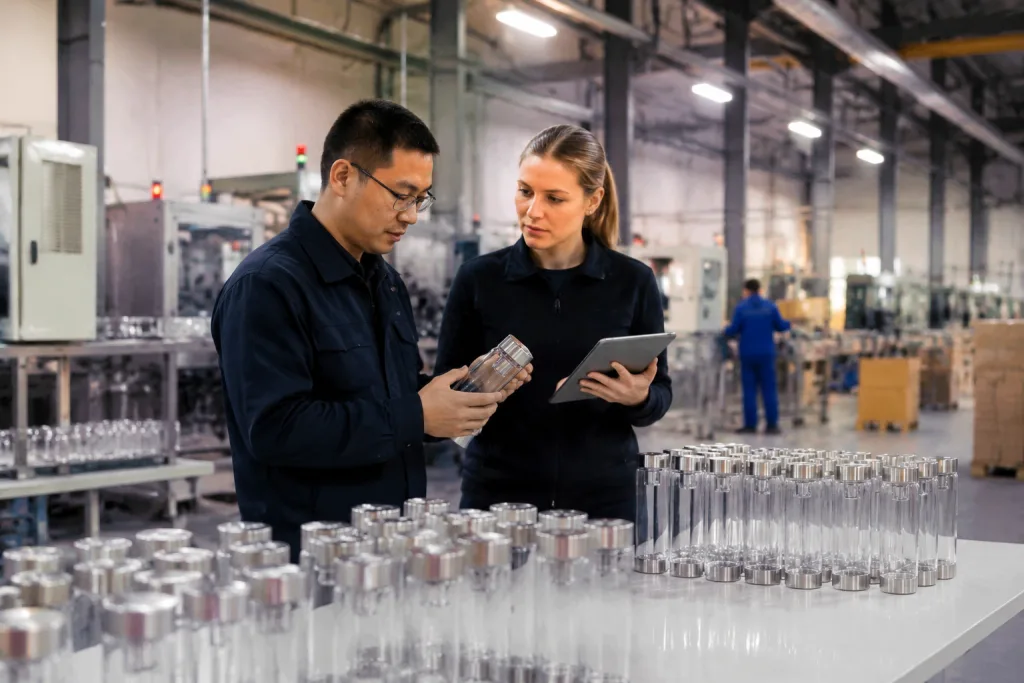
A procurement manager should not approve a borosilicate glass vacuum insulated bottle bulk order without tests. We run leak checks, thermal shock, and drop tests before the line goes live. If the supplier is solid, they know the numbers. If they stall, the math does not work.
For leak testing, ask for 100% pre-pack inspection or a written sample plan. For general production, AQL 2.5 for critical defects and AQL 4.0 for major defects is standard. For hot-fill or iced-water cycles, pin down the temperature delta. A borosilicate body may hold up from 120°C to 0°C, but the cap and gasket often fail first. QC pulled the sample on a 28 mm neck finish, and that is where the weak seal showed up.
Ask for compliance papers too: REACH for Europe, food-contact declaration, and FDA-related material statements for North America when needed. If your brand sells through retailers, they may ask for drop-test data and carton compression data too. A Zhejiang export factory should hand those over without drama. The buyer flagged a PO typo on the carton count once; the docs had to match the corrected pack-out before we ship.
Checklist for approval samples:
- 1 set pre-production sample with final artwork
- 3 leak-test cycles per sample
- 1 thermal shock cycle report
- 1 drop test from 80 cm or 100 cm, depending on route
- Photo record of packaging stack-up
Packaging for export channels
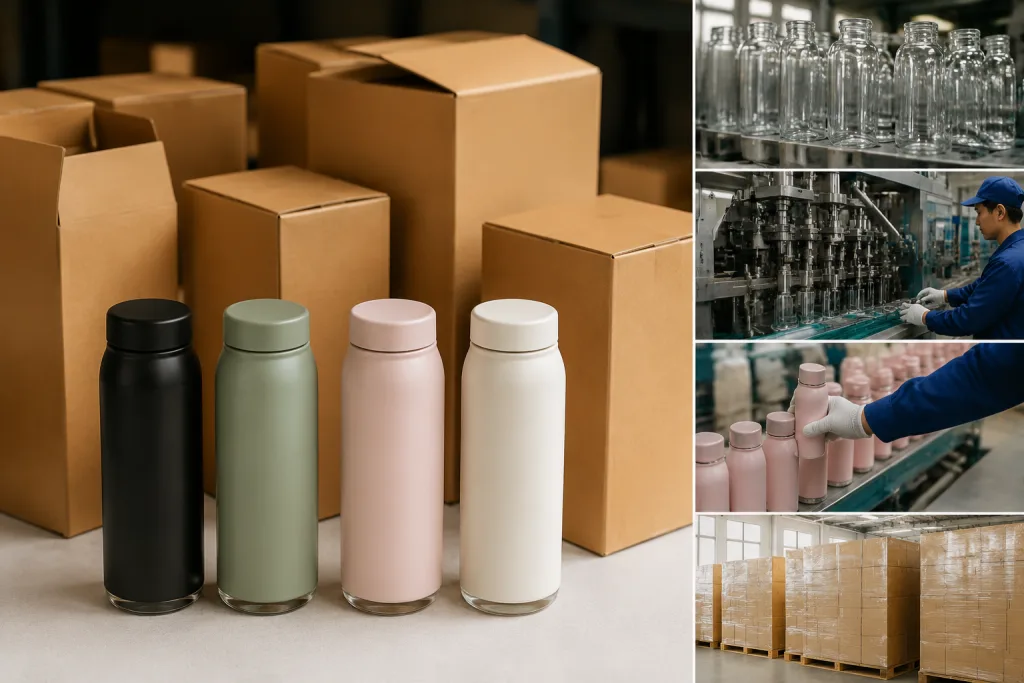
Packaging is where a borosilicate glass vacuum insulated bottle bulk order saves money or bleeds it. Glass needs more protection than stainless. That changes carton size, pallet count, and freight. On one 12,000-piece run, a plain brown export box with one-color print cut packaging cost by 8-15% versus a premium litho carton, and the math was easy to see on the line.
If you sell to retail chains, a full-color box may still be the right call. If the buyer pushes the bottles into canteen bulk, wholesale canteen, or hospitality channels, simple packaging usually makes more sense. This is the wrong question to ask: “What looks best?” Ask where the bottle lands — shelf, warehouse, or direct-to-consumer. For Amazon FBA, we ship to the prep rules first, so carton markings, FNSKU labels, and crush protection matter more than artwork. See our Amazon prep notes in Amazon FBA drinkware sourcing guidance if that is your route.
Ask the supplier to quote packaging in three levels:
- Plain export pack for freight efficiency
- Retail pack for brand presentation
- E-commerce pack for drop protection
For growler bulk and growler wholesale programs, especially beer growler bulk or beer growler in bulk, double-wall cartons and internal dividers usually earn their keep. QC pulled the sample after a 1.5-meter drop test, and the inner tray still held. Breakage claims cost more than better packaging. The same is true for alcohol flask wholesale bulk projects, where a small gasket defect can wipe out the shipment margin.
How to compare suppliers
I’ll rewrite the section in-place, keep the HTML intact, and tighten the sales-engineer voice with concrete sourcing details.Buying for different channels
I’ll rewrite the HTML prose only, keep every tag and link intact, and tune it to sound like a factory-side sales engineer.Send your spec sheet for a fast quote
We will check MOQ, structure, and packaging before pricing, so you get a clean offer from a Zhejiang factory that knows export drinkware.
Frequently asked questions
What is a realistic MOQ for borosilicate glass vacuum insulated bottle bulk orders?
For standard shapes, 3,000 units is a realistic starting MOQ. If you want custom molds, special lid colors, or multi-color printing, 5,000 units is more common. Some Zhejiang factories can support trial runs at 1,000-2,000 units, but unit price may rise 15-25%. Always confirm whether the MOQ applies per SKU, per color, or per artwork version. That detail matters more than the headline number.
How much should I expect to pay FOB China?
For a 500 ml to 750 ml borosilicate glass vacuum insulated bottle bulk order, FOB China pricing often lands around USD 3.20-4.60 for a basic build at 3,000 units. With custom artwork, upgraded lids, and better packaging, USD 5.50-7.80 is normal. Heavy glass, premium decoration, or retail cartons can push it higher. Ask for a breakdown by bottle, lid, print, inner box, and master carton.
What tests should I ask for before confirming production?
Request leak testing, thermal shock testing, and drop testing. For procurement control, use AQL 2.5 for critical defects and AQL 4.0 for majors if the supplier runs batch inspections. Also request REACH documentation for Europe, food-contact material statements, and carton compression data if the bottles ship in retail packs. A responsible factory in China should provide sample reports within a few days.
Can this product work for beer growler or alcohol flask programs?
Yes, but only if the design fits the channel. Beer growler bulk and beer growler wholesale programs usually need stronger packaging, larger closures, and better transit protection. Alcohol flask bulk or alcohol flask wholesale items need tighter seal control and often simpler decoration. A borosilicate glass body is attractive for premium positioning, but if the closure is weak, your returns will erase the margin fast.
How long does lead time usually take from sample approval?
For a standard borosilicate glass vacuum insulated bottle bulk order, 30-45 days after sample approval is typical. If you need new tooling, special packing, or unusual lid hardware, plan on 45-60 days. Add another 7-14 days for ocean freight, depending on destination. If your launch date is fixed, lock artwork and packaging early, because printed cartons are often the first thing that delays shipping.