Key Takeaways
- A practical borosilicate glass vacuum flask wholesale order often starts at 1,000-3,000 pcs, with sampling in 5-7 days and bulk lead time around 25-35 days.
- For retail-ready performance, ask for a 12-24 hour insulation target, 304 or 316 stainless outer shell, and glass liner thickness around 1.2-1.5 mm.
- Typical decoration choices are one-color silkscreen, laser engraving, or a 4-color sleeve; tooling and setup can change MOQ by 20-30%.
- QC should follow AQL 2.5 for major defects and 4.0 for minor defects, with leak, drop, and carton tests before shipment.
You are not buying a “pretty thermos.” You are buying a container that has to survive freight, retail handling, and repeat use without leaking, smelling, or turning into a complaint after week two. That is why borosilicate glass vacuum flask wholesale orders need a different buying process than a basic stainless tumbler run. Skip the spec sheet, and you pay later in returns, slow replenishment, or 500 samples that look fine but fail on the line.
For outdoor retailers and promotional brands, we run these orders like a controlled buyer case: define the bottle, lock the decoration, verify thermal performance, and QC the shipment before balance payment. A 1200-piece MOQ can sound simple on paper, but the math changes fast if the buyer flags a 0.5 mm lid tolerance or a PO typo on the logo position. We handle these programs in Zhejiang, China every week, and the buyer who asks for the right numbers early gets a cleaner launch. The buyer who says “just send catalog options” usually wastes a week.
Start With the Buyer Scenario
Picture the buyer seat at a German outdoor chain or a U.S. promo brand. You need a borosilicate glass vacuum flask wholesale program for winter retail and a corporate gift drop. Same bottle, different math. Retail wants shelf pull, heat retention, and carton loss under control; promo wants logo repeatability, landed cost, and a finish people keep after the event.
Start with use, not decoration. Ask whether the bottle will hold hot tea, coffee, or cold brew, and where it will live: backpack, desk, or cup holder. A real factory in Zhejiang will ask for volume, target price, and annual forecast before it quotes. That is not pushback; that is how we run the line. If your trial is 5,000 pcs and the refill is 30,000 pcs, say it plainly. It changes carton count, glass liner packing, and the PO math. One typo on an RFQ can move the cost stack by a few points.
For this category, the commercial setup is usually FOB Ningbo, MOQ 1,000 pcs for a standard body, and sample sign-off before mass production. If a supplier says 300 pcs with full customization, check the hidden cost. The buyer flagged this more than once: unit price goes up, lead time slips, or color match drifts across the batch. A serious thermos factory will show the tradeoff straight. No smoke.
Choose the Flask Build Correctly
The key buying decision is the build, not the logo. Borosilicate glass liner gives cleaner taste and better chemical resistance than soda-lime glass, but it still sits as a fragile inner tube inside a protective shell. For a borosilicate glass vacuum flask wholesale program, we run a double-wall body with a 304 stainless or powder-coated outer shell, a borosilicate inner liner, and a screw or push-button lid with a food-contact seal. That is the right spec for export, not just for a product photo.
Ask for numbers, not adjectives. Glass liner wall thickness is usually 1.2-1.5 mm, and outer stainless often comes at 0.4-0.5 mm on a light retail model; if you want a heavier hand feel, we go thicker. If a supplier says “strong glass,” the buyer flagged it for a reason. You need the liner grade, the vacuum gap, the seal material, and the insulation claim in hours. A decent promo flask may hold 12 hours hot under a controlled test, while a better retail spec can reach 18-24 hours depending on volume and lid design.
What to confirm in the drawing:
- Capacity: 350 ml, 500 ml, or 750 ml
- Lid type: cup lid, flip lid, or screw lid
- Seal: silicone or TPE, food-grade and replaceable
- Finish: matte, glossy, or powder coat
- Pack-out: color box, mailer, or retail master carton
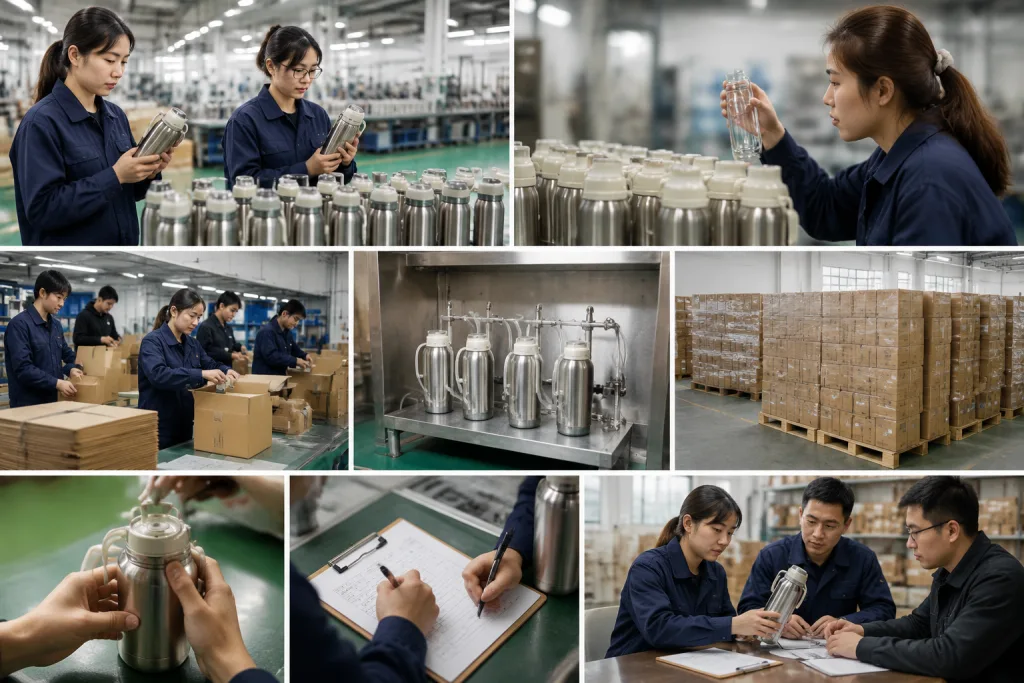
If you are comparing a bulk thermos with a glass-lined flask, the customer experience is not the same. Glass gives cleaner taste, but the pack-out and drop protection carry more weight. We’ve seen this go sideways when the PO typo changed “foam insert” to “paper insert,” and the line caught it before shipment. In Zhejiang, the factories that do this well usually run dedicated foam inserts and carton drop-test checks, because the liner is the weak point, not the shell.
Lock the Customization Early
Decoration changes the math more than most buyers expect. A custom thermos with one-color silkscreen is cheap and fast. A customized thermos with full-wrap print, metallic effects, or laser marking on a curved lid takes longer and can shift the MOQ. We run this every week on the line. If you want a customizable thermos for outdoor retail, ask the supplier to split base price, decoration cost, and packaging cost. Otherwise the offers are not comparable.
For promotional thermos programs, the logo area matters more than the factory brochure says. Measure the printable panel in millimeters. A body that looks large in a catalog may leave you only a 40 x 60 mm logo field after curvature and seam allowance. QC pulled the sample on one job because the buyer flagged the seam overlap. Laser engraving works well on stainless caps, while silkscreen is cheaper on powder-coated bodies. If you need multiple SKUs for one campaign, ask whether the factory can keep the same body and swap lids or colors. That is usually the cleanest way to keep the thermos bulk price under control.
Buyer rule: freeze the logo artwork before sampling, or you will lose 7-10 days each time the revision cycle restarts.
When you talk to a thermos supplier or thermos vendor, ask for Pantone matching tolerance, decoration durability, and whether the print survives 50 dishwashing cycles or only hand wash. This is the wrong question to ask if you leave those points vague. Not every distributor thermos has to be dishwasher-safe, but your claim must match the real use case. On one PO, the buyer typed the wrong Pantone code, and we caught it at pre-production. In Europe and North America, a sloppy logo after two washes is enough to trigger complaints even if the bottle still functions.

Sample, Test, and Approve
This is where you protect the order. A sample should prove the build, not just look clean on a desk. For a borosilicate glass vacuum flask wholesale order, ask for at least two physical samples: one pre-production piece for fit and finish, and one reference sample after the decoration plate is locked. If the supplier only sends a digital rendering, stop there. That is not enough for a factory thermos program.
Test the sample the way the buyer will use it. Fill it with 95°C water, seal it, flip it for 10 minutes, then check the lid and base for seepage. Leave it for 12 hours and log the temperature if insulation is part of the claim. We run drop tests at 70-100 cm onto a hard surface for packed units, then inspect the liner, cap threads, and vacuum seal. One cracked liner at sample stage means the packaging needs work now, not after the shipment leaves the line.
Ask the manufacturer for test documents that match your market. REACH matters for the EU. ASTM methods help with side-by-side comparisons. ISO-based quality systems are useful, but they do not replace product checks. If the factory says BSCI is available, that helps in compliance talks, but it does not tell you whether the bottle will leak in transit. You still need a QC checklist with AQL limits and photo records. The buyer flagged it once on a 3 mm cap gap, and that saved a whole PO.
Good suppliers in China will document:
- Leak test results per batch
- Vacuum retention check
- Cap torque consistency
- Carton compression or drop results
- Visual inspection against approved gold sample
Run Production With QC Gates
Once the sample is approved, do not let production run blind. A solid thermos factory in Zhejiang will lock in incoming material checks, in-process inspection, and pre-shipment inspection. Borosilicate glass does not forgive small shifts. If the liner mouth is off by 0.3 mm, the cap seal can leak. If the vacuum sealing line drifts, your performance claim is dead even when the print looks clean.
For a normal order, the working terms are usually 30% deposit and 70% balance after inspection, with final lead time around 25-35 days depending on capacity and packaging. A plant making 200,000 units/month can still have a queue if you drop a customized thermos order in peak season. Ask where your PO sits on the line. Do not pretend the clock starts the day you pay; we have seen buyers get burned by that typo on the PO and the ship date slips by a week.
Use AQL 2.5 for major defects and 4.0 for minor defects unless your retail channel wants tighter control. Major defects cover leakage, shattered liner, print mismatch, and missing parts. Minor defects cover small surface marks, carton scuffing, or color shift within tolerance. If you sell through distributor thermos channels, the carton is part of the product because distributors will re-stack and re-ship it. One weak master carton can wreck a good bottle, and QC pulled the sample on this more than once.
QC should also cover:
- Thread alignment and cap closure force
- Seal compression and rebound
- Logo placement within ±2 mm where possible
- Inner liner cleanliness and odor check
- Batch code traceability for recall control
Price the Order Like a Buyer
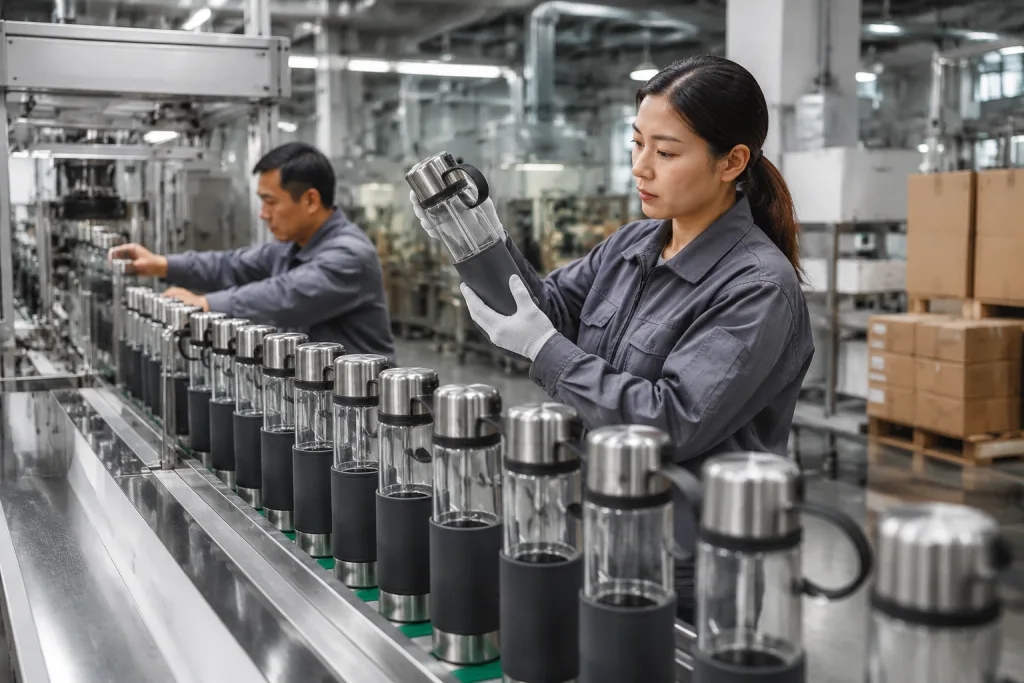
Pricing a borosilicate glass vacuum flask wholesale order is not just unit cost. If you want a clean landed number, split out product cost, decoration, packaging, inland China freight, export docs, and ocean or air freight. A plain model usually sits in the USD 3.20-5.80 range FOB, depending on capacity, cap style, and outer shell finish. Add custom packaging and a complex logo, and the same item can move by 15-35 percent. That is normal. We run this math every week.
Outdoor retailers care about landed margin and sell-through; promotional brands care about target budget per impression. Same discipline. Ask the supplier for a quote ladder at 1,000, 3,000, and 5,000 pcs. On our line, the unit price often drops after the first threshold because the decoration setup gets spread out. If the thermos manufacturer claims a huge discount at 500 pcs and then the price barely moves at 3,000 pcs, the quote was padded at the start. The buyer flagged it, and they were right.
Be careful with “all-in” quotes from a thermos supplier or thermos manufacturer. Sometimes they hide weak carton specs or untested print methods inside the low price. In China, the clean quote is usually the one that shows every cost line. That gives you room to push the parts that matter. For a distributor thermos program, I would rather see a transparent FOB quote and manage freight separately than accept a mystery landed price with no breakdown. We’ve seen that go sideways.
Useful commercial terms to pin down: MOQ, FOB, sample charge, plate fee, lead time, carton count, and replacement policy for transit damage.
Ship It Without Surprises
The last step is packing and shipment control. Glass-lined vacuum flasks need tighter handling than a plain stainless tumbler. We run a 5-layer export carton for most sea shipments and check compression on the carton tester before mass pack-out. Each bottle needs firm top-and-bottom cushioning, not loose paper that looks nice in a sample room. Shake the inner box. If it rattles, stop the line. The flask may look fine on arrival, then fail 30 days later because the cap thread or glass liner took micro-shock during trucking from Ningbo to the port.
Before release, confirm the shipment mark, SKU code, FNSKU if you are feeding Amazon, and carton master label. QC pulled one sample last month where the PO had “matte black” but the carton label said “black matt”; that small typo delayed warehouse receiving by 2 days. If the same model ships into retail, wholesale, and e-commerce, keep the carton labeling distinct. Do not ask the supplier to “make one label work for all channels.” The math doesn’t work. For North America, ask the supplier to match your fulfillment center pack-out rules, including carton weight limits and barcode position in mm. For Europe, check carton wording and print claims against your market wording before we ship.
At this stage, a solid thermos supplier acts like an export desk, not just a factory. We check pallet height, stretch-film tension, desiccant placement, and whether replacement parts should be packed 1 percent extra. We also flag what we cannot guarantee. That saves money. A thermos factory in Zhejiang that has shipped to Europe and North America before knows where shipments go sideways: loose silicone seals, cartons under 8 kg burst strength for the lane, and claim language that sounds harmless in China but causes buyer pushback overseas. Fix it before the vessel leaves China.
Send your spec and get a clean quote
Share capacity, artwork, carton needs, and target market. We will price the order, confirm QC steps, and build the shipment plan.
Frequently asked questions
What MOQ should I expect for borosilicate glass vacuum flask wholesale?
For a standard borosilicate glass vacuum flask wholesale run, 1,000 pcs is a common starting MOQ, while fully customized packaging or multi-color decoration may push it to 3,000 pcs. If the body is standard and only the logo changes, some factories can lower the entry point, but the unit price usually rises 8-20 percent. Sampling typically takes 5-7 days, and mass production is often 25-35 days after approval. Ask whether the MOQ is by color, by artwork, or by carton configuration, because those are not the same thing.
How do I judge insulation performance on a glass-lined thermos?
Ask the supplier to test with a clear method: fill with 95°C water, measure temperature retention at 6, 12, and 24 hours, and confirm the test environment. A practical retail target is often 12 hours hot for a promotional thermos and 18-24 hours for a stronger retail spec, depending on volume and lid design. Also check leakage after inversion, because a bottle can retain heat and still fail as a product. If the factory only gives you a vague “good insulation” claim, that is not enough for a buyer decision.
Can I mix custom logo and retail packaging in one order?
Yes, but you need to plan it carefully. A custom thermos order can share the same bottle body while using different sleeves, inserts, or master cartons for separate channels. That is useful if you sell to outdoor retailers and also run a promotional thermos campaign. The catch is that packaging changes can affect MOQ and lead time. In practice, a second packaging version may add 5-10 days and increase the setup cost by a few hundred USD, depending on print complexity.
What QC standard should I ask the factory to follow?
For most export orders, ask for AQL 2.5 on major defects and 4.0 on minor defects, with 100 percent leak checks on the critical stage if possible. Major defects include cracked glass, leaking lids, print errors, and missing accessories. Minor defects include slight scuffs or minor shade variation within tolerance. If you are buying from a thermos manufacturer in China, also request batch traceability, carton drop testing, and a photo report before shipment. That makes claims easier if a logistics issue appears later.
What documents do I need from a supplier in China?
At minimum, request the commercial invoice, packing list, and a product spec sheet with material callouts. For EU-bound orders, ask about REACH-related material compliance; for U.S. retail or marketplace programs, align labeling with your packaging and FNSKU requirements if needed. If the supplier has BSCI or ISO documentation, that can help with vendor onboarding, but it does not replace product testing. A reliable thermos supplier or thermos vendor in Zhejiang, China should be able to provide photos, batch codes, and inspection records without delay.