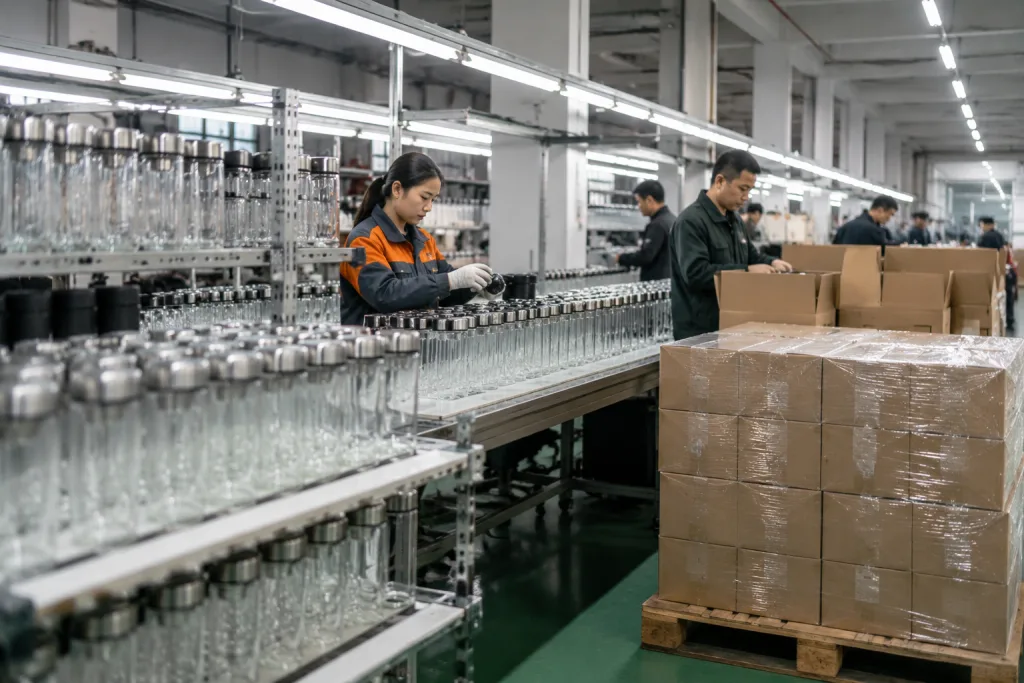
Key Takeaways
- MOQ for a standard custom thermos often starts at 1,000 to 3,000 units per design; glass-inner vacuum flasks usually need 2,000+
- Typical FOB China pricing for borosilicate glass vacuum flasks lands around USD 1.85 to 4.60 depending on size, lid, and print
- Lead time is usually 20 to 35 days for stock tooling and 35 to 55 days for new molds or multi-color decoration
- A Zhejiang factory with 300,000 units/month can handle bulk thermos and distributor thermos programs faster than small workshops
` tags, keep every tag and number intact, and tune the tone to sound like a factory-side sales engineer.
If you are buying a borosilicate glass vacuum flask manufacturer for outdoor retail or a promotional launch, the first mistake is asking only for unit price. We see this every week. The real number is landed cost for a usable, tested flask that arrives on time, clears REACH or LFGB where needed, and lands without a 6% breakage surprise after QC pulled the sample from the carton line. In Zhejiang and across China, two suppliers can quote the same 500 ml thermos at USD 2.10 and USD 3.40, but the cheaper one may be hiding a slower line, thinner glass, or a weak carton spec.
You should price the project the same way a factory does: body material, vacuum performance, lid tooling, print method, packout, and lead time. We run the math on the line, not on a brochure. For a custom thermos program, the gap between a stock factory thermos and a fully customized thermos is often 12 to 25 days, not a few cents, and that is the wrong question to ask when the buyer has a fixed ship date. That gap matters when you are planning seasonal distributor thermos orders or a promotional thermos campaign with a hard deadline.
What Actually Sets the Price
I’ll rewrite the prose in place, keep the HTML exactly as-is, and tighten the pricing language so it reads like a factory-side sales engineer wrote it.For a borosilicate glass vacuum flask manufacturer, the price starts with the inner bottle, not the shell outside. Borosilicate glass looks cheaper than 304 stainless on paper, but the line loses money when the glass cracks, the vacuum seal fails, or the worker spends time reworking a bad neck finish. A standard 500 ml flask with a PP lid, single-color silk screen, and plain carton usually lands around USD 1.85 to 2.40 FOB China at 3,000 units. Add a stainless outer shell, bamboo lid, or double-wall cup function, and that same unit moves to USD 2.90 to 4.60.
The cost drivers are plain: glass wall thickness, vacuum assembly yield, lid tooling, decoration, and packout. A 1.2 mm borosilicate liner is common for mid-market programs; moving to 1.5 mm improves drop resistance, but it can raise cost by 6% to 10%. We’ve seen the buyer flag a spec change after sampling, and that always burns time. If you need a custom thermos with laser engraving, spot printing, and a color-matched cap, plan on extra handling and a USD 0.12 to 0.35 decoration add-on, depending on coverage. On our line in Zhejiang, the width gauge and vacuum check fixture keep costs steady only when the spec is frozen before sample approval.
- Standard 500 ml borosilicate flask: USD 1.85 to 2.40 FOB
- Promotional thermos with one-color print: usually +USD 0.08 to 0.18
- Gift box upgrade: usually +USD 0.20 to 0.55
- Extra test reports or compliance prep: often +USD 0.05 to 0.15 per unit on small runs
If you are comparing supplier thermos quotes, ask what is left out. The wrong question is “what is your best price?” We’ve seen this go sideways when a factory quotes only the bottle and skips inserts, foam, carton strength, or the second packing step; then the PO lands with a typo on the packing spec and the real cost jumps. That is how a cheap quote turns into an expensive order.
MOQ Tiers That Make Sense
I’ll rewrite just the prose inside the existing HTML, keep every tag and heading structure intact, and tune the tone to sound like a real factory-side sales engineer.The MOQ comes down to what you are buying: stock thermos, light branding, or a full custom thermos with its own box and inserts. For a simple logo print on an existing mold, we usually run 1,000 units. If the buyer wants a color shift, a cap swap, or a printed gift box, 3,000 units is the number that holds up on the line. New glass shape or a heavy stainless sleeve? Plan on 5,000 units or more. That is standard in China, because the print screen, packing jig, or tooling setup gets locked to one order.
For outdoor retailers, the clean move is a stepped order. Test 1,000 to 2,000 units first, then move to 5,000 or 10,000 once sell-through is clear. We saw one chain try to jump straight to 8,000 units on a new matte finish, and the buyer flagged the cash flow before QC even pulled the sample. Promo brands usually need faster sign-off, so a thermos customizable platform with proven caps and bottles is the safer play. It keeps MOQ down and cuts the sample loop from 18 days to 12 days.
Typical MOQ bands
- Logo-only stock item: 500 to 1,000 units
- Color or gift-box customization: 1,000 to 3,000 units
- New mold or private shape: 5,000 to 10,000 units
- Mixed SKU distributor thermos program: often 1,000 units per color, 3 colors minimum
Do not let a supplier force a MOQ that misses your sell-through math. A 3,000-unit order with weak demand is a bad trade, even if the unit price looks sharp on paper. We’ve seen that go sideways when the reorder never lands. A solid thermos supplier should quote the entry tier and the reorder tier, since repeat orders usually save 6% to 12% once the print screen and carton die-cut are already set.
Lead Time by Order Type
I’ll rewrite the section in-place, keep the HTML exactly as-is, and tighten the wording so it sounds like a factory-side sales engineer.Lead time is where a lot of buyers misread the market. A stock bottle from a thermos factory in Zhejiang can move fast, but a real custom thermos still needs prep, sampling, production, cooling, packing, and inspection. For stock decoration, 20 to 25 days is the normal run. For a new logo plate, special carton, or multi-step print, 25 to 35 days is more realistic. If you change lid structure or ask for a new bottle mouth diameter, add 10 to 20 days for tooling and first-article sign-off. We’ve seen buyers miss a PO typo on the mouth size and blame the line when the mold spec was wrong.
For a borosilicate glass vacuum flask manufacturer running a clean line, monthly output can reach 300,000 to 500,000 units across models. That sounds big, but the bottleneck is often not the kiln; it is the vacuum seal and the packout table. If the order includes distributor thermos assortments with mixed colors, you can lose 2 to 4 days to line changeover. If you need REACH or LFGB testing, the lab cycle can add 7 to 12 days before shipment approval. QC pulled one mixed-color sample last quarter and found a cap torque issue at 1.8 N·m, so the buyer had to wait for a recheck.
Practical rule: if you need the goods in a U.S. or European warehouse by a fixed date, place the PO 8 to 10 weeks ahead, not 4.
- Stock sample approval: 2 to 5 days
- Logo sample or pre-production sample: 5 to 10 days
- Mass production: 18 to 30 days
- Export inspection and packing: 2 to 4 days
That timeline is normal in China. A supplier promising 10-day custom production for a glass vacuum flask is usually skipping drying time, QC, or proper packing. The math does not work. We run AQL 2.5 on export lots, and that alone takes time when the buyer flags a carton mark or asks for a last-minute artwork fix.
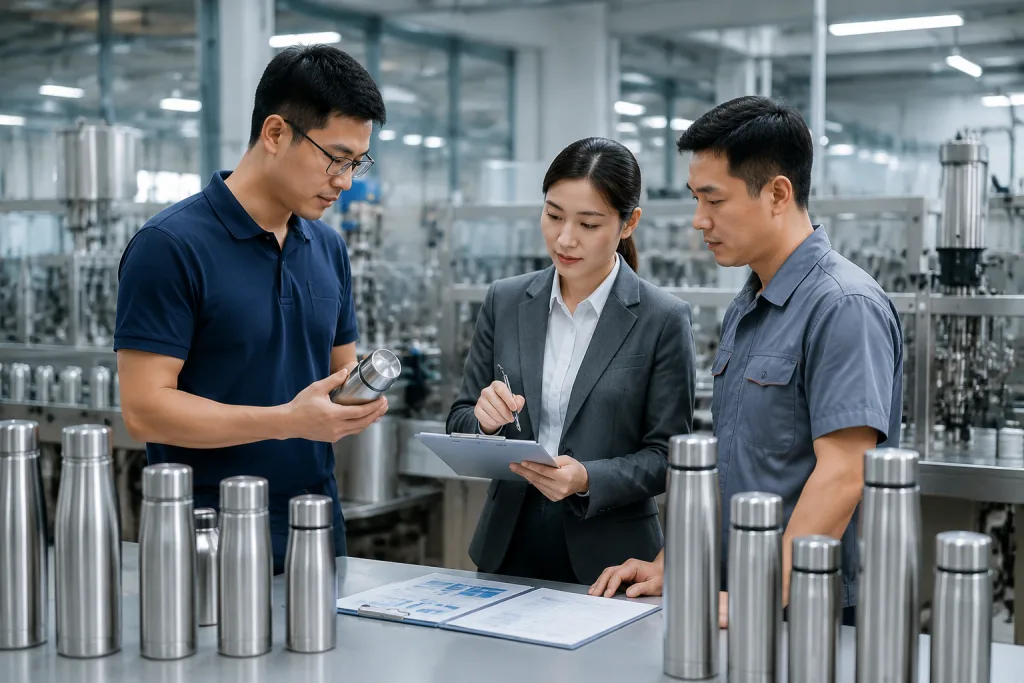
The Hidden Cost Drivers
I’ll rewrite the section in-place, keep the HTML exactly as-is, and strip the AI-ish phrasing while adding factory-floor detail and sharper sales-engineer tone.Most first-time buyers stare at the bottle and miss the system around it. On our line, a custom thermos price moves on small choices that stack fast. The lid is the first one. A basic PP screw lid costs almost nothing to change, but a stainless cap with a silicone sealing ring and one-handed open mechanism adds USD 0.25 to 0.80. If the lid needs a food-grade stainless insert or a bamboo top, the tooling changes and the scrap rate moves with it.
Packaging bites next. A plain kraft box adds USD 0.12 to 0.18. A printed color box with insert, barcode, FNSKU sticker, and a master carton built for drop tests adds USD 0.30 to 0.75 per set. For Amazon FBA, the box spec can matter more than the bottle print. We had a buyer flag a PO typo on the carton size once, and QC pulled the sample back before packing. If your distributor thermos order needs retail-ready labeling, tell the factory before sampling, or you pay for relabeling and rework later.
Compliance also shows up on the invoice. REACH, LFGB, ASTM F963 for kids-related programs, or a written food-contact declaration all need files, and sometimes lab fees too. On a 3,000-piece run, that can spread USD 0.05 to 0.20 per unit. On 50,000 pieces, the unit hit is lower, but the paperwork still has to be clean before booking cargo. We’ve seen this go sideways when the buyer asked for test reports after the goods were packed; the math doesn’t work.
- Lid upgrade: +USD 0.25 to 0.80
- Color box and insert: +USD 0.30 to 0.75
- Drop-test carton reinforcement: +USD 0.08 to 0.20
- Compliance paperwork spread: +USD 0.05 to 0.20
The cheapest thermos manufacturer is usually the one that leaves out the parts you still need. That is not savings. It is a delayed bill.
How China Factories Quote Bulk Orders
I’ll rewrite the section in-place, keep the HTML exactly as-is, and strip the AI-ish phrasing while adding concrete factory detail and buyer-side realism.When you ask for bulk thermos pricing from China, the quote usually breaks into unit cost, decoration, packing, and the shipping term. FOB Ningbo or FOB Shanghai is standard for Zhejiang exporters; EXW can look lower, but then you take domestic freight, export handling, and customs paperwork. We run these comparisons every week, and the math does not work if you line up an EXW number against a full FOB quote.
A proper quote from a Zhejiang factory should list size, material, inner liner thickness, vacuum retention target, lid type, print method, carton spec, MOQ, and lead time. QC pulled the sample on a 500 ml borosilicate glass vacuum flask last month and measured a 1.8 mm liner, one-color print, color box, and FOB Ningbo at USD 2.25 for 3,000 units; at 10,000 units, the same item was USD 1.98. That 12% to 15% spread is why smart buyers split orders into tiers instead of chasing one price for every volume.
Ask about the failure points too. What breakage allowance are they carrying, and is the factory checking AQL 2.5 for appearance and 4.0 for carton damage? What vacuum retention target are they promising after 24 hours? We’ve seen this go sideways when a buyer missed a lid gasket spec on the PO, so a real thermos factory answers fast and with numbers. If they stall, you are not talking to a dependable supplier.
- 3,000 units: common entry point for private label
- 5,000 units: better pricing and line priority
- 10,000 units: stronger leverage on packaging and print cost
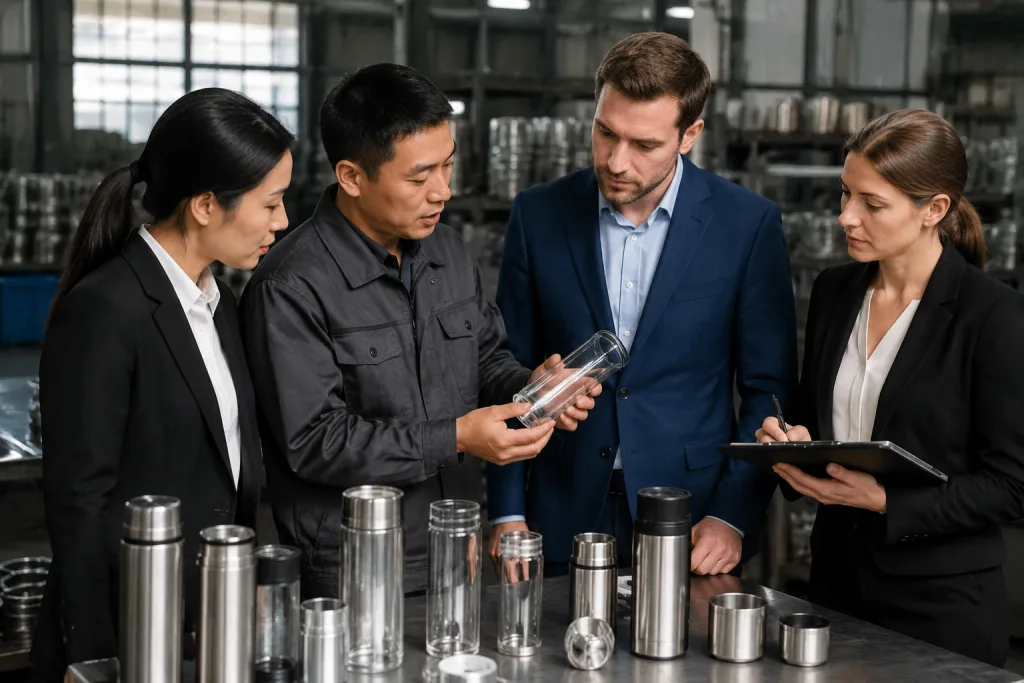
What Buyers Should Ask Before PO
Before you issue a PO, ask questions that kill ambiguity. Not broad ones. Ask if the borosilicate glass vacuum flask manufacturer is a real factory or a trading desk with a WeChat number. Ask if they can hold the same seal, logo placement, and carton spec on a reorder six months later. We once saw a PO with the logo line typed as “center-ish”; QC pulled the sample and the buyer flagged it in ten minutes. Consistency beats a flashy sample.
For outdoor retailers, ask for drop results from 80 cm, leak testing, and carton compression. For promo brands, ask whether the print survives 50 dish cycles or sits only on the surface. If you are buying thermos promotional inventory for giveaways, a leaner spec often makes more sense than stuffing in every premium feature. The math does not work if the return rate jumps. Repeatable, usable, on time. That is the job.
Questions worth sending in one email
- What is your monthly output for this model in Zhejiang or another China plant?
- What is the MOQ for logo print, color change, and full custom mold?
- What is the exact lead time after sample approval?
- Which test reports can you provide: REACH, LFGB, FDA food contact, AQL?
- What is the breakage rate you budget for bulk thermos shipment?
If a thermos manufacturer gives you clean numbers, you are probably talking to the production team. If they answer with vague promises, walk away. We have seen that go sideways on a 12,000-piece order when the pack-out changed on day 3. The right manufacturer thermos partner saves time on the first order and even more on the reorder.
Request a quote with exact spec today
Send your volume, logo method, lid style, and target ship date. We’ll quote FOB China, MOQ, and lead time without guesswork.
Frequently asked questions
What is a realistic MOQ for a custom borosilicate glass thermos?
For a simple logo print, 1,000 units is realistic. If you want a color cap, custom box, or mixed packaging, 3,000 units is more common. New mold or new shape projects often start at 5,000 units. A Zhejiang factory with stable lines can sometimes accept lower trial volumes, but the unit price will rise by 10% to 20% because setup is spread across fewer pieces.
How much does a bulk thermos usually cost FOB China?
A standard 500 ml borosilicate glass vacuum flask typically lands around USD 1.85 to 2.40 FOB China for 3,000 units. Add a stainless cap, premium print, or retail box and the range can move to USD 2.90 to 4.60. If you are comparing quotes, check whether cartons, inserts, and compliance paperwork are included, because those items can add USD 0.20 to 0.75 per unit.
How long does production take for a customized thermos order?
For a stock-based customized thermos, expect 20 to 35 days after sample approval. New tooling or a new lid structure can add 10 to 20 days. If you need lab reports or final export inspection, add another 7 to 12 days. In China, the safest planning window is 8 to 10 weeks from PO to warehouse-ready shipment.
Can a borosilicate glass vacuum flask manufacturer handle Amazon FBA labeling?
Yes, a proper thermos supplier can do FNSKU labels, suffocation warnings, and master carton marks. Tell them before sampling so the box layout is correct. For FBA, ask for carton compression strength and scan-friendly barcode placement. That usually adds only a small cost, often USD 0.03 to 0.10 per unit, but it avoids relabeling later.
What should I check in a thermos factory audit?
Check monthly output, in-line QC, vacuum sealing equipment, breakage handling, and document control. A credible factory thermos operation should show production records, AQL inspection limits, and test reports. In Zhejiang, stronger plants often list 300,000 units/month or more across product lines. If they cannot show consistent process control, treat them as a trading supplier and price the risk accordingly.