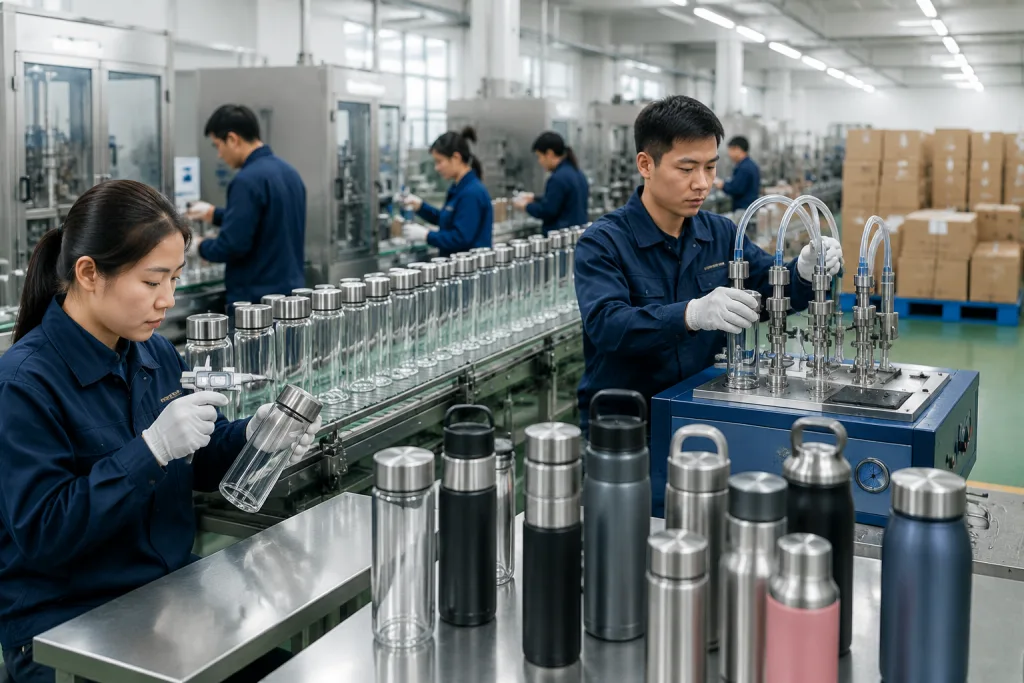
Key Takeaways
- A borosilicate glass vacuum bottle private label program usually starts at 1,000-3,000 pcs MOQ and 35-50 days lead time.
- Glass wall thickness around 1.5-2.0 mm and lid torque control matter more than decorative extras.
- AQL 2.5 for major defects is a realistic baseline; vacuum retention should be checked on every lot.
- FOB China pricing for a basic custom thermos often lands around USD 2.10-4.80 depending on capacity and print complexity.
Private label drinkware looks easy until the first carton shows up with hazy glass, a lid that rattles, or a vacuum layer that drops out after 3 weeks on the road. If you are buying a borosilicate glass vacuum bottle private label program for outdoor retail or a promo line, the job is not picking a nice sample. It is finding where the line breaks and locking the spec before a Zhejiang factory starts cutting tooling.
That matters because a thermos is judged in use, not in a catalog. A distributor thermos sold into camping channels gets dropped, washed, and filled past the line mark. A promo thermos may sit 4 months in a warehouse before a deadline campaign. If your supplier, manufacturer, or thermos factory does not hold glass thickness, seal compression, drop resistance, and carton packing, you pay for it in returns and reprints. We run this kind of QC every week, and the buyer flagged a 1.2 mm wall drift on one lot before it turned into a claim. In Zhejiang and across China, the factories that last treat QC like engineering, not luck.
Where private label projects fail first
I’ll rewrite the section in place, keep the HTML exactly as-is, and tune the prose to sound like a factory-side sales engineer.The first failure point is not the bottle body. It is the belief that “glass is glass” and any borosilicate bottle can go into a vacuum build. It cannot. A custom thermos with a glass inner chamber needs tighter control than a simple single-wall bottle. Borosilicate glass helps with thermal shock, but it does not forgive uneven wall thickness, weak annealing, or rough seam work. If the factory thermos team is not checking neck concentricity and lip flatness with a caliper and gauge ring, the vacuum assembly drifts out of spec fast.
For outdoor retailers, the usual mistake is asking for style before structure. A taller silhouette looks premium on paper, but if the center of gravity climbs and the cap seal area shrinks, leaks show up and breakage follows. A promotional thermos has the same problem from the other side: decorators push low-cost print, then ignore lid fit and carton compression. We’ve seen that turn a 5,000-piece thermos promotional order into a claims file. That is the wrong question to ask.
- Specify glass thickness by zone, not just overall: body 1.5-2.0 mm, neck and base tolerances separately.
- Ask for lid torque and leak testing on every lot, not just sample approval.
- Require drop-test criteria in writing, such as 1.0 m on packed units and 0.8 m on unpacked samples.
In China, a serious thermos manufacturer will understand this language right away. If they only talk about color cards and box art, you are talking to a thermos vendor, not an engineering partner. QC pulled the sample, measured the mouth at 32.4 mm, and the buyer flagged it before production. That kind of detail saves the line.
Vacuum loss and thermal drift
I’ll rewrite the section in place, keep the HTML exactly as-is, and tighten the sales-engineer tone with concrete factory details and cleaner phrasing.Vacuum failure is the costly defect because it usually slips through receipt checks. The bottle looks clean, then the drink drops fast or the outer wall turns warm. That points to a vacuum leak during sealing or a later hit in transit. For a borosilicate glass vacuum bottle private label run, we run a retention test, not a visual pass. Ask for a 95°C fill test, then check at 2, 6, and 12 hours with the same water volume, lid torque, and room temperature. If a supplier sells “12-hour insulation” without a test rig, the math does not work.
The usual causes are a bad glass-to-vacuum interface, sealant dust, cap venting errors, and neck damage from packing. On one 5,000-piece bulk thermos order, QC pulled the sample after a carton drop test at 1.2 m and found three cracked necks; that sort of miss shows up fast when the liner, cap, and body come from different subcontractors. This is why manufacturers thermos programs need batch traceability. A real thermos factory can tell you which liner lot, cap mold, and gasket batch went into each production day.
“If the insulation claim matters to your brand, treat it like a measured property, not a marketing line.”
For premium outdoor retail, I would take a verified 8-hour hold over an untested 12-hour claim. The buyer flagged it once on a PO typo too: “hot water” became “hot waer,” and that kind of sloppiness usually shows up in testing as well. Customers forgive a smaller number. They do not forgive a broken promise.
Cap leaks and gasket drift
I’ll keep the HTML intact and rewrite the copy to sound like a real sales engineer, with tighter, more specific factory-floor language.Most leak complaints start at the cap, not the glass. First-time buyers usually miss that. The gasket is carrying the load. If silicone hardness is off, if the thread pitch drifts, or if the cap shell moves during cooling, the thermos customized for your brand will fail in normal use. We have seen a bottle pass a quick inversion test on the line and still come back with a slow seep after 7 days of hot-cold cycling.
For a custom thermos or customizable thermos program, lock three points: gasket material, thread engagement, and assembly torque. We usually specify food-grade silicone at 50-60 Shore A unless the design calls for something else. A lid that grabs only 2.5 turns looks neat on the drawing, but a 4-turn cap with a proper compression path usually holds better. If you are selling thermos bulk for outdoor use, the cap has to survive backpack shake and cup-holder vibration; that is the real test, not a showroom demo.
- Require leak testing after 24 hours at room temperature and again after hot-fill cycling.
- Ask the thermos supplier for gasket compression drawings.
- Reject any lid design that operators cannot reassemble in 20-30 seconds on a line.
The better thermos suppliers in China document cap failure modes because they know where the warranty claims come from. QC pulled a leaky sample last month with a 0.3 mm gasket mismatch, and that saved a shipment.
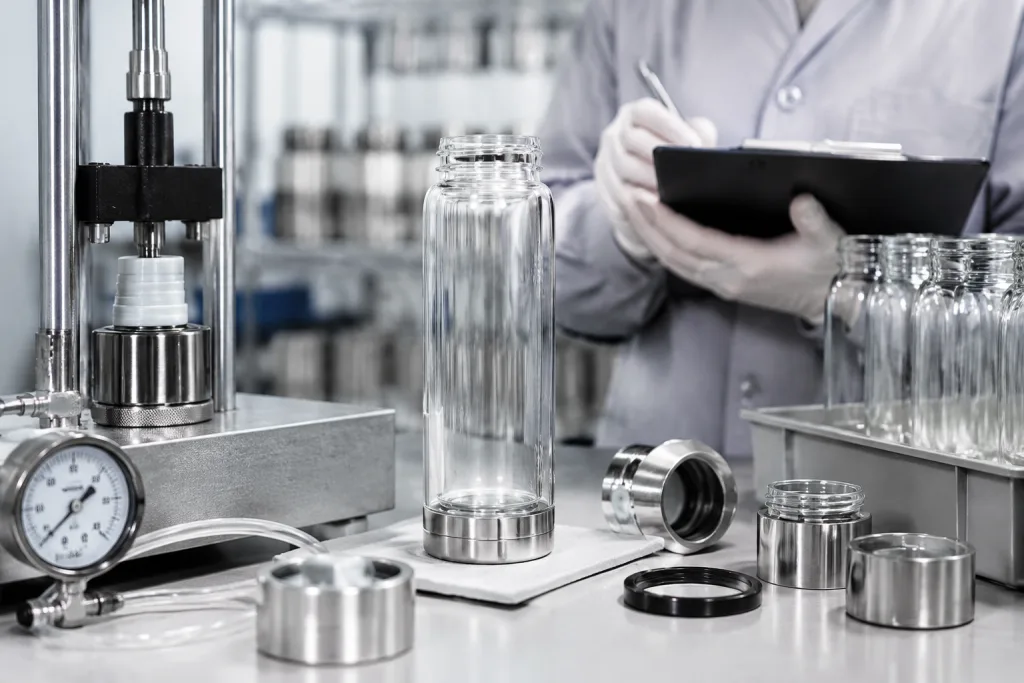
Decoration that looks good, then flakes
I’ll rewrite the section in place, keep the HTML structure unchanged, and strip out the AI-ish phrasing while adding sharper factory-floor detail.Decoration fails quietly until it kills a launch. Screen print on a promotional thermos chips fast if the surface prep is off or the bake window gets cut short by 8 minutes. Laser engraving on a metal outer shell holds up better, but with glass we watch abrasion and heat stress closely. For a custom logo on a borosilicate glass vacuum bottle private label run, the finish has to fit the substrate. A layout that works on stainless steel can crack, haze, or lift on coated glass or a powder-coated sleeve.
Outdoor retailers ask for full-color branding, then the ink gets blamed when the first carton scuffs in transit. Full-color systems on drinkware are touchier around wash cycles and UV, and that is just the math. If buyers will hand-wash bottles with detergent, we tell the factory to run a 50-cycle wash test on the line. If retail staff will gift-wrap units or bundle them with packs, the print also has to survive carton rub. We once saw a buyer flag a 1.2 mm logo shift on a PO typo, and that kind of miss is why we standardize one decoration method per SKU instead of mixing two or three across small orders.
Keep the spec tight. A single-color print with a locked bake time costs less and usually gives fewer headaches than a flashy decoration that looks good on day one and flakes in 30 days. When a manufacturer thermos team says, “We can do it,” ask for the 30-day sunlight result and the 10-wash-cycle report, not a desk sample. QC pulled one that passed at first glance, then the edge started lifting after a 72-hour heat soak. That is the line between a real factory thermos program and a sample that only photographs well.
Packaging failures in transit
I’ll rewrite the section in-place, keeping the HTML exactly as-is and sharpening the language for a factory-side B2B tone.Glass does not fail only at filling. It fails in cartons, on pallets, and inside containers. A borosilicate glass vacuum bottle private label project needs packaging work from day one. If the insert is loose, the bottle rattles and the vacuum liner can chip at the base. If the carton is too tight, the cap becomes the stress point. If pallet stacking is sloppy, corner crush turns into microfractures that show up as a buyer claim two weeks later.
For FOB China shipments, ask the thermos factory to run a transit simulation: vibration, compression, and drop testing on packed master cartons. We run this on a simple rig with a compression tester and a 60 cm drop standard, because “export carton” means nothing by itself. Double-wall cartons are common for premium custom thermos programs, but flute grade and inner partition do the real work. A solid baseline is an outer carton that holds 5-7 layers of stacking for 24 hours with no visible deformation, then a carton drop from 60-80 cm depending on the route risk. If your distributor thermos order goes into Amazon FBA, carton size and label position have to match inbound rules, or you pay for rework at the warehouse. The math does not work any other way.
- Ask for carton ECT/BCT values, not a vague “strong packing” note.
- Use molded pulp or corrugated dividers for each bottle, not loose void fill.
- Require drop and compression tests on the master carton before mass production.
This is where a thermos manufacturer earns its margin: by proving the pack survives China-to-warehouse transport. QC pulled the sample, and the carton corners held. That is the standard.
How to spec the job correctly
I’ll rewrite the prose only, keep the HTML tags and structure intact, and make it sound like a factory-side sales engineer wrote it.If you want fewer failures, write the spec like a buyer who expects something to slip. Start with capacity, overall height, mouth diameter, glass wall thickness, lid type, decoration method, carton count, and target price. Then add the parts people skip: gasket hardness, torque range, vacuum hold target, allowable cosmetic defects, and AQL. For a premium custom thermos program, I’d call major defects at AQL 2.5 and critical defects at AQL 0.65, then require pre-shipment inspection with photo records. That is normal discipline. On the line, a 0.3 mm wall-thickness miss can turn into a leak claim fast.
Factory reality in Zhejiang is plain. A solid thermos factory may run 200,000-500,000 units per month across several lines, but your slot still depends on parts and print setup. A simple 500 ml stainless-looking glass vacuum bottle with one-color print may have an MOQ of 1,000 pcs and 35-45 days lead time. Add gift packaging or multi-color branding and you move to 3,000 pcs and 45-60 days. FOB China pricing often starts around USD 2.10-2.80 for simpler builds and can reach USD 4.80 or more when packaging and finishes stack up. QC pulled the sample last week and found a lid insert typo on a PO; that kind of thing burns time.
The goal is not to hunt the cheapest thermos supplier. The goal is to find a partner who can tell you why a batch failed, what the fix was, and how they keep it from repeating in Zhejiang, in China, and at your destination. If a vendor hand-waves the failure mode, the math does not work. We’ve seen that go sideways.

What a good factory response looks like
I’ll keep the HTML structure intact and rewrite the three paragraphs so they sound like an export-side factory lead, with concrete QC/factory details and fewer filler phrases.A capable thermos factory does not argue with your concern; it turns it into a test plan. If you ask about leak risk, we pull the gasket section drawing and run a 50°C tilt check. If you ask about breakage, QC shows the 1.2 m drop data. If you ask about print durability, we bring out the dishwasher rub results. That is the line between a real manufacturer thermos partner and a “we can arrange it” middleman. You want the team making process calls, not passing messages.
When you compare thermos manufacturers, look for discipline on the floor: incoming inspection sheets, in-process checks, final AQL reports, and a corrective-action log when defects show up. Ask whether they can support BSCI, REACH, and food-contact files for your market. Ask who owns the vacuum seal step, who signs off on cap assembly, and who blocks a lot if the carton compression test fails at 20 kg. Those answers tell you more than a glossy catalog ever will.
If your business needs a thermos distributor program with multiple SKUs, the best partner will also help you cut the line down. One bottle family, two lid options, one decoration system, one carton structure. That is how we ship bulk thermos without QC chaos. Last month a buyer flagged a PO typo on lid color code, and it cost a full reprint; the math does not work when every SKU needs its own mold, label, and carton spec. In Zhejiang, the factories that stay busy are the ones that keep complexity under control.
Buying signals worth trusting
I’ll rewrite the prose in-place, keep the HTML exactly as-is, and make it sound like a factory-side sales engineer wrote it.Here is the fast filter: trust the supplier who speaks in numbers. Not slogans. If a thermos supplier can give you the vacuum retention target, gasket hardness, drop height, AQL standard, and monthly output without stalling, you are probably talking to someone who has shipped real orders. If they can show how a customized thermos run is packed for export, that is better still. We run this check on the line all the time.
For outdoor retailers, that kind of clarity protects margin. For promotional brands, it protects the ship date. For distributors, it protects repeat orders. The best custom thermos program is not the cleverest one; it is the one that gets through production, transit, shelf life, and daily use with the fewest surprises. We saw a buyer flag a 2 mm carton typo on a PO last month, and that tiny miss would have blown the whole label run. That is the standard I would use on any borosilicate glass vacuum bottle private label project, whether you are buying thermos bulk for a seasonal campaign or building a private label line in China.
Send your spec, get a factory quote
We can review your bottle structure, MOQ, pricing, and QC risks before production. If you need a Zhejiang supplier with export discipline, start here.
Frequently asked questions
What MOQ should I expect for a borosilicate glass vacuum bottle private label run?
For a standard build, expect 1,000-3,000 pcs MOQ. A simple one-color decorated bottle may start at 1,000 pcs, while a more complex thermos custom program with special packaging often moves to 3,000 pcs. If you need mixed colors or multiple lid options, the factory may require separate MOQs per SKU. In Zhejiang, many factories prefer one stable specification to keep line changeover low. Lead time is usually 35-50 days after sample approval and deposit, but decorated or gift-boxed orders can stretch to 45-60 days.
How do I test whether the vacuum layer is reliable?
Do not rely on appearance. Ask for a thermal retention test with a fixed fill volume, usually 95°C hot water, then measure temperature at 2, 6, and 12 hours. Add a vacuum integrity check and a sample drop test at 0.8-1.0 m depending on the pack. For a serious thermos manufacturer, the test report should show batch date, operator, and sample count. If the supplier cannot explain the test method, you are taking a risk. A good supplier thermos partner will also separate glass-body failures from cap leaks in the report.
What pricing is realistic for custom thermos production in China?
For FOB China, a basic borosilicate glass vacuum bottle private label order often lands around USD 2.10-2.80 per piece at larger quantities. Add multi-color print, gift packaging, or heavier cartons and you can move into USD 3.20-4.80 or higher. Small orders cost more because setup and labor are spread across fewer units. The exact quote depends on capacity, decoration, cap complexity, and QC requirements. If a thermos supplier is far below that range, ask what they are leaving out, because something usually is.
What QC standards should I put in the PO?
Use a written AQL plan, commonly AQL 2.5 for major defects and AQL 0.65 for critical defects. Define leak rate, cosmetic acceptance, vacuum retention, cap torque, and carton crush requirements. For a custom thermos or promotional thermos program, include photo references for printing alignment and surface marks. Ask for pre-shipment inspection by lot, not just a final random sample from one carton. If you sell through distributors or retail channels, keep the spec consistent so one factory thermos lot does not vary from the next.
Can you support branding for outdoor retail and promotions?
Yes, but keep the decoration method realistic. For a promotional thermos, one-color print or a controlled multi-color build is usually safer than elaborate finishes. For outdoor retail, you may want stronger packaging, better wash resistance, and a more durable lid design. We typically recommend locking one bottle body and offering two decoration paths rather than mixing too many SKUs. That keeps thermos bulk sourcing manageable and avoids inventory fragmentation. If you need custom logo work, the artwork should be checked against the actual print area before production.