Key Takeaways
- A 1.2 mm borosilicate wall and 0.6 mm stainless shell are common starting specs for a durable custom thermos
- Ask for vacuum retention below 4 mbar leak rate and a 24-hour thermal test before approving thermos custom production
- A Zhejiang factory with 200,000 units/month can usually hold a 15-25 day lead time on standard customized thermos orders
- Use AQL 2.5 for major defects and 4.0 for minor defects if you want realistic QC on thermos bulk shipments
If you buy drinkware for outdoor retail or promotions, you already know the ugly part: the sample looks fine, the first carton ships, and then the failures start showing up in the field. Vacuum loss, loose lids, weak printing, dented shells, off-center liners, and packaging that cannot survive a 30-day ocean route are not random. They come from process gaps you can spot before you place a 5,000-piece thermos order.
That is true when you work with a borosilicate glass vacuum bottle manufacturer in Zhejiang or anywhere in China. Borosilicate is forgiving in use, not in production. The line has to hold glass thickness within 1.2 mm, keep vacuum retention stable, and pass drop checks without shifting the seal geometry. If you are buying thermos bulk for a retailer chain, distributor thermos program, or a thermos promotional campaign, the cheapest quote often turns into the highest claim rate. We have seen that go sideways fast.
Where thermo failures usually start
Most thermos failures start before assembly. On a borosilicate glass vacuum bottle manufacturer line, the weak spot is usually glass consistency, neck roundness, or the way the inner liner sits in the outer shell. We run a go/no-go ring gauge on the neck for this. If the borosilicate tube is thin by zone, it can pass visual check and still crack after a small drop. If the neck finish is off by 0.3 mm, cap torque shifts and the seal starts leaking after a few hot-fill cycles.
For a custom thermos program, the wrong assumption is that all stainless and glass-insulated bottles fail the same way. They do not. Borosilicate glass is touchier on thermal shock, while a stainless shell can hide dents that later pull the lid interface out of line. In Zhejiang, solid thermos factory lines measure glass dimensional tolerance, shell concentricity, and gasket compression as separate checks. Ask for all three. We once had a buyer flag a PO that said “food grade” and “vacuum insulated” only. That is not a spec. It is a guess.
- Glass wall target: 1.1-1.3 mm for most retail use
- Shell gauge: 0.5-0.7 mm stainless, depending on size
- Neck tolerance: keep within ±0.2 mm on critical seal areas
Vacuum loss is not a mystery
I’ll rewrite the section in a more senior factory-sales voice, keep the HTML exactly as-is, and make sure the wording feels grounded with a few concrete production details.Vacuum loss kills repeat orders fast. Once insulation drops, the bottle turns into a complaint machine, especially for outdoor buyers who expect a thermos manufacturer to hold temperature, not explain it away. We usually see it come from seal contamination, weak evacuation, or an unstable glass-to-metal join on the line. Micro-cracks from cooling are another one. The bottle can pass visual check and still fail after shipping.
You need a test that matches the failure. A proper factory thermos line should run a vacuum hold test, not just a quick hot-water check. Ask for a leak rate under 4 mbar if the plant has the gauge, or set a 24-hour retention benchmark with a defined temperature curve. For a thermos promotional run, we tell buyers to sample cartons from the bottom pallet layer too, not just the top. QC pulled a set like that last month and found two weak seals in a 1,200-piece lot. That is the wrong place to save time.
“A bottle that holds heat for one hour in the sample room but fails after truck vibration is not a thermos. It is a return shipment.”
For thermos bulk orders, ask for a written reject rule for bubbles, seal haze, and any trace of vacuum discoloration. Those are early warnings, not cosmetic issues. If a PO says “ok if slightly cloudy,” the math does not work. We have seen that go sideways after the first carton audit.
Why lids and gaskets fail
I’ll rewrite the prose in-place, keep the HTML structure untouched, and make it read like a factory-side sales engineer note with tighter sourcing language.The lid is where most distributor thermos programs get embarrassed. A weak gasket, shallow thread engagement, or a cap that warps under heat turns a good bottle into a leaker. We’ve seen a 2 mm seal lip save a run, and we’ve also seen a buyer flag a cap after the first 48-hour hot-water hold because the thread started binding. If you are sourcing a customizable thermos with branding, check decoration cure temperature against the lid resin. A matte spray or soft-touch coat can change grip enough that one batch opens fine and the next batch feels sticky.
Spec the lid like a working part, not an accessory. Ask for gasket material, usually silicone at 50-60 Shore A, and ask for compression data from the line. If the cap is PP, confirm it holds up at 95°C. If it is stainless, check thread profile and torque window. For a thermos custom project, we’d take a heavier lid with a stable seal over a pretty cap that fails on tolerance. That is the wrong place to save 8 grams. A distributor thermos buyer will accept a plain lid before a leaking premium one.
- Gasket material: food-grade silicone, with migration compliance for REACH markets
- Thread fit: verify 3 full turns minimum before torque peak
- Torque range: define a closing torque window during pre-production
Decoration breaks more than you think
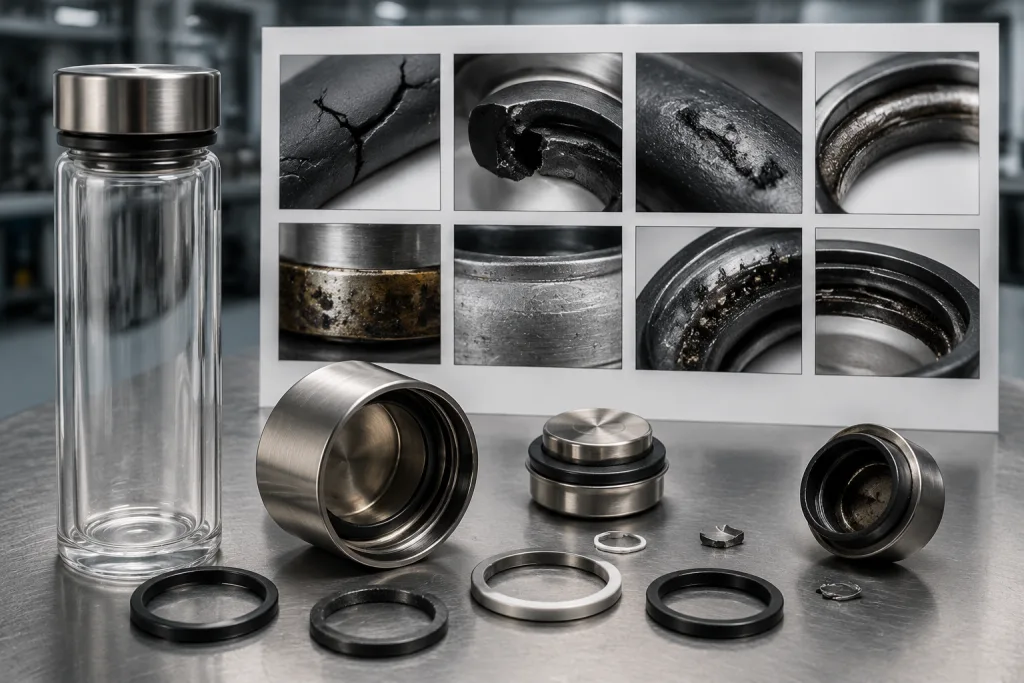
I’ll rewrite the section in place, keep the HTML intact, and tighten the language so it reads like a factory-side sales engineer wrote it.Branding failures look cosmetic until the line starts rejecting units. Then they are production failures. Screen print can crack after 3 wash cycles, laser marking can ghost on a curved stainless wall, and a full-color wrap will lift at the edge if the pre-clean is sloppy. If you are ordering thermos customized for a retail chain or a promo run, decide up front whether the decoration must survive abrasion, dishwasher cycles, or just sit clean on a shelf.
A working supplier thermos should send samples for each process. Do not sign off on artwork from a PDF alone. Ask for a test piece on the exact body shape and finish you will buy; we once caught a buyer typo on the PO that put the logo 8 mm too low, and QC pulled the sample before packing. On borosilicate glass, adhesion and bake temperature matter more than on flat stainless. On stainless shells, surface energy and oil removal decide whether the ink stays down. If a factory says they can do custom thermos decoration on anything, that is not confidence. It usually means the process control is loose.
For outdoor retailers, laser engraving or a high-temperature screen print with a written rub test is the safer call. For thermos promotional orders where unit price drives the deal, ask the thermos supplier to state whether the decoration passes 20, 50, or 100 abrasion cycles. That is a real spec. “Durable” is not. We have seen this go sideways when the buyer accepted a glossy mockup and skipped the rub card.
Packaging failures hit export orders hard
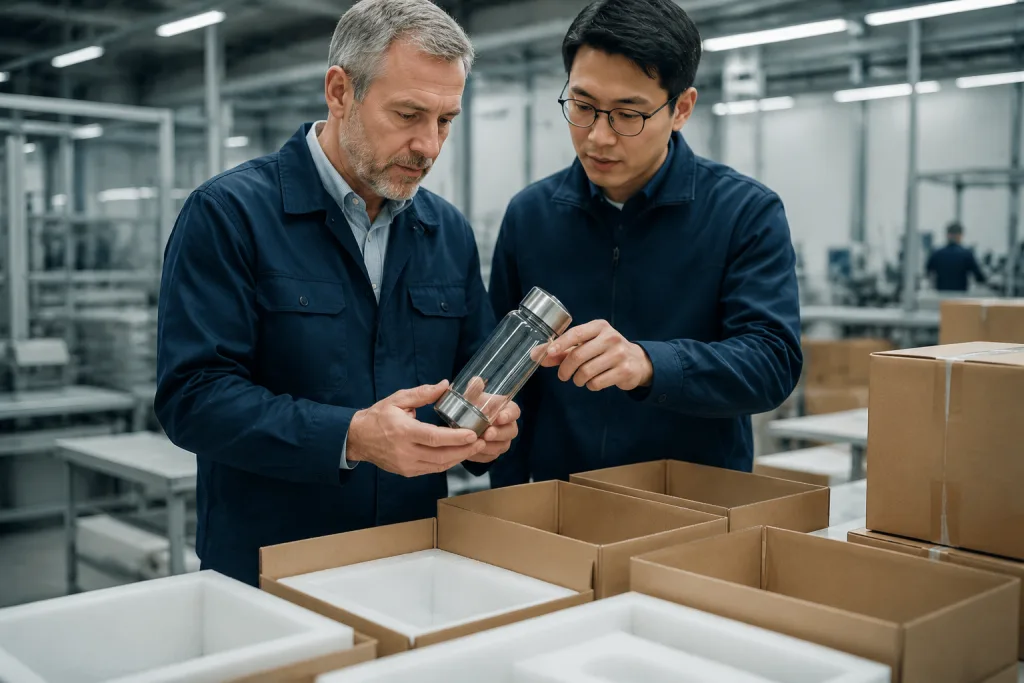
I’ll rewrite the section in place, keep the HTML tags unchanged, and tighten the sales-engineer tone with concrete factory-floor details.Packaging is where a lot of China sourcing jobs go wrong after the bottle itself already passed inspection. A borosilicate bottle can clear line packing and still arrive cracked because the insert lets it rattle 3 to 5 mm in the carton. If you import from Zhejiang or another export base in China, think about transit energy, not shelf display. We’ve seen a 24-unit thermos carton pass a factory drop test and fail after pallet compression, wet corners, or one hard strike in ocean freight.
For a thermos factory program, lock down the inner pack, drop height, and carton compression before mass production. Our standard check is a 76 cm drop on all six faces for e-commerce or mixed freight, then a stacking target that matches the actual pallet build, not a brochure number. If the buyer flagged Amazon FBA, we also set FNSKU labels and carton size limits early. For distributor orders, the math doesn’t work unless you define master carton count, insert thickness, and whether each unit ships in a polybag or sleeve.
- Inner protection: molded pulp or EPE, not loose cardboard
- Carton test: 5-layer export carton for heavier glass models
- Labeling: confirm barcodes, country-of-origin, and FNSKU if needed
What to lock into your spec sheet
I’ll rewrite the three paragraphs in-place, keep the HTML tags unchanged, and tighten the language so it sounds like a factory-side sales engineer wrote it.If you want fewer surprises, the spec sheet needs to read like a build sheet. Lock down bottle size, material stack, surface finish, color tolerance, print method, and test standard. For a customized thermos order, spell out what fails the batch: scratches, bubbles, off-center logos, seal leaks, lid wobble, and carton damage. Without that, every pallet turns into a back-and-forth.
For a borosilicate glass vacuum bottle manufacturer in China, I always ask for a sample approval file with raw material certificates, production photos, and an in-line QC record. One job came through with a PO typo on the carton count, and the buyer flagged it before we ran the line. If the factory says BSCI audited, check the scope. If they claim REACH compliance, ask for current test reports, not an old PDF from last season. Use AQL 2.5 for major defects and 4.0 for minor defects on general retail programs. For a promotional thermos run, you can loosen the cosmetic callout a bit, but do not move on leak or safety limits.
A good thermos supplier should also state MOQ in plain numbers. At BottleForge in Hangzhou, Zhejiang, standard thermos customization starts at 1,000 units, with 15-25 days for repeat builds and about 30 days for new tooling or new decoration. We run that timing off the mold room schedule and the UV printer queue. That answer matters because it lets you plan replenishment instead of guessing, and the math does not work any other way.
Choosing the right factory partner
I’ll rewrite the section in-place, keep the HTML tags untouched, and make the prose sound like a factory-side sales engineer wrote it.Outdoor retailers and promo brands want different things, but both want a steady ship. A thermos distributor needs replenishment that lands on time and defect rates that stay low. A brand owner needs print, carton, and label consistency from lot to lot. A factory that does both usually has tighter process control than a trading-only shop. That is why the factory question matters. If you are checking a thermos factory in Zhejiang, ask for monthly output, QC checkpoints, and whether glass forming, stainless shell work, and assembly stay in-house or get split across subcontractors.
A solid manufacturer thermos partner should run at least 200,000 units per month across its drinkware lines, hold incoming inspection on raw tubes and steel coils, and pull final checks on vacuum, seal, and surface marks. We run a go/no-go gauge on the line for cap fit. You do not need a perfect speech; you need proof. Ask for an export reference list by channel type: retail, distributor, or promotional. A thermos manufacturers shortlist should include at least one plant that can show stable sampling across three lots, not a single hero sample that disappears after sign-off.
If the project is price-sensitive, put the FOB quotes side by side and check every line. A cheaper thermos supplier may be saving on wall thickness, print steps, or carton spec. We’ve seen a buyer flag a 0.3 mm shell change after the first shipment, and the math stopped working fast. A slightly higher quote from a real thermos manufacturer in China often costs less once you add breakage, returns, and a launch that slips by 12 days instead of 18.
Get a factory quote with real QC specs
Send your target size, logo method, and market. We’ll return a practical thermos custom plan, MOQ, lead time, and export packaging detail.
Frequently asked questions
What MOQ should I expect for a customized thermos order?
For most standard custom thermos programs, 1,000 units is a realistic MOQ from a real factory in Zhejiang. If you want new tooling, special caps, or multi-color decoration, expect 3,000 units or more. For thermos bulk reorders, a supplier with in-house assembly may accept 500 units on a repeat SKU, but the unit price usually rises 8-15%. Always ask whether the MOQ applies per color, per size, or per logo version, because many thermos suppliers quote in a way that hides the true minimum.
How do I check if the vacuum is reliable?
Ask for a documented vacuum hold test and thermal retention report, not just a hot-water demo. A practical target is less than 4 mbar leak rate if the factory has the right equipment, plus a 24-hour temperature retention result under defined ambient conditions. For a borosilicate glass vacuum bottle manufacturer, you should also request sample pull tests from different production lots. If the factory cannot show vacuum data by lot, the thermos may look good in sampling and still fail in bulk shipments.
Is borosilicate glass safer than standard glass for thermos use?
Yes, borosilicate is the better choice when you want thermal shock resistance and lower breakage risk in a vacuum bottle. It handles hotter fills and cooler ambient changes better than ordinary soda-lime glass. That said, it still needs correct wall thickness, usually around 1.1-1.3 mm for consumer thermos applications, and it still needs proper cooling control. A manufacturer thermos line can ruin borosilicate with poor annealing just as easily as it can ruin cheaper glass.
What defect rate is acceptable for export orders?
For retail and distributor thermos shipments, I would set AQL 2.5 for major defects and 4.0 for minor defects as a baseline. Major defects include leaks, broken liners, loose seals, and unreadable logos. Minor defects include small print shifts, light scuffs, or packaging wrinkles that do not affect function. For promotional thermos orders, you may accept slightly more cosmetic variation, but never loosen the leakage standard. One leaking unit in a 500-piece carton can trigger a full return from a serious buyer.
What should I ask a thermos supplier about packaging?
Ask for carton specs, inner inserts, drop-test height, and pallet loading details. A good export carton should use 5-layer board for heavier glass models, with molded pulp or EPE around the bottle and no free movement inside the box. If you are shipping to Amazon FBA, confirm FNSKU labels and carton dimensions before production starts. For thermos bulk projects, packaging often adds 3-8% to cost, but it can save far more by cutting breakage and claim rates.