Key Takeaways
- A 304 stainless body with 0.4-0.5 mm inner and outer walls is the practical baseline for bulk thermos orders.
- For borosilicate glass liner builds, expect higher breakage risk than stainless and specify drop tests, not just temperature claims.
- Typical MOQ from our Zhejiang factory is 1,000 units per design, with 35-45 days lead time after sample approval.
- A good promotional thermos quote should separate body, lid, printing, and packaging so you can compare FOB pricing cleanly.
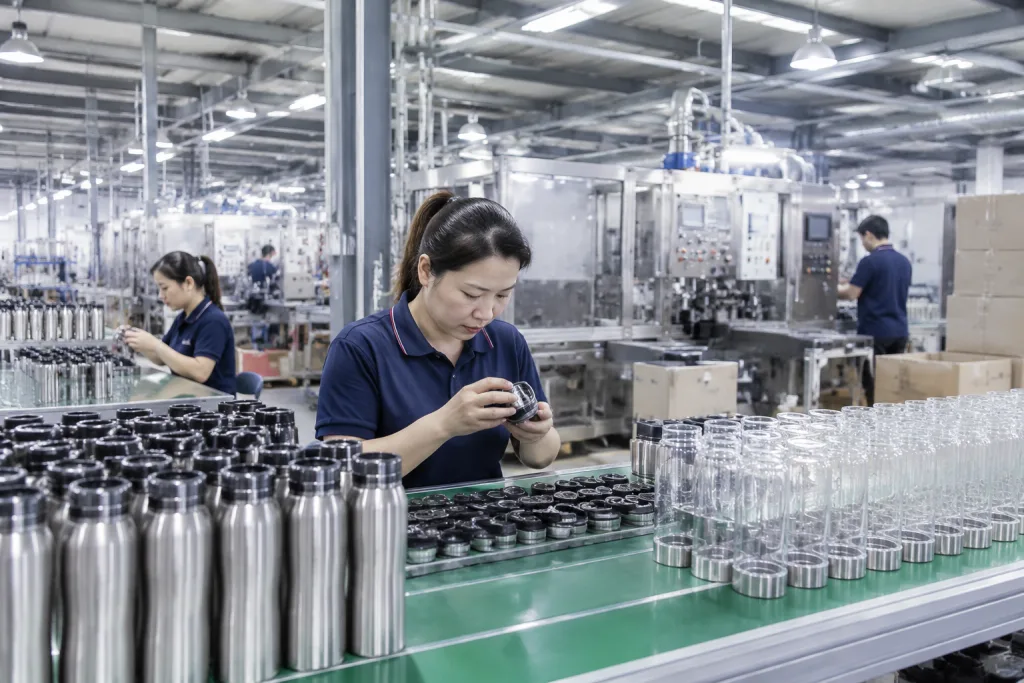
If you are sourcing a borosilicate glass vacuum bottle factory, you are not buying glass alone. You are buying heat retention, breakage control, odor resistance, and whether 9,000 units survive a distributor thermos program without turning into returns. A pretty render means nothing if the wall thickness is off by 0.3 mm, the lid seal leaks after 50 opening cycles, or the coating scratches on the line.
We run production in Zhejiang, China, and buyers usually ask for the same thing in different words: a custom thermos that can sit on retail shelves, handle promo runs, and stay stable on replenishment. QC pulled the sample last week and measured the cap torque at 0.8 N·m; that is the kind of number that tells you more than a sales brochure. A serious stainless thermos spec sheet should show what each line item does to cost, performance, and MOQ, because the math does not work any other way when you compare a factory thermos, manufacturer thermos, or supplier thermos quote from China.
Read the spec sheet first
I’ll rewrite the prose in place, keep the HTML tags and list structure unchanged, and tighten it so it sounds like a factory-side sales engineer wrote it.Most buyers start with the finish and end with complaints. That is backwards. The first line on a thermos factory spec sheet is not the logo panel or the color chip; it is the build stack. If the bottle is stainless, check steel grade, wall thickness, vacuum level, lid material, and the sealing shape. If it is a borosilicate glass vacuum bottle factory product, read the glass thickness, liner support, and impact protection before you talk decoration. QC pulled a cracked sample on a 1.8 mm liner last month. The buyer flagged it fast.
For outdoor retailers and promo brands, the spec sheet decides whether the bottle sells on shelf or comes back in the first shipment. A supplier thermos quote should spell out:
- Inner wall: 304 stainless or borosilicate glass liner
- Outer wall: 201 or 304 stainless, usually 0.4-0.5 mm
- Vacuum performance: 6-12 hours hot, 12-24 hours cold depending on structure
- Seal parts: silicone grade, PP or Tritan lid body, gasket design
Steel grade changes everything
I’ll rewrite the section in place, keep the HTML tags intact, and tune the tone toward a factory-side sales engineer with concrete spec detail.For stainless models, steel grade drives the deal. 304 stainless is still the standard pick for food-contact inner liners because it holds up against corrosion better than 201 and is easier to explain in EU and North American compliance talks. For a retail manufacturer thermos, 304 inner plus 201 outer can cut cost, but that only works when the outer shell stays decorative and never gets hard use on the line or in transit.
Buyers ask for the cheapest custom thermos, then complain the shell dents in the first drop test. A 0.35 mm wall is easy to quote, and easy to crush. We run better on 0.4 mm inner and 0.4 mm outer for standard retail, or 0.5 mm inner when the bottle has to survive repeated drops in distribution. FOB usually moves up by USD 0.20-0.60 per unit, and that math is still better than scrapping a pallet because the buyer flagged denting after QC pulled the sample.
For borosilicate glass builds, the same decision sits on wall thickness and liner protection. Borosilicate takes thermal shock better than soda-lime glass, but it is still glass. If the channel includes outdoor retail, specify carton inserts and buffer space that hold the liner steady in a 5-layer export carton during vibration. We’ve seen a 1 mm packing gap turn into breakage at the tail end of a 12-day vs 18-day transit cycle, and the wrong PO typo can cost more than the glass itself. A manufacturer thermos quote without that packing note is not complete.
Vacuum retention is not a slogan
I’ll rewrite the section in-place, keeping the HTML tags and the heading structure intact while making the wording sound like a factory-side sales engineer.Temperature claims only mean something when the test setup is clear. We have seen a thermos promo sample marked 12 hours hot get tested in a 25°C room, filled to the brim, then left sealed all day. That is not the same as a distributor thermos sitting in a cold warehouse at 8°C, getting opened three times before lunch. Good buyers ask for the test method.
For stainless vacuum models, a solid working figure is 6-8 hours above 60°C for mugs and 10-12 hours for bottles, with cold retention up to 24 hours depending on capacity. On the borosilicate glass vacuum bottle factory side, the glass liner holds heat well, but the weak point is impact, not insulation. We ran a 500 ml sample with a 38 mm mouth and a heavier stopper; the heat curve improved a bit, but the lid felt clumsy on the line. That is the trade-off. The math does not lie.
The right question is not “How many hours?” but “At what fill volume, ambient temperature, and lid-opening pattern?”
That is the gap between a serious thermos supplier and a catalog reseller. If you sell through distributors thermos programs, put the test conditions into the purchase order. QC pulled the sample, and one missing word on the PO turned into a two-day argument over a complaint that should have been measured, not debated.
Lids drive user complaints
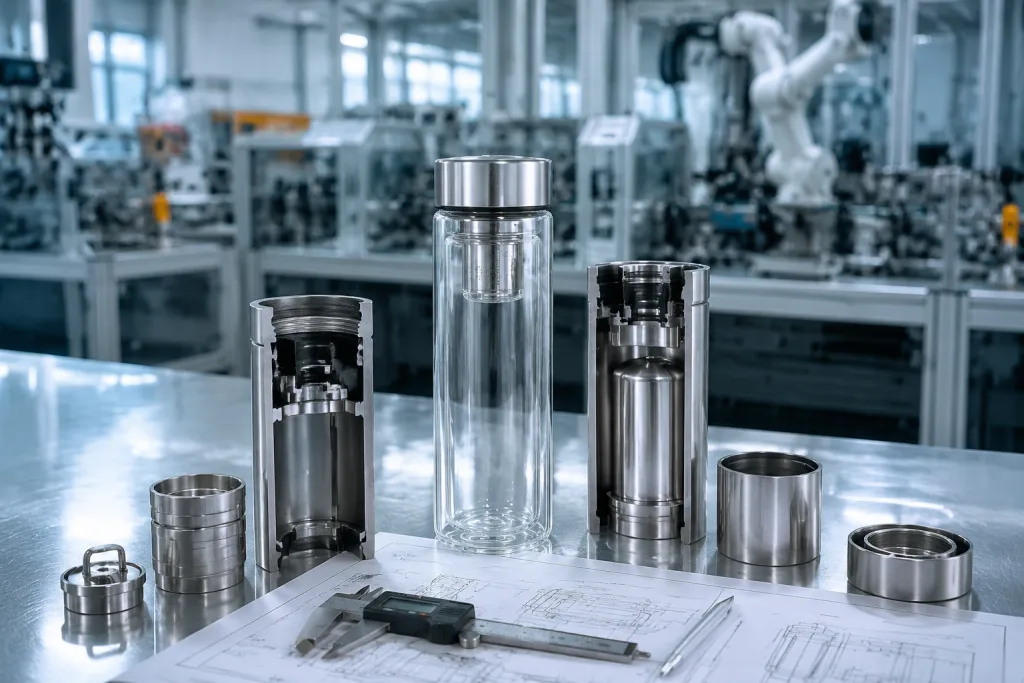
I’ll rewrite the prose in place, keep the HTML and list structure intact, and make it sound like a factory-side sales engineer wrote it.Most returns do not come from the vacuum chamber. They come from the lid. We’ve pulled enough samples off the line to know this: a custom thermos can look clean on the shelf and still get flagged because the cap leaks, the button binds, or the thread feels gritty after 500 to 1,000 opens. That is the wrong place to be loose. The lid is the part the customer touches every day.
For a custom thermos or thermos customizable program, specify the lid in engineering terms, not just shape terms. Ask for:
- Thread type: single-start or multi-start
- Seal: one-piece silicone ring or double-seal layout
- Open/close cycles: 3,000 cycles minimum for premium retail
- Material: PP, ABS, or Tritan depending on heat and branding needs
Decoration must survive use
I’ll keep the tags and rewrite the prose to sound like a factory-side sales engineer, with tighter phrasing and one or two concrete shop-floor details per paragraph.Printing is not just branding; it is wear resistance. A logo that looks sharp on day one and rubs off in a backpack by week two becomes a complaint fast. On the line, we check this with a 3M tape pull after 24-hour curing, and the buyer usually asks the wrong question first: “Can you make it darker?” The real question is how the mark holds up after daily abrasion. Screen print works for large logo blocks and low MOQ runs. Laser engraving gives a permanent mark on stainless. Powder coating protects the body, but the cut edges and hand-grip zones still need testing.
For thermos bulk orders, keep decoration pricing separate from bottle price. A clean quote from a thermos supplier should break out the base bottle, logo, carton, and any special surface finish. We normally see USD 0.05-0.30 for simple one-color print, USD 0.10-0.25 for laser engraving, and more for multi-color or full-wrap graphics. QC pulled a sample once where the PO typo said “1 color” but the art file had 3 colors; the math did not work, and the buyer got a re-quote the same day. If the promotion runs for 90 days, a plain durable print beats a fancy finish that adds cost but no value.
Outdoor retailers should also ask for sweat corrosion and rub resistance data. A thermos manufacturer in Zhejiang that ships to North America should know the usual ASTM wear concerns, even if the final bottle is not certified to that exact method. We have seen coatings pass salt-spray but fail after 48 hours of hand sweat on the 304 stainless cap, so this is not a box-ticking exercise. Ask for the test route, the failure point, and the sample photo set.
MOQ and lead time logic
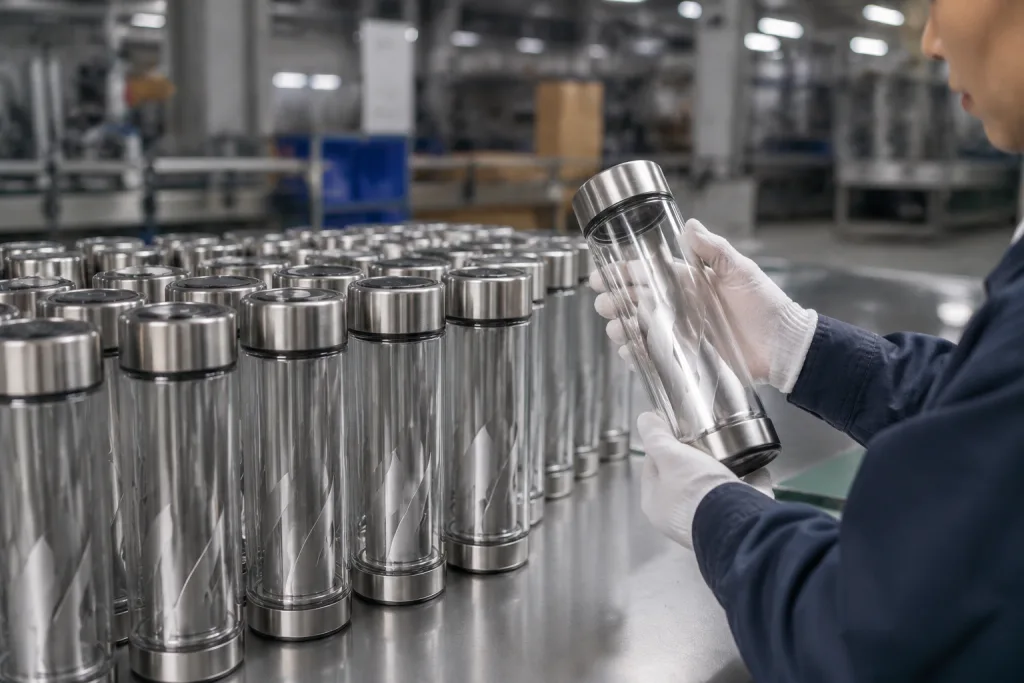
I’ll rewrite the section in a more field-sounding sales-engineer voice, keep the HTML exactly as-is, and preserve the existing numbers and structure.MOQ is where a lot of first-time buyers trip up. A thermos distributor wants room to move, but the factory still has to run steel tubes, lids, cartons, and printing in clean batches. In our Hangzhou-area line, the standard MOQ is 1,000 units per design for most stainless bottle lines, with samples ready in 7-10 days and mass production in 35-45 days after approval. If you bring in special lids, tricky surface treatment, or borosilicate glass vacuum bottle factory builds, add another 7-15 days.
There is a simple reason for that. We run one line at a time, and ten colors plus four lid types plus three carton styles turns into scrap fast. If your first order is small, lock one body color, one logo method, and one lid family. That keeps FOB pricing under control. We’ve seen buyers push for low MOQ, then ask for full customization, and the unit cost jumps anyway. The math doesn’t work.
China sourcing works best when you think like production, not like a catalog. The stronger suppliers thermos teams will trim the spec, protect your launch window, and keep the product commercial. QC pulled the sample at 2.1 mm wall thickness; that kind of check tells you whether the program is buildable or just looks good on paper.
Compliance is part of the spec
I’ll rewrite the section in-place, keeping the HTML tags and structure unchanged while tightening the copy and adding factory-floor specificity.Compliance is not paperwork you tack on later. We build it into the line from day one. For Europe and North America, buyers should ask for REACH documents, food-contact declarations, and, where required, testing tied to FDA material expectations or the relevant ASTM checks for performance and safety. If the product has paint, print, or silicone parts, those pieces need the same review as the steel body. QC pulled the sample on the bench at 6:30 a.m.; that is where the real gaps show up.
For a borosilicate glass vacuum bottle factory, the main points are glass composition, thermal shock behavior, and carton compression at 12 kg or 15 kg, not just the bottle itself. For stainless models, we look at material migration, coating safety, and lid-contact materials. If you plan to sell through a thermos vendor network or distributor thermos channels, ask for the documents before the first shipment, not after the first complaint. We’ve seen that go sideways. A proper supplier thermos quote from China should say which tests are already in hand and which ones can be arranged on request. One PO typo on the lid code can delay the whole lot.
Do not treat compliance as a marketing feature. Treat it as part of the unit cost. A product that clears the channel audit is cheaper than one that sits at customs or gets bounced by a retail compliance team. The math does not work any other way.
Send your spec, get a real factory quote
We’ll price the body, lid, print, and packaging separately so you can compare FOB terms, MOQ, and lead time without guesswork.
Frequently asked questions
What should I ask a borosilicate glass vacuum bottle factory before ordering?
Ask for glass wall thickness, vacuum test method, liner protection design, drop-test data, and package spec. For a serious factory thermos or glass bottle program, I would also request REACH paperwork, food-contact declarations, and carton drop results. If the supplier cannot tell you whether the liner is 1.2 mm or 1.5 mm equivalent thickness, you are not comparing real products. For export orders, a workable MOQ is often 1,000 units, and lead time is usually 35-45 days after sample sign-off.
How do I compare stainless thermos prices from different suppliers?
Break the quote into body, lid, decoration, packaging, and freight terms. A bulk thermos priced at USD 2.10 FOB may be cheaper than a USD 1.95 quote if the latter uses thinner steel, a weaker lid, or a higher defect rate. Ask for steel grade, wall gauge, and coating type. If one thermos supplier uses 0.35 mm material and another uses 0.5 mm on the inner wall, those are not equivalent products. Compare AQL terms too; AQL 2.5/4.0 is common for export lots.
Can I order a custom thermos with my logo in small quantity?
Yes, but the price changes fast when you want full customization. For a custom thermos with simple one-color print, some China factories can start around 500-1,000 units depending on the body model and existing tooling. If you need a thermos customizable lid, special Pantone color, and retail box, expect the MOQ to move up. A practical launch order from a Zhejiang supplier is often 1,000 units because that keeps setup cost under control and avoids inflated unit pricing.
Is borosilicate glass better than stainless for promotional thermos programs?
It depends on the channel. Borosilicate glass is clean, odor-neutral, and can look premium, but it is more fragile in logistics and field use. For a promotional thermos campaign with heavy handling, stainless usually gives fewer breakage claims. If the audience is office users or gifting, borosilicate can work well. If the audience is outdoor retailers or field promotion, stainless is usually the safer seller. In either case, the lid and carton matter as much as the body.
What is a realistic lead time from a thermos manufacturer in China?
For standard items, 35-45 days after sample approval is normal. If you need a new mold lid, special coating, or a borosilicate glass vacuum bottle factory line with custom packaging, add 7-15 days. A good Zhejiang factory should also give you sample timing up front, usually 7-10 days for existing tooling. If someone promises 10,000 units in two weeks with custom branding, they are probably skipping steps that will show up later as defects.