Key Takeaways
- A usable borosilicate glass vacuum bottle custom order usually starts at 1,000 units and 35-45 days after sample approval.
- Specify 2.0-2.5 mm borosilicate glass, 304 stainless outer shell, and at least 18-24 hours heat retention target.
- Ask for AQL 2.5 / 4.0 inspection, REACH confirmation, and carton drop tests before you approve shipment.
- FOB China pricing for a 500-ml custom thermos in this build often lands around USD 3.80-6.20 depending on print, lid, and packaging.
You are not buying a “nice bottle.” You are buying a part that has to survive packing, freight, shelf display, and the first return window with your logo on it. For a borosilicate glass vacuum bottle custom order, the spec sheet matters more than the mockup. We can turn a polished sample in 7 days in Zhejiang, but if wall thickness, vacuum hold, cap torque, and the drop test are not set first, the buyer ends up paying for the miss later. That is the wrong place to save time.
If you are an outdoor retailer or a promotional brand, the job is plain: lock the bottle spec, artwork, test standard, and carton spec before the line starts. We make factory thermos and custom drinkware in Zhejiang, China, and QC pulled the sample more than once for the same failures—chipped inner cups, loose lids, weak prints, and cartons that pass eye check but fail a 1.2 m drop. We ship better when the supplier runs like a manufacturer, not a broker, and the PO spelling is clean before someone prints 5,000 pcs.
Start with the use case
I’ll rewrite just the prose inside the existing HTML, keep every tag intact, and make it sound like a real factory-side sales engineer.Before you ask for price, decide who will use the bottle and where it will run. A borosilicate glass vacuum bottle custom for a hiking promo pack is a different job from a desk-gift model for a financial conference. Outdoor retail wants a tougher outer shell, a lid that does not weep in a carton test, and packaging that survives a 1.2 m drop. Promo buyers usually push logo position, color match, and landed cost.
For a normal order, pin down these items first: capacity, lid type, insulation target, decoration area, and carton count. A 500 ml bottle with a double-wall borosilicate glass insert, 304 stainless outer shell, and PP/silicone lid is the usual start on our line. If you want a more premium hand feel, go with powder-coated stainless outside and laser logo, but the unit price moves up. If the bottle goes into a retail planogram, ask the thermos manufacturer for a shelf-ready master carton, not a plain export box.
The mistake we see most is a buyer writing “premium quality, gift box, good insulation” and then asking why the quote bounces around. This is the wrong question to ask. A real supplier thermos quote needs exact details: cap style, inside cup finish, vacuum gap, artwork method, and whether you want a reusable mailer or a 5-ply export carton. QC pulled a sample last week with a typo on the PO, and that tiny miss changed the packing spec. In China, vague specs make vague prices.
Build the spec sheet
I’ll tighten the copy, keep the HTML exactly as-is, and make the spec sheet read like a buyer-facing factory note. Next I’m rewriting each paragraph with concrete measurements, line-level details, and less fluff.Use one page and make every line measurable. For a borosilicate glass vacuum bottle custom program, the spec sheet should lock down capacity tolerance, wall thickness, lid build, gasket material, finish, and test standard. We usually quote 2.0-2.5 mm borosilicate inner glass, 0.5 mm to 0.6 mm 304 stainless outer wall, and a food-grade silicone gasket. If the bottle uses a clear glass insert, ask the factory for the glass composition and thermal shock test report in writing. QC pulled a cracked insert at 120°C to 20°C, and that kind of miss turns into a chargeback fast.
- Capacity: 450 ml, 500 ml, or 600 ml, with ±5% tolerance
- Glass: borosilicate, 2.0-2.5 mm wall thickness
- Outer shell: 304 stainless steel, 0.5-0.6 mm
- Seal: silicone, food-contact compliant
- Insulation target: 18 hours hot, 24 hours cold as a realistic commercial claim
- Decoration: silk screen, laser engraving, or 1-color pad print
For a custom thermos sold in North America or Europe, ask for REACH and LFGB documents if the market needs them, plus a food-contact declaration. If your distributor thermos channel needs barcode and retail labels, define the carton barcode, inner box count, and master carton gross weight at the spec stage. We had a buyer flag a PO with “24 pcs/ctn” but the packing list said 20, and the line had to stop. That is the wrong question to leave for later.
Do not over-spec decorative details before you solve the functional ones. A lid that looks clean but cracks after three drop tests is still a bad order. The sample is a technical checkpoint, not a design reveal. We’ve seen this go sideways when buyers chase matte paint first and ignore the latch torque on the cap.
Price the order correctly
I’ll rewrite just the prose, keep the HTML tags intact, and tighten the pricing language with concrete factory-floor details.Price on a custom thermos comes from three levers: materials, decoration, and packaging. For a 500 ml borosilicate glass vacuum bottle custom order from a Zhejiang factory, FOB China usually starts around USD 3.80 to 4.50 for a single-color print and a plain box. Add a gift box, laser logo, color-matched lid, or upgraded sleeve pack, and USD 5.20 to 6.20 is the number we run. If a quote lands far below that, check the glass wall thickness, carton grade, and gasket spec; QC pulled a sample last month and the cheap one failed the lid seal test at 2 kg pressure.
MOQs are practical, not magical. A common MOQ is 1,000 pcs per design for a standard custom bottle, while 3,000 pcs makes more sense if you need three print colors or special packaging. Lead time is often 15 days for samples and 35-45 days for mass production after sample approval and deposit. If your launch date is fixed, ask the thermos supplier to lock a production slot on the line, not send you a soft “around one month”; we’ve seen that go sideways when the buyer’s PO had a typo on the lid color code.
One point buyers miss: a distributor thermos quote should split product price from freight terms. FOB Ningbo or Shanghai gives a clean comparison; a door-to-door quote often hides carton upgrades or a weaker inner box. If you want thermos bulk pricing, every supplier needs the same spec, same carton count, and the same inspection standard. The math doesn’t work any other way.
Sample like a buyer, not a tourist
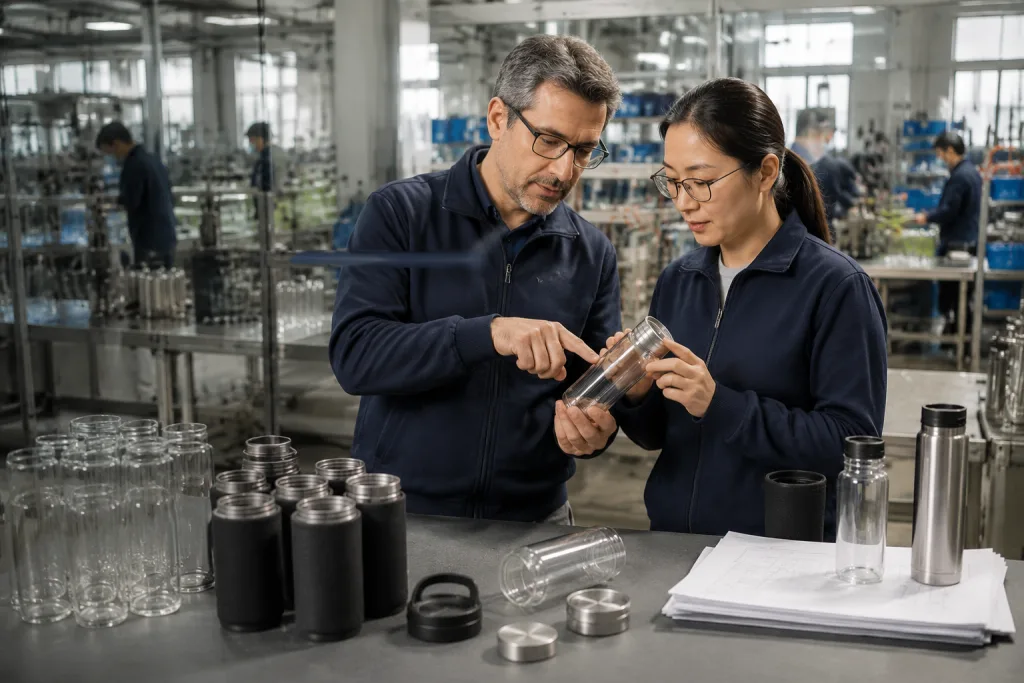
I’ll keep the HTML structure exactly as-is and rewrite only the prose with a more field-tested sales-engineer tone. Then I’ll do a quick pass for the banned filler words and any awkward AI phrasing.The sample stage tells you if the thermos maker knows export QC or just knows how to ship a shiny prototype. Ask for a pre-production sample with final artwork, final lid, and final box. Then run it like a buyer would. Fill it with 95°C water, close it, wait 10 minutes, and check for steam leakage. After 6 hours, measure temperature loss. Then do a simple bag-drop check from 1.0 m onto the carton corners.
Check the details buyers actually complain about: lid thread feel, gasket compression, glass insert alignment, and whether the logo scratches during wipe-down. If the bottle uses a steel outer shell with an internal glass insert, listen for any rattle. We’ve seen that go sideways fast; loose fit turns into breakage in transit. In our Zhejiang factory, QC rejects samples that look fine but fail after repeated lid cycling or thermal shock. That beats paying for a custom order that comes back as a retailer claim.
“A sample that looks good but fails a 1.0 m drop test is not a sample; it is a future claim.”
For promotional thermos programs, ask for 2 approved samples: one stays as the golden sample, one goes to production control. That matters when the second shift starts and the line needs a hard reference.
QC the factory line
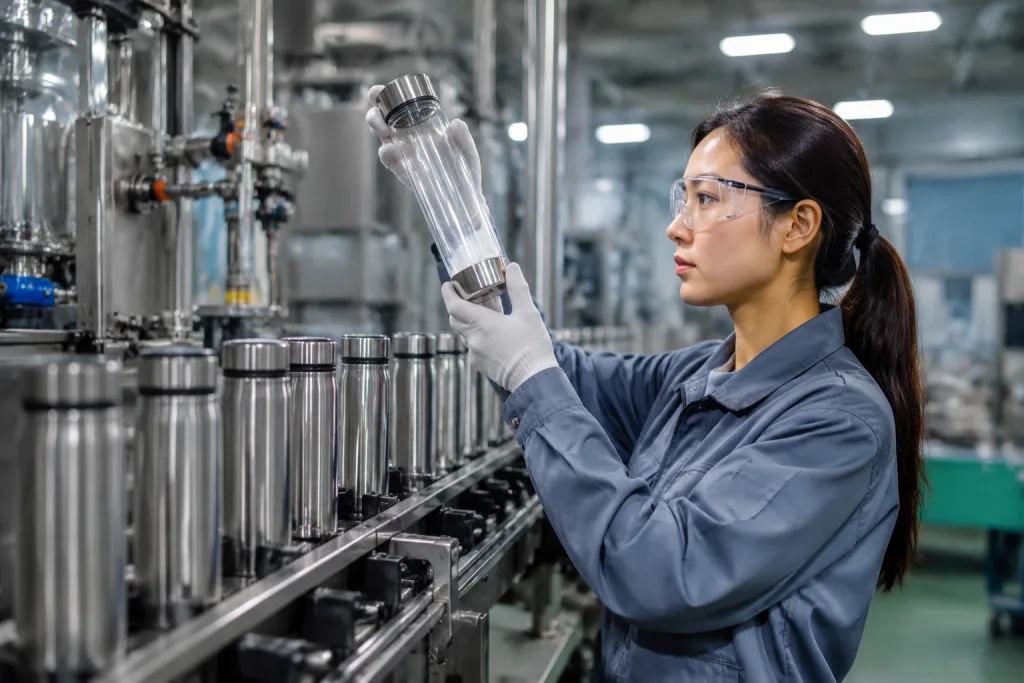
I’ll keep the HTML structure exactly as-is and rewrite the prose to sound like a factory-side sales engineer, with concrete QC details and cleaner, more natural wording.Once the line starts, the thermos factory should check incoming glass inserts, stainless shells, and silicone parts before assembly. The first 200 units matter most; that is where print shift, lid mismatch, and fit problems usually show up. Ask for in-line checks on threading, leakage, vacuum appearance, and logo placement. If you buy from China, ask for line photos or a short video from the actual station, not just a polished sample desk.
Use AQL the right way. For a normal order, AQL 2.5 for major defects and 4.0 for minor defects is a solid baseline. Major defects include cracked glass, no vacuum, leaking lids, or wrong artwork. Minor defects include small print misalignment, light scratches, or box scuffing. For retail orders, we run 100% leakage testing on assembled units and random carton drop tests on finished cartons. That is the right call.
We also push a simple check against the batch claim. If the spec says 18 hours hot retention, pull five units from different cartons and test them. If one unit falls off fast, you are looking at a vacuum or assembly issue. A good thermos factory in Zhejiang will log that result and move on it. A weak one will argue the math does not matter.
Pack it for the channel
I’ll rewrite the three paragraphs in a more field-tested sales tone, keep the HTML exactly as-is, and preserve the topic and technical numbers.Packaging is not an accessory. For borosilicate glass vacuum bottle custom runs, it is the line between sellable stock and broken goods. We’ve seen cartons pass a 1 m drop test and still fail at corner crush after the third handoff, so define the inner box, master carton, dividers, and pallet pattern before production starts. A 6-pack inner carton can save cube, but a 4-pack with molded pulp usually gives better break resistance. If the bottle is going out as promo stock, the outer box still has to survive 2 or 3 touches, not just one handoff.
Tell the supplier if you need FNSKU labels, UPC stickers, or neutral export marks. The buyer flagged it once because the carton art covered the relabel area, and the warehouse had to peel boxes by hand. If your channel is mixed, keep a clean label zone on the carton so the distributor can relabel without covering artwork. A common master carton spec for a 500 ml bottle is 24 pcs per carton, 52 x 36 x 31 cm, gross weight around 13-15 kg depending on insert and box style. That math drives freight cost and shelf handling.
If you want thermos customized packaging, don’t overbuild the insert just to make the sample look fancy. We run better with a molded pulp tray and one outer sleeve than with a glossy box and loose movement inside; the wrong question is “how premium does it look,” because the carton has to protect glass first. QC pulled the sample after a corner rub test showed scuffing at the lip. The product must arrive intact, and the carton still has to look decent after transit from Zhejiang to your distribution center.
Negotiate like a repeat buyer
I’ll keep the HTML exactly as-is and rewrite only the prose to sound like a factory-side sales engineer. I’m making it tighter, more specific, and less generic, while preserving the section structure and numbers.Most first orders are not where you win the best cost. They are where you show you can run a clean account and come back for round two. If you are buying thermos bulk, send one RFQ with volume, artwork, target market, and delivery terms. Ask for separate pricing at 1,000 / 3,000 / 5,000 pcs. That shows the setup charge, carton cost, and where the break point sits.
For a promotional thermos program, the right negotiation is not just unit price. Ask for free logo setup, sample credit against PO, and a fixed re-order price for 6-12 months if colors and materials stay unchanged. We had one buyer push back on a $35 logo plate fee, and QC pulled the sample again on the laser mark before we cut it. If you are building a distributor thermos line, ask whether the factory can hold raw material stock for repeat runs. A good manufacturer in China can, and that saves you 10-15 days on the second order.
Keep the commercial terms clear: deposit, balance before shipment, inspection timing, and what happens if the carton count or artwork is off. The strongest supplier thermos partners in Zhejiang will accept a detailed PO because it protects both sides. I’ve seen a PO typo on “12,000 pcs” turn into a messy claim when the buyer really meant 1,200. Loose POs create disputes; precise POs create repeat business.
Send your spec, get a factory quote
We can review your artwork, confirm MOQ, and quote FOB China pricing for your borosilicate glass vacuum bottle custom order within 24 hours.
Frequently asked questions
What MOQ should I expect for a borosilicate glass vacuum bottle custom order?
A practical MOQ is usually 1,000 pcs per design for a standard custom thermos. If you want multiple print colors, special lids, or gift packaging, 3,000 pcs is more realistic. For test-market runs, some Zhejiang factories can do 500 pcs, but unit cost often rises by 15-25%. Ask the supplier to quote tiered pricing at 1,000, 3,000, and 5,000 pcs so you can see the real breakpoints.
How long does production usually take?
For a borosilicate glass vacuum bottle custom program, sample lead time is often 10-15 days. Mass production is usually 35-45 days after sample approval and deposit. If you change the logo, lid color, or carton spec late, add 7-10 days. A factory thermos line in Zhejiang with stable glass and lid supply can sometimes ship faster, but you should still build in one extra week for QC and freight booking.
What tests should I require before shipment?
At minimum, ask for leakage testing, insulation verification, lid torque checks, and carton drop tests. For export, request AQL 2.5 for major defects and 4.0 for minor defects. If you sell in Europe or North America, also ask for REACH or LFGB-related food-contact declarations where relevant. For retail orders, I would also require a 1.0 m drop test on finished cartons and 5-unit temperature retention checks from different cartons.
How much should I budget per unit?
For a 500 ml custom thermos built with borosilicate glass insert and 304 stainless outer shell, FOB China pricing often ranges from USD 3.80 to 6.20. The low end fits a simple one-color logo and basic white box. The higher end covers better packaging, laser engraving, and a more premium lid. Freight, duty, and inland trucking are extra, so compare only the same FOB terms across suppliers.
Can I use this as a promotional thermos for outdoor retail?
Yes, but you need to tune the spec for the channel. For outdoor retail, I would use a tighter lid seal, a stronger outer shell finish, and a carton that survives warehouse handling. For promotional thermos programs, you can simplify packaging, but do not reduce glass thickness below 2.0 mm or skip leakage testing. If your order goes through a distributor thermos channel, make sure the carton and barcode system are ready for rework and relabeling.