Key Takeaways
- For mixed glass and stainless thermos bulk programs, start decisions around use case, breakage risk, decoration, and MOQ before price
- A practical MOQ is 1,000-3,000 units per SKU for custom thermos colors and 500 units for selected stock colors
- Borosilicate glass handles heat shock better than soda-lime glass, but stainless steel wins on impact resistance for outdoor retail
- Plan 35-50 days production after sample approval, plus 3-7 days for pre-shipment inspection and export documents
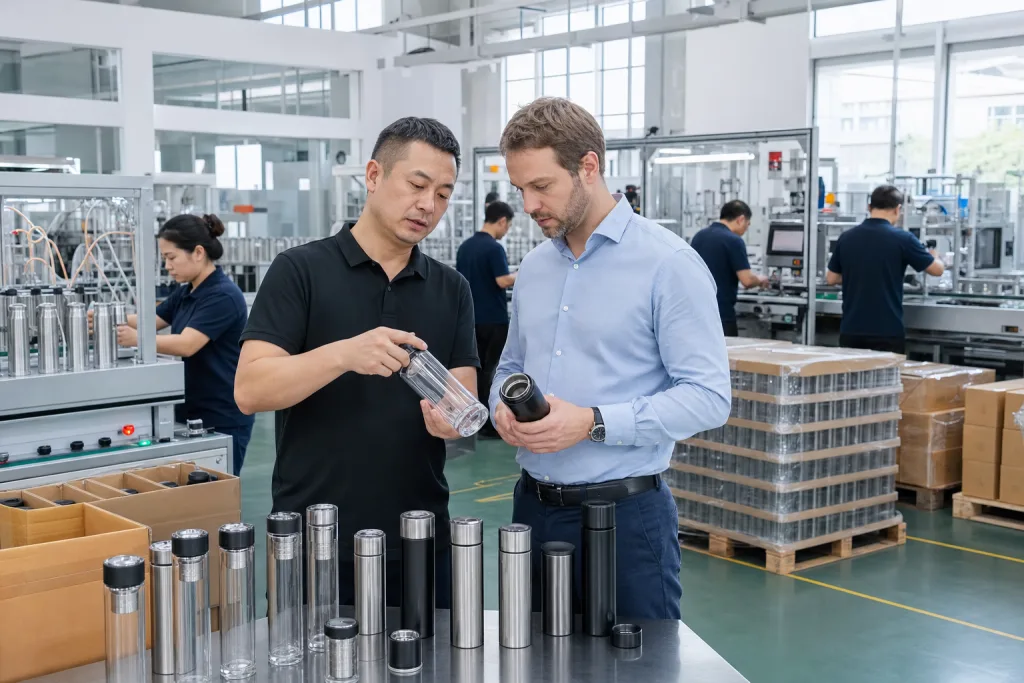
If you are looking for a borosilicate glass thermos supplier, the glass is only part of the quote. Outdoor retailers and promo brands usually put the liner, stainless vacuum bottle, lid, sleeve, logo method, carton spec, and compliance file into one RFQ. We run that mix every week. If the build is wrong, the problem shows up later as cracked liners, weak heat retention, delayed ETD, or a logo that passes on sample day and fails after 30 dishwasher cycles. On our line, QC pulled the sample after a 24-hour vacuum hold and a 1.2 m drop test, and that is usually where the weak point shows up.
From our Hangzhou factory, we see the same pattern again and again: buyers ask for a customizable thermos, then argue about color before they lock the construction. That is the wrong question to ask. China has a lot of thermos suppliers, but a shop that can handle retail packs, outdoor use, and promotional orders together needs stable MOQ control, repeatable printing, and cleaner paperwork. We have seen PO typos on lid size and sleeve length turn into a 2-week delay, so we check the drawing first and the color chip second.
Start with the real use case
The first decision is not glass or stainless steel. It is where the bottle will be used, how it will be packed, and how many hits it takes before the consumer opens the box. On one 6,000 pcs gift order last March, QC pulled the sample after a 90 cm drop test and the glass liner cracked inside the color box. A borosilicate glass thermos supplier can give clean taste, clear liquid visibility, and a premium shelf look. A stainless thermos factory gives better drop resistance, stronger heat retention, and more decoration choices. Both are correct. Just not for the same channel.
For outdoor retailers, we usually push buyers toward 304 stainless steel inner and outer walls, 0.4-0.5 mm wall thickness, vacuum insulation, and a powder-coated finish. That build survives backpacks, car cup holders, cold mornings, and return counters better than a glass vessel. The line checks vacuum performance with a 95°C hot water test, then rechecks after 6 hours before packing. For wellness, tea, office, and gift programs, borosilicate glass makes sense if the set includes a sleeve, silicone base, inner carton, and clear care instructions. Without those parts, the math does not work.
Promotional brands usually focus on logo size, FOB price, and ship date. For that work, a customized thermos made from stainless steel is easier to control across 2,000-10,000 units. We run laser engraving, silk screen, UV print, heat transfer, and full-wrap coating on stainless bodies with fewer breakage claims. Glass accepts screen printing and decals, but handling loss is higher during decoration and packing; on one decal job, the buyer flagged 37 pcs with small rim chips before final AQL 2.5 inspection.
Use this simple filter before you ask for a quotation: if the product will be clipped to a bag, dropped onto concrete, or used by campers, stainless is safer. If it will sit on a desk, show tea color, or support a wellness retail story, borosilicate glass is worth considering. A good thermos supplier should push back on your brief here, not just quote the cheapest open mold. We have seen this go sideways when the PO says “travel bottle” but the packaging spec is a thin 250 gsm color box with no egg-crate divider.
Choose the construction before the logo
We still get RFQs with a logo file, Pantone number, and target FOB price, but no construction details. That is backwards. The logo comes later. On the line, structure decides cost, compliance, insulation, pack-out size, and defect risk. For a stainless manufacturer thermos program, the real choices are single-wall, double-wall vacuum, copper-plated vacuum, and glass liner. For a borosilicate glass thermos supplier program, the main choices are single glass wall, double glass wall, tea infuser design, silicone sleeve, and cap material. Last week QC pulled a sample at 78 mm mouth diameter, and the carton would not close without a tray change.
For stainless vacuum bottles, 304 stainless steel is the default for food-contact surfaces. Some buyers push for 316 stainless steel, mostly for saltwater, acidic drinks, or a premium shelf tag. The math does not work for normal coffee or water use: it adds 8-15% to raw material cost without changing the drinking experience. For outer shells, 201 stainless steel lowers cost, but we skip it for serious outdoor retail. We have seen corrosion complaints come back after a rainy-season shipment, and the buyer flagged it before the next PO even landed.
For borosilicate glass, ask about the glass grade, wall thickness, annealing control, and thermal shock testing. A practical double-wall glass body may use around 1.5-2.0 mm wall thickness, depending on shape. We checked a 1.6 mm sample with a caliper and a go-no-go gauge, then the courier drop test still cracked three pieces. Too thin feels elegant but raises breakage during shipping. Too thick adds cost and weight, which hits thermos distributors selling through e-commerce. The brochure never pays the freight bill.
Lids are where the claim rate starts. PP and food-grade silicone are common. Tritan or stainless caps cost more, but they lift perceived value fast. If you need a promotional thermos for trade shows, a basic screw cap is fine. If you need a distributor thermos for outdoor chains, test one-hand opening, leak resistance, and gasket replacement before you confirm the mold. We once caught a PO typo on gasket size, 18 mm instead of 16 mm, and that 2 mm mistake made the lid pop under hot-fill pressure.
Understand MOQ, price, and tooling
MOQ is where buying plans hit the factory gate. At BottleForge Industrial in Zhejiang, we run a normal custom thermos MOQ of 1,000 units per shape for stock colors with logo, and 3,000 units per SKU for custom Pantone powder coating. For new molds, the tooling charge often starts around USD 1,500-5,000 depending on the bottle body, lid complexity, 3D texture, or a special handle with its own injection tool. Last month QC pulled a trial lid where the hinge pin was off by 0.4 mm; that small miss still stopped the sample run. Our stainless thermos line can produce about 450,000 units per month across standard models when 304 stainless coil and lid parts arrive on schedule.
For a bulk thermos order, FOB China pricing depends on capacity, steel gauge, coating, cap design, carton specification, and inspection level. A basic 500 ml stainless vacuum bottle in bulk sits around USD 3.20-5.80 FOB for standard builds. More complex retail products with powder coating, carry handle, stainless cap insert, and color box often land around USD 6.50-10.50 FOB. Borosilicate glass thermos pricing looks sharp on the first quote, but once we add 5-ply cartons, corner protectors, and a higher breakage allowance, the gap closes fast. The math doesn't work if packing is treated as an afterthought.
Be careful with quotes that hide assumptions. If one thermos vendor quotes 0.35 mm wall thickness and another quotes 0.5 mm, you are not comparing the same product. Same problem with packing: a 5-layer export carton with egg-crate dividers is not the same as a thin mailer box, even if both lines on the quote say “gift box.” We have seen this go sideways when the buyer flagged dented bases after a 1.2 m drop test. Ask every thermos manufacturer to state capacity tolerance, steel grade, coating type, carton size, gross weight, logo method, and Incoterm.
A practical price discussion should include your sales channel. Retail display needs cleaner coating, tighter color box printing, and fewer pinholes under the light booth. Promotional giveaway needs speed and logo consistency; the line has no time to reprint 8,000 crooked silkscreen logos because the PO had the artwork file name typed wrong. E-commerce thermos bulk programs need drop-tested cartons and barcode control. Your best FOB price is not always your lowest landed cost.
Match decoration to sales channel
The decoration method is a buying decision, not just a design decision. A custom thermos order for outdoor retail needs decoration that can take backpack abrasion, wet hands, and repeat handling at the shelf. Laser engraving is stable on stainless steel and has no ink adhesion problem, but it gives a metal-tone mark unless the powder coating is built for contrast. We run a 30 W fiber laser on coated 304 stainless samples, then QC checks the mark after 50 thumb rubs and a quick cross-hatch check. Silk screen printing keeps cost down for one or two colors and works cleanly on straight bodies. On tapered bottles, registration moves fast; at 0.5 mm off-center, the buyer will flag it.
For promotional thermos campaigns, UV print and heat transfer give bright logos, gradients, and photo-style artwork. The trade-off is testing. Ask for adhesion tape tests, alcohol rub tests, and dishwasher simulation if the claim matters on the selling page. We see about 7 out of 10 promo buyers skip dishwasher-safe decoration, which is fine, but say it on the care label. Do not let the consumer guess. Last month QC pulled a UV sample after 20 alcohol rubs because the red logo edge started lifting.
Borosilicate glass decoration has a different risk profile. Screen printing on glass can look premium for wellness and tea products, especially with white or soft metallic ink. Glass bodies need gentler fixture pressure during printing, and packing after curing takes more care; we use EVA dividers and keep clamp pressure under control so the body does not pick up stress marks. If you want a thermos customizable with names, QR codes, or variable artwork, stainless steel is the better production choice most of the time. The math does not work on glass when every piece needs a different code and the line keeps stopping for artwork checks.
For retail packaging, confirm artwork files early. Use AI or PDF vector files, specify Pantone C or U numbers, and leave 2-3 mm tolerance around important print edges. For Amazon or other FBA-style logistics, add FNSKU or UPC placement to the packaging drawing before mass production. We had one thermos distributors order sit 6 days in the packing area because the PO said “UPC on side panel,” but the carton drawing showed it on the bottom. One missing barcode can delay shipment as easily as a steel shortage.
Test before you scale the order
Samples are not souvenirs. They are engineering checkpoints. Before you place a 5,000-unit thermos customized order, ask for pre-production samples made with the final steel grade, final coating, final logo, and final lid gasket. A showroom sample only proves the shape exists; it does not prove the line can build your order. We once had a buyer approve a black sample, then the PO said “matte balck” and the coating chip test failed on the first 20 pcs QC pulled.
For stainless vacuum products, basic tests should cover 6-hour and 12-hour temperature retention, leak testing, coating adhesion, lid torque, odor check, and internal surface inspection. For a 500 ml double-wall vacuum bottle, a common benchmark is boiling water above 60°C after 6 hours at room temperature, depending on mouth diameter and cap structure. Use real tools here: a calibrated thermometer, torque meter, 3M tape for cross-cut adhesion, and a simple inverted leak rack for 30 minutes. Wide-mouth food jars perform differently from narrow-mouth bottles. One standard for every product is the wrong question to ask.
For borosilicate glass, ask for thermal shock testing, annealing review, visual defect sorting, and drop simulation in final packaging. Glass does not fail like stainless steel. A small internal stress issue can pass factory handling and still break during consumer use. We run the annealing check under polarized light, then pack the sample in the final color box and master carton before the drop test. Packaging is part of the product, not an afterthought.
Inspection should be agreed before production. Around 8 out of 10 North American and European buyers we ship to use AQL 2.5 for major defects and AQL 4.0 for minor defects, with critical defects at 0. Critical defects include sharp edges, leakage, contaminated interior, broken glass, wrong material, or unsafe lid fit. If your brand requires REACH, LFGB, FDA food contact, ASTM, or Prop 65 documentation, request the exact test reports before deposit. China factories can arrange testing, but a 5-10 working day lab schedule must be built into the calendar; if the deposit lands on Friday and the lab slot is full, your ship date moves, not the lab.
Plan lead time without wishful thinking
A reliable thermos supplier should send a working calendar, not a loose ship date. For standard stainless models from China, a realistic timeline is 5-7 days for logo sample, 7-10 days for packaging proof and approval, 35-50 days for mass production after deposit and sample sign-off, and 3-7 days for inspection, balance payment, and export booking. Peak season before back-to-school, Black Friday, and year-end gifting can add 10-20 days. We run this on a line schedule, not hope; last September QC pulled a laser-logo sample at 10:30 a.m. because the artwork was 2 mm off-center, and that small miss cost the buyer 2 days.
For a borosilicate glass thermos supplier project, add time for glass body availability and breakage allowance. If the order includes a silicone sleeve, bamboo-style cap, stainless infuser, and color box, you are coordinating four or five sub-components with different molds, cartons, and incoming checks. One late component can stop final assembly. For thermos manufacturers working in Zhejiang and nearby provinces, the supply chain is strong, but it is not magic. Chinese New Year alone can shut practical production capacity for 2-3 weeks, with another 1-2 weeks of ramp-up. We usually count an extra 3% glass loss for transit and assembly handling; the math doesn't work if the PO only covers exact sellable quantity.
Payment terms also affect timing. A common structure is 30% deposit and 70% balance before shipment. For long-term distributor thermos programs, some buyers negotiate staged releases, blanket orders, or rolling forecasts. That lets the factory reserve steel, lids, and cartons without forcing you to take all inventory at once. Small detail, big delay: we once had a PO with the deposit line typed as “30% after shipment,” the buyer flagged it late, and finance would not release 304 stainless sheet to the line until the corrected copy arrived.
If you need goods for a fixed event, work backward from the warehouse arrival date, not the factory finish date. Ocean freight to Europe or North America can take 25-45 days port to port, plus customs and inland delivery. Air freight fixes the calendar but can add USD 1.50-4.00 per unit depending on weight and volume. Be careful here. We ship cartons measured by CBM, and a 500 ml thermos with a thick color box often prices worse than the buyer expects; we have seen launch orders go sideways because someone planned 12 days of buffer when the lane needed 18 days after vessel arrival.
Pick a supplier who says no
The best thermos suppliers do not say yes to every request. They push back when a tall 500 ml body tips on a 68 mm base, when a matte coating will scratch at the handle contact point, when a 5-ply carton fails a 1.2 m drop test, or when your target price means thinner 304 stainless. If a supplier’s thermos quote looks perfect but shows no steel grade, wall thickness, packing method, or test scope, something is missing. We’ve seen this go sideways.
When you evaluate a thermos factory, ask for daily line capacity, audit status, recent test reports, QC flow, sample room photos, and one real packaging photo from a shipped order. BSCI, ISO 9001, and documented incoming material inspection are good signals, but they do not replace product checks on your exact bottle. For outdoor retailers, ask whether the manufacturer thermos team has run powder coating abrasion tests, handle fatigue checks at 10 kg load, and leak tests with lids inverted for 4 hours. For promotional brands, ask for logo repeatability on 30 samples, carton labeling format, and mixed-SKU packing rules; one buyer flagged a PO typo where “black lid” became “blank lid,” and QC pulled the sample before mass packing.
A strong manufacturers thermos partner should also tell you when not to customize. If you need 800 units for a regional campaign, a stock stainless model with laser logo is usually smarter than a fully customized thermos with Pantone coating and private mold. The math does not work. If you need 20,000 units for a national retail program, custom color, an exclusive lid, and reinforced packaging may justify the tooling because the mold cost spreads across the order and the line can hold color control within one production window.
At BottleForge Industrial in Hangzhou, Zhejiang, we handle stainless vacuum bottles, travel tumblers, sports bottles, and selected glass bottle programs for overseas buyers. We are based in China, but our job is not to sell every possible option from China. We run the checks first: construction, MOQ, test plan, delivery route, and carton strength. Then we ship the option that still makes sense after your warehouse team opens 300 cartons and starts counting claims.
Send your thermos brief for a practical factory review
Share capacity, channel, target price, logo file, and delivery date. We will recommend the construction, MOQ, and test plan that fits.
Frequently asked questions
Should I buy borosilicate glass or stainless steel thermos for outdoor retail?
For outdoor retail, stainless steel is usually the safer choice. A 304 stainless double-wall vacuum bottle with 0.4-0.5 mm wall thickness handles drops, backpacks, and cold weather better than borosilicate glass. Glass is better for tea, wellness, office, and premium gift positioning where clarity and taste are more important than impact resistance. If you still want glass for outdoor use, budget for silicone sleeves, reinforced cartons, and stricter drop testing. For a 3,000-unit order, the extra packaging cost can be more sensible than dealing with 3-5% damage claims later.
What MOQ should I expect from a custom thermos manufacturer in China?
For standard stainless models, expect 500 units for stock colors with laser logo if the factory has inventory, 1,000 units for normal logo production, and 3,000 units per SKU for custom Pantone powder coating. New molds usually need higher order commitment plus tooling, often USD 1,500-5,000. Borosilicate glass thermos supplier MOQs vary more because glass bodies, sleeves, caps, and infusers may come from different workshops. If you are testing a new market, start with a stock body and custom logo before investing in a private mold.
How long does a bulk thermos order take from sample to shipment?
A realistic schedule is 5-7 days for a logo sample, 7-10 days for packaging approval, 35-50 days for mass production, and 3-7 days for inspection and export paperwork. If lab testing is required for LFGB, FDA food contact, REACH, or Prop 65, add 5-10 working days. Ocean freight to Europe or North America often adds 25-45 days port to port. For event-driven promotional thermos orders, confirm the latest safe production start date before you approve complex decoration or special packaging.
Which logo method is best for promotional thermos programs?
For durable stainless promotional thermos orders, laser engraving is the lowest-risk method because it does not depend on ink adhesion. Silk screen is economical for one or two colors on straight bottle bodies. UV print and heat transfer are better for gradients, full-color artwork, and campaign graphics, but they need adhesion and rub testing. For glass, screen printing can look clean but requires careful curing and handling. If your order is 2,000 units for an event, choose the decoration method that protects the delivery date first, then optimize the visual effect.
What quality standard should I use for thermos suppliers?
For most retail and distributor thermos orders, use AQL 2.5 for major defects, AQL 4.0 for minor defects, and 0 tolerance for critical defects. Critical issues include leakage, sharp edges, broken glass, contaminated interior, wrong material, and unsafe lid fit. Ask for pre-production samples made with final coating, final logo, and final gasket, not only showroom samples. For stainless products, test insulation, leakage, coating adhesion, and odor. For borosilicate glass, add thermal shock review and final-pack drop testing before approving mass shipment.