Key Takeaways
- A borosilicate glass thermos private label program usually needs 1,000-3,000 MOQ, while stainless OEM runs can start at 500 units
- Typical factory lead time in Zhejiang is 25-35 days for standard orders and 40-55 days for full custom artwork or packaging
- For retail, ask for 18/8 stainless, 0.4-0.5 mm wall thickness, and lid leak tests before you approve samples
- For promo brands, keep unit price around USD 3.20-6.80 FOB China depending on capacity, coating, and packaging
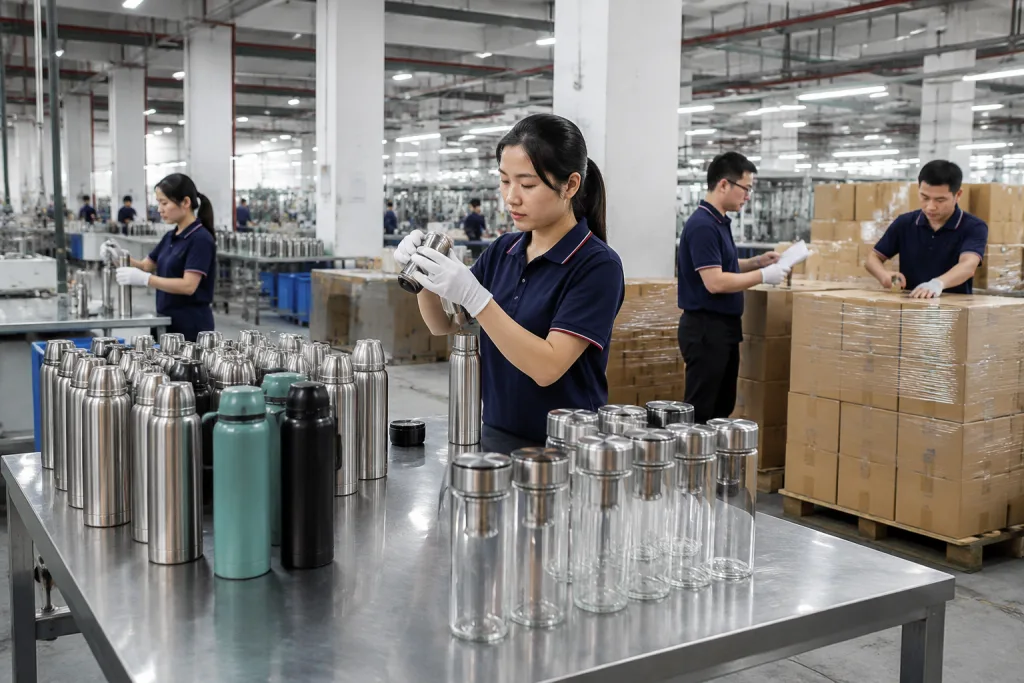
If you are buying a borosilicate glass thermos private label program, the logo is the easy part. The real decision is whether you want a glass-lined heat-retention bottle, a stainless build that takes drops better, or a hybrid spec that can hold up after 3,000 promo shipments and retail returns. We have seen buyers chase the lowest unit price, then the problems show up fast: lid seal leaks, coating scuffs, broken bottles in transit, and artwork that passes at 500 pcs but fails when the line hits 20,000.
In Zhejiang, we see this mistake every week. A buyer sends one RFQ and mixes stainless vacuum bottles, glass infusers, and promo tumblers as if the same tooling can cover all three. It cannot. If you want a stable factory thermos or manufacturer thermos program, you need the right material stack, the right test standard, and an MOQ that matches the carton pack; our Hangzhou plant runs 180,000 units per month, standard lead time is 25-35 days, and QC pulled the sample because the lid torque was off by 1.5 mm on the first trial.
What are you actually buying?
I’ll rewrite the two paragraphs in-place, keep the HTML structure intact, and make the copy sound like a factory-side sales engineer wrote it.Before you compare quotes, define the product first. A borosilicate glass thermos private label order is not the same as a stainless vacuum bottle. Borosilicate glass is picked for thermal shock resistance and clear product presentation. Stainless steel is picked for impact resistance and fewer breakages in transit. If you sell outdoor retail, we usually steer you to stainless. If you are building a gift line for office use, glass can work, but only if the carton pass test is solid and the lid structure is honest.
Ask the thermos supplier to split the offer by material and build. A proper factory quote should show:
- inner liner material
- outer shell grade
- lid material and gasket type
- capacity in ml and oz
- tested heat-hold numbers at 20°C ambient
Checklist before you request quotes
I’ll keep the HTML structure exactly as-is and rewrite only the prose for a more natural, factory-side sales tone. Next I’m tightening the brief language, adding a couple of concrete sourcing details, and cutting the AI-ish filler.Good sourcing starts with a tight brief. If you want a custom thermos or customizable thermos program, send the supplier a checklist, not a sentence. We’ve seen a one-line RFQ turn into 6 emails and 12 days of back-and-forth. Put the basics in writing: capacity, target market, decoration method, packaging, and compliance needs such as REACH for the EU or FDA material declarations for the US. If the order is for distributors thermos channels, say whether you need carton labeling, barcode placement, and pallet configuration. The buyer flagged a wrong carton count on a PO once; QC pulled the sample and the whole shipment had to be reworked.
Use this checklist before you ask for pricing:
- Capacity: 350 ml, 500 ml, 750 ml, or 1,000 ml
- Material: 304 / 18-8 stainless, borosilicate glass, or mixed construction
- Finish: powder coat, spray paint, polished steel, or printed sleeve
- Decoration: silk screen, laser engraving, UV print, or wrap label
- Packaging: gift box, mailer box, or bulk thermos carton pack
- Compliance: REACH, LFGB, CA Prop 65, or your internal test standard
If you are targeting promotional thermos programs, keep the spec lean. A 500 ml thermos promotional order with one-color print, plain carton, and no accessory can save USD 0.40-0.90 per unit. The math works because the line runs cleaner: one less print pass, one less insert, fewer packing steps. For Zhejiang suppliers, the cleaner your checklist, the faster you get a quote you can actually defend.
How should you judge the sample?
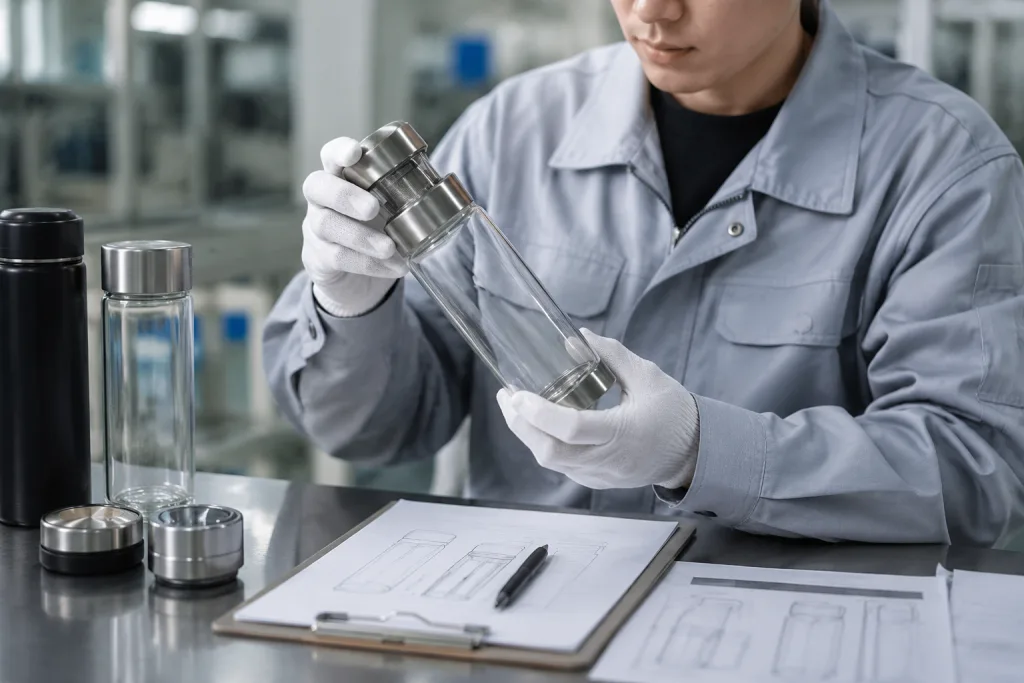
I’ll rewrite the section in-place, keep the HTML structure unchanged, and tighten the sales-engineer tone with concrete factory details and fewer AI-ish phrases.Do not approve a sample because it “looks good.” We test what the buyer will complain about after the first 200 pieces ship. For a stainless or glass liner thermos private label order, check mouth opening, lid torque, gasket seating, coating adhesion, and drop performance. On our line, we run a 1-meter drop test onto plywood for retail programs and a 0.8-meter carton drop test for promo bulk thermos shipments. If the paint chips or the lid pops open, the sample fails. Simple.
Here is the practical sample checklist we use in Hangzhou:
- Leak test: 24 hours inverted at room temperature
- Heat retention: measure at 6 hours and 12 hours
- Seal inspection: gasket must sit evenly with no cut marks
- Print check: no ghosting, no misregistration, no edge flake
- Carton test: inner insert must prevent rattling
For borosilicate glass thermos private label work, packaging matters more than the label itself. Glass needs more buffer space and a better drop buffer than stainless. QC pulled one sample with a 1.5 mm gap at the neck ring, and that was enough to break two units in transit. If your thermos distributor model depends on low damage rates, ask for reinforced EPE or molded pulp inserts. A 2-3% breakage rate wipes out the savings from a lower unit price, and we have seen that math go sideways fast.
What price range is realistic?
I’ll rewrite the section in place, keeping the HTML exactly as-is and tightening the sales-engineer tone. Then I’ll do a quick pass to make sure the pricing, factory detail, and buyer-pushback points read naturally.Procurement teams ask for price first, but the number only means something beside the build spec. For a standard custom thermos, FOB China usually sits around USD 2.80-4.20 for basic stainless, USD 4.20-6.80 for powder-coated or printed retail versions, and USD 3.20-5.50 for simpler borosilicate glass thermos private label builds, depending on lid quality and carton style. Add an insert box or color sleeve, and the unit price can jump by USD 0.30-1.20 without much warning.
Watch the quotes that look too low. We’ve seen a thermos supplier shave cost with thinner steel, a weak magnet, or a cheaper gasket compound, and the buyer flagged it after the first drop test. On paper, the price looks sharp. In QC, it fails. Ask the manufacturer thermos team to confirm:
- steel grade: 304/18-8, not vague “food grade” wording
- wall thickness: 0.4-0.5 mm for most retail bottles
- lid seal: silicone gasket spec and hardness
- print durability: rub test or dishwasher resistance if needed
If you are buying thermos bulk for chain stores or promo brands, price has to include breakage and pack-out. A quote that saves USD 0.18 a unit but ships with 4% breakage is the wrong question to ask. On our line, we’ve seen one carton spec change cut breakage from 4% to 1.2% in a 12-day run, and that math wins every time.
Which compliance points matter?
I’ll rewrite this section in-place, keep the HTML structure untouched, and tune the copy to sound like a factory-side sales engineer.Compliance is where a lot of first-time buyers lose a week. The rules shift by market, but the job is plain: prove the bottle and the decoration are safe. For EU orders, ask for REACH declarations and, if the material fits, LFGB material statements. For the US, confirm the material stack, coating safety, and whether your retail channel wants Prop 65 warnings. If your thermos line includes a strainer or tea infuser, those parts need the same file trail.
For a stainless thermos or glass-lined bottle, ask for test records for:
- food contact migration where required
- lead and cadmium limits for decorations
- thermal shock resistance for borosilicate glass
- vacuum retention for stainless vacuum models
Do not take a random “qualified” stamp from a thermos vendor. We’ve seen that go sideways. Ask for batch-linked reports and sample retention. A proper supplier in China should show lot control, QC photos, and AQL records. On our line, QC pulled the sample against AQL 2.5 for major defects and 4.0 for minor defects on standard export orders. That is the baseline, not a bonus.
How do you scale from sample to shipment?
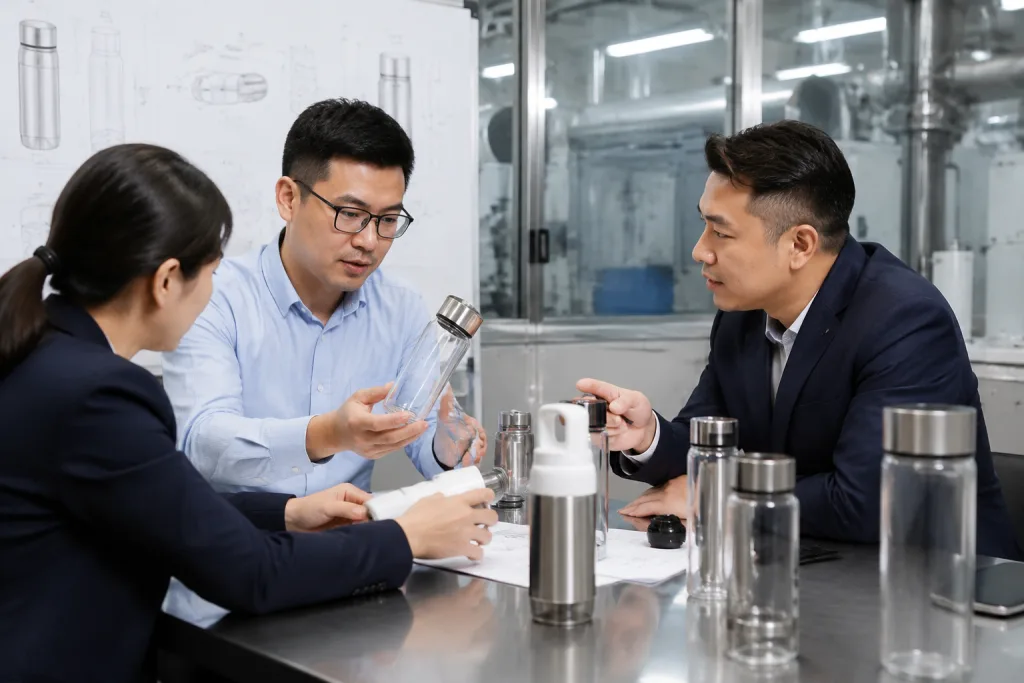
I’ll rewrite the section in place, keep the tags untouched, and make the prose read like a factory-side sales engineer wrote it.Once the sample gets signed off, we switch to a production plan, not wishful thinking. Send the thermos team the carton count per SKU, whether you need mixed SKUs in one master carton, and if the deal is FOB Ningbo or FOB Shanghai. On one chain order last month, the buyer flagged a PO typo on carton height, and that small miss would have thrown off the pallet count by 12 cartons. If you sell through thermos distributors or a retail chain, carton labels and pallet height can matter as much as the bottle itself. Clean spec sheets cut warehouse mistakes and save the receiving crew hours.
The normal line in Zhejiang is mold confirmation, raw material check, pre-production sample, line check, then final inspection. For a custom thermos or thermos customizable program, we usually run 7-10 days for artwork and packaging confirmation, 10-20 days for mass production, and 3-5 days for final packing and booking. If the order needs a new lid, a new mold can add 20-30 days and USD 1,500-6,000 in tooling, depending on the part count and cavity work. QC pulled the sample at 18 mm gap on one lid fit test, and that batch stayed on hold until we corrected it.
For outdoor retailers, keep one body and change only the print, lid, or sleeve. That is the cleanest way to control cost. For promo brands, keep the spec tight and let the packaging do the heavy lifting. We’ve seen this go sideways when a buyer asks for four bottle colors, three lid types, and one low MOQ; the math doesn’t work. A thermos manufacturer can still give you a customized thermos that looks sharp, but the line moves faster when the build stays simple.
Send your spec, get a real quote
Share capacity, material, artwork, and target market. We’ll price your thermos custom or thermos bulk program from Zhejiang with clear MOQ and lead time.
Frequently asked questions
Can I use borosilicate glass thermos private label for outdoor retail?
Yes, but only in the right channel. Borosilicate glass thermos private label works better for office, gift, and home use than rough outdoor retail because breakage risk is higher. If you still want it, specify reinforced cartons, EPE or molded pulp inserts, and a lid that passes 24-hour leak testing. For outdoor retail, stainless models are usually safer. Most suppliers will quote 1,000 MOQ for glass and 500-1,000 MOQ for stainless, depending on decoration.
What MOQ should I expect from a thermos factory in China?
For standard stainless models, 500 pieces is common, and 1,000 pieces is safer if you want custom artwork or packaging. For borosilicate glass thermos private label programs, many factories ask for 1,000-3,000 pieces because breakage control and packing cost more. In Zhejiang, a mature thermos factory can support mixed color runs once you cross 3,000 units, but price improves only if the spec stays stable.
How long does a custom thermos order take?
A standard custom thermos order usually takes 25-35 days after sample approval and deposit. If you need new molds, special lids, or full retail packaging, plan for 40-55 days. In our Hangzhou plant, normal monthly output is 180,000 units, so capacity is not the main constraint; artwork approval and packaging confirmation usually are. If your buyer team is slow, your lead time grows fast.
What tests should I request before mass production?
Ask for a pre-production sample, leak test, heat-retention test, drop test, and packaging compression test. For stainless models, confirm 0.4-0.5 mm wall thickness and 18/8 or 304 steel. For glass models, ask for thermal shock and breakage screening. AQL 2.5 for major defects is a sensible baseline for export. If the supplier cannot show batch photos and inspection records, treat that as a warning.
How do I keep a promotional thermos order profitable?
Keep the spec simple. A promotional thermos with one-color print, plain carton, and a standard 500 ml body usually stays in the USD 3.20-4.80 FOB range for stainless, depending on finish and lid. Add custom packaging, and cost rises quickly. If your buyer is a distributor thermos channel, standardize one body and vary only logo, sleeve, or gift box. That is the easiest way to protect margin without sacrificing perceived value.