Key Takeaways
- For a borosilicate glass thermos flask factory, expect MOQ from 1,000 to 3,000 pcs and 30-45 days for normal bulk thermos orders.
- Borosilicate glass handles thermal shock better than soda-lime glass, but you still need drop testing and a reinforced cap system.
- For custom thermos projects, ask for vacuum retention, leak test, and AQL 1.5 sampling on critical defects before approving mass production.
- A Zhejiang supplier can usually support OEM/ODM faster than a trading-only thermos vendor, especially for 2,000-10,000 unit promotional thermos programs.
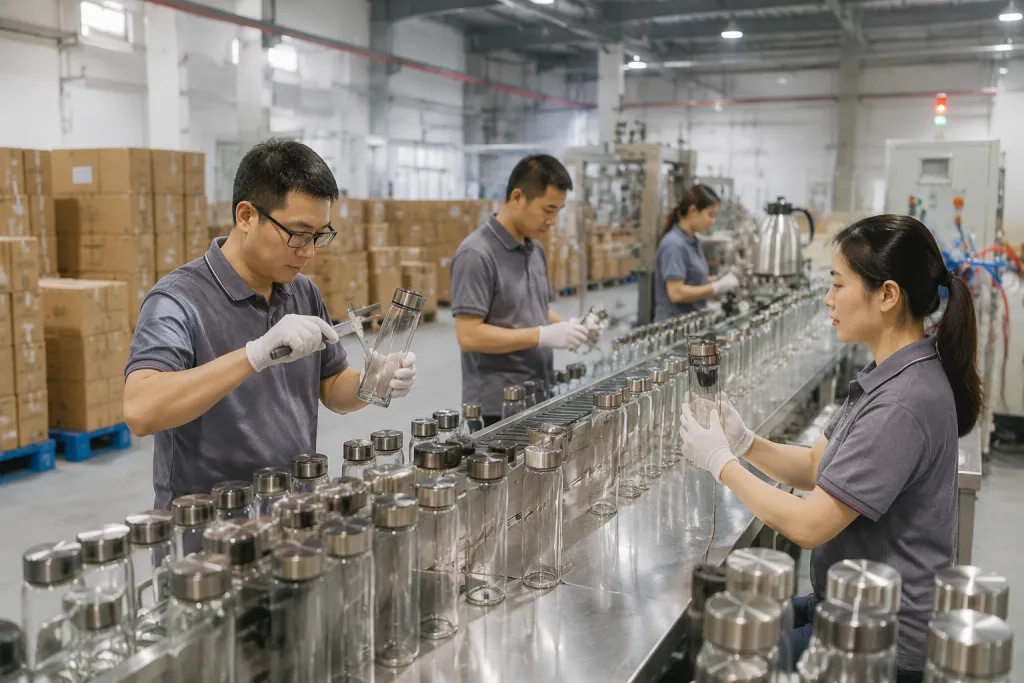
If you are buying drinkware for outdoor retail or a promo run, the wrong thermos spec gets expensive fast. A stainless shell can look the same on paper, but once we compare liner material, wall structure, leak test results, and print limits, the sourcing call changes. A borosilicate glass thermos flask factory fits best when you want a clean taste, a clear shelf look, and a gift-grade feel without pushing the retail price out of range. On our line, QC pulled a sample with a 24-hour upright leak check before packing.
The real question is not whether glass is “better” than stainless. The question is whether your order needs a factory thermos that balances breakage risk, vacuum retention, and decoration room. In Zhejiang, we see the same item quoted six ways, and the math does not work if you ignore the details. You need a buyer checklist: what the bottle must do, what you can accept, and which controls matter at 5,000 or 20,000 units. A PO typo on capacity once cost us a full reprint, so this is the wrong question to ask at a surface level.
Start With the Use Case
I’ll rewrite the section in-place, keeping the HTML structure intact and tightening the sales-engineer voice. Then I’ll do a quick pass to make sure the wording stays specific and factory-grounded.Before you ask for color chips or logo placement, lock down where the flask will sell. A borosilicate glass thermos flask factory can build a trade-show giveaway, a retail gift box item, or a distributor line, but the spec should not stay the same. We run different caps, lid torque, and carton tests for each. Outdoor buyers usually push for a tougher cap, 12 N·m lid torque, and outer cartons that survive drop tests. Promotional buyers care more about print area, unit cost, and whether the first look lands clean; the 12-hour heat claim is secondary in that lane.
Use case sets the material stack. If you need a clear viewing window and a premium shelf look, borosilicate glass makes sense. If the flask will sit in a car cup holder or get tossed on a job site, a stainless shell is the safer call. This is the wrong question to ask as “which one is better.” On our line, we split the decision by channel: glass liner for tea and coffee presentation, stainless outer protection where dents are part of the game. QC pulled the sample after a 1.5 m drop test; the glass version held the lid, but the shell spec won the buyer’s approval for field use.
Ask the supplier to quote the same concept two ways: one as thermos custom for retail, one as thermos promotional for low-cost gifting. The math changes fast. A cap swap, print method change, and lighter inner box often move the price by $0.30-$1.20 per unit, and we have seen that gap decide the order. One PO typo we catch a lot is “gift box” written where “mailer box” was intended; that small line item can flip carton cost and freight weight by 8 kg on a 1,000-piece shipment.
Judge the Glass, Not the Brochure
I’ll rewrite the prose in place, keep the HTML exactly as-is, and strip the AI-ish phrasing while adding a few factory-floor details and sharper sales-engineer tone.Borosilicate glass sounds simple until you put it on the line. The real buying difference is in wall thickness, forming quality, and stress control. A credible borosilicate glass thermos flask factory should tell you the wall thickness in millimeters, not hide behind “high borosilicate.” For most consumer thermos bodies, we see 1.8 mm to 2.5 mm, and the narrower the neck or the trickier the inner curve, the tighter that number has to be. Thin glass saves grams and cost, but it also raises breakage risk during assembly and shipping. QC pulled a 2.0 mm sample last week and the buyer still flagged it because the neck radius was too tight.
Check the annealing curve and ask for thermal shock data, not a marketing line. We run a cold-water-to-hot-fill cycle, then a hot-cold differential check, and that tells you more than a glossy brochure ever will. If the supplier cannot explain what happens at 100°C fill temperature or how residual stress is controlled, this is the wrong factory to trust with a container order. Ask for breakage targets by stage: forming, assembly, and final carton packing. On a stable design, a decent China plant should keep outgoing breakage below 0.8%. If they dodge that number, the math does not work.
Do not buy a glass thermos on appearance alone. One bad annealing lot can wipe out the margin on an entire container, and we have seen that go sideways fast.
For bulk thermos orders, the glass spec also changes the outer shell decision. A higher-end bottle may justify a 0.5 mm stainless decorative shell, while a promo line can stay with coated plastic parts to hold weight and freight down. We ship both. The buyer once sent a PO with “0.5mm” typed as “0.05mm,” and that typo would have wrecked the quote if we had not caught it before tooling. Let the use case set the build, not the brochure.
Choose the Stainless Structure Wisely
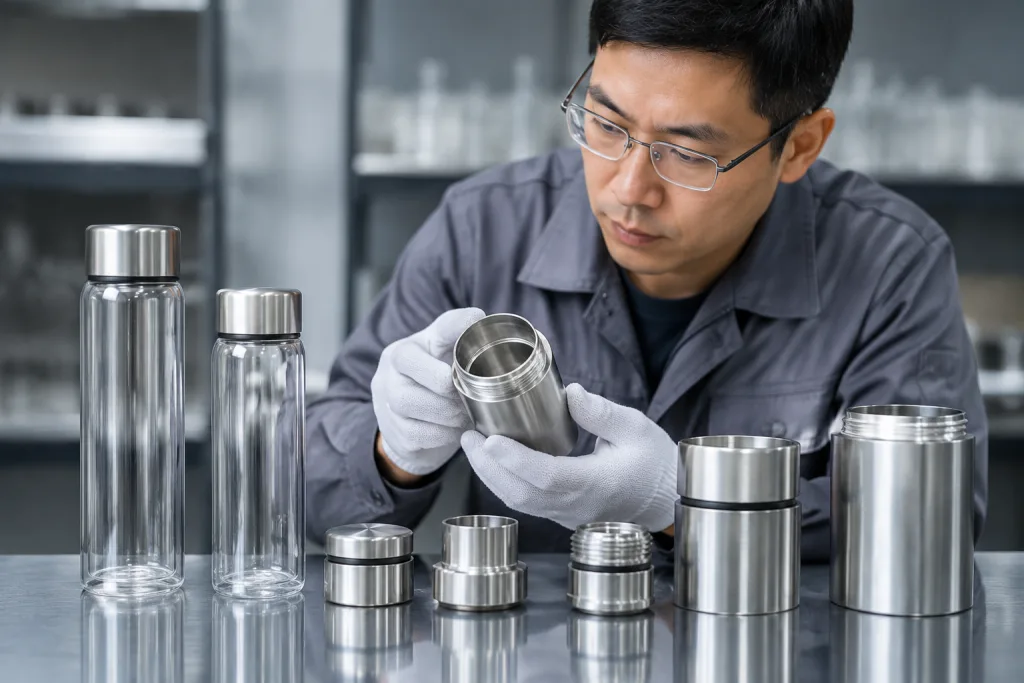
I’ll rewrite the prose in-place, keep the HTML structure unchanged, and tighten it to sound like a factory-side sales engineer.Even with a glass inner vessel, the outer structure drives the buyer’s impression. The lid seal, base ring, handle, and shell decide whether it feels like a proper custom thermos or a throwaway promo item. If your market is outdoor retailers, we run the shell gauge, thread fit, and impact resistance first. A normal spec here is 18/0 or 18/8 stainless on the outside parts, with shell thickness at 0.35 mm to 0.5 mm depending on the target price.
If a factory offers a stainless thermos version beside the borosilicate model, put both on the same quotation sheet. We’ve seen the glass unit look cheaper until carton upgrades and stricter drop tests get added. One Zhejiang thermos line we work with had to explain why a single lid does not fit every body shape. That is the real issue. Most leak complaints start at the lid, and the math does not work if torque, gasket, and thread engagement are left vague before you approve a thermos customized range.
- Ask for lid opening torque in N·cm.
- Confirm gasket material, usually silicone or food-grade TPE.
- Require leak testing at 48 hours for sample validation.
- Check whether the shell can survive a 1.0 m drop with no sharp edge exposure.
For distributor thermos programs, the safer move is a proven shell structure with your branding on top. We ship those faster, and QC can hold the line on consistency. A brand-new body shape on the first order usually turns into rework.
MOQ, Lead Time, and Price Reality
I’ll rewrite the section in-place, keep the HTML tags untouched, and tighten the sales-engineer tone with concrete numbers and shop-floor detail.Most buyers underestimate how order size changes the deal. A borosilicate glass thermos flask factory in Zhejiang will usually quote an MOQ of 1,000 to 3,000 pcs for existing molds, and 5,000 pcs or more for new customization. If you want a custom shape, print, and color box, a small trial run is not the normal answer unless you pay tooling or accept a higher unit cost. For stock geometry with logo work, FOB China pricing often lands around USD 2.20 to 5.80 per unit, and that moves with capacity, cap complexity, and packing spec. QC pulled a sample on the line last month and found a 1.2 mm gap on the lid insert; that kind of miss gets fixed fast, but it is why the buyer flagged the price gap.
Lead time matters more than first-time buyers admit. A normal thermos factory schedule is 30-45 days after sample approval and deposit, but a new color, special carton, or metal cap can add 7-15 days. If you are aiming at a seasonal launch, count backward from ship date, not order confirmation. We run the schedule off artwork signoff, carton proof, and compliance docs; if those come in late, the line waits.
When you compare supplier thermos quotes, split the cost into body, lid, decoration, carton, and freight. A low body price can look good on paper, then the math breaks when the carton crush test fails and the damage rate climbs. In bulk thermos procurement, a $0.12 carton upgrade can save a $1.50 claim later. We have seen this go sideways on a PO where the buyer typed 3,000 pcs but the packing list said 3,500; that kind of typo turns a clean quote into a messy shipment.
Testing That Actually Protects You
I’ll rewrite the section in place, keeping the HTML structure intact and tightening the wording so it sounds like a buyer-facing factory note.If you are buying for North America or Europe, compliance is not optional. A real thermos supplier should already know REACH, food-contact rules, and the documents buyers ask for every week. We run material declarations, silicone safety sheets, and, when the market needs it, LFGB or FDA-style food contact checks. For glass parts, ask for the borosilicate spec, the finish spec, and how the line keeps dust and oil off the forming molds.
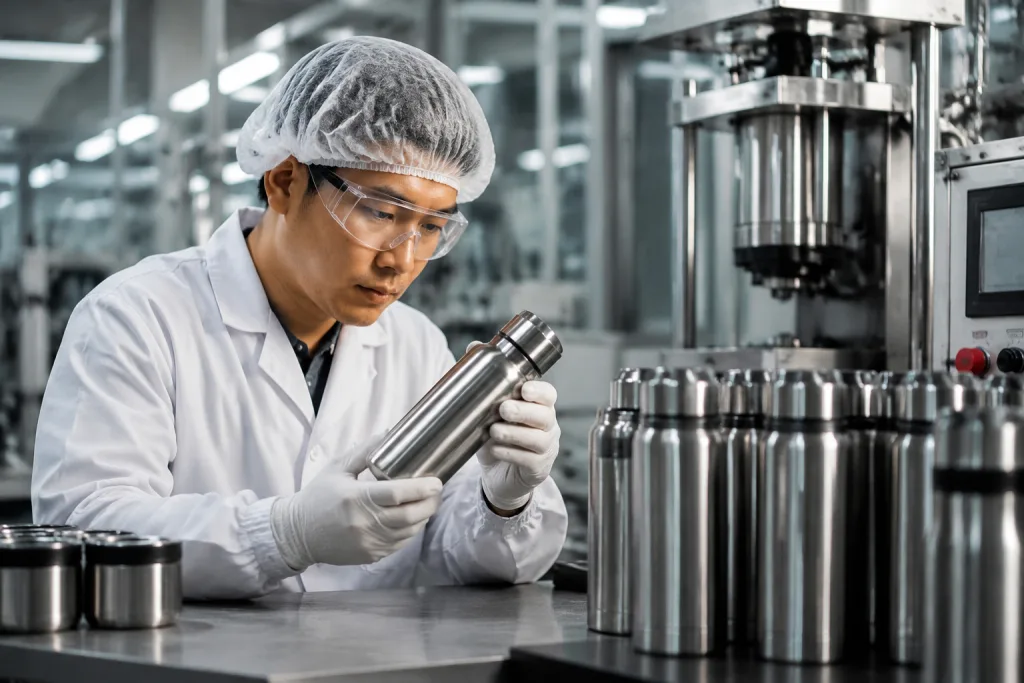
Quality control should target the failures that show up after delivery. We check leaks, vacuum retention on insulated models, lid fit, logo wear, carton drop, and surface flaws under AQL sampling. On a 5,000-unit order, buyers often set AQL 1.5 for critical defects and AQL 2.5 for major defects. If the supplier cannot explain that cleanly, the math does not work.
For outdoor retail, ask for a packaging vibration test and an outer carton edge-crush check. For promotional brands, print adhesion is the usual weak point. We have seen a buyer flag a logo that passed one hand wash and failed after three. That is not branding. That is a return.
Good suppliers in China will show in-process inspection points, finished-goods checks, and pre-shipment photos. QC pulled the sample, the carton spec matched, and the buyer still had the paper trail. If they cannot show that, keep looking.
Branding and Channel Fit
I’ll rewrite the three paragraphs in clean B2B sales English, keep every HTML tag intact, and make it sound like a factory-side channel fit note with a few concrete details.Decoration should match the channel, not someone’s personal preference. For a promo run, we usually keep it simple: one-color silk screen, pad print, or laser mark on the lid ring or metal cap. If the order is retail-facing, a customizable thermos can take more color work, gift sleeves, or UV print, but only when the surface, MOQ, and target price still make sense. On a borosilicate glass thermos flask line, we usually place the logo on the shell or lid; direct glass printing looks neat on day one, then the buyer flags it after washing tests.
Outdoor buyers care about shelf hit and abuse resistance. That means tight branding, cleaner carton art, and often a QR code or barcode panel for warehouse handling. A distributor thermos program needs a neutral look because one line may serve 6 accounts, not 1. We run this by keeping one base body and changing only color, logo, and box copy. It cuts SKU count, keeps reorder lead time down by 4–6 days, and the math works.
Do not let a supplier sell you random “upgrades” that miss the channel. A glitter finish can look good in a sample photo, but if your customers are hardware chains or camping stores, it will sit on the shelf. We’ve seen this go sideways on a 3,000-piece order where the PO typo changed the carton text and QC pulled the sample twice before packing. The best thermos customizable program is the one a buyer can understand in 3 seconds.
Working With the Right Factory in Zhejiang
I’ll rewrite the three paragraphs in place, keep the HTML exactly as-is, and tighten the language so it sounds like a Zhejiang factory sales engineer.There is a practical reason buyers keep sourcing from Zhejiang and the wider China supply base: the supplier network is dense, the tooling is already there, and export packing is routine work. But not every thermos quote comes from a real factory. We have seen polished photos hide weak production control. Ask straight: how many units per month, how many lines, and what lead time do you run for each model. A real China factory should answer with numbers, not noise. On our line, 100,000 to 300,000 units per month is normal across product lines, and the buyer should know where the order sits in the schedule before deposit.
When you check a borosilicate glass thermos flask factory, ask for the sample approval flow, BSCI or another social compliance file if your customer needs it, and the spare-parts plan. QC pulled a broken stopper sample on a 2 mm neck mismatch last month; that is the kind of issue a real team catches early. A factory that knows its job will not flinch when you ask for a second pre-production sample or a packaging mock-up. They will tell you what works, what adds cost, and what is a bad idea.
The best supplier is not the one shouting the lowest number. The math does not work that way. It is the one that tells you where the risk sits and how they will keep it under control. In Zhejiang, that is usually where a decent factory turns into a long-term partner. We ship repeat orders every week, and the real test is the second order, not the first sample that looked perfect under showroom lights.
Get a quote with real specs
Send your target capacity, MOQ, logo format, and packaging needs. We’ll match the right thermos supplier setup for your market.
Frequently asked questions
What MOQ should I expect for a borosilicate glass thermos flask factory?
For standard models, expect 1,000 to 3,000 pcs MOQ. If you need new tooling, special cap parts, or full thermos custom packaging, 5,000 pcs is more realistic. Smaller trial orders are possible, but the unit price usually rises by 15% to 30%. A Zhejiang factory with stable production can often support repeat bulk thermos replenishment at the same spec once the first run is approved.
Is borosilicate glass safe for hot drinks and tea?
Yes, borosilicate glass is widely used for hot beverage contact because it handles thermal shock better than ordinary glass. For a thermos customized for tea or coffee, the key is not just the glass type but also annealing quality, lid seal, and assembly control. Ask the supplier for hot-fill tests, cold-to-hot cycling, and breakage data. A good factory thermos line should be able to show practical test results, not just marketing claims.
How much does a custom thermos usually cost FOB China?
For a straightforward promotional thermos or custom thermos order, FOB China pricing often falls between USD 2.20 and 5.80 per unit, depending on capacity, decoration, and packaging. A more complex thermos custom with metal cap upgrades or premium print can go higher. Freight, duties, and carton upgrades are separate. If the quote looks unusually low, check whether the vendor is hiding packaging or quality costs somewhere else.
What tests should I ask for before approving mass production?
Ask for leak testing, lid torque checks, drop testing, and visual inspection under AQL sampling. For a borosilicate glass thermos flask factory, also request thermal shock validation and breakage-rate reporting. If you sell to Europe or North America, request material declarations and any needed food-contact documentation. For a 5,000-unit order, many buyers use AQL 1.5 for critical defects and AQL 2.5 for major defects.
Can one factory support both stainless and glass thermos lines?
Yes, many manufacturers thermos operations in Zhejiang run both stainless and glass programs. That can help you compare pricing, packaging, and channel fit under one supplier. Still, do not assume both lines have the same quality controls. Ask which line has the better vacuum retention, which cap design has lower leak rates, and whether the factory is a true manufacturer thermos facility or just coordinating outsourced parts.