Key Takeaways
- 304 stainless steel at 0.4-0.5 mm body thickness is the normal export baseline for outdoor retail
- Borosilicate glass liners improve taste neutrality but need stronger drop-test packaging
- Factory MOQ is usually 1,000 pcs per model for logo orders and 3,000 pcs for custom color
- AQL 2.5/4.0 inspection should cover leakage, vacuum retention, coating adhesion, and carton drop tests
A buyer who asks a borosilicate glass thermos factory for a quote usually hits the same wall: the web page looks clean, but the real spec sheet runs five or six choices deep. On our line, QC pulled 12 samples last week and three failed the lid torque test at 1.8 N·m. Outdoor retailers care about drop resistance and heat retention; promo buyers care about a clean logo, carton fit, and whether the shipper marks match the PO.
At our Zhejiang plant, we see this mix every week. A custom thermos can be 304 stainless vacuum, borosilicate glass liner, or a hybrid build, and each one changes material cost, MOQ, and lead time. One buyer pushed back on a 3,000-piece MOQ until we showed the sleeve print setup and the carton die line; the wrong question is whether the bottle looks the same, because the real issue is how it runs through production and customs after you place the order.
Material line decides the complaint rate
The first spec line should not stop at stainless steel or glass thermos. For a stainless factory thermos, write 304 stainless steel for the inner wall, then 201 or 304 for the outer wall. For outdoor retail, 304/304 is easier to explain on Amazon, Costco-style line sheets, or a buyer’s compliance form. We usually run body thickness at 0.4-0.5 mm; below 0.35 mm saves about USD 0.08-0.15 per piece, but QC pulled more dented samples after a 1.2 m carton drop test. Cheap gets visible fast.
For a borosilicate glass thermos factory project, the liner usually uses high borosilicate glass, not soda-lime glass, because it handles hot-water shock better. It stays taste-neutral for tea, coffee, and fruit infusions, but this is not the wrong place to chase the lowest quote. A glass liner shifts the complaint from “the cup dented” to “the liner cracked.” The silicone support ring, bottom buffer, and carton drop-test method matter as much as the glass grade; we have seen 2 mm off-center padding turn into cracked liners after the second drop corner.
If you are comparing thermos suppliers in China, do not accept soft wording like food grade material. Ask for LFGB, REACH, or FDA contact-material reports that match the actual material code on the BOM. For stainless vacuum models, ask whether the cap contact parts are PP, Tritan, or stainless. For glass liner models, ask how the liner is fixed and whether spare liners are available; one EU buyer flagged this after their PO said “replaceable liner” but the approved sample was glued at the neck. A manufacturer thermos program with clear material codes quotes faster, inspects cleaner under AQL 2.5, and sells with fewer claims.
Capacity, mouth size, and usability
Capacity looks like a marketing choice. It is not. It decides tooling, export carton size, freight cost, and whether the user carries the bottle by hand, in a backpack pocket, or in a car cup holder. Outdoor retailers usually move 500 ml, 750 ml, and 1,000 ml best. Promotional thermos buyers often choose 350 ml or 500 ml because unit price and logo area stay balanced. A 500 ml stainless vacuum bottle from Zhejiang may pack 24 pcs per export carton, while a 1,000 ml bottle may pack only 12 pcs. On one 40HQ quote, the buyer flagged this after seeing freight jump by about 18% per unit. The math doesn't work if capacity is picked only from a catalog photo.
Mouth diameter is another line worth checking on the spec sheet. A 45-55 mm mouth drinks cleanly and holds heat slightly better. A 70-85 mm wide-mouth design lets users add ice, clean inside with a bottle brush, and sell it as an outdoor thermos. Wide-mouth models need tighter thread tolerance, usually checked with a go/no-go gauge on the line, because the cap sealing area is larger. The gasket matters too. For glass liner or borosilicate glass thermos designs, too large a mouth leaves the liner more exposed during drop impact, and QC pulled samples before for tiny rim chips after a 1.2 m carton drop test.
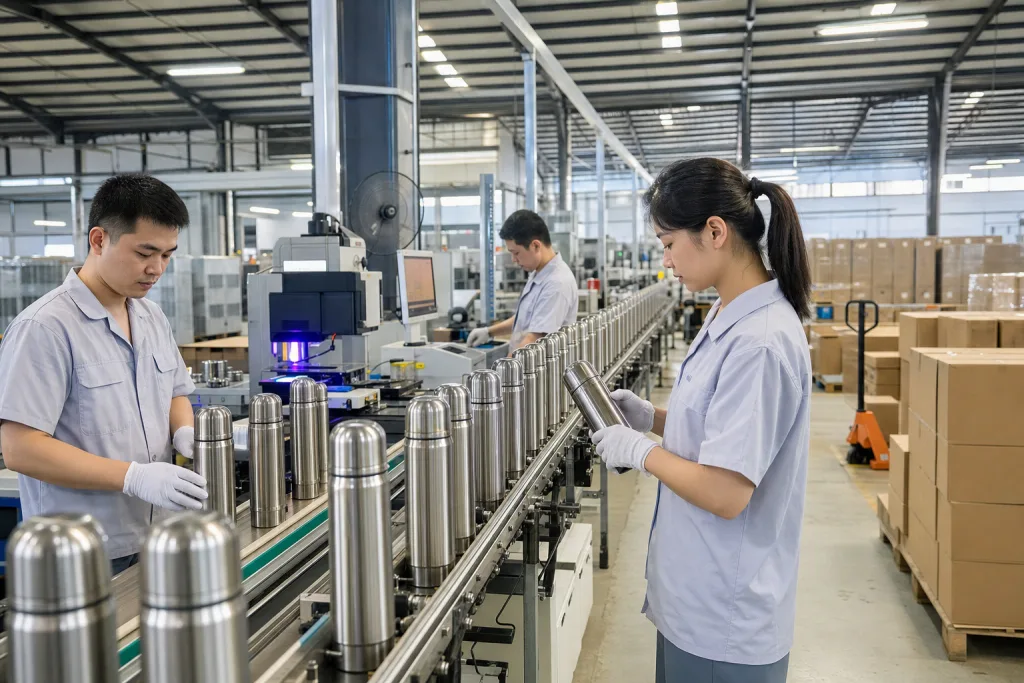
For a customizable thermos range, avoid launching too many sizes at once. Three sizes with shared cap structure usually cost less than five sizes with separate lids. Shared caps reduce spare-part confusion and cut the development cycle from about 18 days to 12 days when the lid mold and gasket are already approved. Our Hangzhou, Zhejiang production line can run about 450,000 drinkware units per month across stainless bottles, tumblers, and thermos models, but cap changes still slow scheduling. We have seen this go sideways when a PO typo listed two gasket colors for the same SKU. If you want distributor thermos stock that can be reordered quickly, standardize the cap and gasket first.
Insulation data must be testable
Insulation claims are where factories get loose; we see this on 6 or 7 inquiry sheets out of 10. A serious spec should name the test method, water starting temperature, room temperature, fill level, and measuring point. No shortcuts. A typical stainless vacuum thermos can hold water above 60°C after 12 hours when tested from 95°C at 20°C room temperature, with the probe placed near the liquid center, not touching the wall. On our line, QC uses a calibrated K-type thermometer and records the reading again after the cap has been closed for the full test time. A large 1,000 ml model may beat a 350 ml model because the volume-to-surface ratio is better. The math matters.
Borosilicate glass liners behave differently. Glass itself conducts less heat than metal, but the final result depends on whether the item is vacuum insulated, double-wall glass, or a glass liner inside an outer shell. Do not let a thermos supplier mix these three descriptions on one spec sheet; we have seen buyers flag this during artwork approval. If the product is not vacuum sealed, it should not carry the same heat-retention claim as a stainless vacuum bottle. That is the wrong promise to print. It creates returns for outdoor retailers and weakens your promotional brand promise, especially when the hang tag says 12 hours and the sample drops below drinking temperature before lunch.
Ask for a pre-production insulation report on at least 5 pcs, not only one golden sample. For mass production, set an AQL check where inspectors test a smaller sample overnight. It adds 1 day to the inspection plan, but it catches vacuum failure, cap leakage, and welding defects before the goods leave China. QC pulled one sample last season with a 0.3 mm cap gasket mismatch; the bottle passed visual inspection but lost heat fast. For thermos custom orders, insulation claims should be printed only after the test data is confirmed. A nice logo cannot compensate for a bottle that loses heat in four hours when your carton says twelve.
Surface finish and logo tolerance
Decoration is where a promotional thermos turns into a solid campaign item or 3,000 cartons sitting in a warehouse. We run silk screen, laser engraving, heat-transfer print, water-transfer print, powder coating, and UV print, but the right choice depends on artwork, order qty, and how the bottle will be handled. Laser engraving stays clean on 304 stainless steel and passes most scratch checks, but it will not print a full-color mascot. Silk screen works for one or two colors, often starting around USD 0.08-0.18 per color depending on coverage. Full-wrap UV or heat-transfer costs more, and the line needs clean vector files; last month QC pulled a sample because a 0.3 mm white outline disappeared on the curved body.
For powder coating, ask for coating thickness and adhesion testing before the PO is locked. A normal outdoor bottle coating may sit around 60-90 microns. Cross-hatch adhesion should meet at least 4B or 5B before you approve production. We check it with a 1 mm cross-hatch cutter and 3M tape, not by rubbing it with a thumb. If the bottle will be sold through outdoor retailers, add a simple rub test and decide the dishwasher warning early. The math does not work if the buyer expects a low-cost painted stainless thermos to survive dishwasher cycles without a tested coating and print system.
Logo placement tolerance should be written in millimeters, not “centered.” A good factory thermos spec may allow logo position tolerance within 1.5-2.0 mm and color tolerance against Pantone within a practical range. For a customized thermos with a large wrap design, ask for a printed approval sample, not only a digital mockup. Curved bodies distort artwork. Tapered tumblers distort it more. We have seen this go sideways when a buyer approved a flat PDF, then flagged a 2 mm seam shift after mass production; a thermos vendor that calls this out early is protecting your launch, not being difficult.
Compliance lines protect the shipment
Compliance is not paperwork decoration. It decides whether the container clears, whether the retailer books the inbound slot, and whether the legal team stops chasing the merchandiser at 11 p.m. For Europe, buyers usually ask for LFGB food-contact testing on the parts touching drink, REACH screening on restricted substances, plus BSCI or Sedex audit status if the program goes through a chain store. For North America, FDA food-contact expectations apply, California Proposition 65 screening often gets requested by Amazon and California retailers, and CPSIA is required when the item is sold for kids. If the cap has a straw, a flip button, or small parts under 31.7 mm, do not treat it like a standard adult thermos. QC pulled one sample last year where the buyer flagged the straw plug as a child-risk part after the PO already said “adult bottle.” We had to rework the carton copy.
For stainless steel, testing should cover heavy metals and extractables on every food-contact surface, including the inner wall, the lid insert, and the thread area where tea residue sits. For borosilicate glass, test the glass liner separately from any coating, decal, or printed sleeve, because the ink supplier and the glass furnace are not the same risk. For silicone gaskets, ask for food-grade silicone test reports tied to the actual gasket batch; this is the weak point we see in cheap thermos offers. The math does not work if your supplier thermos quote is USD 0.30 cheaper but the report shows a different silicone code than the material in production. On the line, we check gasket color, hardness with a Shore A gauge, and odor after 30 minutes in hot water at 95°C.
Factory audit status also matters for distributors thermos programs. We have seen 8 promotional brands and 3 outdoor chains reject goods from unaudited factories before they even review the artwork. BottleForge Industrial in Zhejiang, China works with export programs where pre-shipment inspection uses AQL 2.5 for major defects and 4.0 for minor defects. Check leakage after inversion, smell after hot-water filling, sharp edges around the mouth rim, coating damage under tape test, logo position in mm, barcode scanning, carton marking, and gross weight against the packing list. Put these into the purchase order. A friendly email is not enough when a claim appears after delivery, especially when the PO has one typo in the SKU and the warehouse says the goods are “not our item.”
MOQ, price, and packing reality
MOQ is a production number, not a sales trick. It comes from the powder-coating booth changeover, silk-screen film setup, carton plate printing, stainless coil and cap purchasing, plus QC inspection time on the line. For a standard custom logo order, a realistic MOQ is 1,000 pcs per model; below that, the screen fee and color matching charge get spread over too few units. For custom color powder coating, 3,000 pcs is more stable because we run the coating line by batch, and a 600 pcs trial can waste 18-25 kg of powder during cleaning and adjustment. For a new mold or special cap, expect 5,000-10,000 pcs depending on complexity. A thermos bulk order below these numbers may still be possible, but the unit price will carry setup costs. The math doesn’t work any other way.
FOB Ningbo or Shanghai pricing for a standard 500 ml stainless vacuum manufacturer thermos often sits roughly in the USD 3.20-5.80 range depending on steel grade, lid structure, coating type, and packaging spec. We quote tighter after checking the lid gasket, inner wall thickness, and whether the buyer wants 304 stainless or a lower-cost option. Borosilicate glass liner thermos items can be similar or higher because breakage control and packing take more labor; QC pulled one sample last season with a 0.8 mm glass liner chip at the mouth, and that finding changed the whole packing plan. Gift boxes may add USD 0.20-0.60 per unit; molded pulp or foam protection adds more but can reduce claims. Cheap packing looks good on the PI. It looks bad when 27 cartons arrive with rattling liners.
Lead time should be split into sample and mass production. Logo samples usually need 7-12 days after artwork approval, assuming the AI file has the correct Pantone code and the logo is not rebuilt from a low-resolution JPG. Mass production commonly takes 30-45 days after deposit and sample confirmation. If you need FNSKU labels, retail barcodes, Amazon carton rules, or mixed distributor thermos assortments, put those lines into the proforma invoice before it is signed; we once saw a PO typo list “FNSKQ,” and the buyer flagged it only after carton printing. The cheapest thermos factory quote often assumes plain export cartons and no special labeling. For outdoor retailers and promotional brands, packaging is part of the product, not an afterthought.
Send your thermos spec sheet for a factory review
We will check material, MOQ, decoration, packaging, and compliance gaps before you commit to samples or mass production.
Frequently asked questions
Can one factory make both stainless and borosilicate glass thermos products?
Yes, but check how much is made in-house. Many China suppliers assemble both types while sourcing glass liners from a specialized borosilicate glass workshop. That is normal. What matters is control: incoming glass inspection, silicone buffer design, liner assembly, leakage testing, and carton drop testing. Ask whether the factory can provide 5-10 pre-production samples for thermal and drop checks before mass production. For a mixed stainless and glass thermos program, we normally recommend one shared cap family where possible and separate AQL criteria for denting versus glass breakage.
What MOQ should an outdoor retailer expect for a custom thermos?
For a standard stainless model with your logo, plan on 1,000 pcs per SKU. If you need custom powder coating, Pantone color matching, or printed retail boxes, 3,000 pcs is a more realistic MOQ. New lid tooling or a non-standard capacity may push the project to 5,000-10,000 pcs. A lower MOQ can be possible for stock colors, but the unit price may rise by USD 0.20-0.80 because setup, printing, and inspection costs are spread across fewer units.
Is borosilicate glass better than stainless steel for a thermos?
It depends on the buyer promise. Borosilicate glass is excellent for taste neutrality, tea, coffee, and users who dislike metal contact. Stainless steel is better for impact resistance, hiking, camping, and daily commuting. A glass liner can crack if the bottle is dropped, even with a good outer shell. Stainless can dent but often keeps working. For outdoor retail, stainless vacuum thermos products usually create fewer breakage claims. For premium tea or wellness promotional thermos campaigns, borosilicate glass can be the better story.
How should we inspect thermos bulk orders before shipment?
Use AQL inspection, usually 2.5 for major defects and 4.0 for minor defects. The checklist should include capacity, net weight, leakage, vacuum insulation, cap fit, gasket position, smell, coating scratches, logo placement, barcode scanning, carton marks, and drop-test packaging. For glass liner products, add liner cracks, rattling, and inner support checks. Insulation testing needs time, so agree on the method before inspection day. A 12-hour heat-retention check on sampled units is more useful than a quick visual inspection.
What information is needed for an accurate FOB China quote?
Send capacity, material preference, lid type, logo method, number of print colors, target market, packaging style, order quantity, and required compliance reports. If you have a target price, say it directly. For example, a 500 ml 304 stainless customized thermos with powder coating, one-color logo, and color box is very different from the same bottle in plain white carton. FOB Ningbo or Shanghai quotes are usually clearer when the supplier knows whether you need REACH, LFGB, Prop 65, FNSKU labels, or retailer carton standards.