Key Takeaways
- A realistic MOQ for borosilicate glass thermos custom orders is 1,000-3,000 pcs per model
- FOB China pricing usually ranges from USD 3.20-8.80 depending on capacity, lid, sleeve, and packaging
- Sampling takes 7-15 days; bulk production normally takes 25-45 days after approved sample and deposit
- Custom packaging, Pantone coating, and third-party testing can add 5-12 days if not planned early
A borosilicate glass thermos custom project looks simple until the first price sheet lands. The bottle body, sleeve thickness, lid mold, tea filter mesh, logo method, color box paper, carton drop test, and AQL 2.5 inspection all change the FOB number. Buyers often ask us for “one best price” with only a 500 ml photo; that is the wrong question to ask. Last month QC pulled a sample where the silicone ring was 0.4 mm off, and that small gap changed the leak-test result and the lid supplier we had to quote.
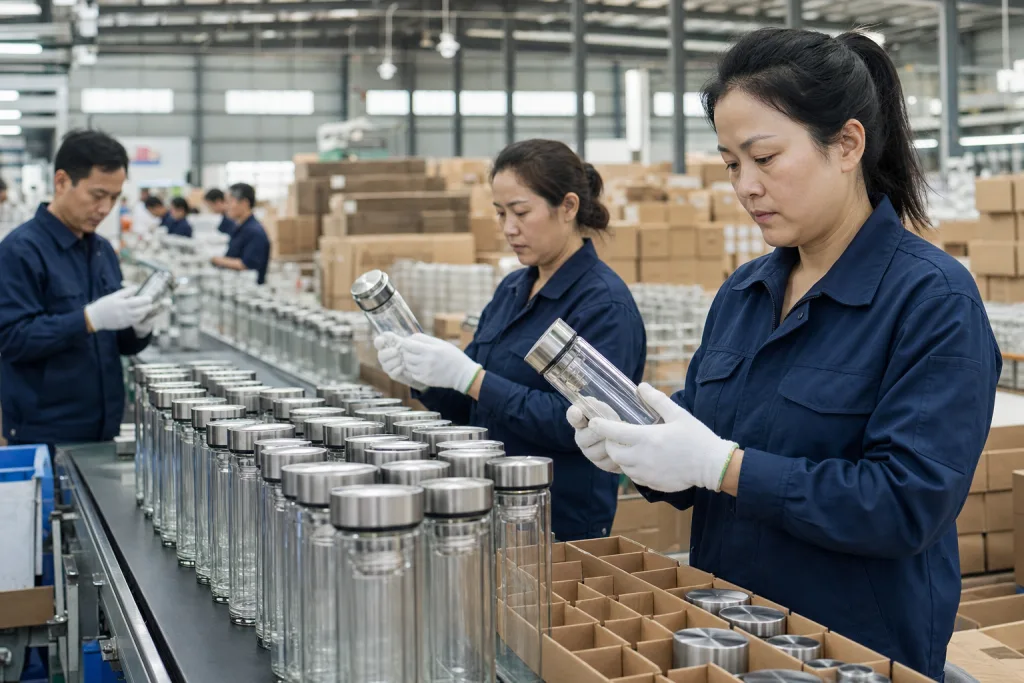
From our factory base in Zhejiang, China, we quote stainless thermos and glass-liner thermos programs for distributors, outdoor chains, and corporate gift buyers. A normal MOQ starts at 1,000 pieces per model, with monthly capacity around 450,000 units across drinkware lines. For a new buyer, we usually map the job as 7 days for artwork and sample confirmation, 25-35 days for mass production after deposit, then vessel time based on port and season. We ship from Ningbo or Shanghai. Before we ask for a deposit, we break out cost and lead time by part, because we have seen launches go sideways from one missed detail, like a PO typo calling for “matte black” while the approved sample was powder-coated dark grey.
Where the FOB price starts
For a borosilicate glass thermos custom order, the FOB start price sits above a basic stainless sports bottle. Simple reason: the glass liner breaks easier, and the assembly gap is tighter. We run a 350 ml glass-lined thermos with a PP lid, silicone seal, and one-color logo at about USD 3.20-4.30 FOB Ningbo or Shanghai for 3,000 pieces, assuming normal artwork and no special retail packing. A 500 ml model with stainless outer shell, borosilicate inner liner, tea infuser, powder coating, and color box often comes in around USD 5.20-7.40. Premium gift sets with cup lid, carry strap, kraft box, and molded insert can reach USD 8.80 or more. On the line, QC pulled one sample last month with a 0.8 mm liner offset; that small shift is enough to slow assembly and raise scrap.
The main cost drivers are easy to see once you hold the parts. Capacity adds material. A stainless outer shell with 0.45-0.50 mm wall thickness costs more than thin decorative cladding because the coil weight changes fast. Food-contact 304 stainless steel for the cup or filter costs more than 201 stainless steel, and buyers still ask why the cheaper quote “looks the same” on a photo. A tight-fitting glass liner needs slower handling during production and packing, so we add labor time and scrap allowance. If you need REACH, LFGB, or FDA food-contact documentation, the test fee is not inside the bottle cost unless you tell us to include it on the quotation sheet.
For promotional thermos programs, buyers chase the lowest unit price and then find the carton cannot survive export handling. Bad math. We normally quote with a 5-layer export carton, 32 ECT or similar strength, because a broken carton is not a saving. Last Q4, the buyer flagged crushed corners after a drop test from 760 mm, and the cheaper carton saved less than USD 0.06 per piece. A supplier thermos price that skips proper packaging, AQL inspection, and spare parts is not a real landed cost.
MOQ tiers and what changes
MOQ is where 7 out of 10 custom thermos talks start to drift from factory reality. For an existing mold and standard color, 1,000 pieces per model is workable from our Zhejiang factory. At 1,000 pieces, decoration stays tight and the unit price sits higher because the logo plate, carton setup, and line cleaning are spread across a small run. Simple works. Laser engraving, one-position silk screen, and a stock color box sticker are the safe choices at this level; last month QC pulled a 1,000-piece sample where the buyer wanted four logo positions, and the math did not work.
At 3,000 pieces, the cost starts to behave better. This is the usual sweet spot for outdoor retailers testing a new thermos custom line or promotional brands running a seasonal campaign. You can request Pantone powder coating, a one- or two-color logo, a custom paper sleeve, and a cleaner carton layout with shipping marks sized to 60 x 40 mm. Unit cost can drop 6-12% compared with 1,000 pieces, depending on the model and logo process. The line also runs with fewer stops, which matters when the powder coating team is matching 500C grey under a D65 light box.
At 5,000-10,000 pieces, a fully customized thermos program becomes easier to control. Custom lid color, molded silicone parts, printed gift box, barcode label, and distributor thermos carton marks are all more realistic because purchasing can book resin, paper, and cartons in one plan. If you need a thermos distributor program with mixed colors, we suggest keeping each color at 1,000 pieces or more to avoid color change waste and extra setup time, usually 12 days vs 18 days when colors keep switching. We have seen this go sideways when a PO typo split 6,000 pieces into six 1,000-piece colors after artwork approval.
Private mold development is a separate cost discussion. For a new lid, special handle, or unique body profile, tooling can range from USD 1,200 for a simple silicone or plastic part to USD 8,000-18,000 for a complete bottle structure. Lead time for tooling is normally 20-35 days before the first functional sample, then the sample still needs fit testing with a caliper at the thread, lid torque check, and leak testing on the bench. If your order is only 1,000 pieces, private tooling usually does not make commercial sense. This is the wrong question to ask unless the next order is already planned.
Decoration costs buyers miss
Branding cost starts with the surface and the wear test the buyer expects. A borosilicate glass thermos custom item can have a stainless shell, painted shell, glass window, bamboo trim, or PP lid, and each one reacts differently on the line. One-color silk screen is the low-cost choice, usually USD 0.08-0.18 per piece when the artwork is simple. Laser engraving on stainless steel looks clean and does not wash off, often USD 0.15-0.35 per piece depending on logo size. UV print handles gradients, but the price can rise to USD 0.30-0.80 per piece, and QC should run a 3M tape pull plus a 500g rub test before you approve mass production.
Powder coating is common for outdoor retail because it feels tougher than normal spray painting. Standard black, white, or army green is easier to put into the coating booth schedule. A custom Pantone color normally needs 3,000 pieces or more and may add USD 0.25-0.60 per unit. Approve a physical color chip, not a screen image. We have seen this go sideways when the buyer approved Pantone 7499C by email, then flagged the bulk sample under 4000K retail light because the curved bottle body looked warmer than the flat chip.
Packaging is another hidden budget line. A plain white box may cost USD 0.12-0.25. A printed color box can cost USD 0.35-0.90 depending on paper thickness, coating, and insert. For a promotional thermos set, a rigid gift box can exceed USD 1.20. If your channel requires FNSKU, UPC, warning label, country-of-origin mark, or retail hangtag, build that into the artwork stage. Adding labels after production is slower and usually uglier; we once had 2 workers re-stick 1,200 UPC labels by hand because the PO showed “matte lamination” but the box file was marked “gloss.”
My practical view: spend money where the user touches the product. A better lid seal, thicker coating, and readable logo matter more than an overdesigned box that gets thrown away after 20 seconds. The math does not work if you save USD 0.18 on the silicone ring and then eat a 3% return rate for leakage.
Sampling before the clock starts
Buyers often count lead time from the inquiry date. Wrong starting line. On our side, the thermos production clock starts only after we have the deposit, final artwork, approved sample, and confirmed packaging file. If the PO says “matte balck” instead of “matte black,” QC will not release the order to the line until that typo is fixed.
For an existing manufacturer thermos model, a blank sample can ship in 2-5 days if the warehouse has stock. We run the stock check by SKU and color code, not by photo. A logo sample usually takes 7-10 days after the AI file is confirmed. A Pantone-coated sample or custom box mockup may take 10-15 days because the spray room needs a color card match under D65 light. International courier to Europe or North America adds 3-6 days. If your team asks for two rounds of revisions, sampling can burn three weeks before mass production starts.
For borosilicate liner products, we recommend a simple functional review during sampling: lid threading, silicone ring compression, odor after hot water, glass clarity, filter fit, and bottle rattle when shaken. Use 95°C water, wait 30 minutes, then check again. A small rattle sounds harmless in the office, but we have seen this go sideways when a retail customer thinks the inner glass is cracked. For outdoor retailers, we also test whether the bottle fits a backpack side pocket or standard car cup holder if that claim will appear on your product page.
Factory sample charges are usually USD 30-150 per style depending on decoration and packaging. Courier may cost USD 45-95. Some suppliers thermos sellers promise free samples, then bury the cost in the bulk price; the math does not work, it just moves the charge to another line. We prefer to show the charge on the PI and refund it against a confirmed bulk thermos order above 3,000 pieces.
Bulk production calendar in China
After approval, normal bulk production takes 25-45 days for a customizable thermos order using existing molds. Simple stainless thermos styles with a laser logo usually run 25-30 days in a normal month; the laser room can finish about 3,000-5,000 pcs per shift if the jig is already set. A borosilicate glass thermos custom order with powder coating, printed box, inner liner assembly, and carton labels is safer at 35-45 days. Before Chinese New Year, add 10-20 days or place the order earlier. Zhejiang and other China manufacturing regions get booked from November through January, and we have seen a PO arrive on January 6 with the logo file still named “final-final-new.ai.” That schedule does not work.
A typical production flow looks like this: material purchase 3-7 days, shell forming and polishing 5-10 days, coating or surface treatment 5-8 days, glass liner and lid assembly 4-7 days, logo printing 2-5 days, packaging 3-5 days, and internal inspection 1-2 days. Some stages overlap. Coating is the usual choke point because one color change means cleaning the spray gun, checking the powder thickness in μm, and baking another test panel before the line restarts. Packaging artwork can block shipment too; one missed barcode digit on the color box can hold 10 pallets at our warehouse door.
For thermos bulk orders above 10,000 pieces, we usually split production into inspection lots. It is cheaper to stop at 2,000 pcs than to unpack 10,000 pcs after sealing cartons. A standard inspection can follow AQL 2.5 for major defects and AQL 4.0 for minor defects, although some retailers require tighter limits. QC pulled the sample from the second lot last season and found coating dust near the shoulder, a logo tilted by 1.5 mm, weak suction in the silicone seal, carton corner crush, glass liner movement, and barcode placement 12 mm off the buyer’s layout. The buyer flagged it. Fair enough.
Sea freight is outside factory production time. Ningbo to Los Angeles may be 18-28 days port to port in a normal market. Ningbo to Rotterdam or Hamburg is often 30-40 days. If you have a fixed campaign date, do not approve a 45-day production schedule and then expect sea freight to behave like air courier. We ship from Ningbo most weeks, and even a clean booking still needs space release, SI cutoff, VGM, customs declaration, and truck timing from Hangzhou to the port. Ask this earlier, not after cartons are taped.
Quality checks for glass thermos
A glass-lined thermos needs different QC from a full stainless vacuum bottle. Borosilicate glass handles thermal shock better than regular soda-lime glass, but it is still glass, and one hairline crack at the mouth can scrap the carton. Ask your thermos manufacturer how they check fit, leakage, odor, and transport damage before mass production. For typical export orders, we run 95°C hot water leak testing, visual inspection under 600-800 lux light, lid torque checks with a torque meter, silicone ring pull checks, and packed carton drop checks based on the buyer’s standard. QC pulled the sample last month because the inner glass sat 0.8 mm off-center. Good catch.
For food-contact compliance, the target market decides the test plan. EU buyers often request LFGB or EU food-contact testing, plus REACH screening for coatings or plastic parts. US buyers may ask for FDA food-contact confirmation and, for children’s items, CPSIA-related requirements. If the item is not a kids bottle, do not casually market it as child-safe without the right testing. We have seen one PO use “baby thermos” in the item description by mistake; the buyer flagged it, and the lab quotation changed the same day. Claims cost money to prove.
Thermal performance claims should stay conservative. A stainless vacuum thermos can often claim 6-12 hours hot depending on capacity and construction. A borosilicate glass thermos with outer protection may not perform the same unless it has a vacuum or insulated structure built for that claim. If you are selling to outdoor customers, overstating heat retention creates complaints and credit notes. The math does not work. We prefer to test with 95°C water, record the temperature after 6 hours at 23°C room temperature, and print the real number on the spec sheet. On the line, we use one calibrated probe per test batch, not a kitchen thermometer from the sample room.
For distributor thermos programs, spare parts should be planned before the deposit. Extra silicone seals, lids, and filters equal only 1-2% of order value but reduce after-sales friction. We usually pack 2% spare silicone rings in a separate PE bag with the carton mark, because mixed loose parts create warehouse complaints. A thermos vendor that cannot supply replacement parts six months later is a poor fit for retailers building repeat business.
Landed cost decisions to make early
Your lowest FOB quote is not always your lowest landed cost. A custom thermos with a bulky gift box can push carton volume up 20-35%, and that changes sea freight per unit fast. A 500 ml bottle in a tight white box can load 24 pieces per carton. Put the same bottle in a large gift box and you may only get 12 or 16. We checked this on the packing table with a tape measure at 58 x 42 x 38 cm, and the math was clear. For North American and European distributors, carton cube matters almost as much as FOB when freight rates move.
Set the Incoterm before you line up thermos quotations. FOB Ningbo or Shanghai is common for China export orders because the buyer controls the main freight leg. EXW can look cheaper on paper, but you still pay local trucking, export handling, and documents through your forwarder. DDP is handy for small promo runs, yet it hides customs and tax assumptions. On one PO, the buyer wrote 480 pcs and the carton mark said 840 pcs by typo, and that kind of mistake will wreck the freight calc. For serious thermos distributor buying, FOB is the cleanest comparison.
Set your commercial tolerance early. If your promotional thermos order is for a one-day event, a late ship date hurts more than paying USD 0.20 more per unit to stay with a stable factory. If you are building a retail line, repeat order consistency beats shaving the first order to the bone. QC pulled the sample on the leak test bench before balance payment, and that is the checkpoint that matters. A reliable thermos supplier should show production photos, pre-shipment inspection results, and packing details before you pay the balance.
Our blunt advice from Zhejiang: lock the model, artwork, packaging, compliance needs, and delivery term before you ask five thermos manufacturers for price. We run into this every week, and the same buyer still wants to compare three different bottles as if they were one item. That is the wrong question to ask. If the MOQ is 1,000 pcs and the carton spec is different, you are not comparing quotes, you are comparing headaches.
Send your thermos brief for a real quote
Share capacity, logo, packaging, target market, and delivery date. We will return MOQ, FOB price, sample timing, and production lead time.
Frequently asked questions
What is the minimum order for a borosilicate glass thermos custom project?
For an existing mold, 1,000 pieces per model is the practical minimum from our Zhejiang, China factory. At 1,000 pieces, we suggest simple decoration such as laser engraving or one-color silk screen. For Pantone powder coating, custom color box, or mixed retail labels, 3,000 pieces is more realistic. If you want a private lid, special handle, or new bottle shape, the MOQ often moves to 5,000-10,000 pieces because tooling and setup costs must be spread across enough units.
How much should I budget for a custom thermos in bulk?
A basic 350 ml glass-lined custom thermos can start around USD 3.20-4.30 FOB China at 3,000 pieces. A 500 ml model with stainless outer shell, borosilicate liner, tea filter, powder coating, and printed box is commonly USD 5.20-7.40. Premium gift packaging, UV print, special lid parts, and third-party testing can push the cost above USD 8.80. Always compare quotes with the same packaging, logo process, Incoterm, and inspection requirement.
Is borosilicate glass better than stainless steel for outdoor retail?
It depends on the promise you are selling. Borosilicate glass gives a clean taste and is attractive for tea, coffee, and wellness positioning. Stainless steel is tougher for hiking, camping, and heavy daily use. If your outdoor customer expects impact resistance, a full stainless vacuum bottle is safer. If your product is for office-to-trail use, a protected borosilicate liner can work well. We recommend carton drop testing and honest thermal claims before retail launch.
How long does production take after sample approval?
For existing molds, bulk production normally takes 25-45 days after sample approval, deposit, and final artwork. A simple laser-logo order may finish in 25-30 days. A borosilicate glass thermos custom order with powder coating, printed box, assembly, and barcode labels is safer at 35-45 days. Add 3-6 days for courier samples and 18-40 days for sea freight depending on destination. Before Chinese New Year, add at least 10-20 days of buffer.
What quality standard should a distributor request?
For most distributor thermos orders, request pre-shipment inspection using AQL 2.5 for major defects and AQL 4.0 for minor defects. Define critical defects clearly: leakage, broken glass liner, wrong logo, wrong barcode, strong odor, and unsafe sharp edges should be zero-tolerance items. For Europe, confirm food-contact testing such as LFGB or EU standards where needed. For the US, confirm FDA food-contact suitability. Ask for packed carton drop testing if the order ships by sea and then by parcel network.