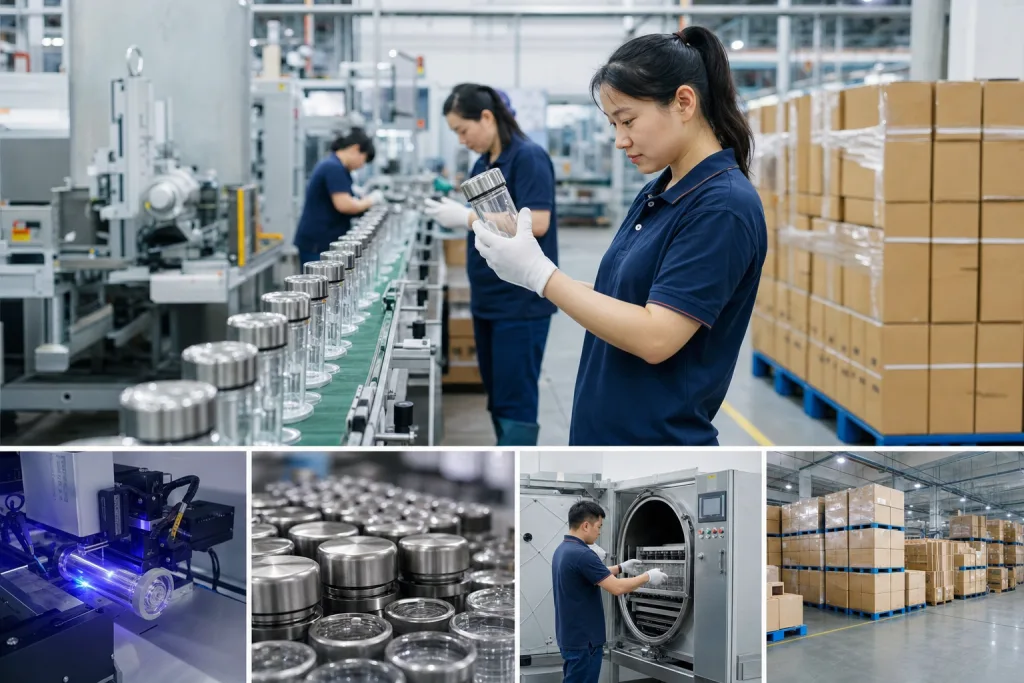
Key Takeaways
- A practical MOQ for borosilicate glass thermos bulk usually starts at 1,000-3,000 pcs per color or body size
- For custom logo work, allow 7-10 days for sampling and 30-45 days for mass production after approval
- Borosilicate glass liners need drop, leak, thermal shock, and carton compression checks, not only a visual AQL inspection
- FOB Ningbo or Shanghai is usually cleaner for distributor thermos projects than mixing EXW and unclear inland charges
If you sell to outdoor retailers or run promotional campaigns, a thermos order looks simple until QC pulls the sample and the logo proof sits 3 mm too close to the curve. Borosilicate glass liners give a clean taste and a premium hand-feel; stainless outer shells give the shelf look buyers ask for. Then the factory math starts: MOQ, glass breakage rate, lid thread fit, print area, carton drop test, and freight cost. Small misses get expensive.
From Zhejiang, China, we see one buyer mistake at least twice a month: treating a custom thermos like a printed pen. Wrong question. A borosilicate glass thermos bulk order has more checkpoints than a basic stainless bottle, especially after the liner is inserted and the cap torque is tested on the line. Your supplier thermos quote should show those points before you send a deposit, not after the buyer flags a loose lid or a chipped glass liner in the pre-shipment inspection.
What are you actually buying?
When buyers search for borosilicate glass thermos bulk, they are usually comparing two builds. One is a double-wall borosilicate glass bottle with a tea infuser or bamboo lid. The other is a stainless outer shell with an inner borosilicate glass liner. For retail and promo programs, we ship the second build more often. It holds up better in the carton, and the shell gives the art team a clean logo area.
A glass-lined thermos is not the same as a vacuum stainless thermos. Borosilicate glass takes hot water well and does not keep coffee or tea odor. It still breaks if the liner sits off-center, if the silicone ring is pinched, or if the export carton has weak corners. QC pulled a sample last month because the liner touched one side after a drop test. A proper quote should list inner liner material, outer shell material, lid material, gasket material, and whether the product is for hot liquid, cold liquid, or both.
For a typical 450 ml or 500 ml custom thermos, we usually start with 304 stainless steel outer shell at 0.4-0.5 mm wall thickness, food-grade silicone gasket, PP or stainless lid parts, and high borosilicate glass rated for fast temperature change. If a supplier thermos sheet only says “glass inside, stainless outside,” ask again. That is not enough for a distributor program where one cracked liner can turn into a claim on 2,000 units. We saw a PO last spring with “500ml” typed as “50ml”; that kind of typo gets expensive fast.
Procurement rule: if a thermos manufacturer cannot describe the construction in material grades and thickness, do not move to artwork yet.
MOQ, price, and realistic lead time
For most custom thermos projects in China, MOQ comes down to body mold, color finish, and logo process. A plain stock-color bulk thermos with laser engraving may start around 500-1,000 pcs if the factory has inventory; we check this against the ERP stock sheet, not a sales guess. A true customized thermos with your powder coat color, retail box, and printed sleeve is usually 1,000-3,000 pcs per SKU. If you need a new lid mold or unusual capacity, the MOQ can move to 5,000 pcs quickly, because one lid trial alone may take 2 rounds on the CNC sample mold. The math doesn't work for 300 pcs with a private PMS color.
As a Zhejiang manufacturer thermos partner, our normal monthly drinkware output is about 600,000 units across stainless bottles, travel tumblers, and thermos lines. That sounds big. It still does not mean every special glass-lined model can ship in seven days. For borosilicate glass thermos bulk orders, we run the timeline around the liner inspection, vacuum test, and packing line slot. Last month QC pulled 32 pcs from a glass-lined pilot run and flagged 3 with small mouth-chip marks under a 600-lux inspection lamp. A practical timeline is:
- Existing model sample: 3-5 working days without logo.
- Logo sample: 7-10 working days after artwork confirmation, if the AI/PDF file is clean and the logo size is confirmed in mm.
- Mass production: 30-45 days after deposit and approved sample.
- Retail packaging proof: add 5-7 days if color box printing is new.
Price moves a lot with liner quality and packaging. For a 500 ml stainless outer, borosilicate inner thermos, a reasonable FOB China range may be USD 3.20-6.80 at 1,000-5,000 pcs, before special gift packaging. If a thermos vendor quotes far below that, ask for the liner material report, a leak test video with the cup inverted for 30 minutes, and the inner carton spec. We’ve seen this go sideways: the buyer flagged crushed gift boxes at destination because the supplier used 5-ply cartons rated too low for glass products. Cheap cartons are a hidden tax on glass products.
Customization choices that do not backfire
A customizable thermos gives you three branding routes, but on borosilicate glass thermos bulk, the wrong choice costs time and rework. Outdoor retailers usually care about drop resistance and how the carton looks on shelf. Promotional buyers care about logo match, lead time, and unit cost. Those priorities overlap. They are not the same thing. QC pulled a shell from the line last week and the buyer still asked for a second visual check, which tells you where the real pressure sits.
For stainless outer shells, laser engraving is the cleanest choice for small logos and long-term use. It does not peel, and it holds up on powder-coated surfaces. On our line, the mark depth is usually around 0.2 to 0.3 mm, so the finish stays sharp without chewing through the coating. The weak point is color. The engraving tone depends on the coating and base metal, so it is the wrong call for bright multi-color artwork. Silkscreen printing works better for one- or two-color logos, with lower setup cost, but the ink still needs adhesion testing on curved powder coat. Heat transfer or UV printing can handle gradients and full-color designs, yet you should ask for rub testing and dishwasher guidance before anyone calls it rugged gear. We have seen that go sideways after a carton rub test came back with edge wear.
For a thermos promotional campaign, do not put the logo too close to the bottom radius or the lid thread area. Curves distort artwork and raise reject rate. On a 500 ml model, a safe logo area is about 45 x 80 mm on the straight wall, but the factory thermos drawing has to confirm it. A PO typo once placed a print 5 mm from the bottom edge, and we had to stop the batch and sort 2,000 pcs by hand. If you need individual names, barcodes, or FNSKU labels for marketplace fulfillment, say it before quotation. Adding variable data after production starts creates manual work and mistakes. Checklist before sample approval: confirm Pantone code, logo size in millimeters, print position from bottom edge, coating type, packaging artwork, barcode format, and whether the approved sample will be used as the golden sample for AQL inspection.
Quality checks for glass-lined thermos orders
A stainless bottle inspection is not enough for a glass-lined thermos. Build the checklist around the metal shell, glass liner, lid seal, and export carton. We run separate checks because a 0.4 mm dent in the shell is cosmetic, while a hairline crack in the liner kills the order. Outdoor retail buyers know the customer will throw the bottle into a pack next to keys, stove fuel, or climbing gear. Promo buyers have a different problem: the thermos gets handed out at an event with zero user coaching. Assume rough handling. We’ve seen this go sideways when the PO only said “standard QC” and nobody defined the glass test.
Common checks include visual inspection under AQL 2.5 for major defects and AQL 4.0 for minor defects, leak testing with hot and cold water, lid torque testing, gasket fit, odor check, and coating adhesion. For glass liners, add thermal shock testing. On the line, QC fills the sample with hot water around 95°C, waits for pressure change, then checks for cracks, distortion, leakage, and lid pressure behavior. Use a torque meter on the cap, not someone’s thumb. Drop testing needs a clear agreement before production starts. A glass-lined thermos will not survive drops like a full stainless vacuum model; the wrong question is “can it pass every drop?” The better question is whether the packaging protects it through warehouse handling and container shipping.
Carton testing matters more than most thermos distributors think. Ask for a 5-ply export master carton for glass-lined products, not a soft domestic carton made for local truck delivery. Inner dividers or molded pulp trays may add USD 0.10-0.35 per piece, but the math works if they cut breakage on a 3,000 pcs shipment. QC pulled one sample last season where the divider slot was 6 mm too wide, so the bottle knocked against the carton wall during a shake test. For North America and Europe, you may also need REACH declarations, LFGB or FDA food-contact reports, and Prop 65 review depending on the sales channel. If the thermos supplier says “all certificates available” but cannot show current test reports with matching materials, the paperwork is not finished.
At BottleForge Industrial in Zhejiang, China, we prefer pre-shipment inspection after 80% packed and 100% produced. That timing lets the inspector open finished cartons, check real retail packing, and still gives the factory time to rework defects before vessel booking. We ship glass-lined orders tighter this way, especially when the buyer’s forwarder gives only a 12-day window before closing. One missed carton mark or loose gasket is cheaper to fix at the packing table than after the container leaves Ningbo.
Questions your sales channel will ask
Your buyer usually won’t ask about borosilicate coefficient or steel gauge. They ask the questions their sales reps hear on Monday morning: Can it take 100°C boiling water? Is it dishwasher safe? Does it leak in a backpack? Can we sell replacement lids? Is the packaging plastic-free? Can we put a $24.99 retail sticker on the box? Short questions. Expensive answers if you guess. A good manufacturers thermos partner should help you lock these points before the shipment leaves China; we’ve had buyers flag one missing “hand wash” line at pre-shipment inspection and hold 3,000 pcs for new carton stickers.
For boiling water, high borosilicate glass is suitable for hot drinks, but the complete thermos still depends on lid material, gasket fit, and pressure release design. We normally advise 8-10 mm headspace instead of filling to the top, especially on narrow-mouth models. For dishwasher claims, be careful. The math doesn’t work if a $0.06 logo issue creates a $6 return. Some powder-coated custom thermos bodies pass gentle washing, but logo durability and lid gasket aging are not the same test. Unless the product has passed your exact dishwasher cycle, with the same print method and gasket material, say hand wash recommended. QC pulled the sample last month after 20 wash cycles because the white pad print lost edges around the logo.
For replacement parts, ask your thermos factory whether lids and gaskets are standard or project-only. This matters. A distributor thermos program is easier when you add 2-3% spare lids and 3-5% spare silicone gaskets to the main order, packed in PE bags with item codes so the warehouse team does not mix sizes. Retailers like that because after-sales cases can be solved without replacing the whole unit. We ship spare parts by carton count, not guesswork; one buyer once wrote “black lid” on the PO, but the approved sample used dark gray, and the buyer flagged it during inbound check.
For sustainable positioning, borosilicate glass has a clean story because it resists odor and supports repeated use. Do not overclaim. If you say plastic-free, the lid, gasket, carry loop, and inner tray must support that claim. If you say recyclable packaging, specify kraft box, molded pulp tray, or paper sleeve, then make sure the artwork and packing list match. Outdoor customers are skeptical, and they should be. We’ve seen this go sideways when a brand approved a paper sleeve but the line used a clear OPP bag to stop scuffing; the product looked better, but the claim became a problem.
How to compare supplier quotes
Comparing thermos suppliers by unit price alone is how buyers get hit later. We run every quote through one sheet: capacity, net weight, outer shell material, inner liner material, lid material, MOQ, sample cost, mold fee if any, logo method, packaging, carton quantity, carton size, gross weight, lead time, payment term, and trade term. FOB Ningbo and FOB Shanghai are standard for Zhejiang and nearby China factories. EXW can look cheap on paper, but then inland trucking, export handling, and document risk land on your side.
Ask straight whether the price includes one-color logo, one-sided logo, retail color box, barcode label, and master carton marks. The buyer flagged a PO once because the color box line was missing, and the gap was USD 0.18 per set across 10,000 pcs. For outdoor retailers, carton size decides freight and rack space. A 500 ml thermos packed 24 pcs per master carton may look tidy, but for glass-lined products 12 or 18 pcs per carton cuts compression damage. This is the wrong question to ask if you only chase the lowest quote.
Factory audits still matter. BSCI covers social compliance, ISO 9001 shows process control, and product-level food-contact reports are still required. Do not mix up a factory certificate with a material test report. QC pulled the sample on our line last month and the gasket passed, while the coating report was still pending. A thermos maker may hold a valid audit, but your gasket, coating, and liner need their own matching paperwork.
Before deposit, ask for the approved quotation version, signed PI, locked artwork file, sample photos and video, packaging dieline, inspection standard, acceptable defect list, shipping mark, payment schedule, and target ship week. If the supplier cannot handle these in English with clear dates, the production stage gets messy fast. We have seen this go sideways on a simple typo in the PO, and the correction cost more than the sample fee. The math does not work.
When stainless vacuum is the better choice
Not every project should use a borosilicate glass thermos bulk model. If the bottle is going into hiking shops, construction-site lunch kits, school sports bags, or 2-hour subway commutes, a stainless vacuum thermos is usually the safer spec. We run 304 stainless inner and outer shells on those jobs, and the line checks vacuum performance after the base welding and polishing steps. Full stainless construction takes drops better and holds heat more consistently than glass-lined builds. Borosilicate glass is clean for taste and tea culture. Drop it on concrete, and the math changes fast.
For outdoor retailers, we normally split the program into 2 lanes. Use glass-lined customized thermos models for tea, coffee tasting, wellness sets, office gifting, and premium promotional packs where the buyer cares about mouthfeel and presentation. Use stainless vacuum models for camping, cold-weather shelves, sports clubs, and rough carton handling. Both can be thermos custom projects, but QC treats them differently; last month, QC pulled the sample after a 1.2 m drop test because the glass liner survived, yet the lid thread showed stress marks.
If you still want glass-lined construction for outdoor use, spec a protective stainless shell, a thicker base pad, a reliable lid thread, and conservative claims. Avoid promising “unbreakable.” No serious thermos manufacturers should say that about glass. We have seen this go sideways when a PO asked for “outdoor unbreakable glass thermos” in one line and “premium tea gift” in the next. Give the customer honest handling instructions, use a fitted insert, and leave 8-10 mm clearance between the bottle and outer carton wall.
A good thermos distributor relationship is built on fewer surprises, not the loudest catalog copy. Bring us your target retail price, sales channel, compliance market, and launch date, and we can tell you whether borosilicate glass, full stainless vacuum, or a hybrid gift set fits better from Zhejiang, China. If the launch date is tight, say 12 days for artwork approval versus 18 days for a new lid mold, we will tell you before the deposit is paid. That saves arguments later.
Send your thermos spec before you request pricing
Share capacity, target price, logo method, market, and launch date. We will reply with MOQ, lead time, and a practical China sourcing route.
Frequently asked questions
What MOQ should I expect for borosilicate glass thermos bulk?
For a stock model with a simple laser logo, 500-1,000 pcs may be possible if the factory has ready shells and liners. For a true customized thermos with your color, retail box, carton marks, and barcode labels, plan on 1,000-3,000 pcs per SKU. If you need a new lid, new capacity, or exclusive shape, MOQ can rise to 5,000 pcs or more because mold cost and component waste increase. Always ask whether MOQ is per color, per logo, or per total order.
Is a borosilicate glass thermos safe for hot coffee or tea?
Yes, high borosilicate glass is commonly used for hot drinks because it resists thermal shock better than ordinary glass and does not hold odor. The full product still depends on lid material, gasket quality, and pressure design. For procurement, ask for hot water testing around 95°C, leak testing after inversion, and food-contact reports for the glass, silicone, and plastic parts. We also recommend user instructions that say not to overfill and to keep a small headspace under the lid.
Which logo method is best for outdoor retail thermos products?
For outdoor retail, laser engraving on a powder-coated stainless outer shell is usually the safest because it will not peel like low-grade printing. For promotional thermos campaigns with full-color artwork, UV printing or heat transfer may be better, but you should request rub testing and adhesion checks. A practical logo area on many 500 ml models is around 45 x 80 mm, but you need the exact factory drawing. Do not approve artwork only from a flat mockup.
What inspection standard should I use before shipment?
A common starting point is AQL 2.5 for major defects and AQL 4.0 for minor defects, with added functional checks for leak testing, lid torque, odor, coating adhesion, and thermal shock. For borosilicate glass thermos bulk, include packaging checks such as carton compression, inner divider strength, and drop handling review. Inspection should happen when 100% of goods are produced and at least 80% are packed. That timing gives your thermos supplier enough room to rework problems before loading.
Should I buy glass-lined thermos or stainless vacuum thermos?
Choose glass-lined thermos products when taste neutrality, tea use, gift presentation, and clean interior appearance matter most. Choose stainless vacuum thermos products when impact resistance, long heat retention, and rugged outdoor use matter more. For promotional brands, glass-lined models can feel premium at events and corporate gifting. For outdoor retailers selling to hikers or jobsite users, stainless vacuum construction is often safer. If your launch includes both channels, consider two SKUs instead of forcing one product to do everything.