Key Takeaways
- Ask for borosilicate glass thickness of 1.2-1.5 mm and define thermal shock at 120°C minimum.
- Set leak testing at 100% for assembly and AQL 1.0 for final carton sampling on thermos bulk orders.
- For print, specify 1,000+ rub cycles for laser and 150+ tape pulls for silk screen on promotional thermos runs.
- A capable factory thermos line in Zhejiang should handle 80,000-120,000 units/month with 25-35 day lead time after sample approval.
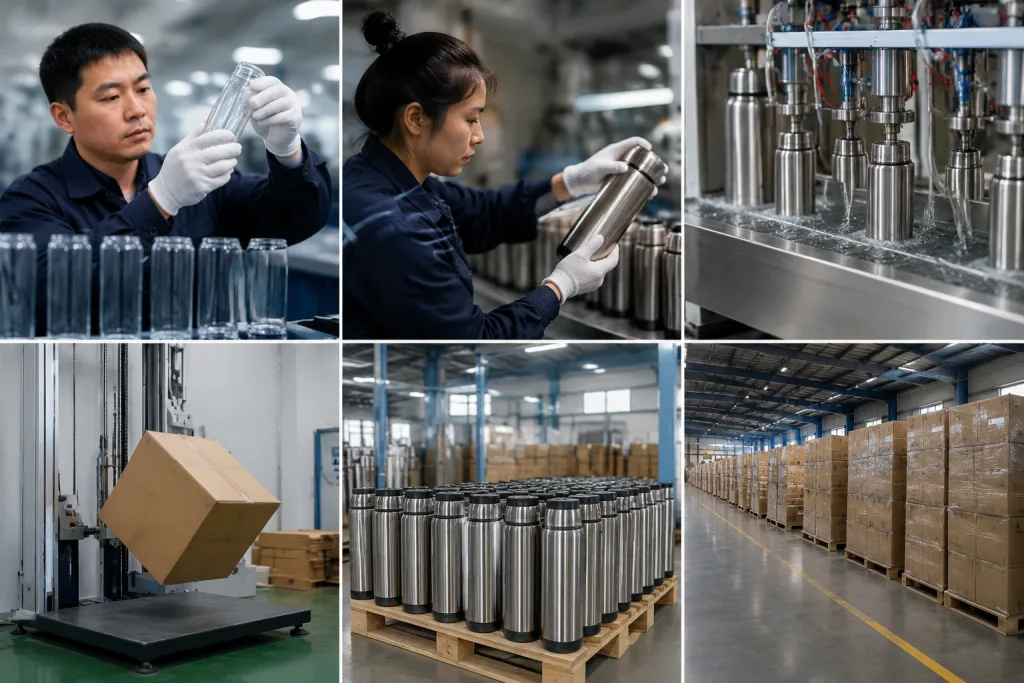
If you are buying from a borosilicate glass thermos bottle supplier, the sample is not the hard part. The hard part is the batch that looks fine in the showroom, then starts leaking after 3,000 openings, one freezer cycle, or a few bumps in transit. That is where outdoor retailers and promo brands lose money: not on unit price, but on leakage, breakage, weak print, and a loose fit between the inner glass liner, the silicone ring, and the outer stainless shell. We run these checks on the line with a torque tester and a 1-meter drop fixture, because the buyer will flag a lid that feels fine by hand and fails in cartons.
In Zhejiang and across China, the better factories do not hide behind “good quality.” They talk about wall thickness, thermal shock limits, cap torque, AQL, and drop-test criteria in millimeters and newton-centimeters. If you want a custom thermos, a bulk thermos program, or a thermos custom project with decoration, spec the failure points first. That is the wrong question to ask last. On one PO, a buyer typoed the cap size by 2 mm, and QC pulled the sample before it reached packing; that kind of miss turns a factory thermos into a warranty headache fast.
Where Glass Thermos Projects Fail
I’ll rewrite the three paragraphs in place, keeping the HTML tags and the existing technical numbers intact while stripping the AI-ish phrasing.The first failure mode is structural, not cosmetic. Borosilicate liner cracks usually come from handling stress, not one big hit. If the liner runs too thin or the shoulder radius is too sharp, the bottle can pass a quick appearance check and still fail after packing, vibration, or a customer drop test. For a borosilicate glass thermos bottle supplier, ask for liner thickness by zone, not a marketing spec. On the line, we want the drawing to show body, shoulder, and base thickness separately; QC pulled a sample at 1.8 mm once and the base still chipped at pack-out.
The second failure is seal mismatch. A glass thermos bottle can look clean and still leak because the silicone gasket is undersized by 0.3 mm or the cap thread tolerance is loose. In our Zhejiang shop, the buyer flagged the cap before the glass, and that is the usual story. For a custom thermos or customized thermos program, make the supplier confirm thread gauge, gasket durometer, and closure torque. We run 0.8-1.2 N·m on most household caps, then check it in your own test matrix; the math does not work if someone leaves torque as “tight enough.”
The third failure is temperature shock. Borosilicate handles heat better than soda-lime glass, but it is not indestructible. If your spec never defines preheat, cold-fill, or ice-water transition, the supplier will pick the easiest reading and ship that. That is how thermos promotional runs end up with cracked bottles in winter cartons. Ask for a thermal shock test at 120°C minimum, and if you are targeting premium retail, push for 150°C. We’ve seen this go sideways when the PO typo said “1200°C” and nobody caught it until sampling.
Spec the Glass Before the Shell
I’ll rewrite the section in place, keep the HTML intact, and tune the prose to sound like a factory-side sales engineer.Buyers often fixate on the stainless shell because it is visible and easy to print. That is the wrong order for this product. The liner and seal decide whether the unit survives. For a thermos manufacturer or thermos factory, we run the spec in this sequence: liner material, wall thickness, then shell gauge and finish. If the liner spec is weak, a thicker shell just covers the fault.
For borosilicate glass, ask for a material declaration with composition and a test reference such as ASTM-style thermal resistance records or an internal equivalent. You do not need a chemistry lesson; you need the same result on every shipment. Ask the manufacturer to state whether the glass is made for food-contact use and whether the supplier thermos system has REACH coverage for Europe plus a basic food-contact declaration for North America. If they stall, we move on. QC pulled the sample on one run and the paperwork did not match the carton lot.
For the outer shell, 201 stainless can pass on price, but 304 is the safer call for a retail line that has to last. If the factory is quoting a sharp number on a promotional thermos order, ask for the sheet gauge and finish, not a glossy brochure. On a lot of custom thermos projects, 0.4-0.5 mm shell thickness works, but only when the drop test and dent resistance are set in writing. We have seen this go sideways when the buyer approved price first and asked about gauge after the PO was issued.
- Glass liner thickness: 1.2-1.5 mm
- Outer shell gauge: 0.4-0.5 mm typical
- Leak test: 100% assembly check
- Final sampling: AQL 1.0 for major defects
Decoration Can Create Hidden Scrap
I’ll rewrite the section in-place, keep the HTML tags untouched, and tighten the copy so it sounds like a factory-side sales engineer.Print failure is the quiet killer in thermos custom programs. A logo can look clean on sample day, then fade, scratch, or bleed after a few wash cycles or one pass through the warehouse. We see this a lot on thermos customizable orders when the buyer asks for laser, silk screen, pad print, and one-color packaging in the same PO. The smarter move is to match the decoration method to the shell’s surface energy, not the photo in the approval file.
For laser engraving on stainless, we ask for a 1,000-rub cycle target on the decorated area. For silk screen, QC should run tape pull after curing and lock the pass/fail standard before the line starts. If the buyer sells to outdoor retailers, abrasion resistance beats a deep matte look. If the buyer works through distributors thermos channels, repeatability matters more, because one mixed batch turns into three claims by Friday.
On borosilicate glass surfaces, direct print is a different game. Some thermos manufacturers promise decoration on glass, then move the graphic to the cap or sleeve once production starts. That can work, but only if the change is written down. The same rule applies to custom logo placement on a promotional thermos order: confirm printable zones, curvature limits, and color tolerance. We’ve seen a Delta E 2.0 shade shift pass one buyer and get rejected by another. Do not assume.
Packaging Breaks More Than You Think
I’ll rewrite the section in-place, keep every HTML tag intact, and tighten the prose so it reads like a factory-side sales engineer wrote it.Most glass damage does not start at the line. It shows up in carton loading, pallet stacking, or the last 3 meters before receipt. We have seen 1 cracked liner turn into a 24-carton claim. That is why a thermos distributor or thermos vendor should treat carton drop testing as part of the product spec, not an afterthought. If the item ships as a bulk thermos program, the outer pack is part of the SKU.
Ask for ISTA-style transit testing or, at minimum, a written internal drop test: 80 cm for retail carton, 60 cm for master carton, then edge drops after vibration. QC pulled a sample last month and the carton corner failed first, not the glass. If a supplier says they skip carton testing because “the bottle is strong,” that is the wrong question to ask. A borosilicate glass thermos bottle supplier should know one broken liner can contaminate the whole inner pack and trigger a chargeback.
For export to Europe and North America, check carton labels, barcode scan rate, and pallet build. If you run FBA or retail compliance, carton quantity, FNSKU placement, and master carton marks need to be locked before the truck leaves. We ship plenty of Zhejiang export orders, and the smooth ones all start with a clean packing sheet and no typos on the PO. Ask for standard export packing photos, not a catalog mockup.
Good packaging does not save a weak bottle. It keeps a good bottle out of a claim.
How to Vet the Factory Properly
I’ll keep the HTML structure exactly as-is and rewrite only the prose, with tighter factory-floor detail and fewer generic phrases.You do not need a perfect factory; you need a factory that can prove control. When you audit a borosilicate glass thermos bottle supplier, start with capacity and quality system, not sales language. A real thermos plant in Zhejiang should tell you monthly output, line count, and rejection rate without checking the brochure. For a mid-sized export factory, 80,000-120,000 units/month, 2-4 production lines, and an internal defect target under 2% are numbers that pass the smell test. We’ve seen buyers get burned by pretty samples and weak output.
Next, ask how they inspect incoming glass, silicone, and stainless parts. Do they use lot traceability? Do they record cap torque? Do they pull from each batch or only inspect the first carton? On the line, QC should be able to show an IQC sheet, an in-process check, final AQL sampling, and retained samples by lot. If they cannot pull a record for one order in under 5 minutes, the custom thermos promise is just talk.
Then look at the commercial details. For a promotional thermos or distributor thermos order, ask for MOQ by decoration method, not just by model. A plain order might start at 1,000 pieces, while laser marking or gift box work can push the MOQ to 3,000 pieces. Lead time is usually 25-35 days after sample approval, with the sample room and printing table adding real bottlenecks. If a supplier says 7 days for a fully customized thermos with printing and packaging, the math does not work.
This is where China sourcing gets practical, not abstract. The better Zhejiang suppliers answer these questions fast, and they do not flinch when the buyer flags a typo on the PO or asks for one more inspection photo. The weak ones dodge the numbers. We’ve seen that go sideways. In a crowded field of thermos suppliers, that is the difference that saves your week.

Pricing Without Getting Burned
I’ll rewrite the section in-place, keep the HTML untouched, and tighten the pricing language so it sounds like a factory-side sales engineer wrote it.Price only makes sense after the spec is locked. For a custom thermos with a borosilicate liner, stainless shell, standard lid, and one-color print, our shop usually lands around USD 2.40-4.20 per unit at 1,000-3,000 pieces. Decoration, packaging, and steel grade move it fast. A quote that comes in 20% lower with no mention of testing, packing, or liner thickness is the wrong number to trust.
When you compare suppliers thermos quotes, ask for a line-by-line split: liner, shell, cap, gasket, print, inner pack, master carton, and testing fee. We ran a batch where QC pulled the sample and found the liner wall at 1.2 mm instead of the 1.5 mm the PO called for. That sort of miss is why we do not buy a single lump sum unless the buyer wants a sample price, not a production price. On bulk thermos programs, the pain shows up later as molding charges, artwork charges, or “extra QC” fees on the final invoice.
For branded retail, ask for FOB Ningbo or FOB Shanghai in plain numbers and check whether the price includes export cartons, barcode labels, and spare gaskets. A good thermos manufacturer will not blink. We ship these quotes every week, and the buyer flagged one last month because the PO had “stainless cap” typed twice and no carton spec. From Zhejiang, clean quote language saves a week of back-and-forth and keeps the line moving.
Get a real QC spec before you order
Send your target price, artwork, and carton needs. We’ll turn them into a production-ready thermos custom spec with clear test limits.
Frequently asked questions
What MOQ should I expect for a custom borosilicate glass thermos?
For a standard custom thermos order, expect 1,000 pieces for plain packaging and 3,000 pieces if you need printing, gift boxes, or color-specific decoration. Some thermos manufacturers in Zhejiang can do 500 pieces for a trial run, but unit price will be higher, often by 15-30%. If you want a thermos customizable program with multiple SKUs, ask whether MOQ applies per color or per total order. That detail changes your landed cost more than buyers expect.
How do I reduce breakage in shipping?
Start with carton design, not just bubble wrap. Ask for 80 cm retail-carton drop testing, 60 cm master-carton testing, and a vibration test before mass production. Use an inner tray that fixes the liner and cap so they do not rattle. For a borosilicate glass thermos bottle supplier, a breakage rate below 0.5% in transit is realistic if the packaging is right. If they ship by pallet, confirm stacking strength and moisture resistance of the carton board.
Is borosilicate glass safe for hot and cold use?
Yes, if the material is real borosilicate and the design is controlled. Ask for thermal shock resistance of at least 120°C and, for premium programs, 150°C. Also confirm the glass is intended for food-contact use and that any silicone gasket is food-grade. The safety issue is usually not the glass chemistry alone; it is the liner thickness, the shoulder geometry, and the seal design. A good thermos manufacturer will provide these specs without hesitation.
Can I use laser engraving on glass and stainless?
On stainless, yes, laser engraving is usually the most durable decoration for a promotional thermos. On borosilicate glass, the result depends on coating, curvature, and artwork size. Ask for sample photos from the same thermos factory, not generic reference images. For stainless, request a rub test target of 1,000 cycles. For print on glass, define whether the decoration is on the liner, cap, or outer shell before you approve the sample. That avoids late-stage disputes.
What should I ask a supplier before placing a bulk order?
Ask for capacity, lead time, sample approval time, material declarations, carton test results, and defect control records. A solid borosilicate glass thermos bottle supplier should give you a monthly capacity number, often 80,000-120,000 units, and a real lead time of 25-35 days after sample sign-off. Also ask if they support REACH, food-contact declarations, and AQL final inspection. If they can answer all of that clearly, they are likely a real supplier thermos partner rather than a trading-only quote machine.