Key Takeaways
- Most first custom thermos orders start at 1,000–3,000 pcs per SKU, with 35–45 days lead time after sample approval
- A practical FOB China price for a double-wall stainless body with borosilicate liner often starts around USD 3.20–6.80 depending on finish and lid
- Use AQL 2.5 for major defects and require a 100% leak test on every thermos custom order
- For retail and promo buyers, carton size, drop resistance, and print durability matter as much as the bottle itself
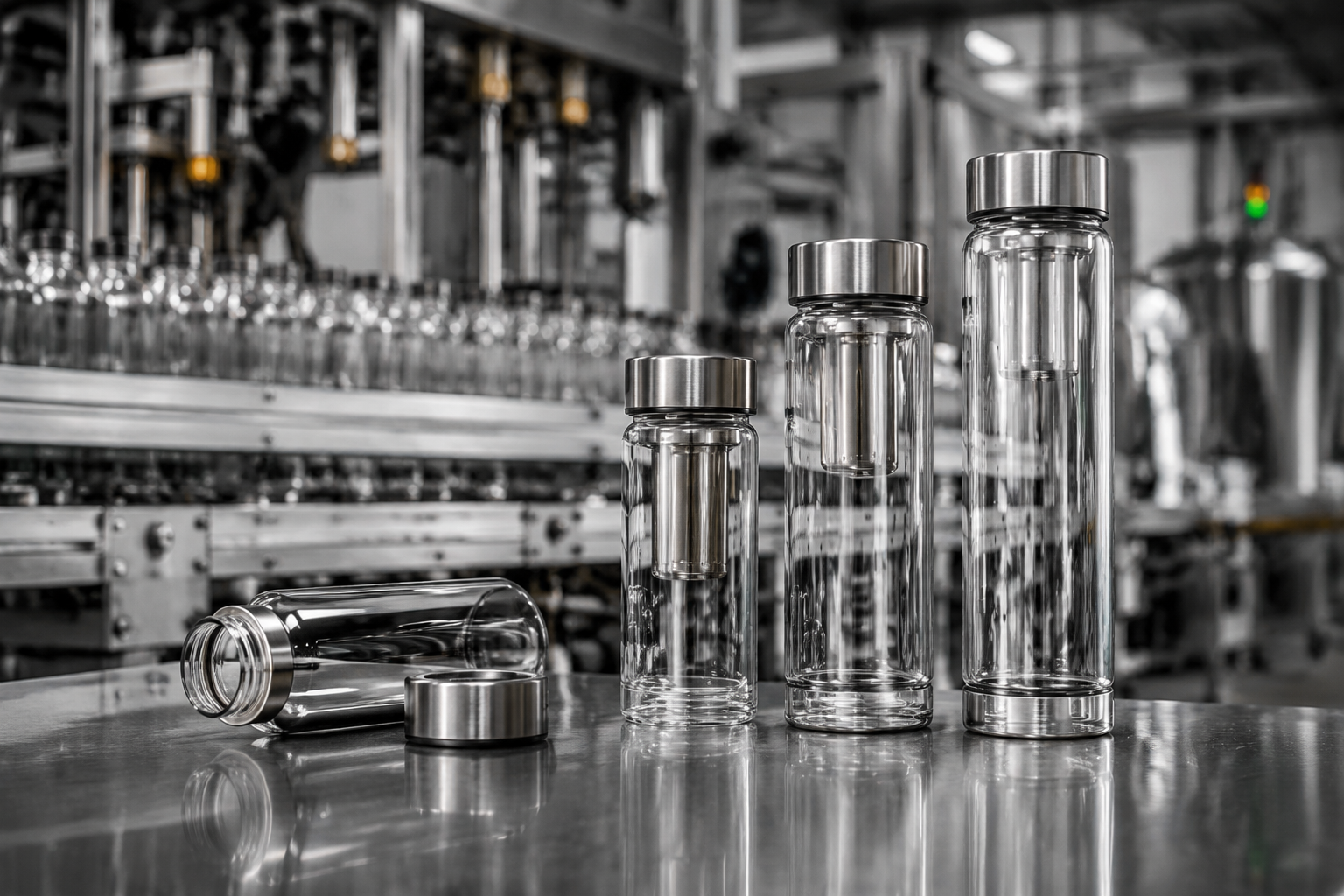
You are not buying a catalog shot. You are buying a thermos that has to survive a 3-hour truck run, a trade-show handout, or a retail shelf where freight, cartons, and breakage still have to leave margin. If you work with a borosilicate glass thermos bottle manufacturer, the real question is not “Can you make it?” The real question is “Can you make it the same way every time, in the finish you want, at a price your market can still carry?”
That is where first orders usually go sideways. A stainless outer shell looks simple until lid torque, liner fit, print registration, and a 1.2 m drop test land on the same PO. At BottleForge in Hangzhou, Zhejiang, we run into this every week with outdoor retailers and promo brands placing bulk thermos orders from China. The clean orders start with one page of specs, an MOQ that matches the market, and QC written before the first sample leaves the line.
Start With the Use Case
I’ll rewrite the prose in place, keep the tags exactly as-is, and tighten the sales-engineer tone with a few concrete factory details.The cleanest orders start with a real use case, not a vague request for a “nice customized thermos.” If you sell through outdoor retailers, you need a cup that feels solid in hand, has a lid that stays quiet, and survives 200 open-close cycles on the line. If the program is for promotion, the math changes fast: logo area, print cost, and carton count matter more than a fancy lid. Same thermos, different job.
For a borosilicate glass thermos bottle manufacturer, the first questions should be plain and specific: 350 ml or 500 ml? Single-wall sleeve or double-wall stainless shell? Clear liner or tinted inner wall? Matte spray or brushed steel? A buyer who sends that list gets a faster quote and fewer sample rounds. A buyer who skips it usually loses 2–3 weeks just on cap matching and decoration. We run it the same way in Zhejiang: lock the packaging path first, then bottle geometry, then decoration. QC pulled the sample, checked the mouth tolerance at 1.2 mm, and that saved a round of back-and-forth.
One practical rule: if your retail target is under USD 15, do not overload the spec. A customizable thermos with a stainless outer, borosilicate liner, and a PP or bamboo-accent lid is easier to source than a heavily tooled premium concept. If you need a distributor thermos for several markets, ask for one body with two lid options instead of two separate molds. We’ve seen this go sideways when buyers chase two SKUs too early. The buyer flagged it, and the margin disappeared on the first PO.
Pick the Right Build
I’ll keep the tags intact and rewrite the three paragraphs to sound like a factory-side sales engineer, with concrete shop-floor detail and none of the AI filler.On paper, “stainless thermos” looks like one SKU. On the line, it is a build choice that changes weight, insulation, breakage risk, and landed price. A borosilicate glass thermos bottle usually runs with a stainless outer shell for impact resistance and a borosilicate inner liner for heat retention and cleaner taste. We usually see the glass liner at 1.2–1.8 mm, depending on size and mold geometry; on a 500 ml sample, that wall is thick enough to survive packing drops without killing thermal performance.
Do not skip the lid. That is where returns show up. More than once, QC pulled the sample because the cap passed a cold-water check and failed after 95°C hot fill. For a custom thermos lid, we check thread engagement, silicone seal compression, and hot-fill distortion at 95°C. Ask for a torque target and a leak test after 24 hours of hot water. If the buyer flagged it and the supplier still says “no problem” but cannot show a fixture or a torque range, the math does not work.
Materials still set the tone. Stainless 304 is the standard for the shell and contact parts, and we ship that on most export orders. For the liner and internal parts, confirm food-contact compliance with REACH for Europe and FDA expectations for North America. A serious thermos supplier in Zhejiang should be able to show material declarations, coating specs, and a migration path without guessing. We’ve seen this go sideways when a PO typo changed one digit on the coating code, so ask for the exact spec sheet before the first 100 units run.
Quote the Order Correctly
Most bad pricing starts with a thin inquiry. If you send a thermos custom request with only capacity and logo, the factory can only give a range, not a real quote. A proper RFQ needs capacity, structure, lid type, logo method, finish, packaging, shipping term, and target market. That is how a manufacturer thermos team prices tooling, decoration setup, and carton loading without guessing.
For a first order at a real factory in China, sample charges usually run USD 40–120 per design, depending on whether you need new color matching or a new lid insert. MOQ is often 1,000 pcs for standard models and 3,000 pcs if you want heavy customization. We had a buyer push back on a 1,200 pcs target last month, but the math did not work once the lid mold and print screen were added. For promotional thermos projects with one-color print and standard packaging, some suppliers can go lower, yet freight and setup often wipe out the savings. A buyer should watch landed cost after carton count, inner pack, and breakage allowance, not just the headline unit price.
The clean way to quote is to ask for three levels: plain body, branded print, and fully packaged retail version. Then you can compare thermos supplier options on the same basis. If a quote is USD 3.50 FOB for a plain unit, USD 3.85 with one-color silkscreen, and USD 4.20 retail packed, you can see where the money moves. QC pulled the sample on a 12 mm carton gap before, and that kind of detail matters for outdoor retailers placing a distributor thermos order.
Sample Like a Buyer
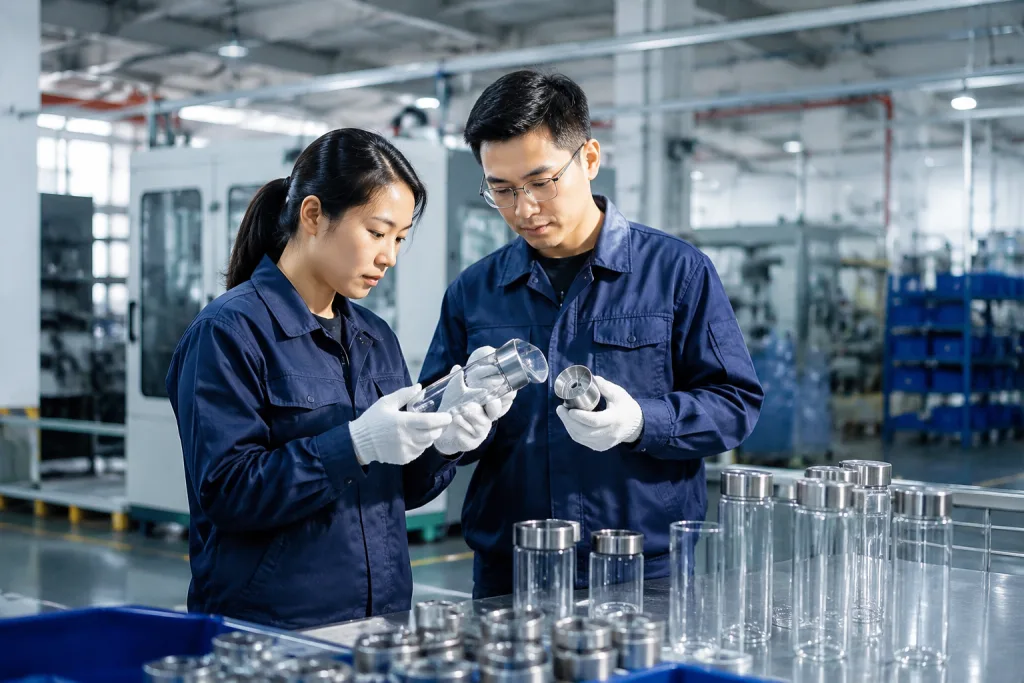
Sampling is where a lot of buyers lose a week, then approve the look and skip the function. A proper custom thermos sample run needs three checks: visual approval, function testing, and packaging verification. Do not sign off from one clean sample photo. Ask for a full pre-production sample with the actual logo position, the production lid, and the final carton insert.
The function test is simple. Fill to 95°C, close the lid, wait 30 minutes, invert it for leak testing, then drop it from 1 meter onto a hard surface. If the customized thermos sample passes that, you have a workable starting point. We’ve seen buyers ignore this and then blame the factory when the lid starts weeping in transit. If you supply distributor programs, test the print with an alcohol rub and 20–30 hand washes too; one PO typo on the artwork file can turn into a faded logo by the first carton open.
At BottleForge, sample lead time sits around 7–12 days for standard structures and 15–20 days when new decoration or color matching is involved. That is normal for a Zhejiang thermos line that is already running production. If a supplier says they can make a fully unique sample in 2 days, ask what they skipped. QC pulled the sample on our side at the 0.5 mm seal edge, and that kind of fit does not come from rushing the line.
Run QC Before Shipment
QC is where you protect the order you already sold. For a borosilicate glass thermos bottle manufacturer, the inspection plan belongs in the PO, not in a last-minute phone call after the line has already started. We write AQL 2.5 for major defects and AQL 4.0 for minor cosmetic issues when the product goes to retail. For promo thermos runs, the visual bar can be a bit looser, but leak and safety checks stay at 100%.
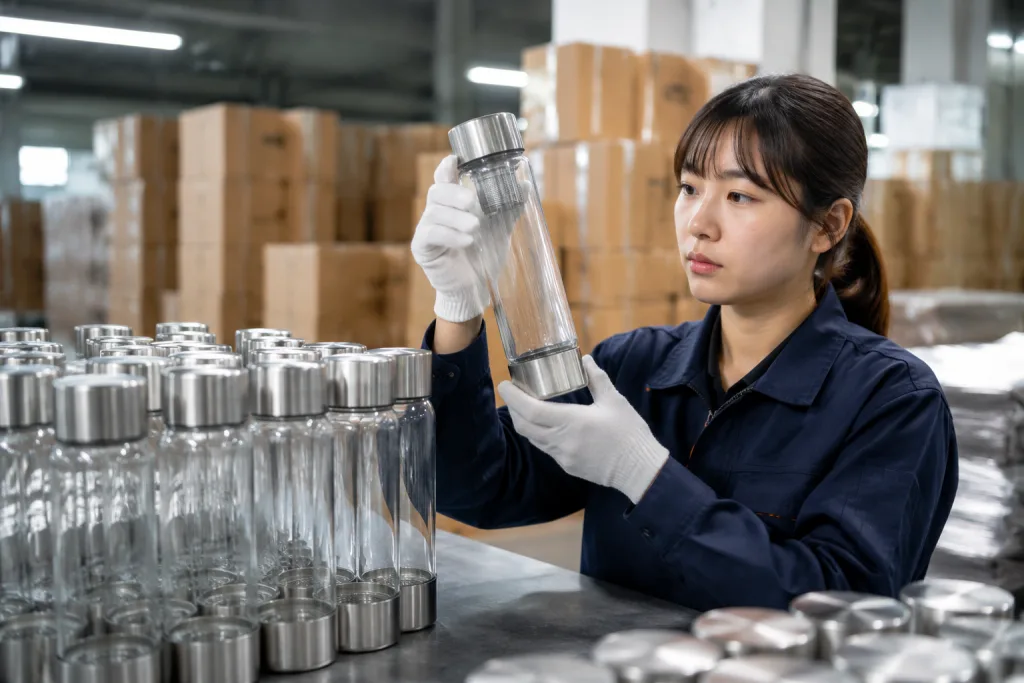
The checks are straightforward: vacuum performance, lid seal, logo position, shell dent limit, carton drop resistance, and odor. A batch can pass eyeballing and still fail in transit if the inner tray is thin or the lid backs off under vibration. We’ve seen that go sideways. Ask for 100% leak testing on export orders. If you ship thermos bulk units to a warehouse with FNSKU labels, confirm barcode placement and carton marks before sealing.
Practical QC block:
- 100% leak test on each unit
- Sampling by AQL 2.5 for major defects
- Carton drop test from 80 cm to 100 cm
- 24-hour hot-water hold test at batch level
- Label and artwork verification before packing
This is not overkill. It keeps a 2% return rate from wiping out the margin on a wholesale order, and the distributor will remember who shipped the broken lid, not who quoted the lower price.
Move It Through Export Cleanly
The best-made custom thermos still fails if export work is sloppy. For Europe and North America, packaging and compliance sit in the product cost, not beside it. Check outer carton strength at 5-layer spec, inner tray fit, and whether the target market needs warning text or recycled-content claims. If you run a thermos promotional program, ask for both FOB and DDP. The landed number tells the truth.
In China, especially Zhejiang, a supplier with export experience should handle commercial invoice details, HS code support, and booking coordination without hand-holding. We ship a standard order in 35–45 days after sample approval, and 50–60 days if the job adds new molds, special coatings, or pack changes. One buyer once missed a pallet label typo on the PO, and the whole booking slipped three days. If you need master carton palletization, Amazon-style prep, or mixed-SKU packing, write it into the order sheet. Labor and freight move fast when those details are vague.
For repeat programs, build replenishment logic into the quote. A factory running 80,000–120,000 units per month gives you room to refill stock, but only if QC stays tight and the reorder window is clear. QC pulled the sample on one line last month at AQL 2.5 and caught a lid-thread mismatch before shipment; that saved the buyer a return claim. This is the wrong question to ask: not “who is cheapest,” but “who can keep the line stable when the second and third orders land.”
Send your spec, get a real quote
We’ll review your order path, confirm MOQ, and quote your thermos custom program with practical pricing, QC, and lead time from Hangzhou, China.
Frequently asked questions
What MOQ should I expect for a custom borosilicate glass thermos order?
For a standard structure, 1,000 pcs is a normal MOQ at a serious thermos factory in China. If you want a new lid, special coating, or unusual packaging, 3,000 pcs is more realistic. Promotional thermos projects can sometimes start lower, but unit cost usually rises fast. In Zhejiang, most supplier thermos teams will quote better once you commit to a full carton run rather than a partial mixed batch.
How much does a customized thermos cost FOB China?
For a double-wall stainless body with a borosilicate liner, simple lid, and one-color logo, expect roughly USD 3.20–6.80 FOB depending on capacity, finish, and carton spec. A more premium customized thermos with matte coating, bamboo detail, or upgraded packaging can move higher. The best way to compare thermos suppliers is to ask for plain, branded, and retail-packed pricing side by side.
How do I check if the thermos manufacturer is reliable?
Ask for production capacity, inspection method, and compliance documents before you discuss price. A reliable borosilicate glass thermos bottle manufacturer should provide material declarations, REACH support for Europe, and a written QC plan. Ask whether they do 100% leak testing, what AQL level they use, and how many units per month they can actually produce. If they cannot answer those without delay, treat them as a risky supplier thermos option.
Can you handle branded promotional thermos orders for distributors?
Yes, but the order needs to be structured around speed and repeatability. For a promotional thermos run, we usually recommend one bottle body, one logo method, and one carton spec to keep the line stable. If you are a thermos distributor, you should also confirm label format, pallet count, and whether you need FNSKU or local barcode application. That keeps rework and warehouse delays low.
What lead time should I plan for from sample to shipment?
Plan 7–12 days for samples on a standard design and 35–45 days for mass production after approval. If you need new tooling, special colors, or a customized thermos packaging structure, add another 10–15 days. In peak season, a Zhejiang factory thermos line may need an extra week if you miss the production window. Good planning saves more money than chasing a lower quote.