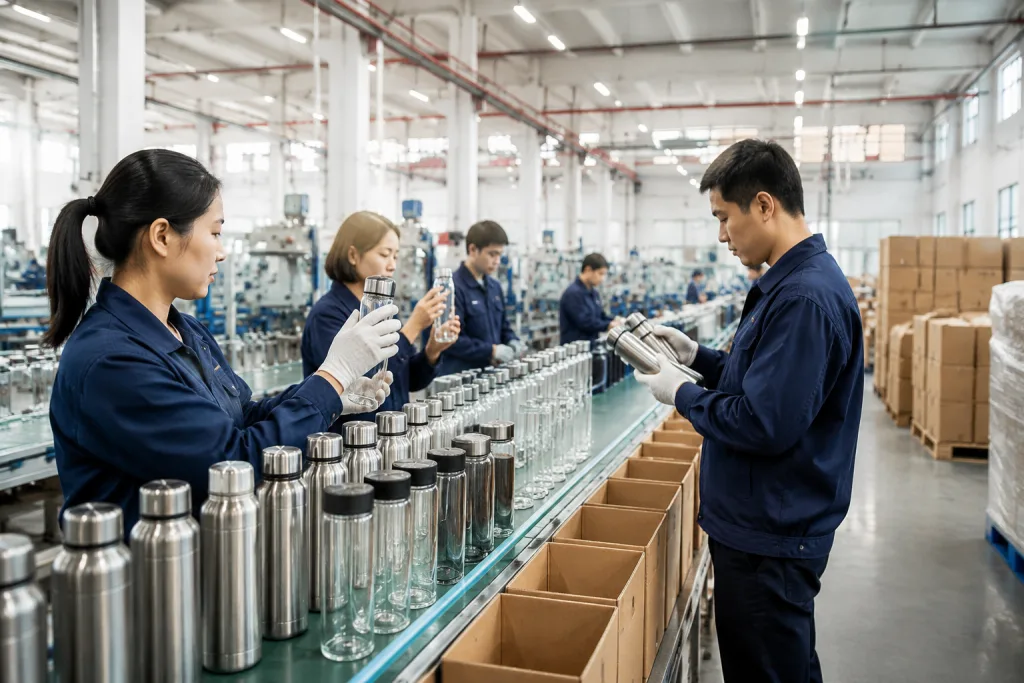
Key Takeaways
- Stainless 304 inner walls usually survive 1.0 m drop tests far better than borosilicate glass, which matters for outdoor retail and distributor thermos programs.
- Borosilicate glass gives cleaner taste and easier visual QA, but it needs thicker packaging and usually adds 8% to 15% to landed cost versus a basic stainless build.
- For custom thermos orders, MOQ commonly starts at 3,000 units in Zhejiang factories; print, laser, and color box changes can push lead time to 30 to 40 days.
- Promotional thermos buyers should match use case to spec: stainless for rugged channels, borosilicate glass for premium deskware, gifting, and low-odor applications.
If you are sourcing a borosilicate glass thermos bottle factory product line, you are usually trying to hold two targets at once: a clean shelf look and a bottle that survives real shipping abuse. Retail buyers want premium graphics and stable heat retention. Promo buyers want fast printing, safe cartons, and a landed cost that still leaves room. We see that tradeoff on the spec sheet every week in Zhejiang.
The wrong move is treating stainless, glass-lined, and borosilicate glass thermos bottles as the same product with different skins. They do not run the same on drop tests, odor retention, coating wear, or MOQ math. At BottleForge Industrial in Hangzhou, we run about 300,000 units a month across thermos and drinkware lines, with a standard thermos MOQ from 3,000 pieces and a 25 to 35 day lead time after sample approval. QC pulled a sample last week with a 0.3 mm lid gap, and the buyer flagged it before we packed the carton. That is where bad choices get expensive fast.
Stainless vs glass at a glance
I’ll rewrite the section in the same HTML, keeping the table structure and the given specs intact, while making the prose read like a factory-side sales engineer.Buyers usually mean one of two builds when they ask for a custom thermos: a stainless vacuum bottle that can handle rough use, or a borosilicate glass bottle that feels cleaner on the shelf. The math starts at the inner wall. That is where we see failures, returns, and the buyer’s first complaint.
| Spec | 304 Stainless Thermos | Borosilicate Glass Thermos |
|---|---|---|
| Drop resistance | High, good for retail and outdoor use | Low to moderate, depends on packaging |
| Taste retention | Very good with proper passivation | Excellent, neutral flavor |
| Weight | Heavier wall set, usually 260-420 g empty | Often lighter body but more fragile |
| MOQ | 3,000 pcs typical | 3,000-5,000 pcs typical |
| Lead time | 25-35 days | 30-40 days |
| Landed cost impact | Baseline | +8% to +15% with stronger packaging |
For outdoor retailers, stainless is the safer call. We ship it with less drama, and a 1.2 mm wall plus a 304 inner makes the line easier to control. For promo brands selling office gifts, tea sets, or premium bundles, borosilicate usually wins if the carton spec is done right. We’ve seen this go sideways when a buyer approved a thin mailer box, then flagged broken inner bottles after the first 200 pcs. In Zhejiang, plenty of factories sell both under one “thermos factory” name, but a real supplier tells you where the risk sits: body, lid seal, or transit carton.
Use case decides the build
I’ll rewrite the HTML in place, keep the tags and headings intact, and tighten the prose so it sounds like a factory-side sales engineer wrote it.You do not choose a thermos by material alone; you choose it by channel. A thermos manufacturer selling to outdoor retailers needs impact resistance, lid cycle life, and insulation that still holds after 300 open-close rounds. A thermos supplier selling corporate gifts cares more about decoration area, color match, and the unboxing hit. Same factory. Different brief. We’ve seen buyers get that wrong and then blame the line.
Outdoor retail
For camping, hiking, jobsite, and travel retail, stainless is the safer build. A 500 ml or 750 ml bottle with 18/8 stainless inner and outer walls, 0.4 mm to 0.5 mm wall gauge, and a silicone-sealed lid is the standard we run. QC pulled a sample with a loose cap after 48 hinge cycles, and that is the kind of failure that turns into a return. Ask for a 6-hour hot test above 68°C and a 24-hour cold test below 10°C, but the real question is drop survival. Retail returns cost more than the bottle.
Promotional branding
For a promotional thermos, print area and perceived value carry the order. A borosilicate glass core inside a sleeve or outer shell gives a cleaner taste story and works well for desk gifts. If the buyer wants a logo on glass, sort the decoration method early: silk print, decal, or laser on the metal parts. We had one PO with a typo on the lid art code, and the buyer flagged it only after proofing. Do not sell a fragile item into a field-sales campaign; the math does not work.
For distributors thermos programs, flexibility wins. Keep one base mold, then change lid color, body finish, and carton art. That is how a thermos distributor keeps stock moving instead of parking it for 90 days. In Zhejiang, the sharper buyers ask for one body and three lid SKUs, not three full products. We ship those faster, and the MOQ stays easier to control.
Cost, MOQ, and margin reality
I’ll rewrite the prose in place, keep the tags and structure intact, and make it sound like a sales engineer wrote it from the floor.Procurement teams like to compare unit prices, but a thermos is not a loose cup. The real cost sits in tooling, inner wall yield, vacuum leak rate, carton strength, and the replacement risk we carry after shipment. A basic 500 ml stainless bulk thermos usually lands around USD 2.10 to USD 3.40 FOB, depending on finish, lid build, and order size. A borosilicate glass version starts closer to USD 2.80 to USD 4.80 FOB once you add thicker packing and a lower breakage tolerance. Last month QC pulled 20 samples and found 3 lids with weak torque, so the buyer dropped the PO. That math does not work.
At a Zhejiang thermos factory, MOQ is where the deal either clears or gets stuck. For custom color powder coating, we run 3,000 pcs minimum. For molded lids or special gift boxes, 5,000 pcs is standard. If you need a customized thermos for Amazon or retail, ask for carton drop test results and master carton compression data before you sign the PO. We’ve seen a typo on a purchase order turn “2,000” into “200” and waste a week. It is cheaper to kill a bad spec at sample stage than to fight over 2% breakage after sea freight.
Here is the margin rule we use on the line: stainless works on volume and repeat orders, while borosilicate works on premium channels and tighter return control. A thermos manufacturer in China can quote both, but your channel only supports one if you want clean margin.

Print, branding, and packaging choices
I’ll rewrite the section in-place, keeping the HTML structure and links intact while making the prose sound like a factory-side sales engineer wrote it.Decoration is where a lot of customizable thermos orders go off track. Stainless takes laser engraving, UV print, silk screen, and powder coat masking without much drama. Borosilicate glass is tighter. We can do decal or screen print on the body if the curve is forgiving, but once the line starts post-processing a fragile shell, QC pulls samples fast. If you want a thermos customized for a brand launch, lock the decoration method before the mold is signed off, not after the PO comes in with a typo on the logo size.
For a thermos promotional program, packaging is part of the SKU, not an add-on. A glass build needs inner inserts, corner blocks, and a master carton that passes 1.2 m to 1.5 m drop tests. Stainless ships in slimmer cartons, and on some SKUs that cuts freight volume by 8% to 12%. That is why a thermos supplier will sometimes push stainless even when the buyer wants glass. We’ve seen the math go sideways on landed cost, then the buyer flags the claim rate two weeks later.
Good packaging is not a marketing extra. For glass-lined products, it is part of the product spec.
If you want to compare decoration routes, work with a factory that also handles silkscreen vs laser engraving and can spell out what survives dishwasher cycles, abrasion, and daily hand contact. For retail branding, that is the right question to ask. We run this test on the line with rub checks and 24-hour soak samples before we approve the print.
Quality checks that actually matter
I’ll rewrite the section in-place, keep the tags and structure, and make the copy sound like a factory-side sales engineer wrote it.Buyers throw out “quality control” all the time. That is too loose. A real manufacturer thermos or manufacturers thermos program needs inspection points tied to the defect we actually see on the line. For stainless, we check vacuum loss, dent resistance, lid torque, weld quality, and passivation smell. For borosilicate, we check wall thickness, thermal shock resistance, cap alignment, and breakage during pack-out. QC pulled one 500 ml sample last month and the lid torque was off by 0.8 N·m. That is the kind of miss that turns into a chargeback.
We usually set AQL 2.5 for major defects and AQL 4.0 for minor defects on mixed consumer programs, but the channel decides the pain level. A national chain buyer once pushed back on “general QC language” in the PO, and he was right to flag it. We want pre-production samples, inline checks, and a final random inspection before shipment. Ask for REACH-compliant silicone, food-contact declarations, and ASTM or ISO references when the buyer asks for them. Paperwork clears customs; bad bottles kill repeat orders faster.
For a thermos distributor or suppliers thermos account, repeatability beats new features. Keep the same gasket hardness, the same carton spec, and the same inner liner finish from reorder to reorder. We run this every week in Zhejiang, and the math does not work if the spec keeps moving. One PO typo can turn “1.5 mm gasket” into “15 mm gasket” and waste a full packing day. Freeze the spec, then ship the same product again.
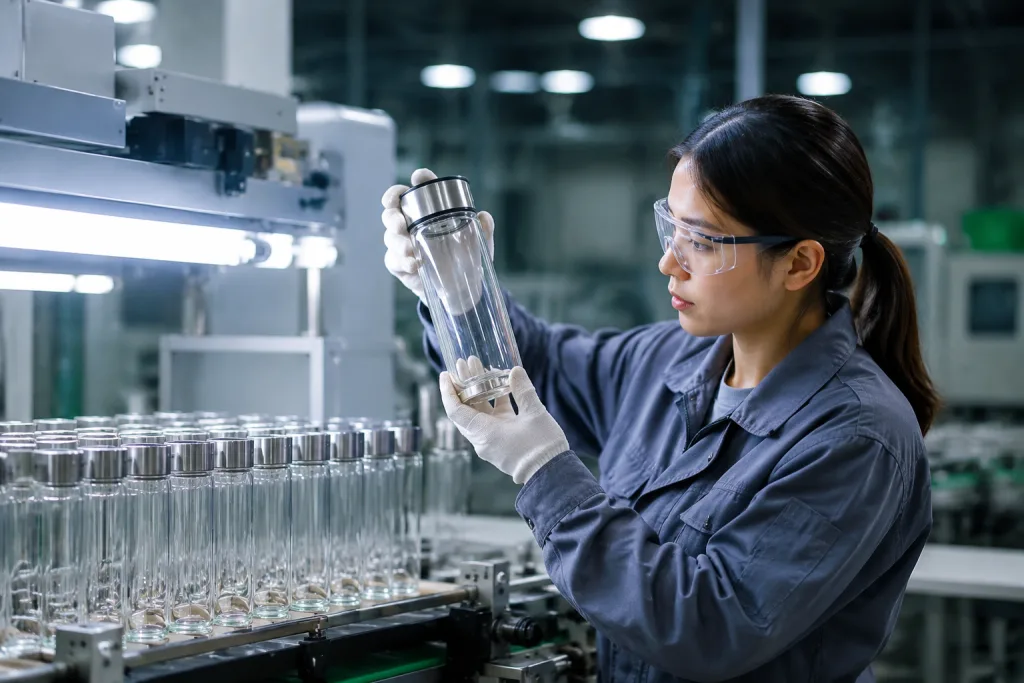
Which factory partner fits your channel
I’ll rewrite this section in place, keeping the HTML and links unchanged while making the prose read like a factory-side sales engineer wrote it.Not every thermos factory fits the same channel. For outdoor retail, we run better with a supplier thermos partner that has in-house tooling, vacuum lines, and a metal polishing bay. For premium gifting, a thermos vendor that can handle glass loading, insert packaging, and artwork sign-off is usually the cleaner move. In Hangzhou, Zhejiang, the good factories look plain on paper: steady output, tight specs, and no reorder surprises.
Ask three straight questions before you send a PO: what is the monthly output, can you hold a 3,000-piece MOQ without drifting on finish, and can you ship a repeat order in 30 days? We had a buyer flag a typo on a carton mark once, and that small miss turned into a 2-day delay at the line. If the reply stays fuzzy, the deal gets fuzzy later. A solid thermos distributors partner should also plan mixed containers, so you can load stainless and glass SKUs in one shipment without overbuying one style.
If you need a broader sourcing roadmap, review sourcing custom drinkware from China and MOQ explained for drinkware buyers. Those two calls usually decide whether the program makes margin or just keeps your team busy.
Get the right thermos spec, not the cheapest quote
Send your target capacity, decoration method, and channel. We will match stainless or borosilicate builds to your MOQ, price, and packaging needs.
Frequently asked questions
Is borosilicate glass better than stainless for thermos bottles?
Better depends on the channel. Borosilicate glass is cleaner tasting and works well for premium desk use, tea, and gift sets. Stainless is more durable, lighter on return risk, and usually better for outdoor retail and travel. In factory terms, a stainless 500 ml bottle often survives 1.0 m drop testing far better than glass. If your order is promotional and low-touch, glass can make sense. If your buyers are active consumers, stainless is usually the safer commercial choice.
What MOQ should I expect from a borosilicate glass thermos bottle factory?
For standard custom orders, expect 3,000 to 5,000 pieces. If you want special colors, custom lids, or gift packaging, 5,000 pieces is more realistic. Many Zhejiang factories can sample faster than they can tool, but they still need scale to keep breakage and packaging costs under control. If a supplier offers 500-piece MOQ on a complex glass thermos, check whether they are quoting standard stock or ignoring true packing cost.
How much does a custom thermos cost FOB China?
A simple 500 ml stainless custom thermos often lands around USD 2.10 to USD 3.40 FOB at 3,000-plus pieces. Borosilicate glass versions usually sit around USD 2.80 to USD 4.80 FOB because of packaging and breakage controls. Complex lids, powder coating, and premium gift boxes can move the price higher by 10% to 25%. Freight and claims matter too, so always compare landed cost, not just factory price.
Can you print logos on borosilicate glass thermos bottles?
Yes, but choose the method carefully. Silkscreen and decals are common on glass, while laser engraving is usually better on metal components such as caps or sleeves. On curved glass bodies, print durability can suffer if the bottle is handled often or washed aggressively. For a promotional thermos, the best result is usually a simple one-color mark with packaging that protects the print during transit.
What certifications should I request from thermos suppliers?
For Europe and North America, ask for food-contact declarations, REACH compliance for silicone and coatings, and material specs for 304 or 316 stainless if applicable. If your buyer needs it, request test references aligned with ASTM or ISO methods for thermal performance or material safety. Also ask for AQL inspection terms, carton drop test results, and a defect acceptance standard in writing. Good suppliers will give these without hesitation.