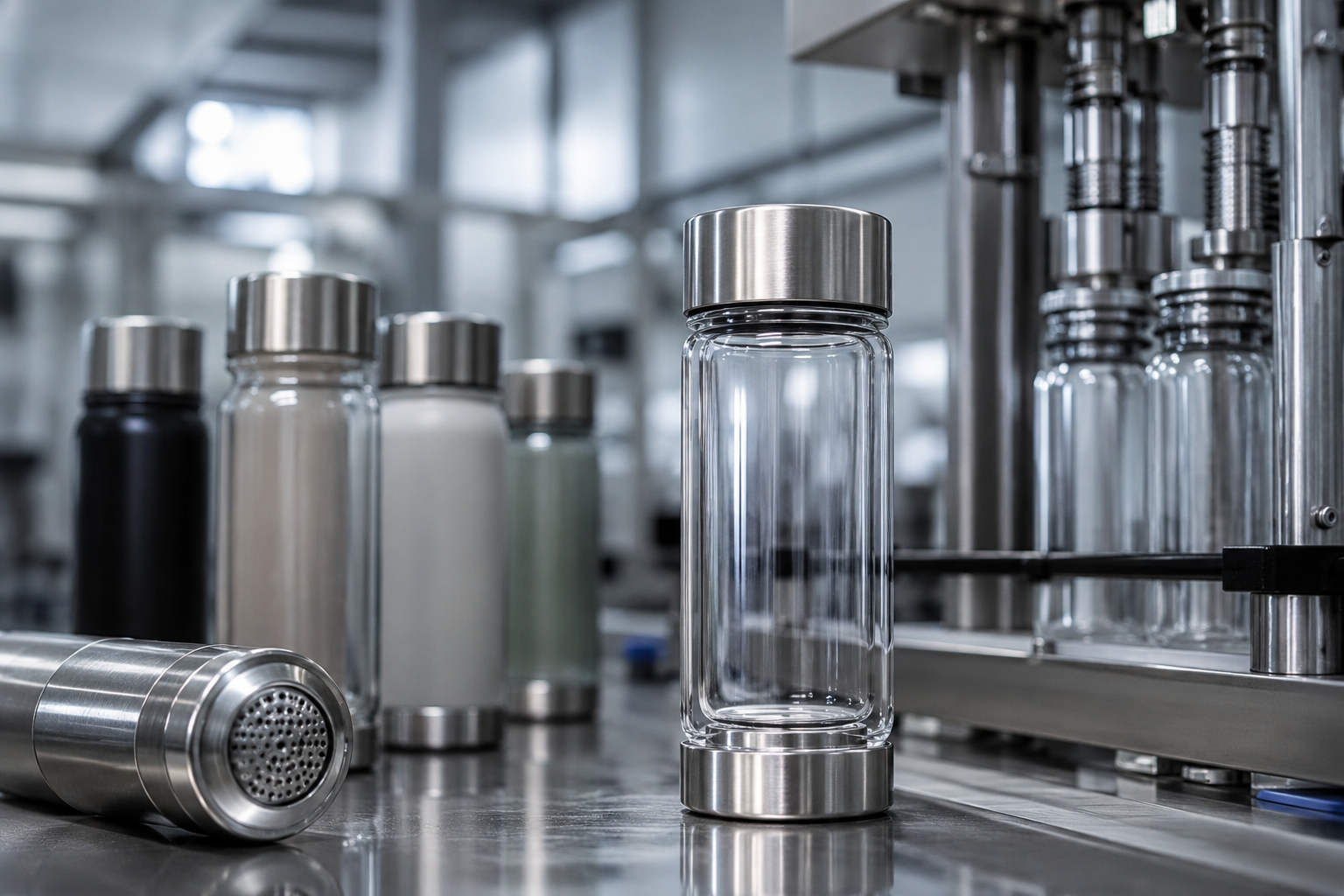
Key Takeaways
- Borosilicate glass usually handles 120-150°C thermal shock better than soda-lime glass, but the lid and seal often fail first.
- For bulk thermos orders, request wall thickness at 1.8-2.2 mm and neck tolerance within ±0.5 mm.
- A practical MOQ is 3,000 units, with 30-35 days lead time after artwork and sample sign-off.
- Ask for leak testing, drop testing, and AQL 2.5 inspection, not just a pretty pre-production sample.
When buyers place a borosilicate glass thermos bottle custom order, they want a clean premium look, steady heat retention, and a logo that still looks sharp after freight. The idea is fine. Production is where it gets messy. One 0.3 mm wall swing, a loose seal ring, or a print that fails cure will turn a good sample into a carton of complaints.
If you buy from Zhejiang or any other part of China, spec the failure points before you issue the custom thermos PO. Check glass grade, lid fit, drop risk, leak rate, and the exact decoration method. This is the wrong question to ask if you only want a low unit price. A serious thermos factory should quote MOQ, lead time, and test standards straight away. At BottleForge in Hangzhou, Zhejiang, our standard borosilicate run starts at 3,000 units, with 30-35 days lead time after sample approval, and that is normal for a manufacturer thermos program with real QC controls.
What actually breaks first
Most buyers blame the glass first. In a borosilicate glass thermos bottle custom run, that is usually the wrong place to look. The first failures show up at the lid, gasket, and decoration. We run a 15-20% cap torque swing check on the line, and that gap gives you slow leaks, pressure loss, or a lid that feels loose after one opening. That is how distributor complaints start even when the bottle body still passes.
The next weak point is finish damage. If your customized thermos uses frosted spray, a decal, or a laser mark on the outer sleeve, ask what happens after 50 dish cycles or a 1 meter drop test. “Durable” means nothing. QC pulled a sample last month where the print looked fine at packing, then the buyer flagged edge wear after the first carton test. For Zhejiang production, we split body, lid, and graphic approval before assembly, because the math does not work any other way.
- Glass wall: target 1.8-2.2 mm
- Neck tolerance: ±0.5 mm
- Leak test: 100% on final assembly
- Inspection: AQL 2.5 for major defects
If you are sourcing a thermos distributor or thermos supplier for retail, ask for the failure history by component. One PO typo on the lid code can waste a whole batch, and that sheet tells you faster than any catalog what will crack first.
Glass quality is not all equal
Borosilicate is not a magic word; it is a glass chemistry range. For custom thermos bottles, we look for a stable mix with a low coefficient of thermal expansion, usually around 3.3 × 10^-6/K. That helps the bottle take hot fill and a cold rinse without cracking like cheap soda-lime glass. Even then, bad annealing leaves hidden stress and microcracks that show up later at packing or on a 40-foot container ride.
For outdoor retailers, heat resistance is only half the job. Breakage in real handling is the issue. A glass thermos can pass the lab and still fail when 6 cartons are stacked in a container for 28 days. That is why a manufacturer thermos program needs annealing control, edge polish inspection, and random internal stress checks. On our line in Zhejiang, we have rejected bodies that looked clean but failed stress viewing, and those are the ones that come back as claims in Europe or North America.
Spec around the glass:
- Annealing temperature curve documented per batch
- Internal stress checked on 5-10 samples per lot
- Rim finish smooth, no chips, no “seed” points
- Carton drop test at 80 cm for packed units
If your thermos custom brief is for gifting, do not chase ultra-thin glass to save 0.08 USD. The math does not work. One broken carton wipes out the paper savings fast, and the buyer usually flags it after the first shipment.
Lid leaks kill repeat orders
Every distributor thermos program learns the same lesson fast: customers forgive a logo flaw before they forgive a leak. If the lid system is not engineered right, your customizable thermos turns into a complaint machine. We usually see leaks start in three spots: silicone geometry, thread engagement, or assembly torque drifting from one shift to the next. On the line, QC pulled the sample with a 0.5 mm gasket offset and the issue showed up immediately.
For a borosilicate glass thermos bottle custom order, specify food-grade silicone with odor control, and ask for compression set data if the supplier has it. The cap should close at repeatable torque, usually in the 0.8-1.2 N·m range for this category, depending on geometry. Run a hot-fill test at 95°C and a 2-hour inversion test. We had a buyer flag a PO typo on the lid spec once; the math does not work if the lid and bottle neck are not matched from the start.
Do not approve a lid from photos alone. The lid is where the margin disappears.
For bulk thermos shipments, ask for pre-shipment leak testing on 100% of assembled units. It slows the pack-out by a few hours, but it saves you from the kind of returns that wreck a promotional thermos campaign. If you sell through retail or online, one leaking carton can trigger 20-30 support tickets before lunch. We ship with AQL 2.5 on appearance, but for leak risk, this is the wrong question to ask.
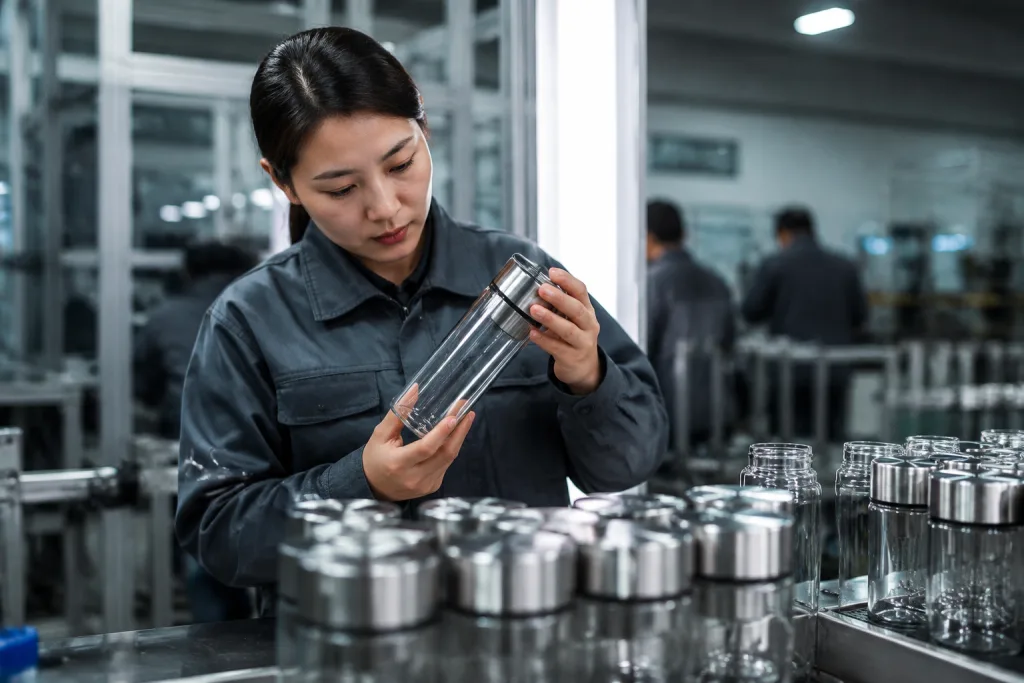
Decoration fails in shipping
Printing is a quiet failure mode. A custom thermos for brand programs often runs silk screen, pad print, UV print, or laser marking, and each one breaks in a different place. Silk screen can crack when the body curve is too tight. UV print can scuff in carton abrasion if curing is short. Laser looks sharp, but on coated metal lids it may cut through the top layer and show base material.
For a customized thermos or thermos customized for promotion, ask for adhesion testing before mass production. We usually run cross-hatch testing and solvent rub checks, especially when the cartons will sit in a US or Europe warehouse for 12 days and get moved twice. If the decoration sits on a frosted glass body, the ink system has to match the surface treatment; we’ve seen the logo look fine on day one and fade after a week of handling. The buyer flagged that once, and the math did not work.
Common decoration spec points:
- Logo area tolerance within ±1 mm
- Cure time documented by process step
- Rub test: 50-100 cycles minimum
- Scratch resistance verified on packed samples
If you are comparing thermos manufacturers, ask which decoration method survives carton friction after 3 drops from 80 cm. That is the right question to ask, not whether the render looks glossy.
Retail packaging changes the risk
Packaging is where good bottles turn into damaged goods. A borosilicate glass thermos bottle custom project needs packaging built for distribution, not shelf display. Leave too much void and the bottle shifts. Leave too little and the insert crushes the lid. For an outdoor retailer or promo brand, the carton has to survive warehouse stacking and cross-border freight vibration. We’ve seen that go sideways on the line more than once.
For thermos bulk programs, we run a molded pulp tray or EPE insert with tight body support and lid clearance. Standard export cartons usually go with 5-ply or 7-ply, depending on bottle weight and how many pieces sit in one master carton. The shipped weight check matters more than a nice mock-up: once one retail unit goes past 700-800 g with packaging, carton loading and freight cost move fast. The buyer flagged it only after the PO typo pushed the carton count off by 8 units.
Ask your thermos factory for a carton drop test, an ISTA-style vibration check, and a master carton compression limit. If the factory cannot show packaging test results, the product is not ready for export from Zhejiang to North America or Europe. QC pulled the sample, and the box failed before the bottle did. That is the wrong question to ask.
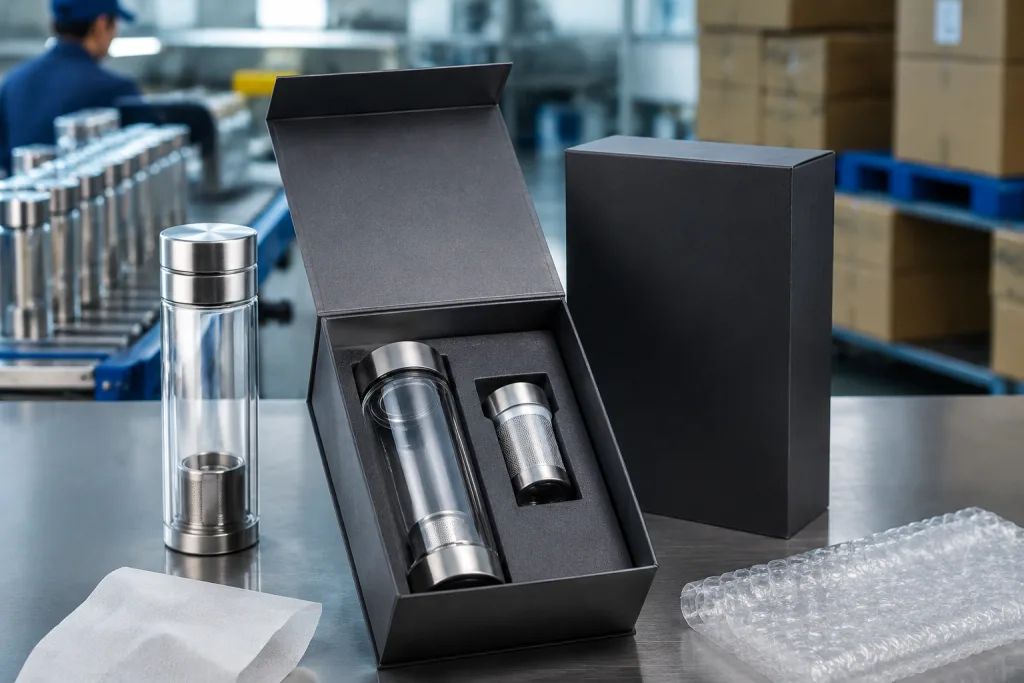
How to write a cleaner spec
If you want a borosilicate glass thermos bottle custom program that ships cleanly, write the spec like a factory engineer, not like a retail buyer. Start with body material, capacity, lid type, color, print method, and packaging. Then add numbers the line can check. We run that sheet against the first sample, and it keeps quotes aligned across manufacturers thermos options. Skip those details and every supplier fills in the blanks differently; the math stops matching.
Use a one-page control sheet with these items: capacity tolerance, wall thickness, lid torque, leak test, drop test, print method, and carton requirement. If you need promotional thermos pricing, ask for tiered FOB China quotes at 3,000, 5,000, and 10,000 units. That shows the real break points. A buyer once asked for “normal packing,” and the PO typo turned into a 24-bottle gift box instead of a 12-bottle shipper. In Zhejiang, a serious factory thermos partner should also tell you whether lead time moves from 30 days to 40 days when you add a second decoration pass or a custom gift box.
Practical buyer checklist:
- Request sample and pre-production sample separately
- Confirm AQL level in writing
- Ask for REACH-compliant materials if selling into the EU
- Confirm silicone, coating, and print safety declarations
If you work with a thermos distributor or thermos manufacturers network, this spec sheet keeps everyone on the same page and cuts late-stage surprises. QC pulled the sample, checked the lid torque at 0.8 N·m, and found the print shifted 1.5 mm; that is the kind of miss you want to catch before mass production.
Send your spec for a clean factory quote
Get a quote with MOQ, FOB price, lead time, and QC checkpoints from a Zhejiang thermos manufacturer that handles custom runs properly.
Frequently asked questions
What MOQ should I expect for borosilicate glass thermos bottle custom orders?
For most export programs, a realistic MOQ is 3,000 units per design and color. If you need multiple lid colors or print variants, some thermos manufacturers will split tooling or charge extra setup. On a standard factory thermos line in Zhejiang, 3,000 units is the point where pricing starts to make sense. Below that, the unit price often jumps 15-30% because of labor setup and packaging waste. If you need a very small pilot, ask for 500-1,000 units only if you accept a higher FOB price and slower lead time.
How much does a custom thermos cost in China?
A borosilicate glass thermos bottle custom order usually lands around USD 2.20-4.80 FOB China, depending on capacity, lid type, decoration, and packaging. A simple one-color logo with standard carton is cheaper; a multi-step promotional thermos with gift box, sleeve, and special lid will move higher. If you add laser logo, metal cap parts, or a custom mold, the price can rise another USD 0.30-1.20. Always ask for quotes at 3,000, 5,000, and 10,000 units so you can see where the cost curve flattens.
What tests should I require before shipping?
At minimum, ask for 100% leak testing, visual inspection under AQL 2.5, and packed drop testing. For borosilicate glass, request hot-fill and thermal shock validation, plus lid torque consistency checks. If you are importing into Europe or North America, also ask for REACH declarations and food-contact documentation. A strong thermos supplier will show test records, not just say the product is compliant. For retail, I would also require carton compression and vibration testing, because breakage often happens in the box, not on the line.
Can I use my logo on the glass body and lid?
Yes, but the two surfaces behave differently. Glass usually takes silk screen, pad print, or laser mark depending on finish, while lids may need UV print or laser on coated metal. For a customized thermos, keep logo placement within the printable flat zone or expect distortion on curved surfaces. Ask for a decorated sample and a rub test of at least 50 cycles. If your design has fine text under 4 pt, you may lose legibility on frosted glass or textured coatings.
How long does production take for bulk thermos orders?
Standard lead time is 30-35 days after sample approval and deposit for a normal borosilicate glass thermos bottle custom order. If you need custom packaging, new lid tooling, or multiple artwork revisions, plan on 40-45 days. Shipping from Zhejiang to the US or EU adds ocean transit time on top of production, so do not promise launch dates based only on factory time. A reliable thermos factory should give you a clear timeline for sample, pre-production approval, mass production, and carton loading.