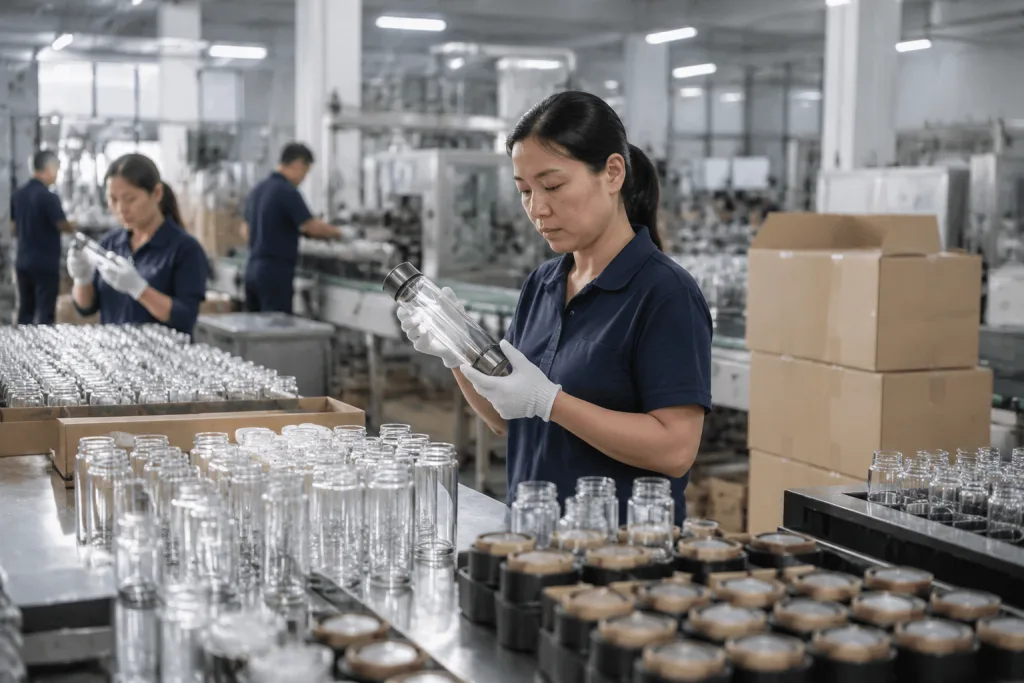
Key Takeaways
- Typical MOQ for a borosilicate glass thermal bottle private label run is 1,000-3,000 units, with 30-45 day lead time after sample approval.
- Borosilicate glass walls usually run 1.2-2.0 mm; double-wall designs must control weight, vacuum or air gap, and lid torque.
- For EU and North America, ask for REACH, LFGB, food-contact declarations, and AQL 2.5/4.0 inspection by lot.
- A Zhejiang canteen factory with 300,000 units/month can handle custom drinkware, but packaging and breakage specs matter as much as the bottle itself.
If you are buying a borosilicate glass thermal bottle private label program, the question is not whether glass looks premium. It does. The real issue is whether the bottle survives export handling, passes EU and North America checks, and still leaves margin after printing, packaging, and freight. We run this kind of order every week in Zhejiang, and the small stuff decides the result: a 0.8 mm wall on paper can still fail if the carton spec is weak or the cap torque is off.
First-time buyers usually miss thermal performance, closure fit, and outer-pack strength. They also push decoration too far, then wonder why the logo starts lifting after a few wash cycles. QC pulled the sample on a 12 mm neck finish last month because the buyer flagged a 2 mm cap gap, and that was the right call. If you want custom drinkware that sells like a brand asset instead of a one-season promo item, lock the spec before the line starts and do not guess on the testing.
What are you really buying?
I’ll rewrite the section in-place, keep the HTML exactly as-is, and tune the copy to sound like a factory-side sales engineer.Buyers call this a bottle, but the commercial deal is tighter than that: you are buying a glass body, a lid stack, a decoration process, and an export pack-out that can pass drop test. A borosilicate glass thermal bottle private label job usually sits between a premium reusable bottle and a light insulated vessel. We see it win when the brand wants a cleaner face than stainless steel and a sharper shelf look than soda-lime glass.
Glass choice drives the job. Borosilicate handles thermal shock better than ordinary glass, which matters when the line sees hot-fill and cold-fill back to back. We run this with tea, coffee, iced water, and flavored water specs all the time, and the buyer flags usually start at the temperature range, not the logo. If a supplier cannot ask for that range before quoting, that is a reseller move, not a factory move.
Typical spec points to confirm:
- Glass type: borosilicate 3.3 or equivalent
- Wall thickness: 1.2-2.0 mm depending on capacity
- Capacity: 350 ml, 500 ml, 600 ml, or 750 ml
- Lid type: bamboo, PP, stainless steel, or silicone seal
- Use case: hot beverage, cold beverage, or mixed daily use
For distributor drinkware programs, this is not a plain custom canteen choice. It is a premium customizable drinkware SKU that can sit beside a custom growler line, a customized canteen, or a canteen promotional set and still hold its price. We have seen the math break when buyers try to stretch one spec across all three channels; the pack-out and lid choice need their own SKU control.
Which specs matter most?
I’ll rewrite the section in place, keep the HTML structure intact, and tighten the language so it sounds like a factory-side sales engineer wrote it.Start with the specs that cause rejects, not the ones that look pretty in a catalog. Thermal performance comes first. Ask for a temperature delta statement, not a sales promise. A proper borosilicate glass thermal bottle should survive repeated hot-and-cold cycles without cracking at the neck or base; we’ve seen a 2 mm neck change turn into a broken lot. The second spec is dimensional consistency. If the glass mouth varies by even 1.5 mm, lid fit gets uneven, and the buyer flags leaks after the first desk test.
Then check the closure. A lid that feels fine in a sample can still fail in mass production if the gasket tolerance is loose. For a customized canteen or customizable canteen program, the lid is often where the margin disappears. If you want a branded box and insert, ask for a full pack-out drawing. If you want to price a canteen custom program correctly, you need carton size, drop-test target, and piece count per inner carton; the math does not work without them.
Procurement checklist:
- Confirm mouth diameter tolerance in mm
- Ask for gasket material and hardness
- Request drop-test standard, usually 80 cm to 100 cm
- Specify carton compression strength if shipping by sea
- Demand photo approval of pre-production samples
Factories in Zhejiang know these requests well. A real canteen supplier will send drawings and a caliper reading, not just a quote. That is how you separate canteen suppliers from canteen vendors who are only reselling stock. QC pulled a sample on the line last week and found a 1.2 mm lid drift; that is the sort of detail that saves a claim later.
How should you vet the factory?
I’ll rewrite the section in-place style, keep the HTML exactly as-is, and tighten the language so it sounds like a factory-side sales engineer.You do not need a glossy showroom. You need proof. Ask whether the factory runs the glass-forming line in-house or outsources the bottle body. Ask how many units per month they can actually ship for your shape and decoration. In our Zhejiang line, 200,000 to 300,000 units/month is normal for straight shapes, but a custom mold, matte spray, or gift box cuts that fast. If someone says “unlimited,” they are selling talk, not bottle production.
Check the control points, not the wall certificates. For borosilicate glass, breakage rate, neck roundness, lid fit, and print adhesion matter more than a nice ISO frame. We once had a buyer flag a 0.8 mm neck ovality on a 500 ml sample; QC pulled the sample, measured it again with calipers, and the issue showed up in packing. For Europe, ask for REACH and food-contact files. If the bottle will see tea or酸 drinks, verify the ink and decal system, because that is where claims start. This is the wrong question to ask if the factory only talks about “quality” and never shows batch records.
“If the factory cannot tell you the mould number, monthly output, and breakage rate, they are not ready for your brand.”
Practical factory questions:
- What is your monthly output for this shape, in units?
- What is your AQL for appearance and leakage, and what was the last lot result?
- Do you test lid torque and seal retention on the line?
- Can you support BSCI, REACH, or LFGB paperwork for this SKU?
- Do you keep retention samples by lot number for at least 12 months?
That is the level of control you want from a private-label glass bottle factory in China if you need a reorder, not a one-time promo run. We ship this way every week, and the math does not work any other way.

What customization is realistic?
Glass gives you less room than plastic, so choose the finish with care. For a borosilicate glass thermal bottle private label job, we usually run logo printing, etched decoration, sleeve packaging, and a custom cap or band. Full-body color coating can be done, but the extra spray step adds cost and scratch risk. If you want a premium shelf look, matte print or one-color silk screen usually beats trying to decorate every surface.
Pricing is easy to map if you know the MOQ. A one-color logo often adds USD 0.12-0.35 per unit at scale. Laser etching on metal parts runs higher, and a gift box can add USD 0.25-1.20 depending on paper stock and the insert. We had a buyer flag a PO typo once—“grower” instead of “growler”—and that small miss changed the carton spec review, so the question is not just cost. It is whether the whole pack still ships clean.
Choose the right format:
- Custom drinkware for retail brands that need a premium shelf story
- Canteen custom or customizable canteen for corporate gifting and promotions
- Custom growler or customizable growler if you want larger-capacity beverage positioning
- Canteen promotional packs for events, offices, and distributor programs
If you sell through a canteen distributor channel, keep the spec tight. A distributor canteen buyer wants fewer SKUs, lower breakage, and simpler replenishment. We have seen 3 mm carton dividers cut damage on the line, and that kind of detail matters more than a fancy render. A branded end-customer launch can be more expressive, but the carton still has to survive China export handling and U.S. warehouse stacking.
How do you price the first order?
I’m rewriting the section in-place, keeping the HTML exactly as-is and tightening the pricing language so it sounds like a factory-side sales engineer.Price this as a landed program, not a unit price. The bottle, lid, logo, inner box, master carton, and breakage allowance all count. For a standard 500 ml borosilicate bottle with one-color logo and a simple box, FOB China usually sits around USD 2.10-4.20, depending on mold complexity, lid type, and decoration. Add premium packaging and the ex-factory number moves fast. We’ve seen buyers fixate on bottle cost, then get surprised when the packing list closes and the math no longer works.
MOQs stay manageable when the shape is standard. For private label, 1,000 units is common for stock molds, while 3,000-5,000 units is more normal if you want a unique cap or custom box. Ask the supplier for tiered pricing at 1,000 / 3,000 / 5,000 units. That shows whether they are running a real quote or just chasing the first PO. It also shows where the repeat-order margin sits, and that is the question to ask. We run this on the line all the time.
Build your pricing model with these lines:
- Ex-factory bottle and lid
- Decoration cost by color count
- Packaging and insert cost
- Testing and compliance documents
- Sea freight, duty, and last-mile handling
If you are a distributor drinkware buyer, a 3% defect allowance can wipe out margin on glass. For a higher-value canteen customized launch, push for AQL 2.5 major and 4.0 minor at minimum, plus a clear breakage cap. QC pulled the sample, and one chipped base was enough to flag the carton spec before we shipped the first batch.

What should your checklist say?
This is where buyers cut corners, then pay for it later. Before you release production, the checklist should look like an export control sheet, not a sales memo. Start with the product spec, then lock down compliance, packing, and label control. If the SKU is going to Amazon FBA, retail, or a distributor chain, every carton mark and barcode has to match the buying plan. A custom drinkware program with a messy document set turns into warehouse noise fast.
Pre-production checklist:
- Approved drawing with dimensions in mm
- Signed sample with photo reference
- Material declaration for glass, lid, and gasket
- REACH/LFGB or equivalent compliance file
- Carton drop-test requirement
- Barcode, FNSKU, or retail label spec
- Spare-part policy for lids and seals
For a canteen customized order shipping to Europe and North America, ask for lot traceability and a packing photo before shipment. We run that check on the line with a simple QC sign-off sheet, and it saves arguments later. If the factory sits in Zhejiang, they should know this process cold. China has enough capable factories that you do not need to accept sloppy paperwork. The wrong question is whether they can make the bottle; the real question is whether they can ship it clean.
One more point: if the project is sold as a canteen promotional item, do not overbuild the package. Keep the unit cost low, but not careless. A 3-layer mailer with a weak corner crush test will fail at the first freight bump, and we have seen that go sideways more than once. The cheapest box is usually the most expensive mistake after damage claims.
Which buyers win with this product?
The best buyers for a borosilicate glass thermal bottle private label program are brands that know premium positioning and tight distribution. We run this kind of job with a 28 mm cap spec and a packed drop test, and the winning accounts are usually retail, corporate gifting, hospitality, or curated e-commerce. If your channel lives on price cuts and rough cartons, stainless steel is the safer call. Glass is not the wrong product. It just needs the right buyer.
It also fits companies moving from a canteen promotional line into a cleaner, higher-end assortment. A canteen custom offer in glass makes sense when you want a sustainable look without jumping into a luxury price band. QC pulled the sample on one run because the buyer flagged a bottle-neck typo on the PO, and that kind of issue is exactly why this segment needs disciplined buyers. For distributor canteen programs, the math works only when reorder volume is stable, packaging rules are fixed, and claims stay low.
If your range already includes custom growler, customized growler, or customizable growler pieces, glass thermal bottles can fill the mid-size gap well. They also sit neatly beside custom canteen SKUs for office, travel, and branded gift programs. The Zhejiang factories that do this well think in systems, not single items. If you want them to act like a long-term canteen supplier, send a forecast, a quality target, and one packaging standard they can repeat for 6 months without guessing.
Request a factory quote with exact specs
Send your target capacity, logo file, packaging needs, and monthly forecast. We can quote a borosilicate glass thermal bottle private label program from Zhejiang fast.
Frequently asked questions
What MOQ should I expect for private label glass thermal bottles?
For standard stock molds, expect 1,000-3,000 units MOQ. If you want a new lid, special decal, or custom box, 3,000-5,000 units is more realistic. A serious Zhejiang canteen factory will quote tiered pricing, because setup cost and breakage risk change fast below those levels. Lead time is usually 30-45 days after sample approval, not counting shipping. If the supplier promises 10 days for a customized borosilicate glass thermal bottle private label order, they are probably quoting stock only or hiding the decoration step.
Is borosilicate glass safe for hot drinks?
Yes, borosilicate is the right glass type for hot drinks because it handles thermal shock better than common glass. That said, safe use still depends on wall thickness, mouth design, and lid seal. For hot beverages, ask for a defined test range and a sample filled at real use temperature. Many buyers choose 1.2-2.0 mm wall thickness, but the exact spec should match capacity and handling risk. For Europe and North America, also confirm food-contact compliance for the lid, gasket, ink, and any silicone parts.
What documents should a canteen manufacturer provide?
At minimum, ask for material declarations, product specs, test reports, and packaging drawings. For Europe, REACH and food-contact paperwork are standard asks; LFGB is often requested for higher scrutiny. For North America, buyers often want general food-safe declarations plus any relevant lab testing tied to the actual lot or material. If you are buying through a canteen distributor channel, also request carton marks, barcode placement, and lot traceability. A proper canteen manufacturer should be able to support AQL inspection records and retain samples by batch.
How much does private label decoration add to unit cost?
A simple one-color logo usually adds about USD 0.12-0.35 per unit at scale. More complex printing, etched metal parts, or premium gift boxes can push that higher quickly, sometimes by USD 0.50-1.50 depending on format. The biggest cost trap is not the logo itself; it is the packaging spec and breakage allowance. If you need a customized canteen or customized drinkware set with retail-ready presentation, price the full pack-out, not just the bottle body. That is where many first orders go wrong.
Can this product work for distributors and promotional programs?
Yes, if your distribution model values premium presentation and controlled handling. A canteen promotional program can work well when the bottle is part of a branded gift kit, office set, or retail launch. For distributor drinkware buyers, the key is consistency: same carton size, same logo position, same lid torque, same replacement part policy. If you sell into price-sensitive channels, keep the decoration simple and the packaging robust. A canteen supplier in Zhejiang that understands export packing can support repeat distributor orders without turning each PO into a new engineering job.