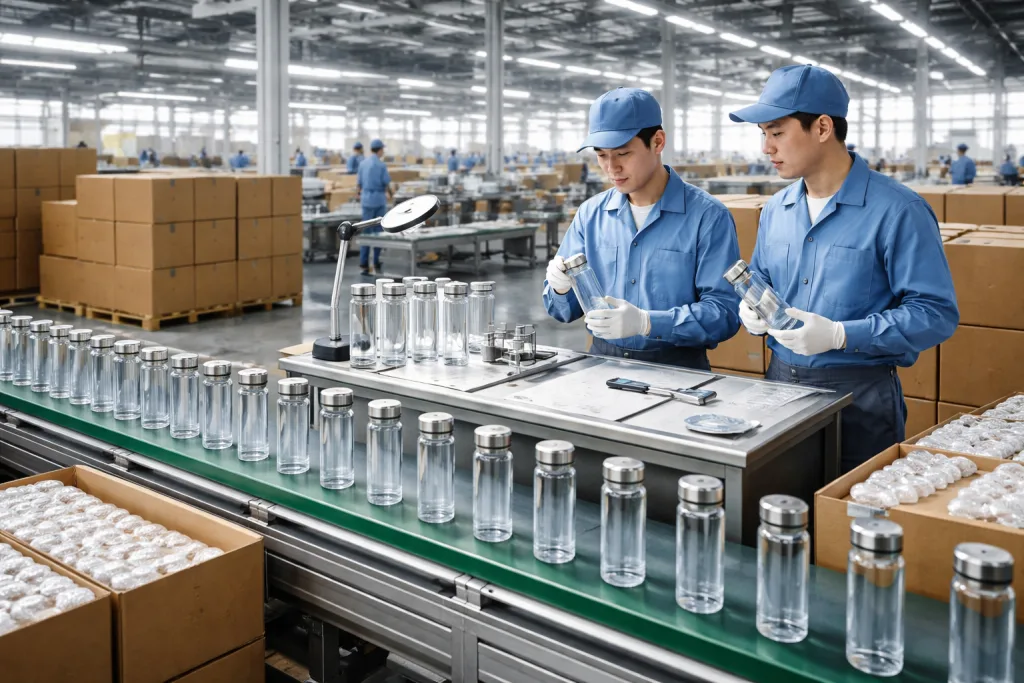
Key Takeaways
- Start with an RFQ that names 1.5 mm borosilicate wall thickness, lid material, and decoration method.
- Typical MOQ for custom borosilicate glass bottles is 1,000-3,000 pcs per SKU.
- A Zhejiang canteen factory can often ship bulk orders in 25-35 days after sample approval.
- Ask for AQL 2.5 / 4.0 inspection, REACH or LFGB support, and carton drop-test data.
If you are sourcing from a borosilicate glass thermal bottle manufacturer, the usual mistake is simple: buyers ask for a “nice insulated bottle” and expect the factory to fill in the blanks. We see this on the line all the time. In China, that gets expensive fast. A proper RFQ needs glass grade, wall thickness, lid material, seal type, decoration, test standards, and pack-out before price talks start.
This matters even more for retail, promotion, or distribution orders. A canteen distributor, brand owner, or procurement manager needs repeatable specs, not vague promises. A serious factory in Zhejiang or elsewhere in China will quote faster when you send clear PO line items, target MOQ, and compliance needs like REACH or LFGB. We’ve had buyers flag a one-word typo on the PO and that alone pushed the sample by 3 days. That is how you avoid sample churn, missed lead times, and landed-cost surprises that do not pencil out.
Start with the RFQ, not the price
The cleanest sourcing projects start with a tight RFQ. If you want a borosilicate glass thermal bottle manufacturer to quote accurately, give the factory the structure first: bottle capacity, glass type, wall thickness, lid design, silicone ring spec, and whether you need a tea infuser, sleeve, or carrying loop. For export buyers, “custom drinkware” is too loose. A Zhejiang line will quote differently for a 350 ml borosilicate bottle with a bamboo cap than for a 500 ml double-wall thermal bottle with a stainless lid. We run this every week.
Use PO-style line items even at the inquiry stage. For example: Item 1 bottle body, borosilicate glass, 500 ml, 1.5 mm wall, clear; Item 2 lid, 304 stainless steel with PP inner cap; Item 3 logo, laser engraving or one-color silk screen; Item 4 packaging, white box + master carton. That level of detail saves days. QC pulled the sample and found the lid gasket was 0.8 mm short, which is the sort of miss that kills a quote. A factory cannot price a “custom canteen” well if the lid seal, finish, and packaging are still open. If you are comparing canteen suppliers, ask each one to quote the same BOM and Incoterm, usually FOB Ningbo or FOB Shanghai.
Good RFQs also split commercial requirements from product requirements. Put target annual volume, first order quantity, required certifications, and shipment window in a second block. A canteen vendor that knows you need 6,000 pcs with a 30-day loading window will answer differently from one quoting for a promotional trial. The buyer flagged a PO typo once—6,000 pcs became 60,000 pcs—and the math did not work. That is normal. It is also why the best distributors treat the RFQ as a control document, not an email blast.
Check materials and thermal behavior
Borosilicate is not marketing fluff. It is the reason this category handles heat shock better than ordinary soda-lime glass. A real borosilicate glass thermal bottle manufacturer should state the glass composition, heat resistance, and test method without hedging. Buyers usually care about two numbers on the spec sheet: wall thickness and thermal performance in use. For a single-wall borosilicate bottle, 1.2 mm to 1.8 mm wall thickness is common. At 1.2 mm, freight drops; at 1.8 mm, the bottle takes more abuse. If your distributor network sends cartons through rough transit, the math gets ugly fast.
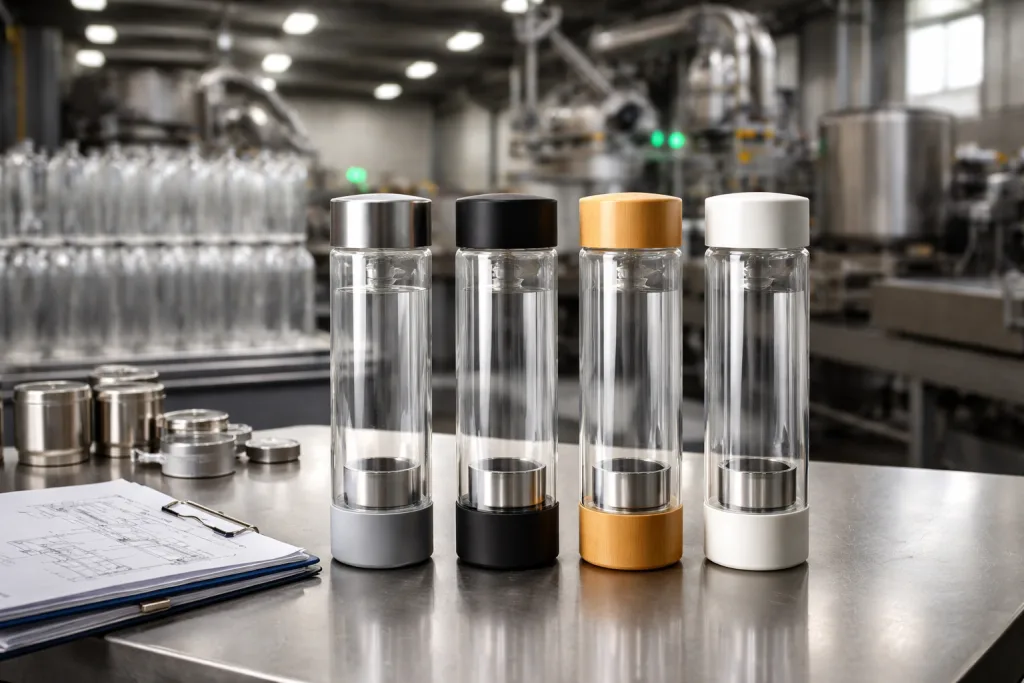
The lid is where a lot of canteen customized programs go wrong. Pretty body, weak cap, dead product. Specify whether the lid is PP, Tritan, bamboo, or 304 stainless steel, and define the gasket material, usually food-grade silicone. We’ve had a buyer flag a PO typo on the gasket callout, and QC pulled the sample because the seal stack changed by 0.3 mm. If you need customizable drinkware for Europe, ask for REACH documentation on all contact components. If you sell into North America, ask for relevant food-contact declarations and any ASTM-based test references the factory already uses. The same logic applies to a custom growler or customized growler: geometry matters, but the closure and seal decide whether the bottle feels premium or cheap.
What to verify before sampling:
- Glass thickness tolerance, typically ±0.1 mm
- Thermal shock resistance method, such as hot/cold cycle testing
- Cap torque and leakage behavior after repeated opening
- Silicone odor control and food-contact declaration
- Packaging drop resistance for export cartons
If you are sourcing canteen promotional items, do not over-spec the bottle and under-spec the lid. Buyers often approve a nice-looking custom canteen, then find the cap stains, loosens, or leaks after 50 cycles. That is the wrong question to ask. In Zhejiang and other parts of China, serious canteen factories know repeat purchase depends on the boring details, and we run the line around those details every day.
Sample like a distributor, not a tourist
Once the quote is close, move to samples with a checklist on paper. A distributor does not sign off on “sample approved” from a photo alone. Ask for pre-production samples, decorated samples, and, if the bottle will ship far, a packed sample for drop and transit checks. For customized canteen programs, the decoration sample must match the final process exactly. A silk-screen logo is one thing; laser engraving is another; full-color decal on a dishwasher run is a third test.
Write the sample PO the same way you will write the bulk PO. Keep it short and exact: quantity, colors, logo position, carton artwork, and any accessory set. We often run 3 pcs undecorated, 5 pcs decorated, and 2 complete retail packs. That is enough to catch nonsense before the line starts. If the buyer flags a typo on the PO now, good. Better now than after 5,000 pcs are packed.
Use the sample stage to test real use. Put the bottle through hot water at 95°C, then cold water around 5°C, and look for stress cracks or lid movement. Check whether the cap threads stay smooth after repeated tightening. Measure the weight against your target, because 18 g off on a 320 g spec is not a small miss. If the item is meant to be a canteen customizable promotional SKU, test the box fit, insert protection, and scuff resistance too. QC pulled the sample, and one weak sample usually tells us the bulk run will follow the same pattern.
Buyers who skip sample discipline usually pay for it later in chargebacks, replacement shipments, or retail complaints.
Translate approval into a real PO
After sample approval, turn the project into a purchase order the factory can run without guessing. This is where buyers lose control fast. A bulk PO for custom drinkware should list the SKU code, approved sample reference, order quantity, unit price, payment terms, packaging spec, inspection standard, and delivery date. If you want 5,000 units, write whether 4,800 accepted units is allowed under AQL or whether every carton must match the count. If the factory is in China, put the agreed HS code note, shipping port, and trademark owner details in writing. We’ve seen a PO typo on carton count turn into a 12-day delay, and the line had to stop while QC pulled the sample again.
For a borosilicate glass thermal bottle manufacturer, a clear PO usually includes line items like:
- Bottle body, borosilicate glass, 500 ml, clear, 5,000 pcs
- Lid assembly, PP + silicone seal, 5,000 pcs
- Logo decoration, 1 color silk screen, 5,000 pcs
- Retail box, 1 pc per box, 5,000 sets
- Master carton, export grade, 50 sets per carton
That structure helps both sides. It also lets the canteen supplier quote against the same scope if you want to compare two factories. Ask for unit price at 1,000 pcs, 3,000 pcs, and 10,000 pcs so you can see the breakpoints. In Zhejiang, a capable canteen manufacturer usually gives a better price once tooling and print setup are amortized, but only if the artwork and packing are frozen. If they are still changing cap color at PO stage, expect delays. The buyer flagged it on our side before, and the math did not work.
Commercially, this is the point to lock terms. Many buyers choose 30% deposit and 70% before shipment for standard export orders, while larger distributor canteen programs may negotiate better once the supplier relationship is stable. Make sure the PO mirrors the approved sample and spells out who pays if a carton fails AQL or a logo is misprinted. Unclear PO language is how you end up arguing over rework. We ship more smoothly when the PO says it plainly, down to the 304 stainless lid insert or the wrong way around.
Control bulk production in China
Bulk production is where a good canteen vendor earns trust. A serious factory in China should give you a production schedule with raw material intake, molding or forming, decoration, assembly, packing, and final QC dates. For a standard custom canteen order, lead time usually runs 25-35 days after sample approval and deposit. If the job involves complex molds, mixed finishes, or imported accessories, it stretches. We had one buyer flag a PO typo on capacity, and that 500 ml versus 550 ml mistake would have wrecked the line. If you need 20,000 pcs for a seasonal launch, ask whether the canteen factory can stage output across multiple lines or only one.
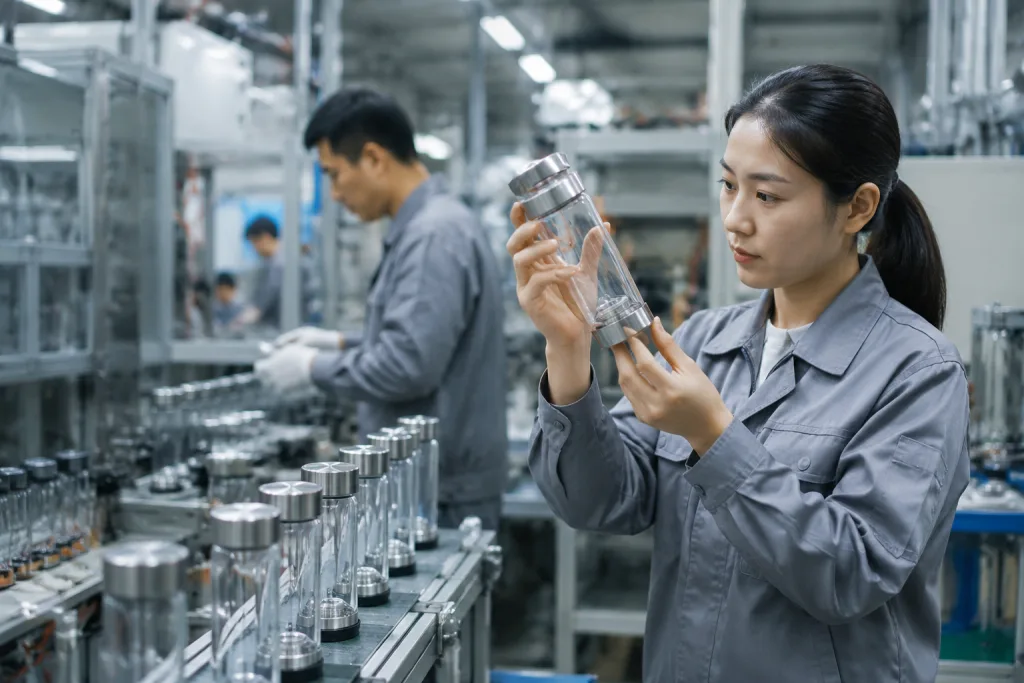
Ask for in-process checks, not only final checks. AQL 2.5 is common for visual defects on export orders, and 4.0 may apply to minor packaging issues, but the plan should be signed off before production starts. The factory should also define which defects are critical: leakage, sharp edges, cracked glass, missing seals, wrong logo, and wrong capacity. This is the wrong question to ask if a buyer says “can you just sort it at packing?” No, because QC pulled the sample and the defect was already on the forming table. If you sell as distributor drinkware, those defects are not acceptable. If you are a canteen promotional buyer, even a 2 mm color shift can hurt campaign consistency.
Keep an eye on practical factory metrics. A well-run Zhejiang operation may run tens of thousands of units per month across multiple lines, while smaller canteen suppliers can handle only a few thousand before lead time slips. Ask for daily output targets and how many inspection points sit between forming and packing. We ship by the numbers here: one line, three shifts, 12-hour windows when the order is hot. If the supplier cannot answer that clearly, you are probably dealing with a trading layer, not a true canteen factory.
Also confirm how they handle breakage. Glass needs overpack discipline. Separators, corner protectors, and carton compression strength matter more than many buyers expect. We’ve seen this go sideways on a 6-layer carton that looked fine on the pallet but failed after a 1.2 m drop test. A factory that understands custom growler and customizable growler packing already knows this logic: heavy glass and export freight punish weak cartons. Good packaging is not a nice extra; it is part of the product.
Price the landed cost honestly
I’m rewriting the section in place, keeping the HTML tags untouched and tightening the sales-engineer voice. I’ll preserve all existing structure and numbers, then return only the cleaned HTML.FOB price is only one piece. For a borosilicate bottle, freight and breakage can change the real margin fast. A unit that looks fine at USD 2.10 FOB can turn ugly if the carton is awkward or the pallets ride loose. Ask the canteen supplier for a full pack-out sheet: gross weight, net weight, carton size, quantities per carton, and pallet loading plan. That is how distributor canteen buyers protect margin.
Separate tooling, decoration, and sample cost from unit price. A one-color logo on a canteen custom order is one number; a multi-step print or laser job can add USD 0.15 to USD 0.60 per unit, depending on the setup. We run this check on the line because a buyer flagged a PO typo once and the “cheap” quote jumped after rework. If you need customized drinkware for a retail launch, this is the wrong question to ask: “what is the unit price?” A canteen vendor quote that hides setup charges is not cheaper; it is just less transparent.
For Europe, compliance costs add up: REACH testing, carton labeling, and sometimes extra paperwork take time and budget. For North America, retail-ready work can mean barcode placement, FNSKU labels, and master carton markings. If you sell through Amazon, your custom drinkware program should state whether labels go on at the factory or by your 3PL. QC pulled the sample on a 38 mm print gap before, and that kind of miss will eat a week at inbound receiving.
When you compare canteen manufacturers, use a simple landed-cost frame: product, packaging, inland move, export docs, ocean freight, duty, and local handling. The cheapest FOB quote is often not the cheapest delivered result. We have seen this go sideways on a 20 kg export carton because the stack pattern failed in transit. In Zhejiang and across China, experienced buyers know the real game is not unit price alone; it is defect rate, transit survival, and how fast the supplier answers when you need a fix.
Build repeat orders into the relationship
The best buying result is not a one-time PO. It is a repeat order you can run without reopening the file every time. Keep the approved spec sheet, signed sample, carton artwork, and QC criteria in one folder. If the project is a custom canteen, custom growler, or customized canteen line, lock the critical dimensions at once so the next run matches. We’ve seen this go sideways when a 2 mm neck change slips into the second order. That is the gap between a real supplier relationship and a firefight.
Ask the canteen manufacturer to hold one retained sample and a photo record of the approved bulk run. QC pulled the sample on the line, checked the lid fit, and that saved a buyer from a typo on the PO that would have changed the cap color. If you are working with multiple canteen distributors, that record keeps spec drift out of different regions. It also lets our factory in China quote the next job faster because the exact lid, glass grade, and decoration method already passed. A good canteen supplier should be able to run the next order with the same tooling, the same artwork file, and the same packing plan.
If you plan to move from one SKU into a broader range of customizable canteen or customizable drinkware items, set the range architecture now. One bottle body can share two lids, three colors, and two print methods. That keeps MOQ in line and cuts dead stock. The math does not work any other way. The same logic applies to canteen promotional programs that later become retail programs. Start with a clean spec, then scale the family. Buyers in Europe and North America do this because they need a Chinese sourcing pipeline that stays tight without giving up product quality.
Send your RFQ with exact specs
We quote fast when you give capacity, wall thickness, lid type, logo method, and target MOQ. That is how we avoid wasted rounds.
Frequently asked questions
What MOQ should I expect from a borosilicate glass thermal bottle manufacturer?
For a standard custom order, MOQ is often 1,000 to 3,000 pcs per SKU. If you need multiple lid colors, decorated packaging, or mixed capacities, the effective MOQ can rise to 5,000 pcs across the program. A smaller trial run is sometimes possible, but unit price usually jumps 15% to 30%. A serious Zhejiang factory will tell you the real MOQ early, not after sample approval.
How long does a custom bottle order take from sample to shipment?
A normal timeline is 7-12 days for first samples, 3-7 days for sample revision, then 25-35 days for bulk production after approval and deposit. If tooling changes are needed, add 10-15 days. For a canteen factory in China, decoration complexity and carton confirmation usually matter more than the bottle body itself. If you need rush production, expect a surcharge and a tighter payment schedule.
What price range is realistic for custom borosilicate glass bottles?
For export orders, a simple borosilicate bottle may land around USD 1.20 to USD 3.50 FOB depending on capacity, lid material, decoration, and packaging. A premium retail-ready custom growler style bottle can go higher if you add thick glass, stainless fittings, or gift packaging. The key is to compare the same specs, because one supplier may quote an unfinished item while another includes box, insert, and print.
Which compliance documents should I ask for?
For Europe, ask for REACH-related material declarations and food-contact support. For the UK or EU retail channel, LFGB-style test support is often requested by buyers even when not legally required in every case. For North America, ask for food-contact declarations and any relevant ASTM or internal test reports the factory already uses. Also request AQL inspection terms, carton drop-test data, and if needed, barcode or FNSKU labeling confirmation.
Can I customize the bottle for promotion and distributor programs?
Yes. A canteen promotional project can use one-color print, laser engraving, or full-color decals, while distributor drinkware programs often need repeatable packaging and regional barcode control. You can also build a canteen customizable range with shared bodies and different lids. For a custom canteen or customized drinkware launch, keep the core dimensions stable and vary only the finish, logo, or accessory pack so the MOQ stays manageable.