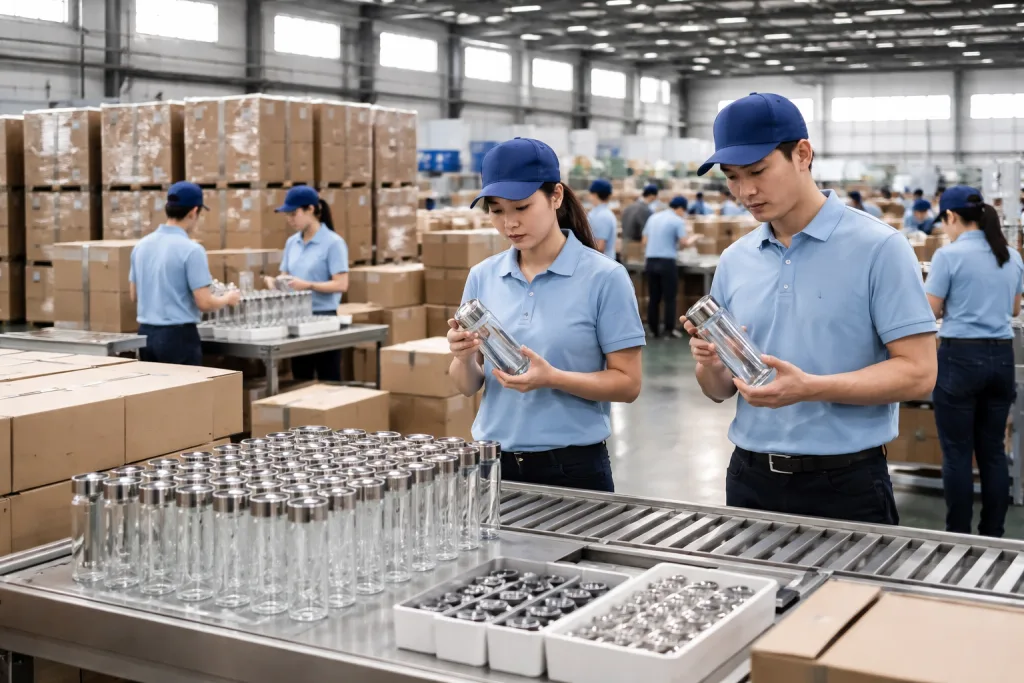
Key Takeaways
- Borosilicate glass bodies usually start at 1.2 mm to 1.8 mm wall thickness for export drinkware programs.
- A practical MOQ for custom canteen orders is often 3,000 to 5,000 units, with 35 to 50 days lead time.
- For Europe and North America, ask for REACH, LFGB, and food-contact documentation before you approve samples.
- A factory running 200,000 to 500,000 units per month can usually support repeat distributor canteen and customized drinkware programs.
If you are sourcing a borosilicate glass thermal bottle factory, the real risk is not finding a supplier. It is picking one that can hold ±0.3 mm on the neck, pass FDA or LFGB checks, and still ship a 10,000-unit order after the sample stage. We run into this all the time in Zhejiang. Plenty of factories call themselves a canteen factory or canteen manufacturer. Fewer can keep thermal performance, mouth finish, and print quality aligned on the line.
For B2B buyers, this is not a glass-only decision. You are balancing 2.0 mm wall thickness, lid structure, carton test results, and the channel you sell into, whether retail, corporate gifting, or distributor drinkware. QC pulled the sample and found a loose logo on one PO because the buyer changed the artwork file name, so we know the wrong question is “can you make it?” A solid borosilicate glass thermal bottle factory shows the trade-offs up front, before deposit and before the first carton leaves packing.
Start with the end market
I’ll rewrite the section in-place, keep the HTML exactly as-is, and tighten the sales-engineer tone while preserving the heading and blockquote.Check the glass and thermal spec
Borosilicate earns its place because it handles thermal shock better than ordinary soda-lime glass, but that does not make every bottle equal. For a thermal bottle, ask the borosilicate glass thermal bottle factory for the exact glass grade, annealing schedule, and wall thickness range. On export jobs, 1.2 mm to 1.8 mm is the usual band for lighter bottles, while 2.0 mm plus is what we run when a buyer wants a heavier hand feel and fewer breakage complaints. The math does not lie: thicker glass looks premium, and it adds cost and freight weight.
Do not buy a vague “high borosilicate” claim. Ask for thermal shock test data, usually hot-to-cold cycling, and check the test method line by line. QC pulled the sample in one lot because the mouth opening drifted by 1.3 mm, so a serious canteen manufacturer should show dimensional tolerance on mouth opening, body diameter, and base flatness. If you are ordering a custom growler or customizable growler style product with a glass insert, the sealing interface matters more than the glass alone. For customized drinkware, rim finish and base stability carry as much weight as the logo. We have seen that go sideways.
- Wall thickness target: 1.5 mm or 1.8 mm for most export bottles
- Thermal test: request the exact temperature delta and pass rate
- Dimensional control: ask for ±1.0 mm where fit affects caps or sleeves
- Weight: compare grams per unit, not just volume capacity
Treat the cap as a system
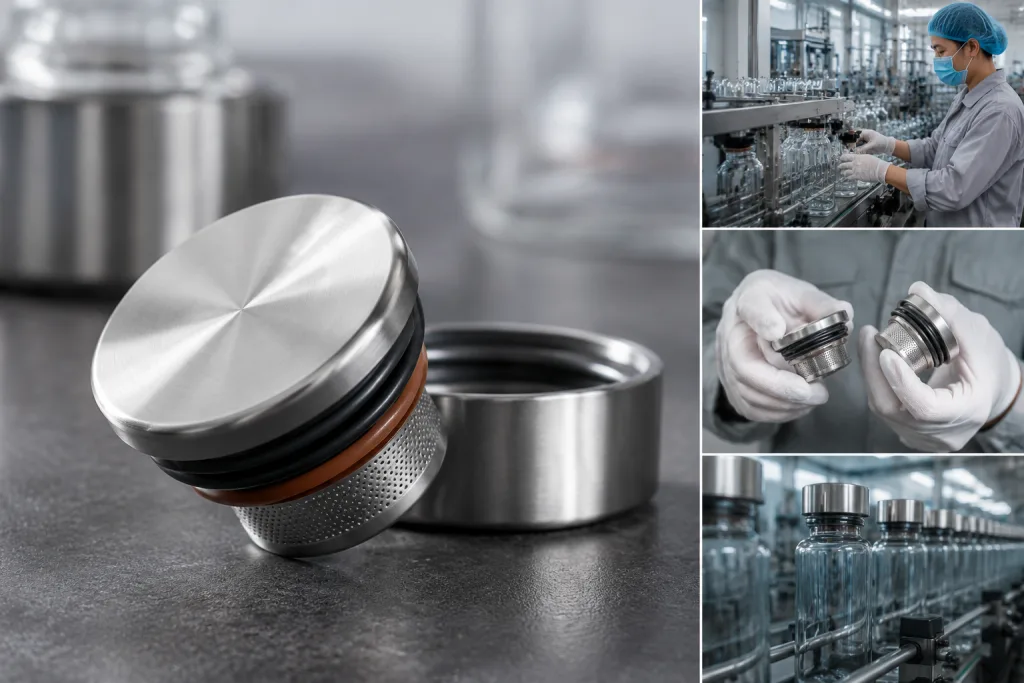
Most leaks start at the lid. Not the glass. Treat the cap system as a separate product, especially if you are buying a canteen customizable SKU for retail or a canteen promotional launch where returns will hurt margin fast. Ask which closure the factory runs: silicone gasket, PP, Tritan, stainless steel, or a hybrid stack. Each one changes unit cost, hand feel, and seal performance. QC pulled the sample last week and the gasket sat 0.8 mm proud, which is the kind of miss that turns into a complaint later.
If your program goes through a canteen supplier or canteen vendors channel, the closure has to survive repeated opening and closing without thread wear. Smooth screw fit beats a fancy surface. For a distributor canteen program, confirm the spare-part policy early. Can the factory ship replacement lids in 15 days? Can they pack gaskets separately? We run torque checks, drop tests, and seal retention tests on the line, because that is what keeps the buyer from flagging a weak lid after the first carton lands. If the product is a customized canteen, keep the cap finish simple unless your brand will pay for extra tooling and another sampling round.
Practical rule: if the lid cost is above 25 percent of the bottle FOB, the closure is probably overbuilt for the market. The math does not work. In China, I have seen good designs go sideways when the cap looks premium but the buyer only needs a tight seal and low breakage, and one PO typo on the lid color code can add a full re-sample.
Match decoration to volume
Decoration is where a canteen custom project either stays on budget or blows up the quote. One-color silkscreen is the low-risk choice for a cylindrical body, and we run that on 12 print heads when the art stays under 2 spot colors. Laser engraving suits stainless steel caps or metal parts; on full-glass branding, the line usually pushes back because the mark sits shallow and the buyer flags it after the first sample. Decal and heat-transfer can handle tighter artwork, but they add a curing step and more scrap.
If you are sourcing customized drinkware for a distributor or retail chain, ask the borosilicate glass thermal bottle factory how many print stations it has and what its reject rate is by process. A factory that handles 3,000-unit orders should tell you which decoration method fits that MOQ without guessing. We have seen the math break fast: a 3,000-unit custom canteen with one-color print and standard color box moves cleanly, while a 20,000-unit program is the one that earns a wrapped sleeve, custom carton, and serialized packaging. QC pulled the sample on one job because the PO typo changed the artwork code by one digit.
- 1-color silkscreen: good for MOQ 3,000+
- Laser marking: better for metal parts than glass branding
- Full-wrap artwork: budget for extra setup and a longer lead time
- Promo orders: keep the decoration simple and repeatable
For custom growler and customizable growler programs, decoration usually sits on the closure, sleeve, or carton rather than the glass itself. That is the safer call, and it saves you from redoing artwork when the buyer changes the logo next season. We ship those parts faster, and a 0.3 mm artwork shift on the cap is easier to correct than a full-glass print that has already gone through the kiln.
Ask for factory proof, not promises
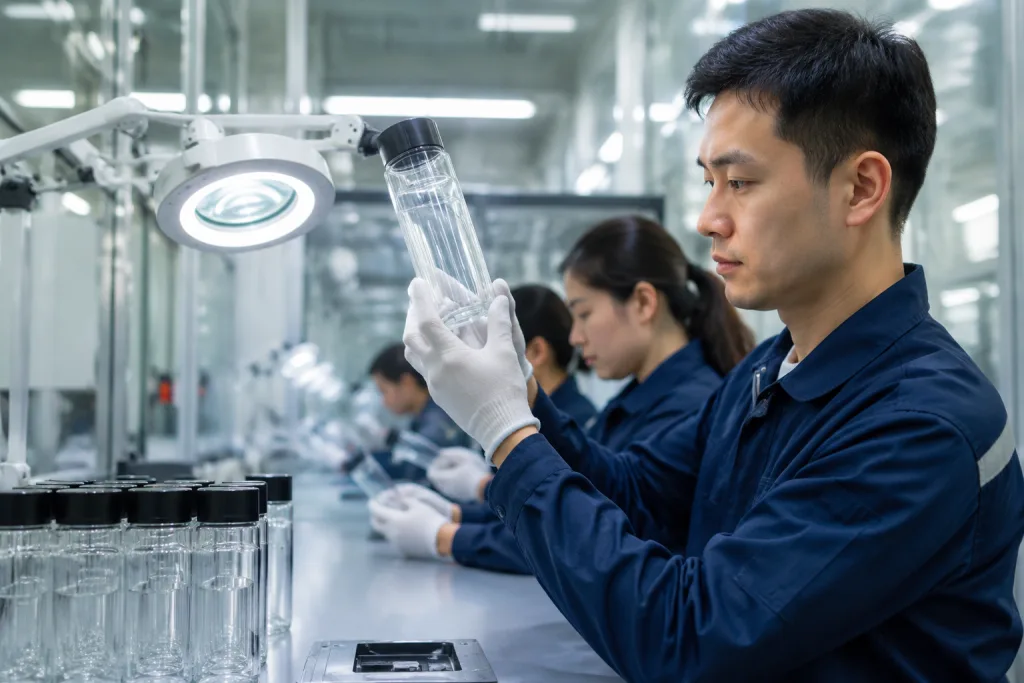
When you compare canteen manufacturers, the real test is not the sales deck. It is whether the factory can show production proof. Ask for recent inspection photos, batch records, and a copy of the quality checklist. A serious borosilicate glass thermal bottle factory in Zhejiang should be able to walk you through incoming inspection, in-process checks, and the final AQL standard. We usually hear buyers ask for AQL 2.5 on major defects and 4.0 on minor defects, but that only works if you define major defects before the first pilot run. QC pulled the sample at 9:40 a.m.; the scrap bin tells the truth faster than any brochure.
Ask for audit credentials if your retailer or distributor requires them. BSCI still comes up often, and some buyers also want ISO-related process control or third-party social compliance documents. If the factory says it serves Europe and North America, it should handle carton markings, pallet labels, and shipping documents without a PO typo turning into a two-day delay. We ship these jobs every week, and the wrong question is “can they ship?” The better question is “can they ship without your team fixing the paperwork?”
Factory scale matters, but only if the process stays locked. A plant making 200,000 units per month with stable control beats a bigger plant that changes specs every week. Ask how many molds are active, how many SKUs are on the line, and how many samples it takes to approve a new custom drinkware project. We’ve seen this go sideways when a buyer chased headcount instead of a stable 18 mm neck finish and a 3-step approval flow.
Price the whole landed order
FOB price is only the start. I’ve seen a custom canteen order look cheap on paper, then jump once cartons, inserts, logo tooling, palletization, and air freight for rush replacement parts get added. Price landed cost per sellable unit. For a typical borosilicate bottle, ex-factory pricing usually starts around USD 2.10 to 4.80 depending on capacity, lid, and decoration. Once you add custom packaging or premium closure hardware, the number moves fast. We run this math on the packing table, not in a sales deck.
For a canteen distributor or distributor growler program, estimate breakage during transit and warehouse handling. If the bottle is fragile and the carton is weak, 2 percent to 4 percent extra loss is not unusual. That wipes out margin fast. Ask the canteen supplier what outer carton strength it recommends, how many inner pack units it uses, and whether drop testing was done with the final pack format. Last month QC pulled a sample with a 5 mm carton crush line, and the buyer flagged it before ship. If you are buying customized canteen stock for Amazon or retail, make sure the factory can label FNSKU or other barcodes correctly before shipment. Rework in a U.S. warehouse costs much more than adding 6 to 12 cents per unit in China.
Be cautious with unusually low quotes. On glass products, the cheapest offer often assumes thinner wall, weaker packaging, or lower decoration accuracy. That is the wrong question to ask. You do not want to find out after the second reorder.
Choose a factory you can scale with
The best borosilicate glass thermal bottle factory for your business is not the one with the flashiest showroom. It is the one that can hold the same SKU across seasons, channels, and markets without making you rewrite the spec every time. We see this on the line all the time. If you are a brand owner, you need stable artwork placement and reliable replenishment. If you are a canteen distributor, you need lead times you can quote and reorder terms that do not change after the PO lands. If you are a corporate buyer, you need fast proofing and tight control on the customized drinkware finish.
Look for a partner that can handle both custom canteen and distributor drinkware work. That usually means enough tooling depth, enough export experience, and enough production discipline to absorb small changes without stopping the line. In Zhejiang and across China’s manufacturing base, the better factories are direct about what they do well: specific capacities, specific lid systems, specific decoration limits. QC pulled the sample, checked the print shift at 1.5 mm, and the buyer flagged it before bulk. That honesty matters. You do not need a vendor who says yes to everything. You need a canteen vendor who tells you where the margin and risk sit.
When the relationship is right, the order flow gets simpler: sample, confirm, pilot run, bulk, then reorder with fewer surprises. We ship like this every week. A PO typo on the color code can cost a full day, so the factory-side process has to catch it early. That is the real advantage of choosing a factory instead of a trader.
Request your custom bottle spec sheet today
Send your target capacity, lid style, and market. We will map the right sample, MOQ, and lead time for your program.
Frequently asked questions
What MOQ should I expect from a borosilicate glass thermal bottle factory?
For a custom canteen program, a realistic MOQ is usually 3,000 to 5,000 units per SKU. If you want multiple colors, custom packaging, or a special lid, the factory may ask for 8,000 units or more. Some Zhejiang factories can quote lower, but you should expect higher unit cost and less flexibility. For distributor canteen orders, the best price usually starts when you repeat a design instead of changing it every run.
How do I check if the bottle is really borosilicate glass?
Ask for the material declaration, wall-thickness spec, and test data for thermal shock. A real borosilicate bottle should come with batch-level records and a clear description of the glass composition or standard used. For Europe, request food-contact documents and, where relevant, REACH-related material compliance. Do not rely on marketing language like “high-grade glass” alone. A good canteen manufacturer will answer with numbers, not adjectives.
What lead time is normal for custom drinkware?
For a standard customized drinkware order, plan 35 to 50 days after sample approval and deposit. New molds, special packaging, or a complex print setup can push that to 55 to 70 days. If the factory says 20 days for a full custom canteen with new tooling and decorated cartons, ask what they are skipping. In China, fast is possible, but only when the spec is already proven.
Which decoration method is best for a canteen promotional project?
For most canteen promotional orders, one-color silkscreen is the safest choice because it is fast, stable, and cost-effective. It works well on 3,000-unit-plus runs and keeps the FOB price under control. Laser engraving is better for metal parts, not the glass body. If you need a premium retail look, you can move to decals or multi-color print, but expect higher setup cost and more sampling time.
What should I ask a canteen supplier about quality control?
Ask for the AQL standard, the inspection checklist, defect categories, and recent production photos. A solid canteen supplier should tell you how it handles incoming raw materials, in-process checks, and final carton inspection. If you sell through distributors, also ask about drop testing, carton compression, and barcode placement. For export orders, BSCI, ISO process discipline, and clear traceability make the buying process much easier.