Key Takeaways
- Typical MOQ for a customized run is 3,000 units, with 35-45 days lead time after sample approval.
- Use borosilicate glass at 1.8-2.2 mm and stainless outer parts at 304 grade with 18/8 spec.
- Ask for AQL 2.5 for critical defects and leakage testing at 1 meter, not just a visual check.
- A Zhejiang canteen factory with 300,000 units/month output can absorb repeat orders faster than trading layers.
You are not buying a bottle. You are buying a repeatable order: material spec, closure, decoration, carton pack, compliance, and a factory that can hit the same result every time. If you need a borosilicate glass stainless steel water bottle supplier, the real question is not who can print a logo. It is who can control breakage, odor, leakage, and mixed-batch consistency across a 3,000-unit or 30,000-unit run.
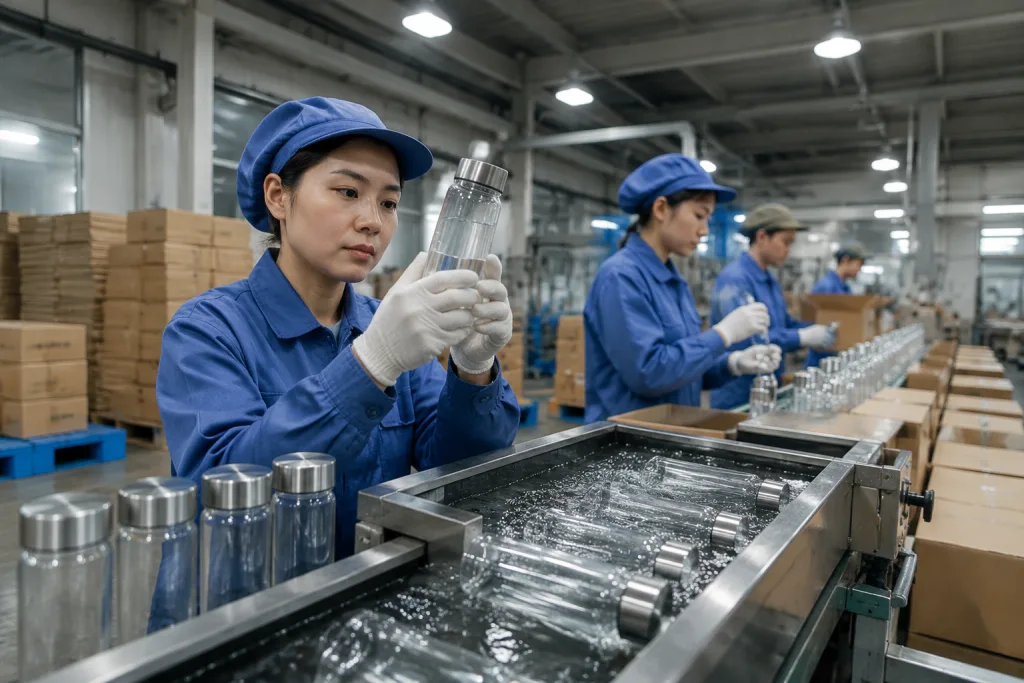
In Zhejiang and across China, good factories talk in wall thickness, drop-test height, AQL, and lead time, not marketing copy. That is the language we run on the line. I have seen a 0.3 mm wall-thickness gap turn into cracked bottles after one carton drop test, so this is the wrong question to ask if you only compare logo mockups. A proper custom drinkware order should survive freight, warehouse handling, Amazon FBA checks, and customer returns. If you are sourcing for a brand, distributor, or promotional program, map the order from sample approval to carton drop test before you send the PO.
Start with the exact buying scenario
Let’s make this concrete. You need a borosilicate glass stainless steel water bottle supplier for a mid-size launch: 5,000 units, two colors, one laser logo, retail carton, and export to Europe. Start with a usable brief, not a price chase. We need capacity, lid type, glass thickness, stainless grade, packaging, compliance target, and whether the bottle is for retail, canteen promotional use, or distributor resale. On the line, that one missing carton spec can stop a quote dead.
A serious factory in Zhejiang will ask about usage first, because the build changes if you want a custom canteen for outdoor retail versus a custom drinkware SKU for corporate gifting. If you are comparing canteen suppliers, canteen manufacturers, or canteen vendors, check how they read a spec sheet. Good ones confirm inner borosilicate glass, outer stainless shell or sleeve, silicone seal, and any coating or powder coat on exposed metal. Weak ones quote from a photo. We’ve seen that go sideways fast.
For a 500 ml bottle, a practical setup is 1.8-2.2 mm borosilicate wall thickness with a 304 stainless steel cap, leak-tested after assembly. If the bottle is designed as a customizable canteen or customizable drinkware item, decide early whether the logo is silk screen, laser engraving, or heat transfer. A buyer once flagged a PO typo on the decoration position, and the sample had to be reworked. Changing decoration after tooling usually costs 7-12 days, and the math does not work if you are already tight on launch.
Lock the material stack
This is where a lot of importers get burned. “Glass and steel” sounds simple, but the material stack decides how the bottle ships and how it comes back from the field. Borosilicate glass takes thermal shock better than soda-lime glass, which matters when a buyer fills hot water, then rinses cold at 7 a.m. For a commercial order, ask for a glass composition declaration and a wall-thickness tolerance band; on our line, QC checks 1.8-2.2 mm with a caliper before packing. On the steel side, specify 304 stainless steel or 18/8 stainless for food-contact parts, and ask whether the supplier can build a compliance file for REACH or FDA-adjacent requirements based on destination.
If you are sourcing from a canteen factory in China, do not accept “food-grade” as an answer. That label tells you nothing. Ask for the exact grade, the silicone hardness if there is a gasket, and whether the lid is PP, Tritan, or stainless; we have seen a PO typo swap “Tritan” for “tritanium,” and the buyer flagged it before tooling started. A lid can look premium and still fail in transit if the threads are soft. A good canteen manufacturer will send thread drawings, gasket cross-sections, and closure torque guidance. For a customized canteen or customized growler order, these small calls decide whether the bottle leaks in the customer’s bag.
- Glass body: borosilicate, 1.8-2.2 mm wall thickness
- Metal components: 304 stainless steel or better for food-contact parts
- Seal: silicone gasket with defined durometer
- Surface finish: matte, brushed, or powder coat with scratch tolerance
When you compare a canteen supplier against canteen distributors, the distributor usually cannot change the structure; they just resell stock. That is the wrong question to ask if you need a custom canteen or a customized canteen. Go straight to the factory. The math works better, and you get control over packing and QC; last month, QC pulled the sample on a 2 mm gasket because the compression was off by 0.3 mm, and that sort of miss is easier to fix before shipment than after landing.
Sample like a procurement manager
The sample stage shows whether the supplier runs a tight line or just talks well. Do not ask for one “nice sample.” Ask for a production-intent sample with the same glass thickness, same lid, same decoration, and the same carton insert you will buy in mass production. A Zhejiang factory should normally ship a standard sample in 7-12 days; if tooling changes are needed, allow 15-20 days. If they promise 2 days for everything, they are probably sending a hand-finished piece that will not match the order.
For a customizable growler or bottle line for retail shelves, we ask for three checks at sample stage: leak test, drop test, and artwork proof. For a laser logo, QC pulled the sample and checked depth plus edge sharpness under a 10x loupe. For print, check whether the ink survives a 50-cycle dishwasher test if your market expects it. North American buyers often care about shelf appearance first, but distributors care about damage rates. You need both, and this is the wrong question to ask as if one side does not matter.
Practical rule: if the sample cannot survive a 1-meter drop test onto carton corners and still seal, do not approve the order.
This is where a canteen distributor mindset goes sideways. Stock sellers say “looks fine.” A canteen manufacturer should show sample records, test methods, and a signed approval sheet from the line. Put the acceptance criteria in the sample email: no chips on the glass rim, no loose lid rotation, no visible glue residue, and no logo shift beyond 0.5 mm. We have seen a buyer flag a PO typo on the lid color code, and that tiny mistake turned into a 3-day rework.
Price the order the right way
Quoted price without the packing scope is not useful. A fair FOB China price for a 500 ml borosilicate glass stainless steel bottle can vary from USD 2.40-4.20 per unit at 3,000-5,000 units, depending on lid structure, logo method, and pack-out. We ran one job with a 3-piece lid and the unit price moved by 0.38 USD just from the cap change. Add a custom carton, inner tray, and multi-color print, and the number climbs fast. If a canteen vendor gives you a low figure but leaves out inner boxes, carton test, or export marks, the quote is incomplete.
Break the quote down the way the line does: glass body, stainless parts, silicone gasket, decoration, labor, packaging, and export carton. Ask for MOQ separately for stock color and special color. Many canteen suppliers will take 1,000 units on stock finish but need 3,000-5,000 units for a canteen customized color or lid tooling. We’ve had buyers flag a PO typo on the lid color code and that small mistake turned into a remake. If you are a distributor canteen buyer, this is the wrong question to ask unless you separate stock and custom margin from day one.
For importers in Europe and North America, ask whether the quote includes testing and paperwork: REACH statement, LFGB-ready materials if needed, and carton drop-test confirmation. The best canteen manufacturers will also tell you the packing ratio for a 40HQ container and the estimated loading quantity, usually in cases per pallet and units per carton. QC pulled the sample on one 5,000-unit run and found the outer carton failed the edge crush check before shipment. That matters if you are planning mixed SKUs or repeated distributor drinkware reorders. A cheap unit price is not cheap if the carton fails at destination.
Build QC into production
Production QC is where you protect the margin you already negotiated. We run this in three gates: pre-production sample signoff, mid-line inspection on the first 300-500 units, then a final AQL check before shipment. For drinkware, AQL 2.5 is common for major defects, but leakage, broken glass, and lid mismatch need tighter limits because one bad seal can blow up the whole PO. QC pulled the sample on the line at 10:20 and the buyer flagged a 0.4 mm rim chip; that one stays out.
Here is the inspection flow that actually works for this product:
- Incoming material check: glass clarity, rim finish, lid thread fit
- In-process check: logo registration, coating coverage, gasket seating
- Finished goods check: 100% leak test or documented sampling method
- Carton test: drop resistance, edge crush, and barcode readability
If your product is a custom growler style bottle or premium retail item, ask for photo records of the first article and random unit checks. A factory that handles canteen promotional orders and retail orders differently should spell that out in the QC report, with the actual test count and reject rate. We ship both, and the math changes fast when MOQ moves from 3,000 to 20,000 pieces. The wrong question to ask is “can you do QC?”; the real one is which defects get stopped on the line.
When you negotiate, ask the supplier to quarantine any glass with rim chips larger than 0.3 mm and any lid that does not pass a 24-hour inverted leak test. That sounds strict because it is. Glass bottles are unforgiving, and a return in Europe or North America costs more than scrapping weak units in Zhejiang, especially when the carton already passed drop test but the cap torque was off by 2 kgf·cm.

Ship without creating claims
Shipping is where a factory order turns into a claim if the packing is sloppy. For a borosilicate glass and stainless hybrid bottle, the carton spec matters as much as the bottle body. Ask for an inner tray or molded pulp insert that locks the bottle in place, and do not crowd the master carton. We ran a drop test at 76 cm; the loose pack failed on the corner, and QC pulled the sample before it left the line. A 3-ply mailer can work for samples, but export cartons need crush strength for sea freight and warehouse handling.
If you sell on Amazon or through another e-commerce channel, the carton has to match FNSKU labeling, any suffocation warning, and the case pack plan. If the PO says 24 pcs and the warehouse wants 20, the math does not work. For a distributor canteen account, a tighter master carton count makes replenishment cleaner. For a retailer, shelf-ready packaging matters more. Your supplier should know the difference before the buyer flags it.
China factories that ship custom drinkware deal with this every week. Zhejiang plants, in particular, ship mixed-channel programs, so ask for pallet patterns, carton dimensions, and loading photos. If you are sourcing a customized canteen or customized drinkware program across two or three markets, ask for one carton spec that covers all destinations, or decide where it must change. We have seen this go sideways over a 5 mm carton-height mismatch, and the freight damage rate jumped 8-12%.
By the time the container doors close, the order should be dull. That is the target. Dull means the bottle hit spec, the cartons held, the labels scanned, and the buyer can reorder the same SKU from the same canteen supplier without reopening the file.
Send your spec and get a real quote
We can quote your custom drinkware order with MOQ, lead time, carton plan, and QC points. Bring the brief, not just a logo file.
Frequently asked questions
What MOQ should I expect for a custom glass and steel bottle?
For a standard custom run, expect 3,000 units MOQ from a real factory, with some stock-color programs starting at 1,000 units. If you need special coating, custom lid tooling, or unique packaging, 5,000 units is more realistic. A Zhejiang canteen factory with about 300,000 units per month can usually handle repeat orders faster than a trading-layer supplier. Always confirm whether MOQ is per color, per logo, or per full SKU, because that changes the landed cost a lot.
How do I know if the supplier is actually a factory?
Ask for factory registration, production photos, and a video of the line doing glass forming, assembly, or leak test. A true canteen factory will discuss machine capacity, sample lead time, and QC flow without hesitation. Trading companies often avoid exacts and cannot explain wall thickness tolerance, gasket spec, or AQL terms. If they cannot quote a production lead time of 35-45 days after sample approval, you may be dealing with a layer, not a manufacturer.
What QC standard should I use for this bottle?
Use AQL 2.5 for major defects and define critical defects separately: broken glass, chipped rim, and leakage. For a glass-and-steel bottle, I recommend 100% leak testing on the first production run or at least a documented sampling plan with inverted hold testing for 24 hours. Ask for carton drop testing at 1 meter and verify the barcode scan rate if the order goes to retail or Amazon FBA. Good canteen suppliers will accept written acceptance criteria before mass production.
Can I get REACH or FDA-related documentation?
Yes, if the supplier is experienced with Europe and North America. For a borosilicate glass stainless steel water bottle supplier in China, ask for material declarations, REACH-related statements, and food-contact paperwork for glass, stainless steel, and silicone parts. You should also ask whether the decoration ink or coating has a separate compliance file. A serious supplier will not just send one generic certificate; they will map the paperwork to the exact SKU and components.
What is a realistic lead time from sample to shipment?
A normal timeline is 7-12 days for a standard sample, 15-20 days if tooling or color matching is needed, and 35-45 days for production after approval. Add another 5-10 days if you want special packaging, extra testing, or a custom carton insert. If you are buying from China to Europe or North America, also account for booking time at port and customs clearance. A factory in Zhejiang with stable lines can keep the production part predictable, but freight still needs planning.