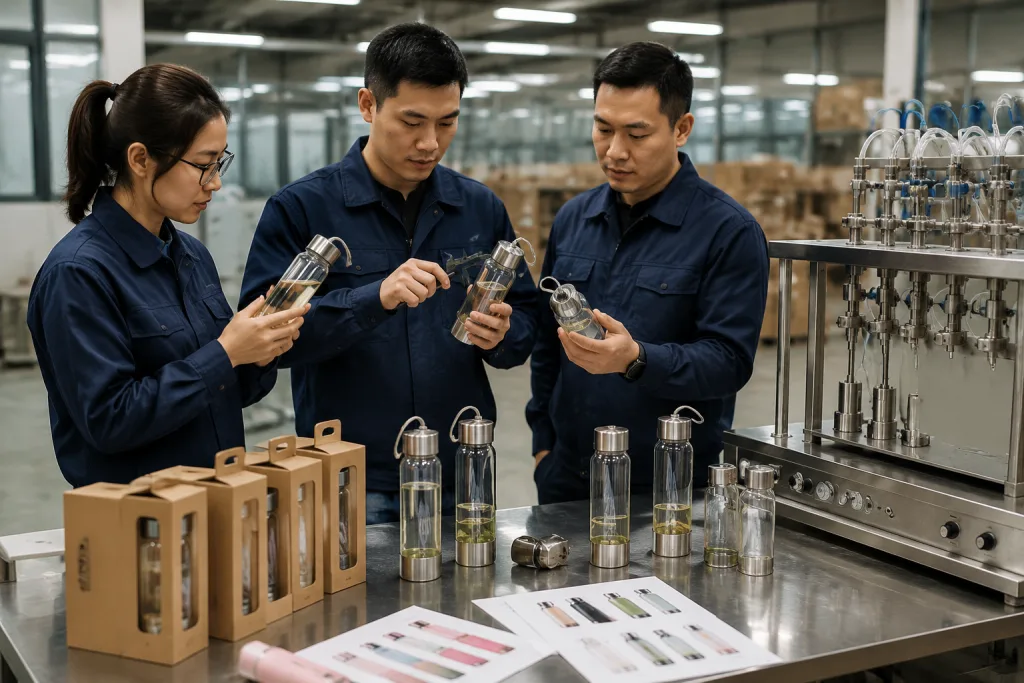
Key Takeaways
- MOQ for a private-label hybrid bottle usually starts at 3,000-5,000 units, with sampling in 7-10 days
- Borosilicate glass should specify thermal shock resistance and wall thickness, not just “heat-resistant glass”
- Stainless steel parts need material grade, finish, and test standard; 304 is common, 316 costs more
- A factory in Zhejiang can usually run 30,000-60,000 units per month if the mold and cap system are confirmed
If you are buying a borosilicate glass stainless steel water bottle private label, the job is not picking a “nice bottle.” It is reading the spec sheet line by line so you know what breaks in production, compliance, or customer use. A hybrid bottle sounds simple: glass holds the drink, stainless steel protects the structure. In practice, a 1.2 mm wall, the liner on the cap, and the test standard decide whether it ships as premium drinkware or comes back as a problem.
From our factory in Zhejiang, we see the same thing every season: buyers start with logo placement, then QC pulled the sample and the wall thickness or lid seal was off by 0.3 mm. China can build this category well, but you need the material stack, tolerance, and carton spec locked before the PO goes in. For private label, that is where the margin lives or dies.
Read the stack, not the marketing
When buyers ask for a borosilicate glass stainless steel water bottle private label program, the first mistake is treating it like one material. It is a stack: inner vessel, outer reinforcement, closure system, seal, decoration, and packaging. If one layer is vague, the whole quote turns soft. We have seen that go sideways on a 5000 pcs order because the supplier wrote “metal part included” and left the rest open. For a B2B buy, make the supplier name each layer and its job.
Start with the bottle body. Borosilicate glass handles thermal shock better than soda-lime glass, but that only matters when the wall thickness stays stable and the neck finish matches the cap. Ask for a wall thickness in millimeters, not a “heavy-duty” promise. We usually see 1.8 mm to 2.5 mm, depending on volume and whether the bottle carries a stainless sleeve or base guard. QC pulled the sample last week and found a neck mismatch at 0.6 mm, which is enough to create a bad seal.
Then check the stainless steel component. In this category, stainless steel is often a sleeve, base ring, or cap shell, not the liquid-contacting chamber. That changes the spec. Ask whether the steel is 304 or 316, whether the finish is brushed, powder-coated, or polished, and whether the coating survives abrasion checks. If the supplier cannot state the gauge or thickness, you are paying for looks only. The buyer flagged a PO typo once — “316L” on the order, but the sample card showed 304 — and the line caught it before we ran production.
Practical rule: if the supplier cannot describe the material stack in one sentence, the quotation is not ready for procurement.
Glass grade and thermal shock
Borosilicate glass is the part that carries the risk, so do not leave it vague. For reusable custom drinkware, state the glass composition grade, the thermal shock target, and the test method in plain terms. A Zhejiang supplier we ship with will usually point to lab data for a 120°C to 150°C temperature differential, depending on the bottle shape. That number is not a badge. It is the pass/fail line.
The buyer impact shows up fast. A lower-grade body may hold cold water all day, but it gets touchy when a user pours boiling water, drops in ice, or moves from hot wash to cold rinse. We’ve seen this go sideways in a canteen program: the buyer flagged cracked units after the first batch, and the math on returns did not work. If you sell into retail, the pain is worse because misuse is normal, not exceptional.
Ask for three checks in sample review:
- Wall thickness consistency across the body, especially at the shoulder and base
- Annealing process or stress-relief detail, because hidden stress shows up later in breakage
- Thermal shock test result with the temperature delta stated clearly
If you are sourcing a custom drinkware line, not a one-off gift, make the supplier put the test method into the PI. QC pulled the sample, and we found one PO typo that changed the delta by 10°C; that kind of mistake becomes a claim later. A factory that runs this work every week will take that request without drama.
Stainless steel hardware choices
The stainless steel part is where a lot of private label jobs fall apart. Buyers ask for “steel trim,” then expect a premium look. On the line, we see the same problem: it photographs well, then dents, rusts at a seam, or comes back with a sharp edge. For a canteen custom program, that is the wrong place to cut corners. Define the steel job first.
If the steel is a sleeve or base ring, lock down the grade, thickness, and finish. A common spec is 304 stainless steel at 0.4 mm to 0.8 mm for decorative protection, and some premium builds go thicker. We had one buyer flag a 0.35 mm ring as too soft after a drop test from 1.2 meters. If the cap uses steel, ask what sits under it. Food-grade silicone is standard, but hardness and compression decide the seal. A loose liner leaks fast.
The branding side matters too. Laser engraving on stainless steel holds up better than print on high-use custom canteen or customized canteen lines. Silk screen can work for bright retail color, but rub resistance needs a real check. QC pulled a sample after 200 rub cycles and the logo stayed readable; that is the kind of result you want. If you are building a canteen distributor bundle or a distributor drinkware assortment, choose the decoration that survives carton friction and warehouse handling, not just shelf photos.
In our Hangzhou facility, the cleanest programs are the ones where the buyer confirms the steel spec before sampling. That keeps the line moving and avoids cap redesigns that can add 10 to 14 days. One PO typo can still slow things down if the finish code is wrong. We ship faster when the cap is settled first.
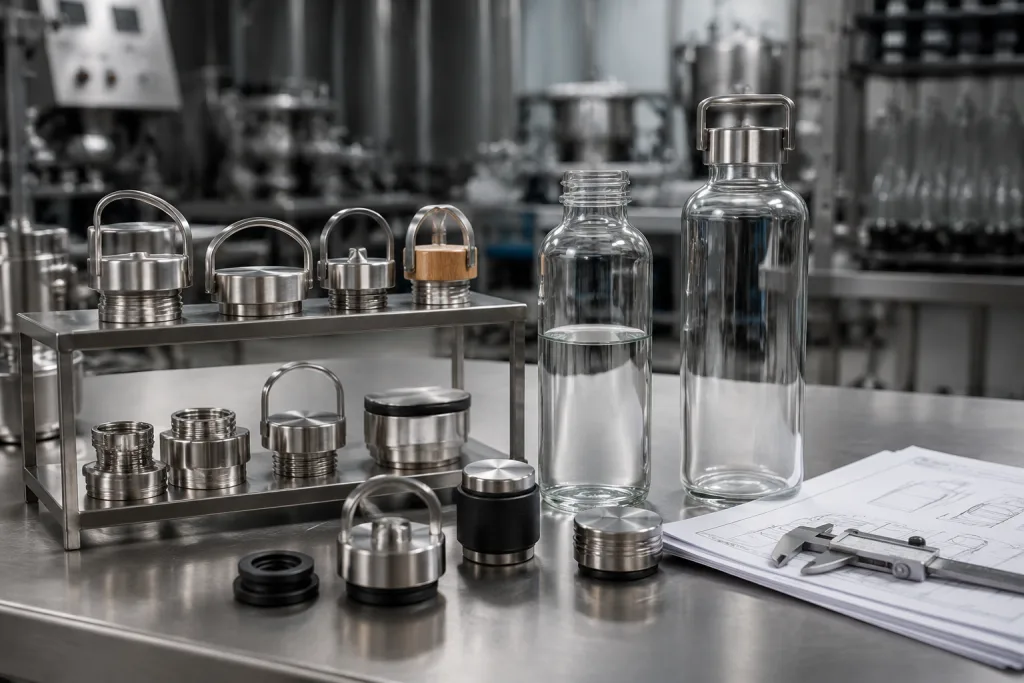
Lid seals and leak risk
For a hybrid bottle, the lid looks plain and usually becomes the expensive mistake. We have seen a cap feel solid in hand and still leak after 500 open-close cycles or a few pressure changes in transit. If the SKU ships to Europe or North America, leak testing is not optional.
Ask for the closure type first. Screw cap, flip lid, bamboo-top style, steel shell cap, and dual-function lid all change the user experience. Then lock down the seal. Silicone gasket size needs a drawing, and the seat geometry needs to be called out in mm. On one canteen customized line, a 0.3 mm change in gasket compression turned a clean sample into a claims issue.
The practical tests we recommend are simple:
- Inversion leak test for 2-4 hours at room temperature
- Drop test from 80 cm to 100 cm in packed condition
- Thermal cycle test if the lid is intended for hot and cold beverages
Packaging matters here too. If the cap threads are delicate, build insert protection into the carton; we run this kind of fix all the time on the line. QC pulled the sample after a buyer flagged a loose cap in a 1,000-piece trial, and the root cause was carton movement, not the carrier. If you want a customized growler or custom growler variant, pressure and closure requirements rise fast, so do not copy a water bottle lid spec into a beverage jug.
Decoration that survives use
Private label is not just a logo. It is how the product survives handling, washing, shelf rotation, and resale. With borosilicate glass stainless steel water bottle private label projects, decoration has to match the substrate. Put the wrong print on the wrong surface and you get peeling, fading, or a brand image that looks cheap after two wash cycles.
For glass, the line usually runs silk screen, decal, acid-etch style effects, or frosting. For stainless steel, laser engraving, pad print, and powder-coat color fill are the commercial choices we ship most. The channel decides the method. A distributor canteen program usually gets better results with engraving because the buyer cares about wear, carton friction, and mixed warehouse handling. Retail canteen promotions are a different brief; a strong color hit wins on shelf faster than a subtle mark.
Be specific about logo size and placement. A 25 mm mark on the neck looks clean; a 90 mm wrap can read loud if the bottle goes into premium channels. Ask the canteen factory for a decorated sample, not a blank prototype. QC pulled one last month where the ink cure was off by 8 minutes, and the buyer flagged the 1.5 mm registration drift immediately. That is enough to make a high-end SKU look crooked.
For buyers building customizable drinkware across multiple SKUs, the smart move is to standardize one body and vary only the decoration. The math works. One mold, one neck spec, one lid set; then change artwork, not tooling. That keeps MOQ manageable and gives canteen vendors and canteen suppliers a cleaner stock picture without a pile of slow-moving variants.
MOQ, pricing, and lead time
This is where procurement gets real. A private-label hybrid bottle is rarely a low-MOQ item unless you accept weak customization. In Zhejiang and other manufacturing zones in China, the practical MOQ is often 3,000 to 5,000 units for a standard shape, with a color change or cap swap pushing it higher. If you want a fully customized canteen form, expect mold charges and a longer approval cycle; we’ve seen that add 12 to 18 days before the line can even start trial shots.
For FOB pricing, a simple borosilicate glass plus stainless steel sleeve bottle usually lands around USD 2.80 to 5.80 at volume, depending on capacity, lid complexity, and decoration. A premium branded lid or heavier packaging can push it up fast. If a canteen manufacturer quotes too low, check whether the steel is real 304, whether the glass thickness is called out, and whether print is included. QC pulled a sample once and found the wall thickness was 1.2 mm instead of the 1.8 mm the PO asked for. Cheap quotes often hide omissions.
Lead time is usually 25 to 40 days after sample approval for standard parts, and 45 to 60 days if new molds or special lids are involved. A capable factory in Hangzhou, Zhejiang can often support 30,000 to 60,000 units per month once production is stable. That number only matters if the ordering schedule is clean, so build your forecast before peak season. The buyer flagged it when the PO said “ship ASAP” with no ship window; that typo cost us a week of slotting.
For brand owners and canteen distributors, the best cost control is to split the project into three stages: sample, pilot batch, then full PO. That keeps you from overcommitting to a cap design that has not passed real use testing. We run it this way for a reason, and the math does not work any other way if you are trying to protect margin on a custom canteen, a customized canteen, or broader customized drinkware for a chain account.

Compliance and shipment checks
Compliance turns a decent bottle into one you can actually ship. If your market is Europe or North America, lock down materials and test files before the booking, not after customs starts asking for paperwork. For borosilicate glass and stainless steel drinkware, we ask for food-contact declarations, REACH substance statements, and lab reports for coatings or inks. If the build includes silicone or plastic parts, those need their own file too.
A factory that knows B2B work should hand over an AQL inspection plan with the order. On most drinkware programs, buyers pick AQL 2.5 for major defects and 4.0 for minor defects, but the final call depends on your own risk level. Do not stop at carton count. Check leak performance, print alignment, cap torque, and packaging integrity; QC pulled a sample on the line last month and found one loose cap out of 80 pieces, which is the kind of miss that turns into a claim later.
Shipping documents need to match the goods in the carton. HS code, carton count, net and gross weight, and outer carton marks all need confirmation before you book space. If you use FNSKU or Amazon-style fulfillment, the label flow has to be built into packing, not patched in at the warehouse. We have seen buyers save $0.12 per unit on the ex-factory price, then pay twice that to relabel cartons because the PO typo was on the wrong SKU.
Ask the factory for a pre-shipment checklist with photos: cap closed, logo close-up, inner tray layout, carton drop test status, and pallet height. That is basic discipline. A supplier with a 20-foot line and a real QC desk does this every week; the ones that improvise are the ones that get the buyer flagged at destination.
Picking the right supplier model
Not every supplier fits every buying model. For a one-off seasonal gift, a canteen vendor or promotional trade supplier can do the job. For repeat stock, you need a canteen factory or canteen manufacturer that keeps tolerance steady across 3 or 5 production runs. We’ve seen sample photos look fine and the second PO fail on cap fit.
Ask whether you are buying a brand story or a replenishment program. For a brand story, a customized growler or customized drinkware presentation box can carry more cost and more handwork. For replenishment, the math is different: stable BOM, spare lid supply, and written change control. A buyer once flagged a PO typo on lid color; that kind of miss matters to canteen suppliers, canteen manufacturers, and any canteen distributor supporting retailers after launch.
Use this short filter:
- Canteen custom if you want logo and color work on an existing body, with a 1,000 pcs MOQ and one print screen
- Canteen customizable if you need a modular platform with 2 to 4 lid and color options
- Canteen customized if the body, closure, and pack need brand-specific control down to the 0.2 mm detail
- Distributor canteen if stock rotation and 7-day replenishment matter more than novelty
If the supplier can explain tooling ownership, sample revision timing, and spare-part availability, you are talking to the right team. If not, keep looking. This is the wrong question to ask if you only care about the first sample. The best long-term private label programs are built with canteen suppliers who think like engineers and canteen vendors who think like exporters, not just traders.
Send your spec sheet for a factory quote
We can review material stack, MOQ, compliance, and packaging before sampling, so you avoid the usual private-label mistakes.
Frequently asked questions
What MOQ should I expect for a borosilicate glass stainless steel water bottle private label order?
For a standard shape, expect 3,000 to 5,000 units as a realistic MOQ. If you change the mold, lid structure, or packaging, MOQ can rise to 8,000 units or more. Sampling usually takes 7-10 days, and a full production run after approval is often 25-40 days. A Zhejiang canteen factory with stable tooling can support repeat orders faster, but only after the BOM is locked. If a quote promises 500 units with full customization, check whether the supplier is actually using stock parts and simple decoration only.
Which stainless steel grade should I specify?
For most private-label drinkware, 304 stainless steel is the practical baseline because it balances cost, corrosion resistance, and appearance. If the bottle will face harsher conditions or premium positioning, 316 can be specified, but it increases cost. Also define thickness: 0.4 mm to 0.8 mm is common for sleeves, rings, or decorative components. Ask for finish type too, such as brushed, polished, or powder-coated. Grade alone is not enough; thickness, surface treatment, and seal interface matter just as much.
How do I check if the glass is safe enough for hot and cold use?
Ask for borosilicate glass test data with a stated thermal shock delta, often in the 120°C to 150°C range depending on the build. Also request wall thickness in millimeters, annealing information, and sample drop or heating-cycle results. A good supplier will give you a written test summary, not just say the bottle is “heat-resistant.” For B2B buyers, this matters because user behavior is not controlled. If the bottle is sold through canteen distributors or retail, you should assume some customers will pour hot water, then rinse cold.
What compliance documents do I need for Europe or North America?
At minimum, ask for food-contact declarations for glass, steel, silicone, and any coatings or inks. For Europe, REACH-related substance information is often needed, and for North America you may also need relevant food-contact or safety declarations depending on the channel. If you sell through Amazon or retail fulfillment, packaging and labeling controls matter too. Keep an AQL inspection plan, carton list, and material declarations in the order file. That makes customs, audits, and retailer onboarding much smoother.
Is laser engraving better than printing for private label?
For stainless steel parts, laser engraving is usually the more durable choice because it resists abrasion and repeated washing. Printing can look stronger in color, but it depends on ink system, cure quality, and surface prep. On glass, screen printing or decal decoration can work well if you control firing or curing. If your bottle is a canteen promotional item, printing may give better visual impact. If it is a premium distributor drinkware SKU, engraving often holds up better in the field.