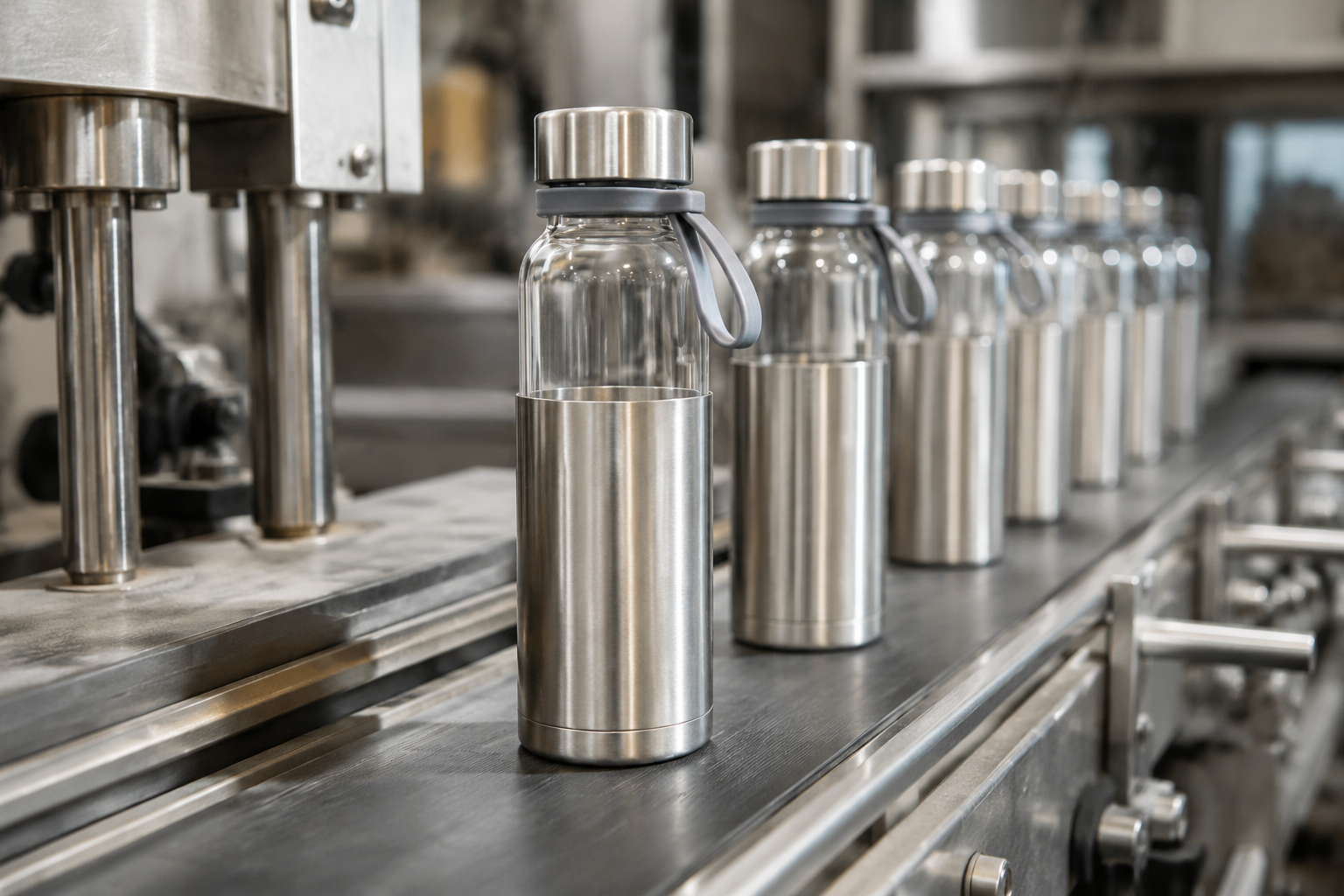
Key Takeaways
- Typical MOQ starts at 1,000 units and drops to 500 for simpler canteen promotional orders.
- A standard borosilicate glass stainless steel water bottle custom program usually runs 35-55 days after sample approval.
- Decoration adds real cost: one-color silk screen is often USD 0.15-0.35 per unit, laser engraving USD 0.25-0.60.
- For export buyers, QC, cartons, and freight can add 12-28% to ex-factory cost before you hit your warehouse.
If you are sourcing a borosilicate glass stainless steel water bottle custom, the real question is not the premium look. It is whether the bottle survives a 1.2-meter drop test, the print stays on after 20 wash cycles, and the landed cost still works once you add cartons, testing, and freight. We have seen buyers in Europe and North America chase the lowest quote, then get hit with broken necks, off-spec lids, and a margin that disappears after the first shipment.
We make custom drinkware in Zhejiang, China, and the pattern stays the same across canteen custom, custom growler, and other customized drinkware programs. A 0.8 mm change in glass wall thickness, a switch from 304 stainless to a cheaper grade, or a new lid tool can move the price more than the artwork does. The buyer flagged it on a PO once: “sample approved” was typed as “sampe approved,” and that kind of slip tells you the real issue—if you want a useful quote from a canteen manufacturer, talk MOQ, AQL, FOB, and lead time, not “nice design.”
What You Really Pay For
The unit price on a borosilicate glass stainless steel water bottle custom starts the conversation, not the math. We break it into five buckets on the line: the glass tube or formed body, the stainless sleeve or base, the lid system, decoration, and packing. If you ask a canteen supplier for a clean quote without naming those parts, you get a low number that turns messy when the PO lands.
Material choice changes the bill fast. Borosilicate glass holds up better than soda-lime glass under thermal shock, but it asks for cleaner handling and tighter packing; one chipped carton can wipe out the margin on 300 units. For a 500 ml bottle, the usual wall thickness sits at 1.8-2.2 mm for glass sections and 0.4-0.6 mm for stainless wraps or trims. Move from a basic PP cap to a 304 stainless lid with silicone seal, and the lid can add USD 0.40-1.20 per unit depending on finish and tooling. We’ve seen buyers push back on that number, then QC pulled the sample apart and found the seal fit was the part doing the work. A custom canteen with mixed materials also needs tighter assembly control, which is why canteen manufacturers in China usually carry a higher labor allowance for hybrid builds.
In Zhejiang, a good factory will split the quote into FOB line items so you can see where savings sit. That matters when you are comparing canteen suppliers, because a distributor drinkware quote may hide margin, re-packing, and export paperwork while a direct canteen factory quote does not. If you are buying at scale, ask for a costed BOM, not a rounded sales price. The wrong question is “what is your best price?”
MOQ Tiers That Make Sense
MOQ is where a lot of buyers burn time. For a borosilicate glass stainless steel water bottle custom order, 1,000 units is the normal starting point for a fresh print setup, while 3,000 units fits when you want multiple colors or a more complex package. We run into this weekly. Some canteen vendor teams will quote 500 units, but that only works with a stock body, limited logo work, or an existing mold.
The math is plain. At 500 units, decoration and packing cost more per bottle because the setup charge is spread too thin. At 1,000 to 3,000 units, pricing settles down, and you can spec a better carton insert, a tougher sleeve, or a customized canteen gift box. Above 5,000 units, there is room to talk bottle thickness, lid finish, and whether the canteen custom project can use shared tooling. QC pulled the sample yesterday at 1.2 mm wall thickness, and the buyer flagged the gap as too thin for retail.
- 500 units: good for a design test or a distributor canteen pilot.
- 1,000 units: common MOQ for a canteen customizable order with one logo method.
- 3,000 units: the best balance for custom drinkware with better carton and print economics.
- 5,000+ units: better for canteen distributors and seasonal programs that run longer.
If you sell through retail or Amazon, do not stop at the unit price. Check FNSKU labeling, master carton loading, and whether your warehouse can receive mixed SKUs without turning the line into handwork. We have seen a buyer save $0.18 per bottle on paper and lose it in labor. A cheap MOQ that adds three hours of picking and relabeling in your fulfillment center is not cheap.
Timeline From Sample To Ship
I’ll rewrite the section in-place, keeping the HTML structure intact and tightening the sales copy to sound more like a factory-side engineer.Lead time is where buyer expectations and factory reality split. A normal borosilicate glass stainless steel water bottle custom job usually runs 7-12 days for sampling, 10-15 days for sample approval and revisions, and 25-35 days for production after deposit and final artwork confirmation. That puts the total at 35-55 days before ex-factory shipment. If you need custom growler or customized growler packaging with inserts, add 5-8 days. We run this every week, and the line still waits on one missing logo file more often than on the machine.
The fastest jobs come with a clean spec sheet. Send Pantone codes, logo vector files, lid type, carton requirements, and the test standard upfront, and QC pulled the sample once instead of three times. Leave those items open, and each round of back-and-forth eats a day or two. This is the wrong question to ask if you want speed; “Can you make it fast?” means nothing when the PO still says “black lid, maybe.”
Practical rule: each change after sample approval can add 3-7 days, especially if you change the lid, print position, or packaging layout.
For urgent orders, ask whether the canteen manufacturer can hold pre-production materials in stock. That can cut 5-10 days off the schedule, but the math does not work if you keep changing art or carton size after we cut the tooling. For Europe-bound shipments, build in extra time for REACH checks and any third-party lab report request. We’ve seen that side of the job go sideways on a 2 mm carton mismatch, not on the bottle itself.
Decoration Changes Your Cost
Decoration is not a side detail. It is often the line between a plain bottle and a drinkware SKU that a buyer will actually reorder. For this borosilicate glass stainless steel water bottle custom program, we run silk screen, laser engraving, UV print, and decal work; each one lands differently on glass and steel, and the wrong pick burns cash fast.
One-color silk screen usually gives the lowest unit cost for a custom canteen or canteen promotional order, often around USD 0.15-0.35 per unit at reasonable volumes. Laser engraving is cleaner and permanent on stainless steel parts, but it can sit around USD 0.25-0.60 per unit because the fiber laser holds the line longer on each piece. Full-color UV print costs more and needs tighter artwork control. The buyer flagged a 2 mm logo shift on one run, and QC pulled the sample before it reached packing. If you are buying for a distributor drinkware catalog, ask which decoration survives abrasion, dishwasher cycles, and repeated handling; this is the right question, not just the cheapest print.
Glass surfaces need extra care. On a borosilicate body, firing or decal options can add setup cost and stretch the sample cycle to 12 days instead of 18 when the artwork is messy. Stainless steel accents are more forgiving, but finish matters: brushed 304, mirror polish, and powder-coated trims all change the look and the margin. We’ve seen a low-price canteen order go sideways because the PO typo moved the logo 5 mm off center, and nobody caught it until first article check. A canteen distributor trying to push low price often cuts decoration complexity first. That can work, as long as the brand still looks deliberate.
If you are comparing canteen custom options, get samples with the actual print method, not just a digital mockup. Digital files do not show how a logo wraps on curved glass or sits under a stainless band, and the gap shows up on the line the moment we start packing.
Testing And Compliance Costs
Export buyers should set compliance money aside before the PO lands. For Europe, REACH and food contact paperwork are standard asks. For North America, we usually get test reports tied to the body material, inks, silicone seals, and any coating on the bottle. If your borosilicate glass stainless steel water bottle custom has a bamboo lid, straw, or silicone gasket, QC will treat each extra material as a separate test item.
Lab fees depend on scope, but a small program often lands at USD 180-450 per material group. If you need Europe plus the U.S. in one shot, the bill climbs fast. That looks small on paper. It is not, once your MOQ is 1,000 units and the buyer flagged a PO typo on the material code. Factories in China, including many in Zhejiang, quote this as an optional service because some buyers already have their own compliance partners.
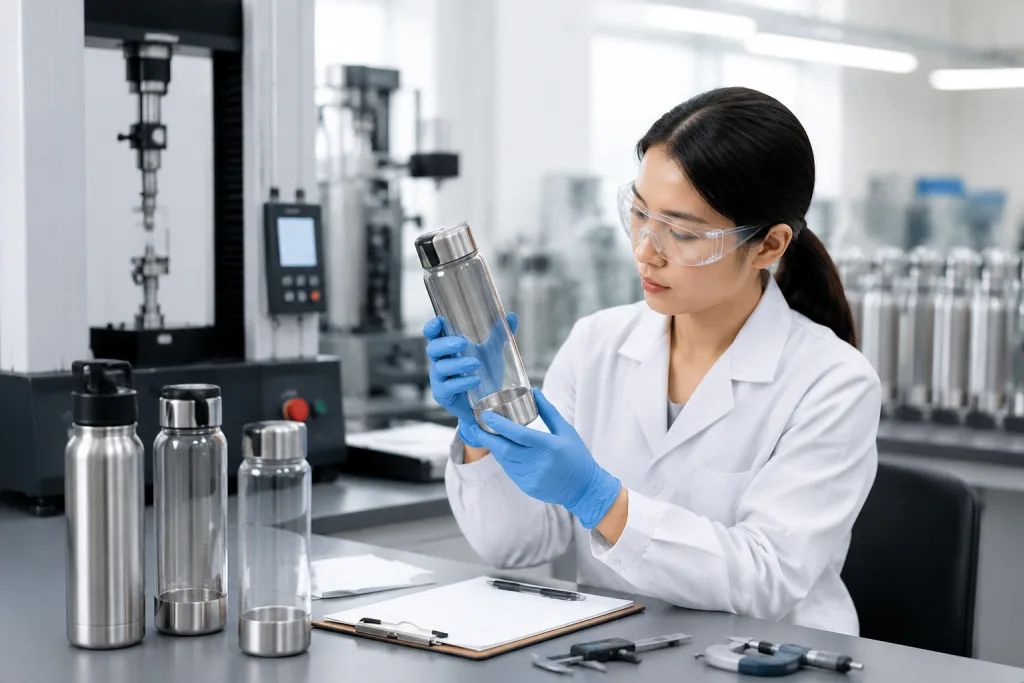
If social compliance matters to your retailer, ask for BSCI. Ask how the factory handles incoming inspection, in-process checks, and final random inspection. We run AQL 2.5 for critical and major defects on appearance and leakage, and we keep drop-test or vacuum-test records when the design needs them. A supplier that cannot explain AQL without pausing is the wrong shop to chase.
Choosing The Right Factory Partner
The right partner is not the loudest catalog on the table. It is the one that can walk you through the line, defect checks, and export packing without talking in circles. A real canteen factory should tell you monthly output, MOQ, and where the choke points sit. On our side, we run 200,000 units a month across drinkware lines, and repeat orders usually sit at 35-45 days. QC pulled a cracked sample once because the shoulder radius was off by 1.2 mm. That is the level you want.
When you compare canteen manufacturers, check three things. Do they own or control the tooling for your shape? Can they run your decoration method at scale? Can they pack for your channel, whether that means retail carton, mailer box, or pallet export? A canteen vendor that only ships loose units is not much help when your warehouse needs barcodes and master carton specs. We had a buyer flag a PO typo on carton count before production started, and that saved a mess.
- For brand launches: choose a canteen manufacturer that can turn samples in 10 days and keep the first shot close to final.
- For distributor canteen programs: prioritize repeatability, spare-part availability, and steady reorders of 5,000-20,000 pcs.
- For promotional runs: keep the structure simple and push the branding, not the tooling.
- For premium custom drinkware: budget for stronger packing, AQL 2.5 checks, and stricter QC.
Buyers often ask whether they should source direct or through canteen distributors. That is the wrong question to ask if your design is still moving. If you need speed and low complexity, a distributor can help. If you need better margin, more control, and a 12-day sample loop instead of 18 days, direct factory sourcing in China usually wins. We’ve seen this go sideways when a brand wants three revisions on a custom growler-style family and still expects the middleman to keep the math clean.
How To Build A Better Quote
The fastest way to get a usable quote is to send a spec sheet that looks like a production order. Put in bottle capacity, target wall thickness, lid material, logo area, print method, carton size, test requirements, and delivery terms. If you want FOB China pricing, say FOB China. If you want landed advice, ask that as a separate line item. Mix the two and the math gets muddy fast.
For a borosilicate glass stainless steel water bottle custom project, ask for three quantities: 500, 1,000, and 3,000 units. That is the clean way to see the cost curve. On the line, we usually see the sticker price move hard between 500 and 3,000, and that tells you if the canteen customized version still leaves margin or if the wholesale plan needs a simpler SKU. The buyer flags this late all the time, and then the quote is already off.
State packaging with no wiggle room. A plain bulk pack can save USD 0.12-0.30 per unit, but retail cartons, hangtags, and barcode labels often add more than that back. If you sell through distributors, online marketplaces, or specialty retail, those items are part of the product. QC pulled the sample last week and found a carton typo on a PO, which cost one extra round of artwork approval. We run better quotes when the buyer locks the artwork before production starts.
Get a quote built for your target margin
Send your capacity, logo method, and target MOQ. We will price it with real lead times, test options, and export packing from Zhejiang.
Frequently asked questions
What is a realistic MOQ for borosilicate glass stainless steel water bottle custom orders?
For most export buyers, 1,000 units is the realistic starting point for a new borosilicate glass stainless steel water bottle custom run. If the body shape and lid are already existing, 500 units can work, but the unit cost is usually higher because setup fees are spread across fewer bottles. At 3,000 units, pricing is usually much easier to optimize, especially if you want custom packaging or more than one print color. For a canteen custom program with multiple SKUs, ask the factory to quote separate tiers so you can see the break points clearly.
How much does a custom bottle usually cost FOB China?
A simple borosilicate glass stainless steel water bottle custom program often lands around USD 2.10-4.80 FOB China depending on capacity, lid type, print method, and packing. A basic one-color logo on a standard body will sit near the lower end. A premium customized drinkware version with laser engraving, stainless lid, and retail box can move higher fast. If you are buying as a canteen distributor, always ask for a cost split by bottle, lid, decoration, and carton so you know where to negotiate.
How long does sampling and mass production take?
Sampling usually takes 7-12 days, especially if the design needs a new logo plate or artwork adjustment. After sample approval and deposit, mass production usually takes 25-35 days. That means a normal project is 35-55 days end to end before export shipment. If you change the lid, finish, or packaging after sample approval, add 3-7 days per change. For canteen manufacturers in Zhejiang, speed is available, but only if your specifications are locked early.
Is borosilicate glass safe for export drinkware?
Yes, borosilicate is widely used for premium drinkware because it handles thermal shock better than standard soda-lime glass. For export, you still need the right supporting materials: food-grade silicone seals, compliant inks, and test reports that match your target market. For Europe, buyers often request REACH-related documentation and food contact confirmation. If your canteen supplier cannot provide consistent material declarations, that is a warning sign, even if the price looks attractive.
Should I source direct from a factory or through a distributor?
If you need speed, limited complexity, or a very small launch, a distributor can be convenient. If you need better margin, more control over design, and a repeatable program, going direct to a canteen factory in China is usually the smarter move. Direct sourcing also helps when you need customized canteen colors, retail-ready cartons, or multiple lid options across one line. For long-term custom drinkware programs, the factory route usually gives you more leverage on pricing and lead time.