Key Takeaways
- Most borosilicate glass stainless steel bottle private label orders start at 1,000-3,000 pcs MOQ, with 25-35 day lead time after sample approval.
- A usable spec sheet should lock glass wall thickness at 1.8-2.2 mm, stainless outer thickness at 0.35-0.45 mm, and leak testing at 24 hours.
- For EU and US buyers, ask for REACH, food-contact declarations, and AQL 2.5/4.0 inspection reports before shipment.
- Decoration choice changes both risk and cost: laser engraving is typically more durable than printed logos on a customized thermos.
You are not buying a “nice bottle.” You are buying a repeatable order that has to survive freight, retail handling, and customer complaints in Europe or North America. If you are sourcing a borosilicate glass stainless steel bottle private label program, the real work starts before you place the PO: wall thickness, lid seal, drop risk, decoration method, and what your supplier in Zhejiang can actually hold steady at scale.
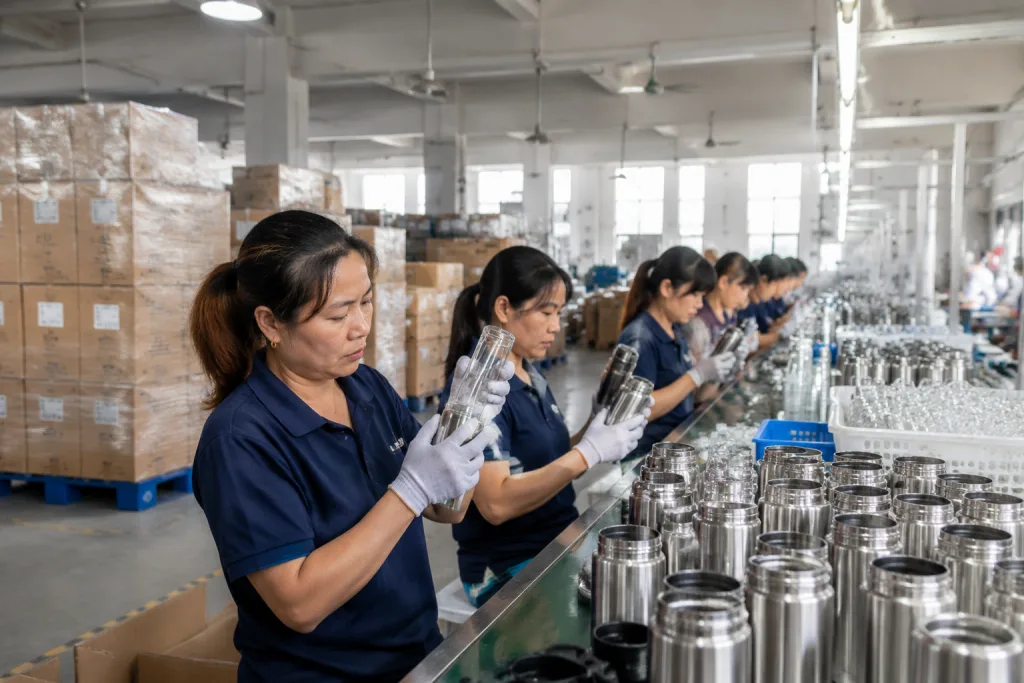
We build drinkware in Zhejiang, China, so we see the same mistake every season: buyers approve a sample, then the bulk thermos shows a different feel, a loose cap, or decoration that fails after a few washes. Last month QC pulled a 2,000 pcs sample at the line and found a 1.2 mm wall drift; the buyer flagged it after the first carton check. This is not a logo game. It is spec control, a clean sign-off on the factory thermos line, and hard QC points before the shipment leaves China.
Start With the Retail Use Case
Do not start with “What can you make?” Start with where the bottle sits: on shelf, in a kit, or in a mailer. Outdoor retailers usually want a borosilicate glass stainless steel bottle private label program that looks premium and still survives a 1.2 m drop test in transit. Promotional brands ask a different question. They care about print area, giftability, and landed cost. That is the split.
For a real buyer case, take a 500 ml bottle with a glass inner, stainless outer shell, and a screw lid. That size moves because it is light for travel and still holds enough for coffee or tea. We run this spec often, and the first thing our team asks is market: Europe, the US, or the Middle East. The same body can need different lid colors, carton art, or warning copy, and a PO typo on the carton code will slow the line for half a day.
Lock the commercial basics early: target order quantity, FOB port, decoration method, and whether the bottle sells as a promotional thermos or a retail custom thermos. Skip that step and the sample can be technically fine but commercially wrong. We have seen that go sideways. A sample passed on the bench, then the buyer flagged the unit carton as too plain for shelf display. The math does not work if the spec ignores channel.
What to define first
- Capacity: 350 ml, 500 ml, or 750 ml
- Target MOQ: 1,000 pcs, 3,000 pcs, or 5,000 pcs
- Decoration: silk screen, laser, UV print, or wrap label
- Packaging: individual gift box, mailer, or bulk tray
If your project is for distributors thermos programs, ask for carton counts that match palletization. If it is a retail launch, ask for retail-ready inserts and barcode placement before you approve the first sample. QC pulled the sample on one project because the barcode sat 6 mm too close to the fold. That saves time later, and in Zhejiang factories time is usually lost in packaging revisions, not in molding.
Build the Spec Sheet Properly
A proper spec sheet separates a real factory thermos order from a vague inquiry. For a borosilicate glass stainless steel bottle private label job, define the build from the inside out. Borosilicate glass handles heat swings, but it breaks easier than buyers expect, so the stainless shell and lid have to carry the load.
For most buyer programs, we run a glass inner wall at 1.8-2.2 mm and an outer stainless shell at 0.35-0.45 mm. That feels solid without turning the bottle into a brick. Ask the supplier to confirm the glass grade and whether it is heat-resistant borosilicate, not ordinary soda-lime glass. We have seen listings blur that line in China, and the buyer flagged it only after QC pulled the sample.
Then lock the lid details: gasket material, thread count, open-close torque, and whether the cap includes a strainer or infuser. If you are building a thermos customizable program for tea or coffee, the lid matters as much as the body. A weak silicone seal kills a promotion faster than a scratched logo. Ask for a 24-hour inverted leak test, plus a hot-fill test at 95°C if the product is sold for beverages.
One unclear sentence in the PO can become 2,000 unusable units. That is the wrong question to ask. In drinkware, ambiguity eats margin.
Use the spec sheet to compare supplier thermos quotations on the same basis. A lower FOB price means nothing if the wall thickness is thinner, the cap tolerance is loose, or the carton count pushes freight up by 12%. That is how experienced thermos suppliers win repeat orders: not by looking cheap on paper, but by shipping fewer surprises from the line.
Approve the Sample Like a Buyer
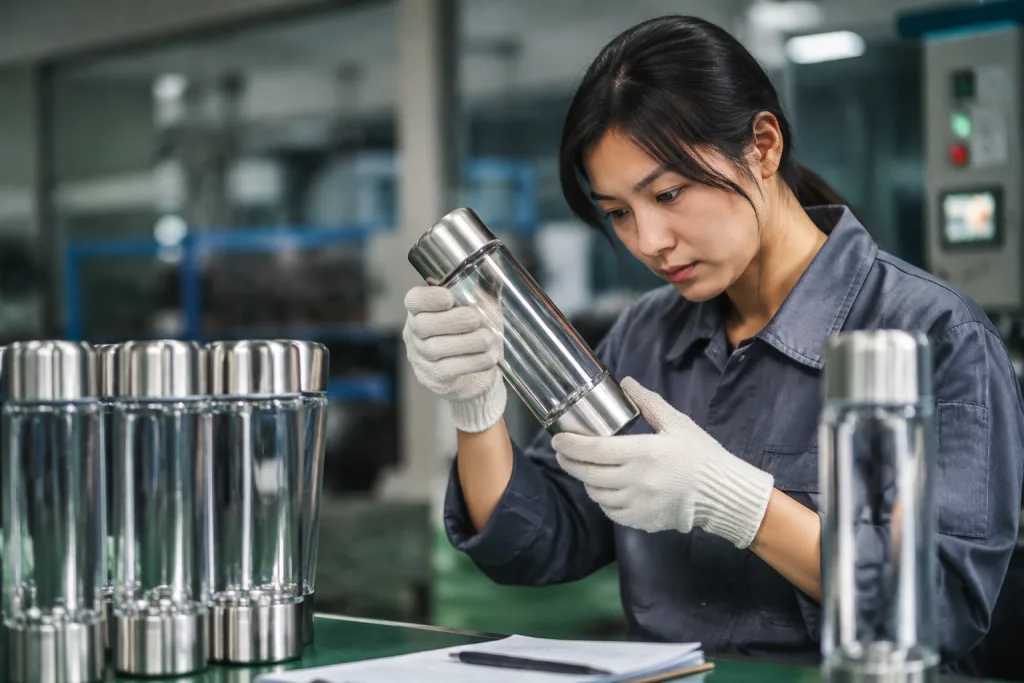
When the sample lands, do not just cut the tape and look at the color. Treat it like a pre-production prototype. Hold it to a lamp. Check whether the borosilicate glass sits centered in the stainless shell. Spin the lid 10 times. Fill it with hot water, close it, and leave it upside down for 24 hours. A solid custom thermos sample should pass without sweating, odor, or cap movement. We run this test on the line with a 500 ml unit, and QC pulled the sample if the gasket sat 1 mm off.
Decoration usually gets the first look, but it should not be the only check. Compare logo placement to the grip zone, because a print that looks perfect on a flat proof can sit awkward on a curved bottle. If the buyer flagged it for an outdoor retailer order, the math does not work with a weak mark. Laser engraving usually holds up better than ink print because it resists backpack abrasion and dishwashing, and we have seen a 0.3 mm shift turn into a rejected PO.
Ask for two samples if the program matters: one golden sample for approval and one pre-production sample after tooling and packaging are locked. The golden sample is the visual reference. The pre-production sample is the shipping reference. A supplier in Zhejiang who knows the job will label both clearly, and if the carton mark has a typo, you catch it before the line starts packing 3,000 sets.
- Check logo clarity at 30 cm viewing distance
- Measure gross weight against the approved sample sheet
- Confirm lid threading and gasket fit
- Test for odor after a hot-water soak
Sample approval is where you protect the order. Once production starts, changes cost time and money. A good thermos manufacturer treats the sample as the contract anchor, not a display piece, and we have seen this go sideways when a buyer waved off one loose cap and the whole batch came back for rework.
Price the Order Without Guesswork
Buyers often ask for “the best price,” which is not a useful brief. Ask for landed cost at your quantity with your pack-out. For a mid-range borosilicate glass stainless steel bottle private label order, FOB China pricing swings with capacity, lid type, logo method, and box style. A basic 500 ml build usually sits around USD 2.10-3.80 per unit at 1,000-3,000 pcs. Add a gift box, a heavier carton, or multi-color print, and the quote moves fast.
We tell buyers to send the exact pack-out. Ask the factory thermos team to quote bottle, lid, insert, gift box, master carton, and test fee as separate lines. Then you can compare one supplier thermos offer against another without freight hiding inside packaging. We had a buyer flag a PO that said “white box” on one page and “kraft box” on another; the line stopped until they fixed it. If you ship into Amazon or a DC, ask for carton dimensions and pallet count early so your freight forwarder can run the numbers on day one.
For promotional brands, the better move is often to cut the packaging and put the money into decoration or a tighter cap tolerance. For outdoor retailers, a stronger box and cleaner shelf presentation can earn a higher FOB price. This is the wrong question to ask if the channel is unclear. A good thermos custom quote should fit the sales channel, not just a target unit cost.
If you compare thermos distributor and thermos factory quotes, check whether testing is included on both sides. A gap of USD 0.18 per unit can vanish once you add missing compliance paperwork or extra carton protection. We’ve seen this go sideways when QC pulled the sample and found the print file had the wrong Pantone code. That is normal. Smart distributors thermos programs ask for a line-item quotation and keep the spec sheet tight.
QC the First Production Run
The first mass run is where the project turns from sample talk into paid goods. For China production, we run a pre-production meeting and a QC checklist before the line starts. The factory should confirm material intake, print position, lid assembly, and carton labeling. One typo on the PO can send the wrong carton mark through the whole batch. If the order goes to Europe, confirm REACH-related declarations and food-contact documents before the goods move to packing. If the buyer sits in North America, line up the customs and retailer papers your importer asks for.
AQL matters here. For a standard drinkware order, many buyers use AQL 2.5 for major defects and 4.0 for minor defects, with tighter checks on leakage, breakage, and decoration defects. That does not mean you accept bad pieces; it means you and the supplier thermos team agree on the sampling math. We’ve seen buyers push for “one more carton check” after QC pulled the sample and found a 1.2 mm print shift, and the math still had to hold. If the product is a premium promotional thermos, tighten inspection on logo alignment and surface scratches.
Ask for three QC checkpoints: incoming material inspection, in-process assembly check, and final random inspection before boxing. The glass inner needs special handling because edge chips and internal stress do not always show up at first glance. A line that ships borosilicate glass stainless steel bottle private label orders should also check lid torque with a torque meter, usually in the 0.8-1.2 N·m range. Foam separators and drop-protection cartons are not decoration; they keep the breakage rate in line.
Minimum QC evidence to request
- Pre-production sample photos with timestamp
- Inline defect photos from assembly
- Final inspection report with AQL results
- Packing photos showing carton marks and FNSKU if needed
For thermo suppliers that serve retail buyers, the best sign is not a perfect promise. It is a supplier that shows defects early and says how they were fixed. QC found a loose lid on a 500 ml trial run, we reworked the seal ring, and the next pull cleared. That is what a real thermos supplier does when the order is large enough to matter.
Plan Shipping, Labels, and Reorders
Once QC signs off, the job is still open. We still need shipping labels, carton marks, and a reorder plan. If you sell on Amazon or another marketplace, check FNSKU labels, suffocation warnings, and master carton barcodes before the cartons leave the line. If you sell through distributors, lock the case pack and pallet spec. This is where we see delays: the bottle passes inspection, then the warehouse rejects the labels.
For a borosilicate glass stainless steel bottle private label shipment, ask the factory to file one production reference sample, one packaging sample, and the approved artwork together in the job folder. We keep that set in a marked tray at the packing table, and it saves time on the next PO. A solid thermos manufacturer can repeat a 3,000-piece order in 25-35 days after deposit and artwork confirmation if the spec stays fixed and no new tooling is needed. That timing is normal on a stable line in China.
Before the order ships, confirm whether the deal is FOB Ningbo, FOB Shanghai, or another Zhejiang port. Freight can change the math faster than the bottle price. For repeat promotions, ask your thermos vendor to keep the mold number, screen file, or laser file on record so the next run starts clean. We have seen buyers lose a week because the PO said “Shanghai” in one place and “Ningbo” in another.
If you want a long-term private label line, you are not just buying a bottle. You are building a repeat-buy system with a supplier thermos partner in Zhejiang who can keep quality, timing, and paperwork steady. That is what turns one order into a product line you can ship again without rework.
Build your next custom thermos order correctly
Send the target capacity, MOQ, logo method, and destination market. We will turn it into a production-ready spec and QC plan.
Frequently asked questions
What MOQ should I expect for a borosilicate glass stainless steel bottle private label order?
For most custom thermos programs, MOQ starts at 1,000 pcs per design and can move to 3,000 pcs if you want multiple colors or premium packaging. A simpler promotional thermos with one logo and stock color may be flexible, but a true retail build usually needs a firmer run to keep unit cost stable. In Zhejiang and wider China, the factory will often price 1,000, 3,000, and 5,000 pcs differently because printing, packing, and carton setup spread across volume. If you want a very low MOQ, expect a higher FOB price and fewer packaging choices.
How do I check whether the glass is real borosilicate?
Ask for the material declaration, heat resistance data, and a sample test under hot water. Borosilicate glass should handle rapid temperature change better than ordinary glass, but you should still require the supplier to state the grade in writing. For a manufacturer thermos order, ask for the glass thickness, the test temperature, and whether the inner bottle passed a 24-hour leak and thermal cycle check. If the supplier cannot produce a clear specification, treat that as a risk. In China, good factories can show a technical sheet quickly; vague answers usually mean the material is not fully controlled.
Which decoration method lasts longest on a custom thermos?
Laser engraving usually lasts longer than printed decoration because it is less likely to scratch or fade on a customizable thermos used in bags, cars, or dishwashers. Silk screen is still fine for bright branding and lower cost, especially on large promotional thermos orders, but it needs more care in use. If your buyer is outdoor retailers, abrasion resistance matters. If your buyer is a giveaway campaign, print may be enough. Always ask for a rub test and a wash test on the approved sample before mass production.
What QC documents should I ask for before shipment?
Ask for the pre-production sample approval, inline inspection photos, final AQL report, packing photos, and carton count confirmation. For Europe, also ask for REACH and food-contact declarations. For North America, make sure your importer has the right compliance file and that carton labels match the PO. A serious supplier thermos factory in Zhejiang should provide these without delay. If the order is large, you can also ask for third-party inspection at AQL 2.5 for major defects and 4.0 for minor defects.
How long does production take for a private label thermos order?
For a standard thermos bulk order with approved artwork and no tooling change, expect about 25-35 days after deposit and sample sign-off. If you add new packaging, special lids, or multi-step decoration, lead time can extend to 40-45 days. This is common for China production because the bottle, lid, print, and packing steps all have to stay in sequence. A reliable thermos factory will tell you the schedule upfront and give you a loading plan before the goods move to carton packing.