Key Takeaways
- Typical MOQ for a custom thermos is 1,000-3,000 pieces, with sample lead time of 7-12 days.
- FOB China pricing for bulk thermos projects often sits around USD 2.80-6.50 depending on size, decoration, and packaging.
- Ask for REACH, food-contact compliance, and AQL 2.5/4.0 inspection terms before you approve production.
- A real borosilicate glass stainless steel bottle factory should quote wall thickness, vacuum loss limits, and packaging drop-test specs.
If you are sourcing a custom thermos for outdoor retail or a promotional campaign, don’t treat every stainless bottle as the same part. It isn’t. A borosilicate glass stainless steel bottle factory runs a different line than a straight vacuum flask plant, because glass liner fit, stainless outer shell tolerance, logo print, and export carton drop test all have to pass together. We’ve seen buyers assume the same spec works across both products, then the sample cracks in transit or the cap print rubs off after one carton test.
Buyers in Europe and North America often ask the wrong thing first: “What is the cheapest unit price?” That’s the wrong question. The math doesn’t work if the supplier can’t hold glass wall thickness, vacuum retention, leak rate, and decoration repeatability on the same order. On our line, QC pulled the sample with a caliper at 1.8 mm and checked the closure on a 0.5 bar leak fixture before release. In Zhejiang, the factories that ship 200,000 units per month, keep MOQ at 1,000 to 3,000 pieces, and hold 25 to 40 days after sample approval are the ones buyers keep.
What You Are Actually Buying
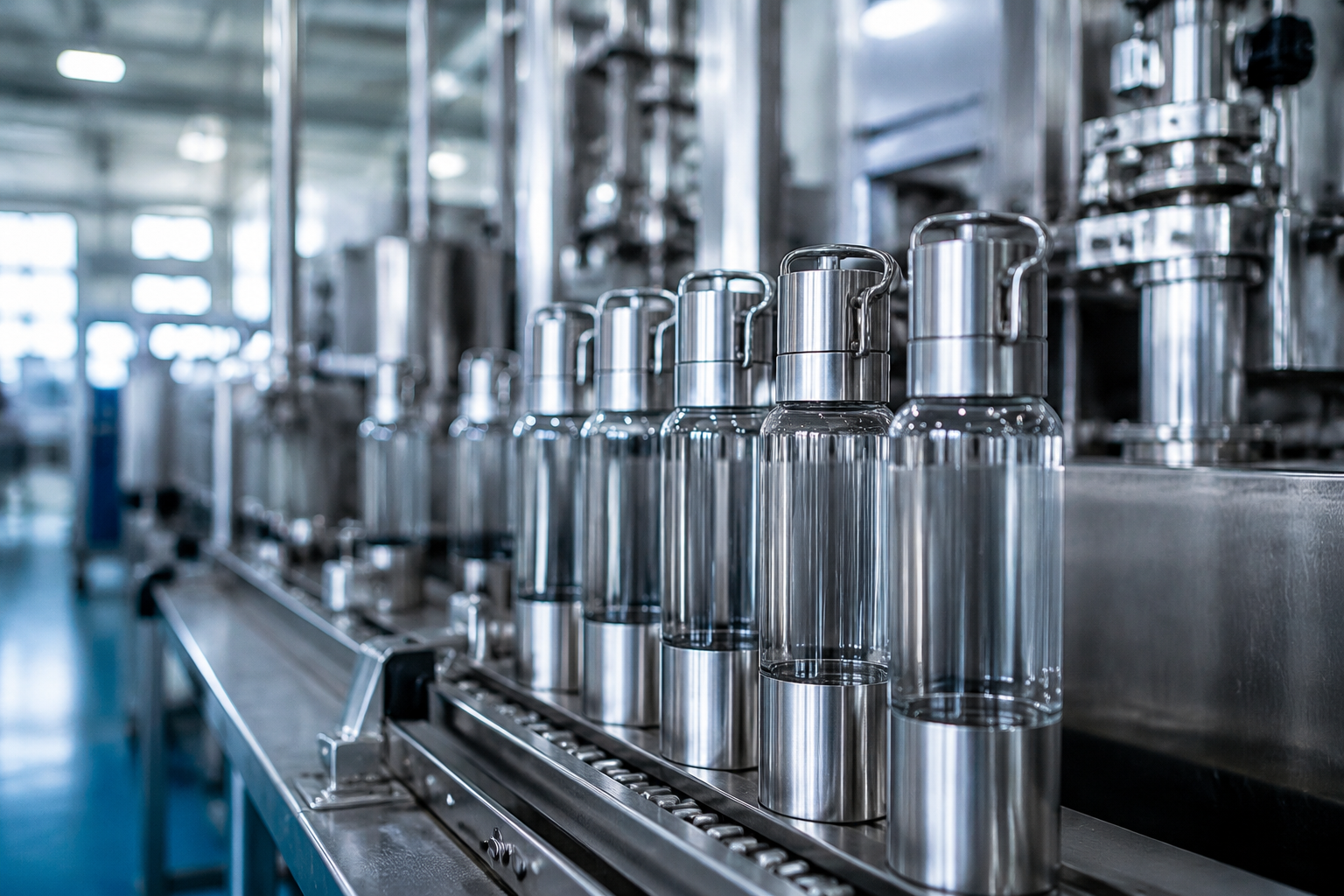
When buyers ask for a custom thermos, they usually mean one of three builds: a straight stainless vacuum flask, a borosilicate glass-lined bottle, or a hybrid with a glass insert and stainless outer shell. A real borosilicate glass stainless steel bottle factory will name the structure first, then talk decoration. That order matters. Material stack drives unit cost, drop risk, insulation, and MOQ.
We run projects for two very different channels. Outdoor retailers care about taste neutrality and easy washing. Promo buyers want logo space and a clean shelf look. The math does not work if you treat a 500 ml trade-show gift like a 750 ml retail bottle. Ask for the liner thickness, shell gauge, lid material, and vacuum position. One PO typo we see all the time is “304” on the drawing and “201” in the spec sheet; QC pulled the sample and caught it before mass production.
- Borosilicate liner: handles thermal shock better than soda-lime glass
- Stainless shell: usually 201 or 304, with 0.4-0.6 mm gauge on mainstream projects
- Closure system: screw cap, push-button, cup lid, or straw lid depending on market
- Packaging: single box, color box, mailer, or retail-ready gift pack
If the supplier cannot explain these parts in plain terms, you are not talking to a manufacturer thermos team with process control. You are talking to a trading layer. We have seen that go sideways on a 1,000 pcs order, and the buyer flagged it only after the first carton opened.
Questions That Expose A Real Factory
If you want to separate a real thermos factory from a polished sales desk, ask operational questions. A qualified thermos manufacturer answers them cleanly. Start with monthly output, mold ownership, and inspection workflow. In Zhejiang, a working line for a thermos customizable program may run 200,000 to 500,000 units per month, depending on decoration steps and assembly complexity. We ship that kind of volume only when the line stays stable.
Then ask how they handle defects. A professional supplier thermos team should state AQL terms up front, usually AQL 2.5 for major defects and 4.0 for minor defects on general consumer goods. If they cannot explain how they check vacuum leakage, lid torque, glass integrity, and print adhesion, they are not ready for distributor thermos business. We had a buyer flag a PO typo on the lid color once; QC pulled the sample, matched it to the order, and the error stopped there. You should also ask whether they can support OEM logos, private label cartons, barcode labeling, and FNSKU prep if you sell through marketplaces. This is the wrong question to skip.
Good factories do not hide from process questions. We welcome them because process control keeps promotional thermos orders from turning into customer complaints.
Ask for these numbers in writing:
- MOQ: 1,000, 2,000, or 3,000 pieces by color and logo
- Sample time: 7-12 days
- Production time: 25-40 days after sample approval
- FOB port: usually Ningbo or Shanghai for China export
That is the level of detail you should expect from thermos manufacturers, not vague promises about “best quality.” We run the gauge, the leak test, and the carton check before we sign off.
Checklist For Customization
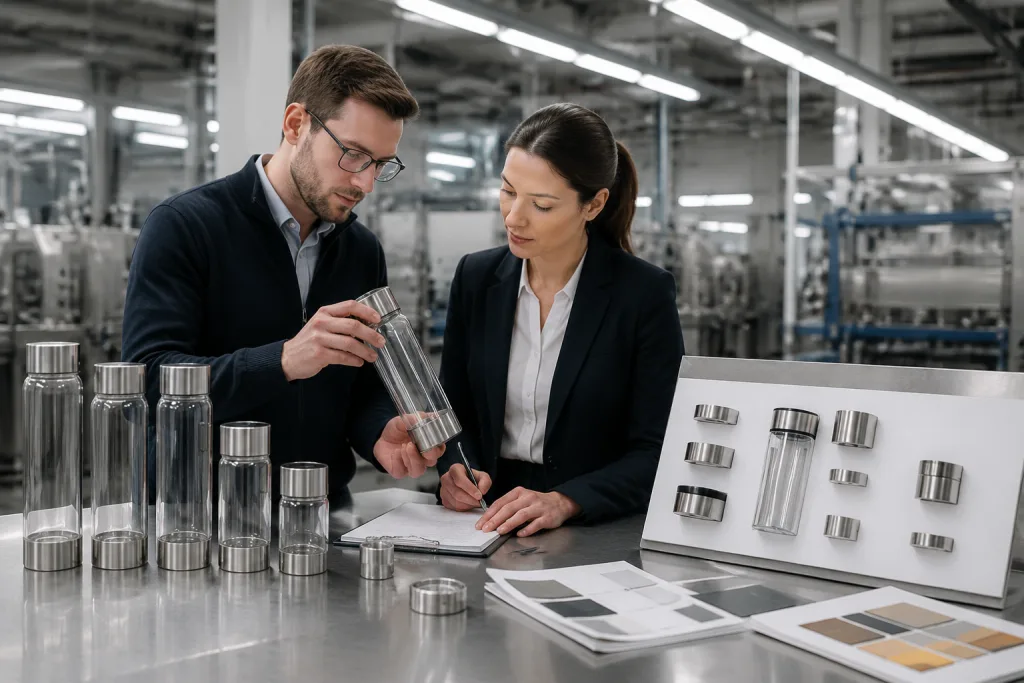
Customization is where a lot of custom thermos jobs slip. Buyers approve artwork first and sort out the structure later. That order is backwards. Lock the bottle body shape, lid type, finish, and carton standard before you freeze the print method. If you want a customized thermos with metallic branding, laser engraving gives a cleaner result than silk screen on brushed stainless. If you want a bright promotional thermos, pad print or wrap print works better, but we still need an abrasion check on the line.
Use this checklist before you send a purchase order:
- Logo method: silk screen, laser engraving, UV print, or heat transfer
- Capacity: 350 ml, 500 ml, 750 ml, or 1,000 ml
- Color control: Pantone match or factory stock shades
- Finish: matte, glossy, powder coat, or brushed metal
- Packing: mailer, retail box, gift set, or bulk master carton
- Compliance: REACH, LFGB, FDA food-contact declarations, and carton marks
A thermos customizable project for outdoor retail usually needs darker finishes and stronger scratch resistance. A thermos promotional order for events usually needs lower unit cost and a faster lead time. Same factory, different setup. The math does not work if you ask for both at once. If you are working with thermos suppliers in China, ask for decoration samples on the real substrate, not a paper mockup. QC pulled the sample on 304 stainless last week and the ink held; the paper proof looked fine, but it was a fake win.
Pricing, MOQ, And Lead Time
Most buyers ask for the price first, so here it is: a standard bulk thermos order from a Chinese vendor usually lands around USD 2.80-3.60 FOB for a plain 500 ml model, and USD 4.20-6.50 FOB for a borosilicate glass stainless steel bottle with better lid parts, print, and gift packaging. Once you add custom colorways, special lids, or retail boxing, the number climbs. That is normal. Price covers material, assembly loss, QC time, and export cartons; on one run, we had a buyer flag a PO typo that changed carton marks, and the rework ate a full day on the line.
MOQ follows the setup work. For one logo and one color, a factory thermos line may take 1,000 pieces. If you want two prints or mixed lids, the MOQ often moves to 3,000 pieces. This is the wrong question to fight. The better question is whether your volume matches the tooling and packing setup. Good thermos suppliers in Zhejiang will quote sample, mass production, and packaging upgrades separately, so you can see the real landed cost instead of guessing. QC pulled the sample at 300 mm drop test, and that kind of detail tells you where the price is going.
Lead time usually runs 25-40 days after artwork and sample approval. If a factory promises 10 days for a customized thermos with printing, packaging, and export cartons, ask what they are skipping. We’ve seen this go sideways. Shortcuts show up later as color drift, weak vacuum retention, or cartons that crush in transit. On a normal order, the bottleneck is often lid assembly or sleeve packing, not the glass body itself, and that is where schedules slip.
Quality Controls That Matter
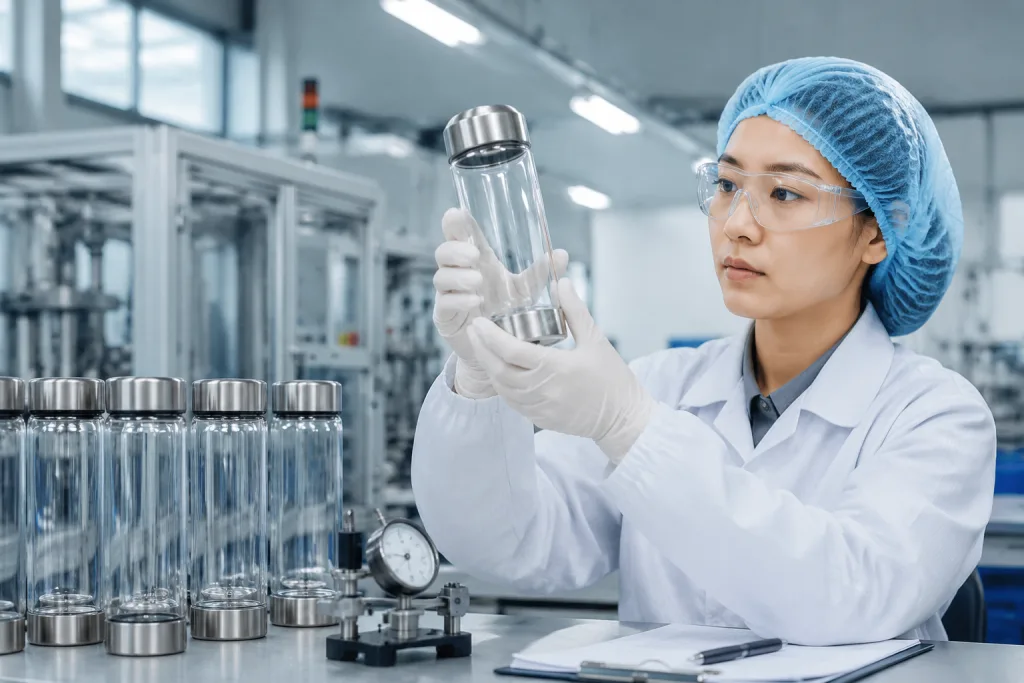
For outdoor retailers, the real question is not whether the bottle looks good in a photo. It is whether the thermos bulk shipment survives transit and still passes shelf checks after 18 days on the line and 12 days at sea. We run a simple three-point QC flow: incoming material checks, in-process inspection, and final random inspection under AQL. For a manufacturer thermos order, QC pulled the sample on vacuum retention, leak resistance, lid seal, print wear, and drop performance of the retail pack. The math does not work if any one of those is skipped.
Ask the factory to state the limits in writing. If a borosilicate liner is used, what is the thickness tolerance in mm? If the outer shell is 304 stainless, what gauge does the supplier use? If the cap includes silicone, is the compound food-grade and compliant with REACH or LFGB? We had a buyer flag a PO typo once because “0.4mm” was typed as “0.04mm,” and that kind of mistake changes the whole order. A solid thermos manufacturer should also show how they test thermal retention: hot fill at a controlled temperature, then measure temperature loss after 6, 12, and 24 hours. If they do not test, they are guessing.
Glass and stainless do not forgive sloppy packaging. One carton drop test at 80 cm will tell you more than a polished sample photo. A real thermos supplier will use molded inserts, inner trays, or bubble-wrapped separation so the bottle does not knock against the carton. We ship a lot of these by sea from China to EU and US warehouses, and we have seen this go sideways when the buyer tried to save 0.2 kg per carton and lost half a pallet to scuffing.
- Inspection terms: AQL 2.5 major, 4.0 minor
- Compliance targets: REACH, LFGB, FDA, food-contact declarations
- Performance tests: leak, drop, thermal retention, print rub
- Packaging tests: carton compression and transit vibration
Buying For Retail Or Promotions
Your channel sets the spec. Retail buyers want stable replenishment, low return rates, and a product story that holds up on shelf. Promo buyers care about lead time, print area, and unit cost in a bundle. We often run two SKUs off the same mold: one retail version with premium carton art, one promo version with plain packaging and a sharper price.
If you sell to retail, 500 ml or 750 ml is the safer ask. Use a matte finish, laser logo, and a lid that does not feel cheap in hand. For events or corporate gifting, 350 ml or 500 ml with one-color print is usually enough. Don’t push one model into every channel; that is the wrong question to ask.
In Zhejiang, the better factories segment this fast because we ship both distributor accounts and direct brand programs. A solid supplier will flag carton size, barcode format, and pallet count before the quote goes out. We had one buyer send a PO with the barcode field left blank, and QC pulled the sample because the outer carton size missed the warehouse slot by 8 mm. That is what a real thermos factory does: it cuts your rework.
When you negotiate, get specific. Ask whether inner boxes are included, whether pallets sit inside the FOB term, and whether the factory can handle a one-off promo run or a quarterly roll. Those details beat a glossy sample photo every time. We’ve seen this go sideways when the buyer assumed “package included” meant the same thing on both sides.
Request a factory quote with real specs
Send your capacity, logo method, target price, and destination market. We’ll match the right thermos factory setup, not just the cheapest line.
Frequently asked questions
What MOQ should I expect from a borosilicate glass stainless steel bottle factory?
For a standard custom thermos, expect 1,000-3,000 pieces per SKU. If you want one logo, one color, and standard packaging, 1,000 pieces is realistic. If you add special lids, multiple prints, or gift boxes, MOQ often rises. A capable Zhejiang factory should also quote sample MOQ separately, usually 1-2 pieces for physical confirmation and 7-12 days for sampling.
How much does a custom thermos cost FOB China?
A simple bulk thermos model may start around USD 2.80-3.60 FOB. A more complex customized thermos with borosilicate glass lining, upgraded lid parts, and retail packaging can reach USD 4.20-6.50 FOB. Decoration method, packaging, and volume drive the difference. Always ask the supplier to separate unit price, sample cost, and carton cost so you can calculate landed cost correctly.
What compliance documents should I request?
For Europe and North America, ask for REACH, LFGB or FDA food-contact declarations, and a basic material specification sheet. If the thermos supplier uses stainless steel, request the grade, usually 201 or 304, and ask for silicone or plastic component declarations. For a promotional thermos program, also request packing test records and, if needed, AQL inspection reports.
Can I get my logo on a thermos promotional order quickly?
Yes, if the design is simple. A thermos promotional order with one-color silk screen or laser engraving can often be sampled in 7-12 days and produced in 25-35 days after approval. Complex artwork, multiple colors, or special cartons will add time. A real thermos factory should confirm the decoration method before promising speed.
How do I know if a thermos manufacturer is reliable?
Ask for monthly output, in-house testing, and export experience. A solid manufacturer thermos partner should be able to produce 200,000 units or more per month on relevant lines, explain AQL inspection, and show how they test leakage and thermal retention. If they operate in Zhejiang or another export hub in China, they should also be comfortable with FOB terms, pallet planning, and retail labeling.