Key Takeaways
- Typical MOQ starts at 3,000 pcs for a custom thermos, with lead time around 30-45 days after sample approval.
- Borosilicate glass liners usually use 1.2-1.8 mm wall thickness; thinner glass lowers cost but raises breakage risk.
- FOB China pricing for a branded stainless/glass thermos often lands around USD 2.80-6.50 depending on cap, finish, and packaging.
- Ask for REACH, LFGB, and drop-test data before you approve a supplier thermos order for Europe or North America.
If you are sourcing a borosilicate glass stainless steel bottle custom order, the real question is not whether it looks premium. It is whether the build survives freight, logo work, and everyday use without landing you in a claims mess. Borosilicate liners take thermal shock better than soda-lime glass, but glass is still glass. We run 1.8 mm wall thickness checks, match the closure to the neck finish, and hold tolerances when a 500-piece sample turns into a bulk thermos run.
In Zhejiang and across China, buyers ask for a custom thermos, then find the weak point is not the print method. It is the interface between the glass insert, stainless shell, and cap seal. I’ve seen a buyer flag a PO typo on the neck size, and the line had to stop while QC pulled the sample. If you buy as a distributor thermos, promotional thermos, or retail SKU, test drop height, leak rate, carton strength, and branding durability before you sign off. That is the right question to ask. It saves cash, and it saves your customer support team too.
What buyers really ask first
Q: Is a borosilicate glass stainless steel bottle custom order worth the money for retail or promotion? Yes, if you want a premium shelf look and you are ready to lock the spec before the line starts. Borosilicate keeps taste neutral and handles heat swings better than cheap soda-lime glass, while the stainless outer shell lifts the perceived value. It is not a gym bottle. We sell it as a desk thermos or gift item.
For outdoor retailers, this is a lifestyle piece, not a trail bottle. For promotional brands, it works when the print is sharp and the box looks planned, not rushed. We had a buyer flag a PO once because they wrote “glossy” but never said which side of the lid needed the logo. That is the wrong question to ask. A factory thermos program should spell out leak test at 30 kPa for 2 minutes, carton drop from 76 cm, and the heat-retention target in the PO. If the thermos manufacturer cannot quote those numbers, keep looking. In Zhejiang, the better shops run this kind of check every week.
- Use borosilicate glass when taste neutrality matters.
- Use double-wall stainless outer protection to reduce breakage.
- Use molded inserts or EVA packing for export cartons.
- Reserve promotional thermos orders for simple logos and one PMS color.
Build the spec before quoting
Q: What information should you send a thermos supplier before asking for pricing? Send numbers, not sales copy. A factory quote for a thermos needs bottle capacity, shell grade, liner thickness, cap style, logo method, packaging, and target market. If you only write “customizable thermos,” the buyer gets a loose answer and the price moves later.
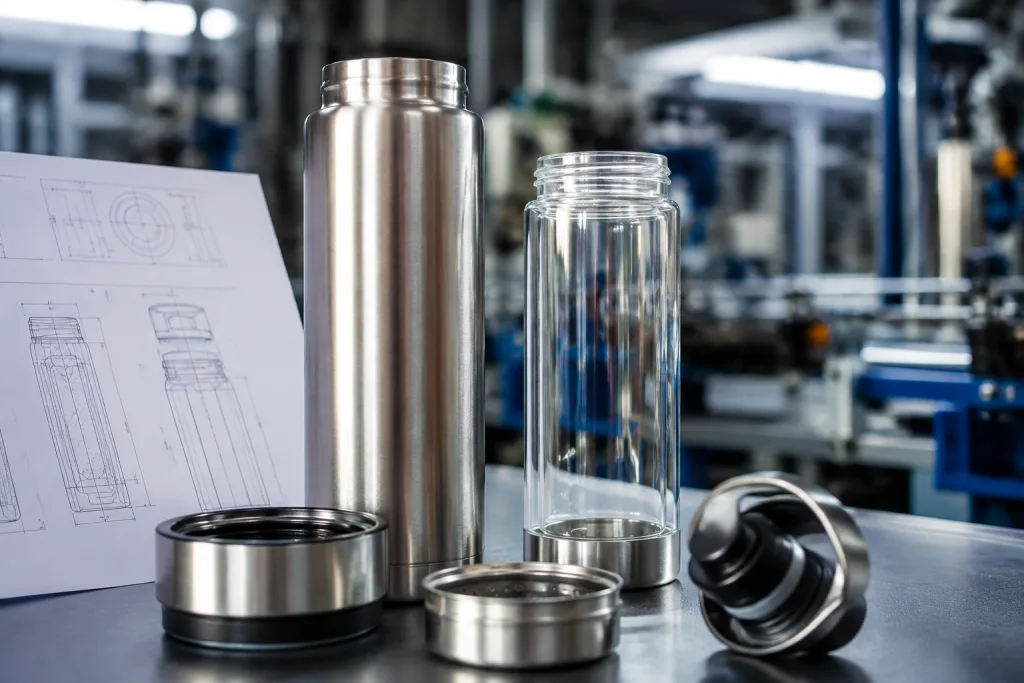
Start with capacity: common sizes are 380 ml, 500 ml, and 750 ml. Then lock the build: 304 stainless steel outer shell, borosilicate glass liner, PP or Tritan lid, and silicone sealing ring. For a thermos custom project for North America, ask for FDA food-contact declaration and CA Prop 65 awareness on inks and coatings. For Europe, ask for REACH and LFGB. We’ve seen a buyer skip this, then QC pulled the sample and the lid ink failed the spec check.
Good sourcing is not “Can you make it?” It is “Can you repeat it 20,000 times without changing the leak rate or the logo position?”
Send the carton plan too: target carton count, master carton size, and whether you need retail-ready inserts. On one run, the PO had a typo on the inner box count, and the math blew up the freight quote by 12%. That is where margin disappears when the spec stays open.
Check the construction details
Q: What separates a dependable custom thermos from a cheap one? Three things: the glass liner, the seal system, and the outer stainless body. Borosilicate glass is not something you judge from brochure copy. Ask for the liner thickness, neck finish, and whether the glass gets annealed after forming. A realistic wall thickness is 1.2-1.8 mm; below that, breakage jumps fast in transit. We have seen this go sideways on a 12-day sea shipment.
The stainless shell should be at least 0.4 mm on the outer body for a sensible balance of weight and dent resistance. If the shell feels too light in hand, the math does not work for a distributor chain. The cap is where buyers get burned. A weak lid turns a premium item into a return-rate headache. For thermos promotional campaigns, keep a wide print area on the cap or body, and keep the sealing path away from the decoration zone. QC pulled the sample on one run because the pad print crossed the gasket seat.
- Ask whether the liner is removable or bonded in place.
- Confirm the gasket material is food-grade silicone.
- Request torque specs for screw caps if the lid threads are printed or coated.
- Check whether the base has an anti-slip pad or protective ring.
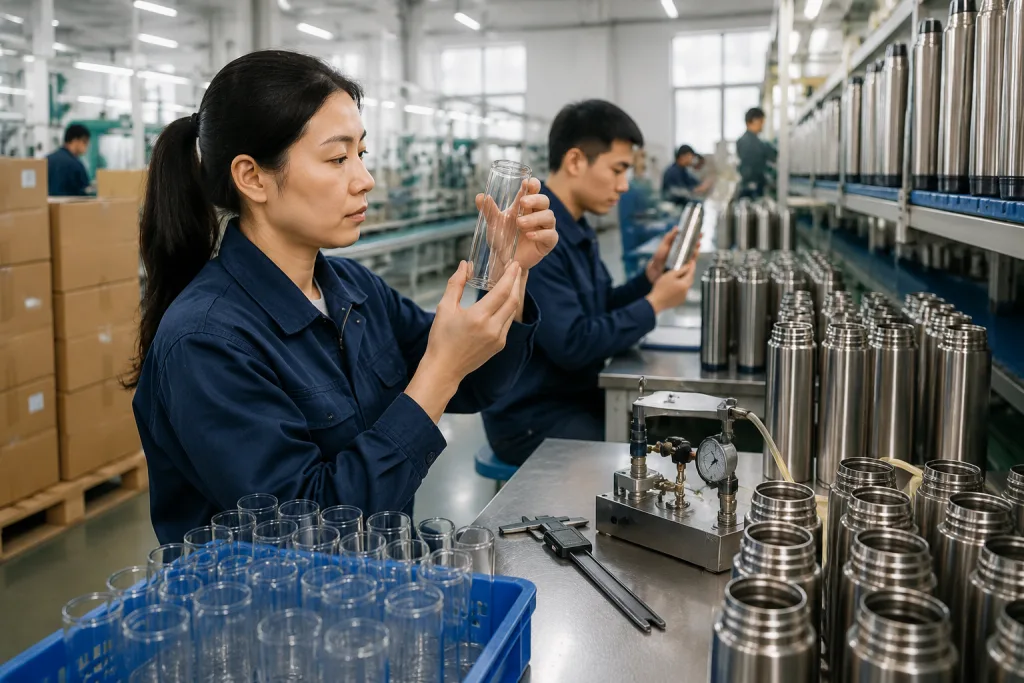
If you are buying from a thermos factory in China, ask for production photos of the lining line and the final assembly line. A real factory can show both, no drama.
Branding options that hold up
Q: Which logo method should you use on a borosilicate glass stainless steel bottle custom order? For premium retail, laser engraving on stainless usually beats print on wear life. For a promo thermos, screen print or pad print costs less and moves faster, but you accept abrasion after normal use. We’ve seen the wrong call here burn a buyer twice: the sample passes, then the first 50 dish-rack cycles tell a different story.
For bulk thermos orders, get the decoration tolerance in writing. On the line, we hold position shift within ±1.5 mm for most simple logos; if the PO says 2 mm and the buyer flags 1 mm later, the math does not work. For full-wrap graphics, lock the mold line and seam location before sampling. A real export thermos manufacturer sends a decoration proof, not a loose mockup from sales.
Use this checklist:
- Laser engraving for long-life logos on stainless surfaces.
- Screen print for simple one- to two-color branding.
- Heat transfer only when the ink system is wear-tested.
- Packaging print when the bottle surface must stay minimal.
For suppliers thermos programs with multiple SKUs, keep the branding area the same across capacities. We run fewer fixture changes, QC pulls the sample faster, and reorder files stay clean when the 350 ml and 500 ml bodies share one print zone.
MOQ, price, and lead time
Q: What should you expect on MOQ and price for a custom thermos order? For a standard borosilicate glass stainless steel bottle custom project, MOQ is often 3,000 pcs per design and color. We run that number on the line because tooling, print setup, and carton runs all need volume to stay sane. Some Zhejiang factories will accept 1,000 pcs if the decoration is simple and the mold is already in hand, but the unit cost jumps, and the math does not work for every buyer.
FOB China prices usually sit around USD 2.80-4.20 for basic branded units and USD 4.50-6.50 for better caps, thicker shells, and retail cartons. Add more for gift boxes, molded pulp, or special coatings. On one 500 ml order, QC pulled the sample and found the lid gasket had a 0.3 mm gap, so we reworked the quote before it turned into a claim. Production lead time is typically 30-45 days after sample approval, plus 5-10 days for final packing and export booking.
If you are a thermos distributor or promotional brand, do not chase the lowest price alone. A cheaper quote can hide extra breakage, slower packing, and logo drift that the buyer flagged only after the first carton landed. Ask for a landed-cost model, not just an FOB number. We’ve seen this go sideways when a PO typo changed the print color code and nobody caught it until mass production.
Use the right quality checks
Q: What quality checks should you require before shipment? Start with incoming material checks, then run packed-carton testing before the goods leave the line. For a glass-lined thermos, the weak points are liner cracks, lid leaks, and dents from transit. Put AQL 2.5 in the PO for appearance, then tighten the acceptance limit on leakage and logo alignment if the item is going to retail shelves.
Ask for these tests in the QC plan: hot-water leak test, drop test, thermal retention test, and carton compression test. We once had a buyer flag a 1.5 mm lid gap on a sample, and that tiny gap became a leak after shipping. A practical thermal target is above 60°C after 6 hours for hot fill, with the exact result shifting by capacity and room temperature. If the factory says premium insulation, ask for the test method and the thermometer model. Standards beat slogans.
For North America, ask whether the inks and coatings were checked against applicable food-contact expectations. For Europe, ask for REACH and LFGB documents, not a certificate cover page. We run batch traceability by production date and lot code, and that saved one customer from a full recall when only 320 pcs were suspect. It is the right kind of boring paperwork.
When this product fits your channel
Q: Where does a borosilicate glass stainless steel bottle custom product sell best? It works best in channels that pay for looks, thermal performance, and a cleaner sip. Office gifts, loyalty programs, museum shops, premium outdoor retail, and branded hospitality fit that brief. Hard-use hiking and gym channels are a poor fit; the buyer usually wants lighter bottles with better drop resistance, and we have seen that pushback kill a quote fast.
If you are building a promotional thermos line, keep the range tight: one or two capacities, one lid platform, two decoration options. That keeps your thermos manufacturers from juggling too many variables on the line. We run this kind of program with monthly output above 200,000 units, and the ones that stay sane are the factories that lock the BOM early and check the first-off sample with QC before mass run.
For distributor thermos programs, the advantage is repeat order rhythm. Hold one core mold, reorder by season, and switch packaging instead of rebuilding the whole product. That is how a thermos distributor keeps stock moving and avoids dead inventory; if the PO has a typo on the carton count, the whole shipment turns into a headache.
Request a factory quote with your exact spec
Send capacity, logo method, packing target, and market. We will quote the real landed cost, not a vague brochure price.
Frequently asked questions
Is borosilicate glass safe in a stainless thermos body?
Yes, if the glass is genuine borosilicate and the assembly is done properly. Borosilicate handles thermal stress better than ordinary glass, but it is still fragile under impact. For a practical buying spec, ask for a liner wall thickness of 1.2-1.8 mm, a silicone gasket, and carton drop testing from 76 cm. If the supplier can also provide REACH and LFGB documents, you are on much firmer ground for Europe. The outer stainless shell protects the liner, but it does not make the product indestructible, so your packaging design matters as much as the bottle itself.
What MOQ should I expect from a thermos manufacturer in China?
For a standard branded custom thermos, expect around 3,000 pcs per design and color. Some Zhejiang factories will offer 1,000 pcs on repeat tooling or simple decoration, but pricing usually rises. If you need special printing, gift boxes, or unique lids, the MOQ may climb to 5,000 pcs. The key is to separate mold cost, decoration cost, and packing cost in the quote. That gives you a real comparison between suppliers thermos offers instead of a misleading headline price.
What is a realistic FOB price for a promotional thermos?
A realistic FOB China range is usually USD 2.80-6.50 depending on capacity, shell thickness, lid complexity, and packaging. A simple promotional thermos with one-color logo and standard carton sits near the low end. A better retail-ready unit with thicker stainless, nicer lid tooling, and printed gift box can move up fast. If one quote is far below that range, check what has been excluded: leak testing, inner foam, retail inserts, or export cartons. Cheap quotes often come back as expensive problems later.
What certifications should I ask for before placing an order?
For Europe, ask for REACH and LFGB documentation, plus material declarations for stainless steel, silicone, and inks. For the U.S. market, ask for food-contact declarations and any relevant compliance statements from the manufacturer thermos supplier. If the bottle is for promotional use, you still need the same material controls, because the end customer does not care that it was a giveaway. They only care whether it smells, leaks, or breaks. A serious supplier thermos partner will provide batch traceability and test records, not just a PDF logo sheet.
Can I customize packaging and still keep lead time short?
Yes, but only if you keep the packaging plan simple. Standard window boxes, kraft boxes, or plain retail cartons add less delay than custom inserts and multi-part gift sets. For a well-run thermos factory in China, lead time is often 30-45 days after sample approval, then a few more days if you need custom packaging printing. If you want to protect margin, standardize the box size across capacities and keep the logo placement consistent. That is how thermos distributors avoid slow-moving packaging inventory.